
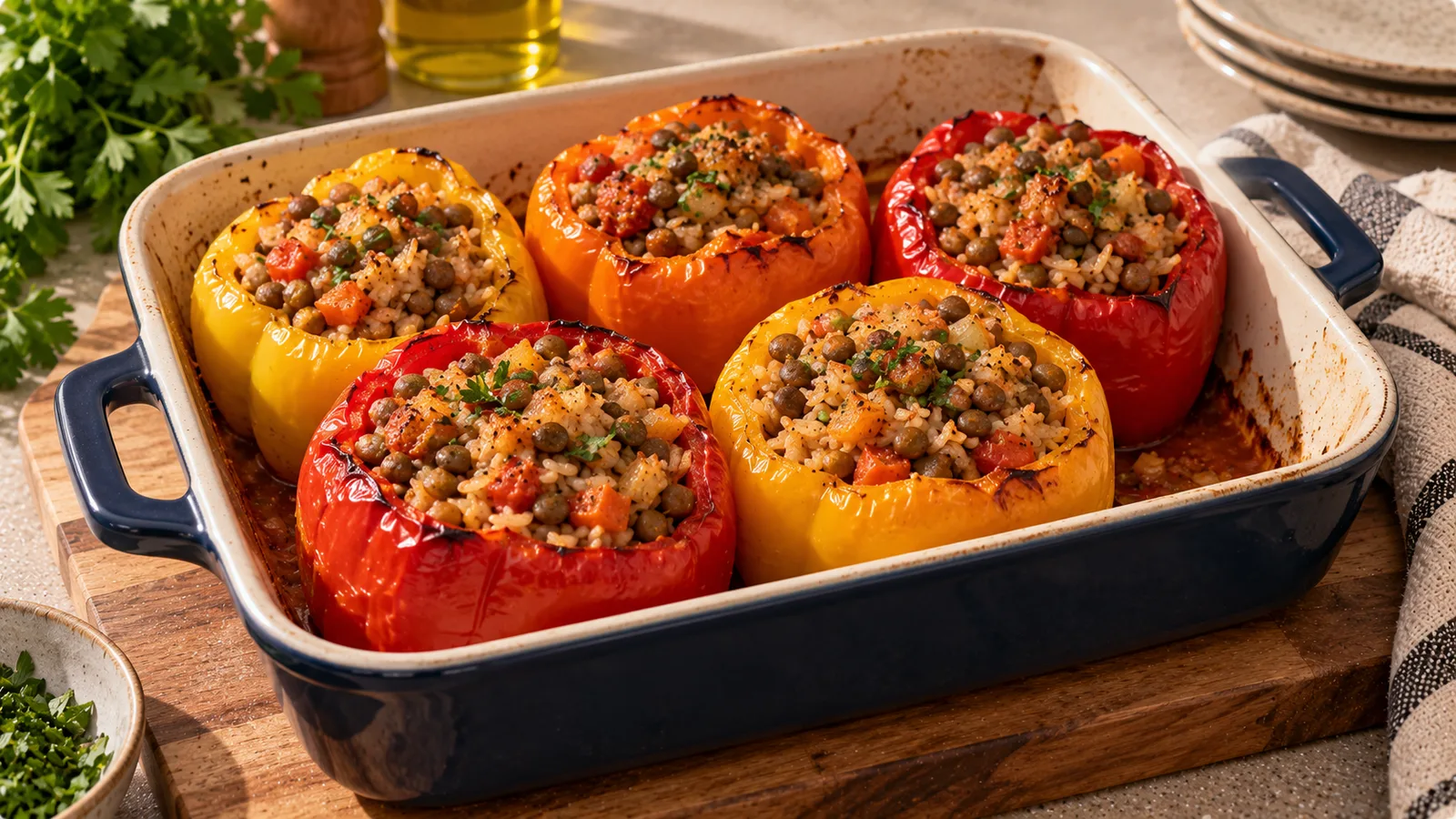
Lentil and rice stuffed peppers are a satisfying vegetarian dinner made with familiar ingredients. Sweet bell peppers become tender in the oven while the filling combines cooked lentils, rice, tomatoes, onions and herbs.
Unlike meat-based stuffed peppers, this version uses lentils to give the filling substance and texture. Rice helps bind the ingredients into a cohesive mixture without making it heavy.
The recipe is suitable for preparing several portions at once. You can serve the peppers immediately, refrigerate leftovers or freeze individual portions.
The most important technique is to cook the lentils and rice before stuffing the peppers. This produces a more predictable texture and prevents the filling from remaining hard while the peppers bake.
Recipe at a glance
| Detail | Amount |
|---|---|
| Servings | 4 |
| Peppers | 4 large bell peppers |
| Preparation | 20 minutes |
| Cooking | 40–50 minutes |
| Total time | Approximately 60–70 minutes |
| Main ingredients | Lentils, rice, bell peppers |
| Cooking method | Stovetop filling, oven baking |
| Suitable for | Vegetarian and vegan diets |
The timing assumes that the lentils and rice are already cooked or can be prepared while the other ingredients are being chopped.
If starting with dry lentils and dry rice, allow additional time according to their package instructions.
Ingredients for four servings
For the peppers
- 4 large bell peppers, approximately 180–220 g each.
- 1 tablespoon olive oil for the baking dish.
- 100 ml water or unsalted vegetable stock for baking.
For the lentil and rice filling
- 250 g cooked brown or green lentils, drained.
- 200 g cooked rice.
- 1 medium onion, finely diced, approximately 120 g.
- 1 medium carrot, finely diced, approximately 100 g.
- 2 garlic cloves, minced.
- 200 g chopped tomatoes.
- 1 tablespoon olive oil.
- 1 teaspoon dried oregano.
- 1 teaspoon sweet paprika.
- 1/2 teaspoon ground cumin, optional.
- 1/2 teaspoon salt, or to taste.
- Freshly ground black pepper.
- 2 tablespoons chopped parsley, optional.
Use fully cooked lentils and rice. Their weights in this ingredient list refer to cooked, drained food, not dry ingredients.
Brown or green lentils work particularly well because they usually retain some shape after cooking.
Red lentils tend to soften more and may create a less distinct filling.
Step 1: Prepare the bell peppers
Preheat the oven to 190°C conventional heat, or approximately 170°C fan.
Wash the peppers thoroughly.
Cut off the tops, keeping them if you want to use them as lids.
Remove the seeds and white membranes without damaging the sides.
If a pepper does not stand upright, carefully trim a very thin slice from the bottom. Avoid creating a hole through which the filling could escape.
Lightly oil a baking dish large enough to hold the peppers upright.
Arrange the peppers inside, leaving a little space between them.
Step 2: Cook the vegetables
Heat one tablespoon of olive oil in a large frying pan over medium heat.
Add the diced onion and carrot.
Cook for approximately five to seven minutes, stirring occasionally, until the onion softens and the carrot begins to become tender.
Add the garlic and cook for another 30 seconds.
Stir in the oregano, paprika and optional cumin.
Cooking the spices briefly with the vegetables helps distribute their flavor through the filling.
Avoid high heat that could burn the garlic or dried spices.
Step 3: Prepare the lentil and rice filling
Add the chopped tomatoes to the pan.
Cook for three to four minutes, allowing some of the excess liquid to evaporate.
Stir in the cooked lentils and cooked rice.
Season with salt and black pepper.
Mix gently until the ingredients are evenly combined.
The filling should be moist but not watery.
If it seems dry, add one or two tablespoons of water or vegetable stock.
If it is very wet, cook uncovered for another two or three minutes.
Taste the mixture and adjust the seasoning before filling the peppers.
Remove from the heat and stir in the parsley if using.
Step 4: Fill the peppers
Spoon the lentil and rice mixture into the prepared peppers.
Fill them generously but avoid packing the mixture too tightly.
The ingredients are already cooked, so they do not need extra room for major expansion. However, a loosely packed filling heats more evenly.
If you kept the pepper tops, place them back on as lids.
Pour approximately 100 ml of water or vegetable stock into the bottom of the baking dish.
This helps create moisture during baking and reduces the risk of the peppers drying out.
Do not pour the liquid directly into the filling.
Step 5: Bake until tender
Cover the baking dish loosely with foil or a suitable ovenproof lid.
Bake for approximately 25–30 minutes.
Remove the cover and continue baking for another 15–20 minutes, until the peppers are tender and lightly roasted around the edges.
The exact time depends on pepper size, thickness and your oven.
A knife should slide into the pepper flesh with little resistance.
The filling should be thoroughly heated.
If the tops begin to brown too quickly, cover the dish again.
Allow the peppers to rest for five minutes before serving.
How to prevent watery stuffed peppers
Bell peppers naturally release moisture as they cook.
Tomatoes also contribute liquid, so the filling can become watery if too much moisture remains in the pan.
For a better result:
- Drain cooked lentils thoroughly.
- Use cooked rice that is not excessively wet.
- Simmer the chopped tomatoes before adding the grains.
- Avoid adding unnecessary stock to the filling.
- Bake uncovered during the final stage.
The goal is a moist, cohesive filling with distinct lentils and rice grains.
You do not need to dry the mixture completely. Some moisture helps prevent the finished dish from tasting dry.
Which lentils are best?
Brown and green lentils are good choices because they generally hold their shape.
| Lentil type | Result in stuffed peppers |
|---|---|
| Brown lentils | Tender, slightly earthy filling |
| Green lentils | Firmer texture and visible individual lentils |
| Puy-style lentils | Distinct texture and rich flavor |
| Red split lentils | Softer, more blended filling |
| Canned lentils | Convenient when rinsed and drained |
If using canned lentils, check whether salt has already been added.
Rinse and drain them well before combining with the other ingredients.
If using dry lentils, cook them separately until tender before starting the filling.
What type of rice works best?
Long-grain white rice produces separate grains and a relatively light filling.
Brown rice adds a firmer texture and usually more fiber, although it requires a longer initial cooking time.
Basmati rice also works well.
Short-grain rice may create a stickier filling, which some people prefer.
Whatever variety you choose, use the cooked weight specified in the recipe.
For food safety, cool cooked rice promptly if preparing it ahead, refrigerate it and avoid leaving it at room temperature for extended periods.
Approximate nutrition per serving
The nutritional values depend on pepper size, the type of rice, the lentils and the amount of oil used.
For one stuffed pepper when the recipe is divided into four equal servings, a broad illustrative estimate is:
| Nutrient | Approximate amount |
|---|---|
| Calories | 240–320 kcal |
| Protein | 9–13 g |
| Carbohydrates | 38–48 g |
| Fat | 6–10 g |
| Fiber | 9–13 g |
These are estimates rather than exact calculated values for a particular set of products.
The meal's energy content will increase if you add cheese, extra oil, bread or another side.
For accurate nutrition tracking, enter the actual ingredient quantities and divide the total recipe by the number of servings.
Ways to customize the recipe
Add mushrooms
Finely chop 150 g mushrooms and cook them with the onion and carrot.
Allow their moisture to evaporate before adding the tomatoes.
Mushrooms provide a savory flavor and can make the filling feel more substantial.
Use brown rice
Replace the cooked white rice with the same weight of cooked brown rice.
The texture will be firmer and slightly nuttier.
Make the filling spicier
Add chili flakes or a little smoked paprika.
Start with a small amount and adjust to taste.
Add more vegetables
Finely diced zucchini, spinach or celery can be added to the filling.
Cook watery vegetables first so they do not make the mixture too wet.
Add a cheese topping
For a vegetarian version that includes dairy, sprinkle a small amount of grated cheese over the peppers during the last ten minutes of baking.
Check that the cheese is suitable for your dietary preferences.
For a vegan version, simply omit cheese or use a suitable plant-based alternative.
What to serve with stuffed peppers
The peppers contain both legumes and grains, so they can form the main part of a meal.
Depending on appetite and nutritional needs, you can add:
- A simple green salad with a light dressing.
- Roasted vegetables.
- A cucumber and tomato salad.
- A spoonful of plain yogurt or plant-based yogurt.
- A slice of wholegrain bread.
- A small portion of vegetable soup.
The best accompaniment depends on the size of the peppers and the rest of your day's meals.
Can you prepare them ahead?
Yes. The filling can be cooked in advance and refrigerated promptly.
Keep it covered and chilled until ready to use.
You can also assemble the peppers ahead of baking.
If they are refrigerated, the baking time may need to be slightly longer because the filling starts cold.
Cook until the peppers are tender and the filling is heated thoroughly.
For leftovers, refrigerate promptly in shallow, covered containers.
Follow local food-safety guidance. Cooked leftovers are generally best used within a few days.
Because this recipe contains rice, avoid leaving cooked portions at room temperature for extended periods.
Can you freeze lentil and rice stuffed peppers?
Yes.
Allow cooked peppers to cool promptly.
Place individual portions in freezer-safe containers and freeze.
The peppers may become softer after thawing because freezing changes their structure.
Thaw in the refrigerator and reheat thoroughly before eating.
Avoid repeated cycles of warming, cooling and reheating.
Common recipe questions
Do I need to boil the peppers before baking?
No. The covered baking stage helps soften the peppers.
If you prefer especially soft peppers, you can briefly blanch them first, but it is not necessary for this method.
Can I use canned lentils?
Yes. Drain and rinse them, then use 250 g of cooked lentils as specified.
Can I use uncooked rice?
Not in this version. The liquid quantity and baking time are designed for already cooked rice.
Using dry rice would require a different recipe and more liquid.
Can I make the recipe without tomatoes?
Yes. Replace the chopped tomatoes with a small amount of vegetable stock and additional sautéed vegetables.
Adjust the moisture carefully so the filling does not become dry.
Are lentil and rice stuffed peppers vegan?
The base recipe contains no meat, dairy or eggs and is vegan when prepared with plant-based ingredients and vegetable stock.
Check any toppings or prepared products you add.
Sources and food-safety information
- USDA FoodData Central — nutritional composition of lentils, rice, peppers and other ingredients.
- FoodSafety.gov: Cold Food Storage — general storage guidance.
- UK Food Standards Agency: Rice safety — food hygiene and safe handling information.
A practical vegetarian dinner
Lentil and rice stuffed peppers combine vegetables, legumes and grains in a meal that is easy to portion and adapt.
Cook the rice and lentils first, keep the filling moist but not watery, and bake the peppers covered before finishing uncovered.
The result is tender roasted peppers with a distinct, flavorful lentil-and-rice filling.