
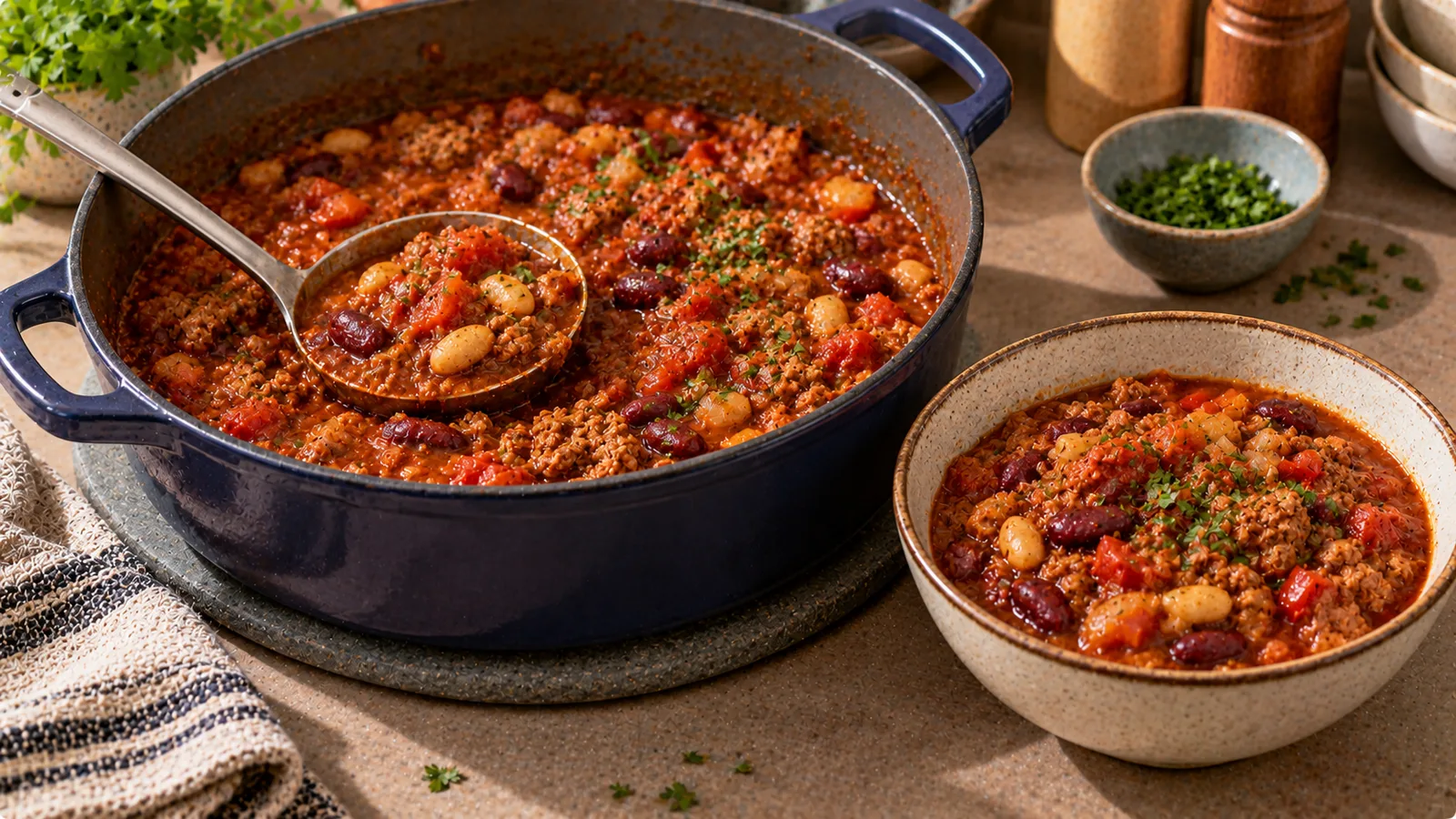
Turkey and bean chili combines lean ground turkey, beans, tomatoes and vegetables in one filling meal.
The recipe is designed for 6 servings and uses drained bean weights and a defined amount of turkey so the nutrition estimate is easier to reproduce.
Because chili loses water while simmering, the final cooked weight can vary. If you want especially accurate portions, weighing the finished batch is more useful than assuming every ladle contains the same amount.
Ingredients
For approximately 6 servings:
- 750 g raw ground turkey
- 2 cans kidney beans, about 480 g drained weight in total
- 800 g canned chopped tomatoes
- 200 g red bell pepper
- 200 g onion
- 150 g carrots
- 3 garlic cloves
- 15 g olive oil
- 30 g tomato paste
- 250 ml water or low-sodium stock
- 2 teaspoons ground cumin
- 2 teaspoons smoked paprika
- 1–2 teaspoons chili powder, according to taste
- 1 teaspoon dried oregano
- 1/2 teaspoon black pepper
- salt to taste
Optional for serving:
- fresh coriander or parsley
- lime
- plain yogurt
- grated cheese
Optional toppings are not included in the base nutrition estimate.
Choosing the ground turkey
Ground turkey can vary considerably in fat content.
A very lean product may contain only a few grams of fat per 100 g, while another ground turkey product can contain substantially more.
That difference affects both:
- calories;
- fat per serving.
For the most accurate calculation, use the nutrition label from the turkey you actually buy.
This recipe assumes a relatively lean ground turkey as the reference.
Why the fat percentage matters
Suppose one ground turkey contains:
150 kcal per 100 g
while another contains:
200 kcal per 100 g
For 750 g, the first contributes:
150 × 7.5 = 1,125 kcal
The second contributes:
200 × 7.5 = 1,500 kcal
That is a difference of:
375 kcal for the whole pot
or:
62.5 kcal per serving
when divided into six portions.
So the exact turkey product can change the nutrition estimate meaningfully.
Drain the beans before weighing
The recipe uses:
480 g drained kidney beans
This means the beans after the canning liquid has been removed.
Do not automatically use the full weight printed on the front of the can.
For example, a can may contain:
400 g total weight
but only:
240 g drained beans
If you use two cans, the edible bean amount is:
240 × 2 = 480 g
When the nutrition label is based on drained product, use the drained weight for tracking.
Step 1: prepare the vegetables
Dice:
- onion;
- bell pepper;
- carrots.
Finely chop or crush the garlic.
Drain and rinse the kidney beans.
Keeping everything ready before cooking makes the chili easier to assemble.
Step 2: cook the onion and carrots
Heat a large heavy pot over medium heat.
Add:
15 g olive oil
Then add the onion and carrots.
Cook for approximately:
5–6 minutes
stirring occasionally.
The onion should begin to soften.
Step 3: brown the turkey
Add the ground turkey.
Break it apart with a spoon or spatula.
Cook for approximately:
6–8 minutes
until there are no large raw sections remaining.
The meat does not need to become deeply browned everywhere, but allowing some moisture to evaporate improves the final texture.
Step 4: add garlic, pepper and spices
Add:
- garlic;
- bell pepper;
- cumin;
- smoked paprika;
- chili powder;
- oregano;
- black pepper.
Cook for another:
1–2 minutes
while stirring.
This briefly heats the spices before the liquid ingredients are added.
Step 5: add tomatoes and beans
Add:
- 800 g chopped tomatoes;
- 30 g tomato paste;
- 480 g drained kidney beans;
- 250 ml water or stock.
Stir thoroughly.
Bring the mixture to a gentle simmer.
Step 6: simmer
Reduce the heat and simmer uncovered or partially covered for approximately:
25–35 minutes
Stir occasionally.
The chili should gradually thicken as water evaporates.
If it becomes too thick before the flavors have developed, add a small amount of water.
If it remains too thin, simmer it uncovered for longer.
Check the turkey is fully cooked
Ground poultry should be cooked thoroughly.
A conservative food-safety target for ground turkey is an internal temperature of:
74°C / 165°F
In a mixed dish such as chili, check several areas if using a food thermometer.
Adjust the seasoning at the end
Taste the chili after it has reduced.
Then adjust:
- salt;
- chili;
- black pepper;
- acidity.
A squeeze of lime can brighten the finished dish without adding substantial calories.
Approximate cooked yield
The exact final weight depends on:
- how strongly the chili simmers;
- how long it cooks;
- how much water evaporates;
- whether extra liquid is added.
A batch made from these quantities may finish at approximately:
2.3–2.6 kg
This is a useful range, not a guaranteed yield.
For accurate portioning, weigh your own finished batch.
Six equal servings
If the finished chili weighs:
2,400 g
and you want six equal servings:
2,400 ÷ 6 = 400 g
Each serving would therefore weigh:
400 g
If your batch weighs 2,520 g:
2,520 ÷ 6 = 420 g
per serving.
The serving weight changes with the final yield even though the ingredients remain the same.
Approximate nutrition per serving
Using relatively lean ground turkey and the ingredient quantities above, one of six servings is approximately:
| Nutrient | Approximate amount |
|---|---|
| Calories | 430–490 kcal |
| Protein | 40–46 g |
| Carbohydrate | 35–42 g |
| Fat | 12–17 g |
| Fiber | 9–12 g |
The turkey product is the largest source of variation.
Toppings such as cheese, sour cream or avocado should be added separately.
Where the calories come from
A representative calculation for the whole pot might look roughly like this:
Ground turkey:
about 1,150–1,400 kcal
Kidney beans:
about 550–650 kcal
Tomatoes, vegetables and tomato paste:
about 350–450 kcal
Olive oil:
about 135 kcal
Total:
approximately 2,200–2,600 kcal
Divided into six portions:
approximately 370–435 kcal
A higher-fat turkey can move the result upward, which is why using the exact package values is preferable.
Calculate the recipe with your exact turkey
Suppose your turkey label says:
170 kcal per 100 g
You use:
750 g
Turkey calories:
170 × 750 ÷ 100 = 1,275 kcal
Suppose the rest of your ingredients contain another:
1,250 kcal
Whole recipe:
1,275 + 1,250 = 2,525 kcal
Six equal servings:
2,525 ÷ 6 = about 421 kcal
per serving before toppings.
Calculate by finished weight
For unequal portions, calculating calories per gram is more flexible.
Suppose the complete recipe contains:
2,525 kcal
and the finished chili weighs:
2,450 g
Energy density:
2,525 ÷ 2,450 = 1.03 kcal/g
A 350 g portion contains approximately:
350 × 1.03 = 361 kcal
A 450 g portion contains approximately:
450 × 1.03 = 464 kcal
This method automatically accounts for different serving sizes.
Why cooked yield matters
Simmering mainly changes the amount of water in the pot.
If the chili starts with 2,800 g of ingredients and finishes at 2,400 g, most of the missing mass is water.
The total calories have not fallen in proportion to the weight.
Instead, the calories are distributed through a smaller final mass.
This means a longer-reduced chili has more calories per 100 g than the same recipe with more water remaining.
Adding water does not add calories
Suppose your chili is too thick and you add:
300 g water
The total calorie content remains essentially unchanged.
But the final weight increases.
If the pot originally contained:
2,400 kcal in 2,000 g
the density was:
1.2 kcal/g
After adding 300 g water:
2,400 ÷ 2,300 = about 1.04 kcal/g
The whole pot still contains 2,400 kcal, but each gram is less calorie-dense.
Beans and protein
Kidney beans contribute both protein and carbohydrate.
They also provide fiber.
They should not be treated as a pure protein food.
For example, a typical cooked or canned kidney bean product may provide approximately:
- 7–9 g protein per 100 g;
- 15–20 g carbohydrate per 100 g;
- meaningful fiber.
Use the label on your canned beans for the exact values.
Can you use black beans?
Yes.
You can replace the kidney beans with:
- black beans;
- pinto beans;
- cannellini beans;
- a mixture of beans.
Keep the drained weight approximately similar if you want to preserve the overall structure of the recipe.
The nutrition values will change slightly.
Can you add more beans?
Yes.
For a more bean-heavy chili, add another approximately:
240 g drained beans
This increases:
- total calories;
- carbohydrate;
- fiber;
- plant protein;
- final yield.
Update the recipe calculation rather than assuming the original nutrition still applies.
Can you reduce the turkey?
Yes.
For example, use:
500 g turkey
instead of 750 g and add more beans or vegetables.
This changes both protein and calorie density.
It also changes the character of the dish, so recalculate the full recipe if you track nutrition.
Turkey breast mince vs mixed turkey mince
Some ground turkey is made primarily from lean breast meat.
Other products contain more dark meat and fat.
Two packages both labeled ground turkey can therefore have noticeably different calorie values.
The nutrition label is more useful than assuming one universal number for all turkey mince.
Adding corn
Corn works well in chili.
You could add approximately:
150–200 g drained or frozen corn
It adds carbohydrate, some fiber and additional calories.
Include it in the recipe calculation.
Adding extra vegetables
To increase the vegetable volume, try:
- zucchini;
- celery;
- mushrooms;
- additional peppers;
- carrots.
Vegetables add weight and volume, but their calorie contribution is usually much smaller than that of turkey, beans and added fat.
Their water content can also affect the final cooked yield.
Making the chili hotter
Increase the heat with:
- more chili powder;
- cayenne pepper;
- fresh chili;
- chipotle.
Spices generally contribute relatively few calories at normal culinary quantities.
Prepared chili sauces can contain sugar or other ingredients, so check them separately if used in larger amounts.
Making the chili milder
Use less chili powder and rely more on:
- smoked paprika;
- cumin;
- oregano;
- garlic.
This keeps the savory chili profile without as much heat.
Serving with rice
Rice is not included in the base recipe.
If you serve each portion with:
150 g cooked rice
add the nutrition for 150 g of the rice you use.
Depending on the type, this may add roughly:
180–220 kcal
per serving.
Serving with bread
Bread should also be counted separately.
For example, two slices could add anywhere from roughly:
150–250 kcal
depending on the bread and slice size.
Use the package information when possible.
Cheese topping
A 30 g portion of grated cheese can easily add approximately:
100–130 kcal
depending on the cheese.
If you add cheese individually, tracking it separately makes the base chili recipe reusable.
Yogurt topping
Plain yogurt can provide a creamy topping with a different calorie profile from sour cream.
For example, 30–50 g may add a relatively modest amount of energy depending on fat content.
Again, use the actual product label.
Avocado topping
Avocado adds unsaturated fat and calories.
If you use:
50 g avocado
include those 50 g separately rather than assuming it is part of the base chili.
This keeps the recipe flexible for different servings.
Meal-prep portions
Turkey and bean chili works well for meal prep because it can be divided after the full batch is cooked.
For six equal portions:
- weigh the empty cooking pot if you want maximum precision;
- weigh the pot with the finished chili;
- subtract the pot weight;
- divide the net cooked weight by six.
Example:
Pot + chili:
5,180 g
Empty pot:
2,720 g
Cooked chili:
5,180 − 2,720 = 2,460 g
Six portions:
2,460 ÷ 6 = 410 g
per portion.
You do not need perfect portions
If one container contains 405 g and another 415 g, the difference is usually small.
The cooked-weight method is most useful for avoiding large differences such as one portion containing 300 g and another 500 g while both are logged identically.
Refrigerating chili
Cool leftovers promptly and transfer them to covered containers.
Keep the refrigerator at approximately:
4°C / 40°F or colder
Cooked chili containing ground turkey can generally be kept refrigerated for about:
3–4 days
when handled and cooled appropriately.
Freezing
Chili freezes well.
Divide it into portions before freezing so you do not need to thaw the whole batch.
Use freezer-safe containers and leave a little room for expansion.
Freeze portions while the chili is still within its fresh refrigerated period rather than waiting until the last day.
Reheating
Reheat the chili thoroughly until steaming hot throughout.
Stir during reheating, particularly in a microwave, because thick foods can develop hot and cold spots.
Add a small amount of water if the chili has become unusually thick in storage.
Does reheating change the calories?
Reheating does not meaningfully create or remove calories by itself.
However, water can evaporate during reheating.
This may reduce the food's weight while leaving approximately the same total energy in the portion.
That is another reason cooked weight should be interpreted in context.
Batch cooking and double counting
If you save the chili as a recipe in a food diary, enter all ingredients into the recipe once.
Then log your portion of the saved recipe.
Do not separately add:
- turkey;
- beans;
- oil;
- tomatoes
again when eating a serving, because those ingredients are already included.
Recipe summary
For approximately six servings:
- Dice the vegetables and drain 480 g kidney beans.
- Cook onion and carrots in 15 g olive oil for 5–6 minutes.
- Add 750 g ground turkey and cook for 6–8 minutes.
- Add garlic, pepper and spices.
- Stir in 800 g tomatoes, 30 g tomato paste, beans and 250 ml water or stock.
- Simmer for 25–35 minutes.
- Ensure the ground turkey is thoroughly cooked.
- Adjust seasoning.
- Weigh the finished batch if you want accurate gram-based portions.
- Divide into six servings.
The main variables for nutrition tracking are the fat content of the ground turkey, the drained weight of the beans and the final cooked yield. Keeping those three measurements consistent makes the recipe much easier to track accurately.