
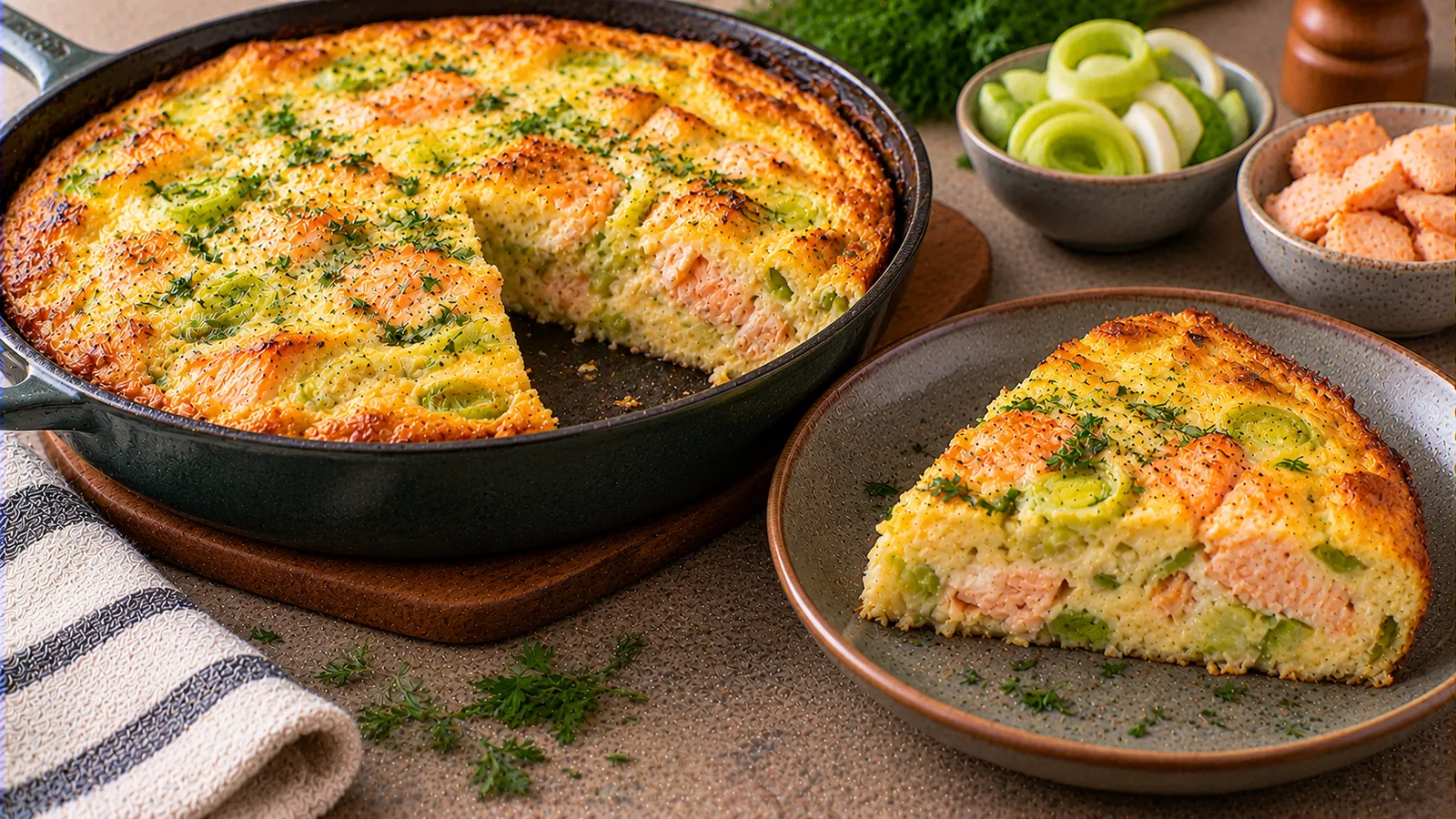
A salmon and leek frittata is a useful way to turn a few eggs, soft-cooked leeks and leftover cooked salmon into a substantial meal. Rather than folding the filling into an omelette, you distribute it through the eggs and finish the whole mixture in the oven. The result is a round, sliceable dish that can be served warm for dinner or packed in portions for another day.
This version uses already fully cooked salmon, not raw salmon folded into eggs. That matters for both timing and food safety: the salmon is simply warmed through as the eggs set. A 24 cm oven-safe skillet gives a fairly even thickness, while a thermometer removes the guesswork from the centre of the frittata.
Recipe at a glance
| Detail | Amount |
|---|---|
| Yield | 4 portions |
| Preparation | About 15 minutes |
| Leek cooking | 9–11 minutes |
| Oven temperature | 180 °C conventional / 160 °C fan |
| Oven time | Approximately 15–22 minutes |
| Rest before slicing | 5 minutes |
| Minimum temperature at centre | 71 °C (160 °F) |
| Equipment | 24 cm oven-safe skillet, food thermometer |
The oven time is an estimate for this pan size; the food thermometer determines when the egg dish is ready.
Ingredients
| Ingredient | Quantity | Preparation |
|---|---|---|
| Eggs | 6 large, about 300 g without shells | Crack into a bowl |
| Fully cooked salmon | 200 g | Remove skin and bones; flake |
| Leeks, trimmed and cleaned | 250 g | Slice into thin half-moons |
| Milk | 60 ml | Any unsweetened dairy milk |
| Cheddar | 40 g | Grate |
| Olive oil | 15 g | For the skillet |
| Fresh dill | 5 g | Chop |
| Fine salt | 2 g | Adjust only after checking the salmon's saltiness |
| Black pepper | ¼ teaspoon | Freshly ground if available |
| Lemon zest | 1 teaspoon | Optional, from a washed lemon |
For the stated quantities, weigh the leeks after cutting off the root and tough dark-green parts. If your cooked salmon was previously seasoned or salted, taste it before using all 2 g of additional salt. The recipe contains fish, egg and milk; check cheese and packaged salmon labels if allergies or other restrictions apply.
Why leeks and cooked salmon work here
Leeks have a mild onion flavour, but they do not become tender instantly. Cooking them before adding the eggs is important. Raw slices added directly to the egg mixture can remain tough while the centre of the frittata finishes cooking.
Cooked salmon is easier to distribute through a frittata than a large raw fillet. Break it into bite-size flakes rather than mashing it: larger pieces are pleasant to eat, but enormous chunks make the slices harder to cut. Use salmon that was handled and refrigerated safely after its first cooking.
Six eggs and 60 ml milk provide the base. The milk loosens the mixture slightly; adding far more can make the frittata watery. Forty grams of cheddar add savoury flavour without overwhelming the salmon and leeks. Dill and a little lemon zest brighten the result but are not required for the eggs to set.
How to make a salmon and leek frittata
- Prepare the ingredients. Heat the oven to 180 °C conventional or 160 °C fan. Trim the leeks, cut them lengthwise and rinse between the layers to remove sand. Dry, then slice into thin half-moons. Flake 200 g fully cooked salmon, removing any bones and skin.
- Soften the leeks. Put 15 g olive oil in a 24 cm oven-safe skillet over medium-low heat. Add 250 g sliced leeks and cook for 9–11 minutes, stirring occasionally. They should be soft and sweet-smelling, not dark brown. Reduce the heat if they begin to scorch. If necessary, add a spoonful of water and let it evaporate.
- Mix the egg base. In a bowl, beat 6 eggs with 60 ml milk, 40 g grated cheddar, 5 g chopped dill, 2 g salt, pepper and optional lemon zest. Mix until combined, without whipping in excessive air.
- Distribute the salmon. Spread the softened leeks evenly in the skillet. Add the salmon flakes, spacing them around the pan. Avoid stirring vigorously at this stage: the fish is already cooked and should remain in recognizable pieces.
- Add the eggs. Pour the egg mixture over the leek and salmon. Tilt the pan gently to reach the edges. Cook over low heat for about 2 minutes, just until the edges begin to set. Do not try to cook the whole frittata on the stove.
- Finish in the oven. Carefully transfer the oven-safe pan to the middle shelf. Bake for approximately 15–22 minutes, depending on pan depth and oven performance. The top should be set rather than visibly liquid. The handle may become extremely hot: use a dry oven mitt.
- Check the centre. Insert a clean food thermometer into the thickest central part of the egg mixture. This frittata must reach 71 °C (160 °F) as an egg dish, according to FoodSafety.gov's temperature chart. If it is below that temperature, return it to the oven and check again. Colour alone is not an adequate safety test.
- Rest and serve. Take the pan out of the oven, let the frittata stand for 5 minutes, then loosen the edges and divide into 4 portions. Watch for the hot skillet handle during serving.
How to prevent a watery or rubbery frittata
The biggest source of excess liquid is usually the leeks. They should soften in the skillet long enough for obvious water to evaporate before the eggs go in. The pan should not contain a puddle of water after step two. Thoroughly drained canned salmon also works, but drain it before measuring the 200 g used in the recipe.
A second common problem is excessive heat. High heat can brown the bottom while leaving the middle unsettled. Keep the stove low once the eggs are added and let the oven finish the centre. Because oven behaviour and skillet materials vary, the 15–22 minute estimate is not a promise. The endpoint is 71 °C in the centre.
Finally, let the cooked dish rest. Cutting immediately can make an otherwise properly cooked frittata appear loose because the hot filling has not settled. A short five-minute pause usually makes portions neater.
Serving ideas for lunch or dinner
A quarter of the frittata works with a crunchy cucumber-and-tomato salad, steamed vegetables or a slice of wholegrain bread. Add potatoes or another starchy side for a larger evening meal. Serving sizes can be adjusted depending on what else is on the plate. For the overall structure of a meal, see our guide to building a balanced meal.
The recipe contains salmon, but its nutrition is not represented by one fixed calorie or protein number. Those values vary with salmon species, cooking losses, cheese and egg size. For a separate look at salmon as an ingredient, consult salmon nutrition and calories. This article concentrates on a reproducible cooked dish rather than a product nutrition comparison.
Can you start with raw salmon or use canned fish?
The main recipe deliberately starts with cooked salmon. If you only have a raw fillet, cook it separately first until the thickest part reaches 63 °C (145 °F), the minimum temperature listed for fish in the FoodSafety.gov chart. Remove the skin and bones, then weigh 200 g cooked fish for the frittata. Do not assume that 200 g of raw fish will yield exactly 200 g cooked.
Canned salmon can replace cooked fillet if it is ready to eat, carefully drained and weighed to 200 g after draining. Check the salt content before adding the recipe's salt. This is a substitution for the salmon component, not a reason to change the egg temperature requirement.
If your skillet is not oven-safe, cook the leeks in a separate pan, transfer the filling to a lightly oiled approximately 22 cm baking dish, pour the egg mixture over it and bake until the centre reaches 71 °C. The baking time will differ, so do not rely on the skillet timing.
Food safety and leftover storage
Keep cooked salmon refrigerated until you prepare the dish. Do not leave prepared fish or eggs sitting on the counter while working on unrelated tasks. After cooking, refrigerate leftover frittata in shallow containers within 2 hours; shorten that window to 1 hour if the surrounding temperature exceeds 32 °C (90 °F).
Store refrigerated cooked leftovers for 3–4 days at most under normal refrigeration conditions, or freeze portions for later use. When reheating, warm the centre to 74 °C (165 °F). These limits come from USDA Food Safety and Inspection Service guidance. For better texture, reheat gently but verify the final temperature with a thermometer.
This salmon and leek frittata is intended as a fully cooked, portionable meal. The key boundaries are pre-cooking any raw salmon, softening the leeks before adding eggs, and verifying the centre rather than guessing from the appearance of the top.
Sources
- FoodSafety.gov — Safe Minimum Internal Temperatures. Supports 71 °C for egg dishes, 63 °C for fish and 74 °C for reheated leftovers.
- USDA FSIS — Keep Food Safe: Food Safety Basics. Supports prompt refrigeration, 3–4-day leftover guidance and safe reheating.
The ingredient quantities, seasoning and estimated cooking times are editorial recipe instructions; the official sources establish food-safety endpoints rather than guaranteed cooking duration or a nutritional analysis.