
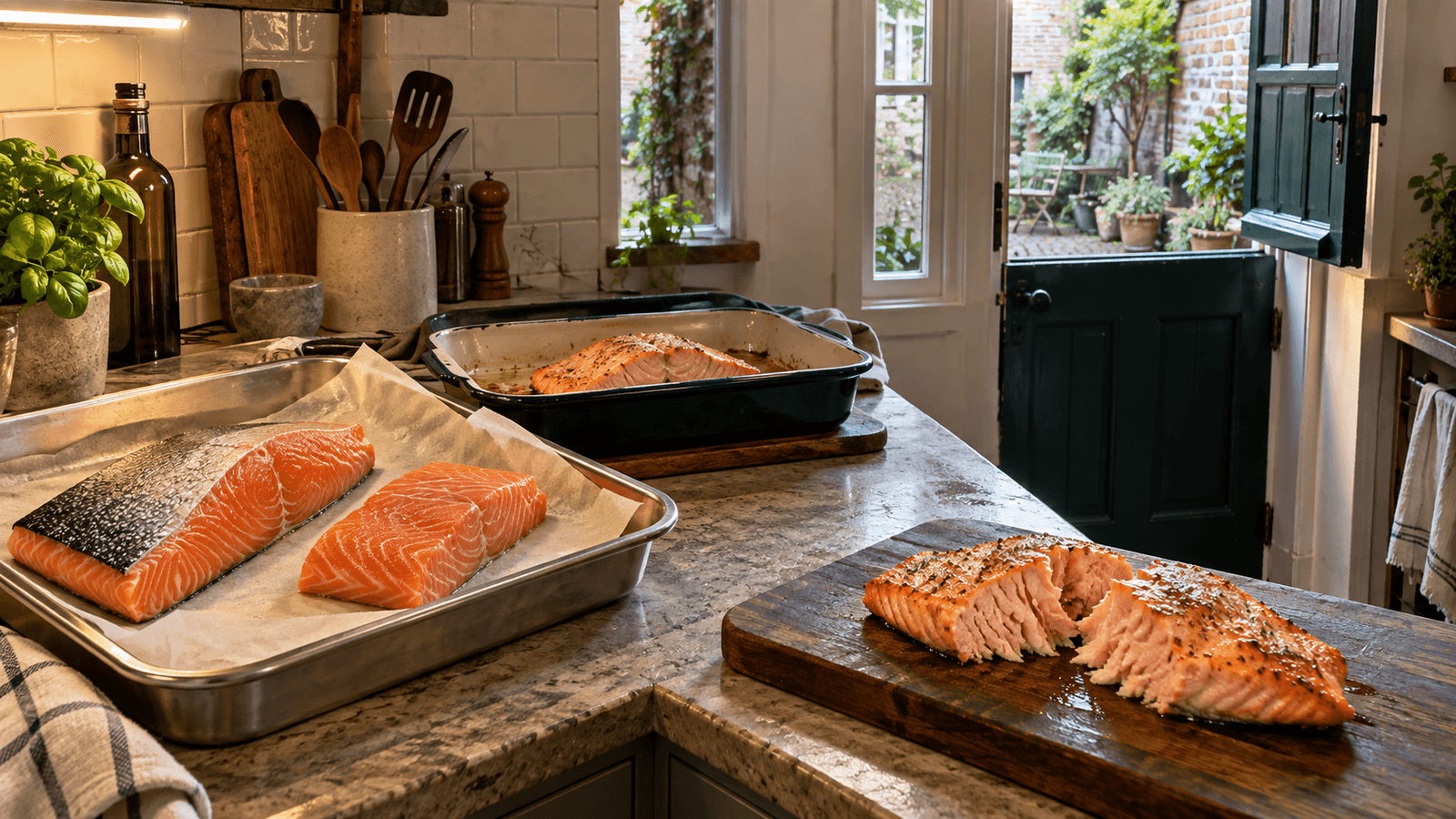
Salmon is a protein-rich fish that also contains a meaningful amount of fat.
That combination means its calorie content is influenced not only by portion size, but also by the type of salmon, the cut, whether the weight is raw or cooked, and how the fish is prepared.
If you are tracking calories, the most useful approach is not to memorize one universal number for salmon.
Instead, match the nutrition entry as closely as possible to the salmon you actually ate.
Calories and nutrition: USDA reference values
Quick answer: 142–208 kcal / 100 g.
The following values describe specific USDA FoodData Central reference foods. They are not universal values for every product.
| Reference food | kcal / 100 g | Protein (g) | Fat (g) | Carbohydrates (g) |
|---|---|---|---|---|
| Wild Atlantic salmon, raw | 142 | 19.84 | 6.34 | 0 |
| Farmed Atlantic salmon, raw | 208 | 20.42 | 13.42 | 0 |
Calories by edible portion weight
| Reference food | 100 g | 150 g | 200 g |
|---|---|---|---|
| Wild Atlantic salmon, raw | 142 | 213 | 284 |
| Farmed Atlantic salmon, raw | 208 | 312 | 416 |
These are two examples of raw Atlantic salmon. Wild and farmed fish differ; cooking changes weight and may change values per 100 g.
Sources:
How many calories are in salmon?
There is no single calorie value that applies to every piece of salmon.
The total depends on several factors:
- species or type of salmon
- farmed or wild salmon
- amount of fat in the fish
- portion size
- raw or cooked weight
- skin and edible portion
- cooking method
- oil, butter or sauce added during preparation
A leaner salmon and a fattier salmon can therefore have different calorie values even at the same weight.
Why salmon calories vary
Salmon naturally contains both protein and fat.
Protein provides energy, but much of the variation between different salmon products comes from differences in fat content.
This is why two database entries labelled simply “salmon” may not be nutritionally identical.
When possible, use information that matches the specific product or type you are eating.
Salmon is a high-protein food
Salmon is a useful source of protein.
Protein contributes to many functions in the body and can also help make meals more satisfying.
The total amount of protein you receive from salmon depends primarily on the edible amount you eat.
A larger fillet generally provides more protein than a smaller one.
If you are planning your overall intake, see How Much Protein Do You Need Per Day?.
Salmon also contains fat
Unlike very lean protein foods, salmon naturally contains a noticeable amount of fat.
That is not automatically a negative characteristic.
Salmon is known for providing unsaturated fats, including long-chain omega-3 fatty acids.
However, because fat is energy-dense, differences in fat content can noticeably affect the calorie value of salmon.
Wild vs farmed salmon
Wild and farmed salmon can differ in nutritional composition.
The exact difference depends on species, feed, origin and individual product.
Farmed salmon is often fattier than some wild varieties, which can also make it more calorie-dense.
This does not mean one type is universally “better.”
They may simply have different nutritional profiles.
For accurate tracking, choose the database entry that most closely matches the salmon you actually have.
Raw vs cooked salmon
One of the most common tracking mistakes is mixing raw and cooked weights.
Cooking changes the weight of salmon, primarily because water can be lost.
For example, a piece of salmon may weigh less after cooking even though the fish did not suddenly lose the same proportion of calories.
As water leaves, the nutrients become concentrated into a smaller cooked weight.
This means:
- 100 g raw salmon
- 100 g cooked salmon
should not automatically be treated as nutritionally identical.
If you weigh the salmon raw, use an appropriate raw entry.
If you weigh it cooked, use a cooked entry when available.
Why cooked salmon can look more calorie-dense per 100 g
Imagine a piece of salmon losing water during cooking.
The cooked piece becomes lighter.
If you then compare equal 100 g portions, the cooked portion may represent more of the original fish than 100 g of the raw product.
This is one reason cooked foods can appear to contain more calories per 100 g even when no extra calories were added.
Does salmon skin affect calories?
The skin and the fat around it can influence the nutritional composition of the edible portion.
Whether this matters for your tracking depends on:
- whether you eat the skin
- how the salmon was cooked
- which nutrition entry you use
If you consistently remove the skin, choose data that reflects the edible portion as closely as possible.
Common salmon portion sizes
Salmon portions vary widely.
You might eat:
- a small piece as part of a larger mixed meal
- a medium fillet as the main protein source
- a larger restaurant portion
- salmon inside pasta, salad or another mixed dish
For tracking, the actual edible weight is more useful than assuming every fillet represents a standard serving.
Should you weigh salmon raw or cooked?
Either can work.
Consistency is more important.
If you usually prepare salmon at home, weighing it raw before cooking can be convenient because nutrition information on packaging may correspond to the uncooked product.
If you only have access to the cooked food, use the cooked weight with an appropriate cooked nutrition entry.
Avoid weighing cooked salmon and logging it using raw nutrition data without accounting for the difference.
Does baking change the calories?
Baking salmon without substantial added fat mainly changes water content.
The salmon's total energy does not increase simply because it was baked.
However, ingredients added before or after baking can change the meal's calorie content.
Examples include:
- olive oil
- butter
- glaze
- honey
- sauce
Track these separately when they contribute meaningfully.
Does frying change the calories?
Pan-frying can increase the total calories if oil or butter is used and some of it remains with the food.
The amount retained is difficult to determine exactly from appearance alone.
If you are tracking closely, include a reasonable estimate of the cooking fat used rather than assuming the salmon itself accounts for the entire total.
Grilled salmon
Grilling can be relatively straightforward to track when little additional fat is used.
Again, remember that cooked weight differs from raw weight because of moisture loss.
Sauces, marinades and oil can still change the final total.
Smoked salmon is different
Smoked salmon should generally be treated as its own product rather than as interchangeable with a fresh salmon fillet.
Processing can affect:
- water content
- sodium
- nutritional values per 100 g
Use nutrition information specifically for smoked salmon when that is what you are eating.
Canned salmon
Canned salmon can also differ depending on the product.
Important details may include:
- whether it is packed in water or oil
- whether skin is included
- whether edible soft bones are present
- drained vs undrained weight
For packaged canned salmon, the product's nutrition label is usually more useful than a generic fresh-salmon entry.
Salmon in restaurants
Restaurant salmon is harder to estimate accurately because the portion and preparation may be unknown.
The fish may contain additional:
- oil
- butter
- glaze
- sauce
If you are using photo-based tracking, treat the estimate as a practical approximation rather than an exact measurement.
How to estimate a salmon portion from a photo
A photo can provide useful information about the size and shape of a salmon portion, but it cannot directly measure weight.
Estimation becomes harder when:
- part of the salmon is hidden
- the camera angle distorts size
- there is no familiar scale reference
- sauce covers the fish
- the salmon is mixed into another dish
See Can AI Estimate Portion Size From a Photo?.
Can AI identify salmon from a photo?
AI image recognition can often identify visually distinctive foods such as salmon, but recognition is only part of the nutrition estimate.
The system may still need to determine:
- portion size
- preparation method
- raw vs cooked state
- visible skin
- added fats
- whether the fish is actually salmon rather than a visually similar food
See How Accurate Is Food Recognition From Photos?.
How to track salmon more accurately
A practical workflow is:
- identify the type of salmon when possible
- decide whether your weight is raw or cooked
- weigh the edible portion if practical
- choose matching nutrition data
- include meaningful cooking fats
- include sauces or glazes separately
- use product-specific information for packaged salmon
You do not need laboratory-level precision.
The goal is to avoid obvious mismatches that can make the estimate less useful.
Salmon and weight loss
Salmon can fit into a weight-loss diet.
Weight loss depends on overall energy balance rather than whether a single food is categorized as a “weight-loss food.”
Because salmon contains protein and fat, it can be satisfying, but portions and added ingredients still contribute to total energy intake.
If your goal is weight loss, consider the entire meal rather than evaluating salmon in isolation.
See How to Build a Filling Meal for Weight Loss.
Salmon in a balanced meal
Salmon can be combined with foods such as:
- vegetables
- potatoes
- rice
- whole grains
- legumes
- salad ingredients
The appropriate combination depends on your preferences, energy needs and overall diet.
There is no need to use the same side dishes every time.
Salmon compared with leaner protein foods
Salmon may contain more calories than very lean fish or skinless poultry because it naturally contains more fat.
At the same time, that fat is part of salmon's nutritional profile.
Comparisons are most useful when they consider more than calories alone.
Protein, fats, micronutrients, preference, price and meal satisfaction can all matter.
Salmon compared with chicken breast
Chicken breast is generally a leaner protein source, while salmon naturally contains more fat.
This means equal-weight portions can have different calorie values.
If you want information about chicken, see Calories in Chicken Breast.
What else does salmon provide?
Beyond protein and fat, salmon can provide several micronutrients.
The exact amounts depend on the type of salmon and portion.
Salmon is commonly associated with nutrients such as:
- vitamin B12
- vitamin D
- selenium
Its fat also includes omega-3 fatty acids.
A food's nutritional value should therefore not be judged only by its calorie count.
Common mistakes when tracking salmon
Using one generic salmon entry for every product
Different salmon types can have different fat and calorie values.
Mixing raw and cooked weights
Water loss during cooking changes weight per 100 g.
Forgetting cooking oil
Oil or butter can add energy that is not part of the fish itself.
Ignoring sauces
Glazes and creamy sauces can meaningfully change the total.
Estimating every fillet as the same size
Salmon portions can vary substantially.
Using fresh salmon data for smoked or canned salmon
These are different products and should be matched to appropriate nutrition information.
Frequently asked questions
Is salmon high in calories?
Salmon can be more calorie-dense than very lean fish because it naturally contains more fat. The actual calorie content depends on the type, portion and preparation.
Is salmon high in protein?
Yes. Salmon is a protein-rich food, although the exact amount depends on the edible portion and specific product.
Is salmon good for weight loss?
Salmon can be included in a weight-loss diet. Overall calorie intake and the composition of the full diet matter more than any single food.
Should I weigh salmon before or after cooking?
Either method can work if you use nutrition data that matches the state in which the salmon was weighed.
Does cooked salmon have more calories than raw salmon?
Cooking mainly changes water content unless additional ingredients are added. Per 100 g, cooked salmon can appear more calorie-dense because it contains less water.
Does salmon skin add calories?
The skin and associated fat can affect the nutritional composition of the portion you eat. Use data that matches whether the skin is consumed when possible.
Does olive oil need to be tracked separately?
If a meaningful amount of oil is used and remains with the food, including it separately can improve the estimate.
Can Mealisa estimate salmon from a photo?
Photo-based food tracking can generate an initial estimate based on the visible food and portion. The result should remain reviewable because exact weight, preparation and added ingredients may not be visible.
The bottom line
The calories in salmon depend on more than the name of the food.
Important variables include:
- salmon type
- portion size
- fat content
- raw vs cooked weight
- skin
- preparation method
- added oil, butter or sauce
For practical tracking, match the nutrition entry to the salmon you actually ate and keep raw and cooked weights consistent.
Salmon is a protein-rich food that also naturally contains fat and several useful nutrients.
Its nutritional value should be considered as part of the overall meal and diet rather than judged by calories alone.
This article provides general educational nutrition information and is not individualized medical or dietary advice.