
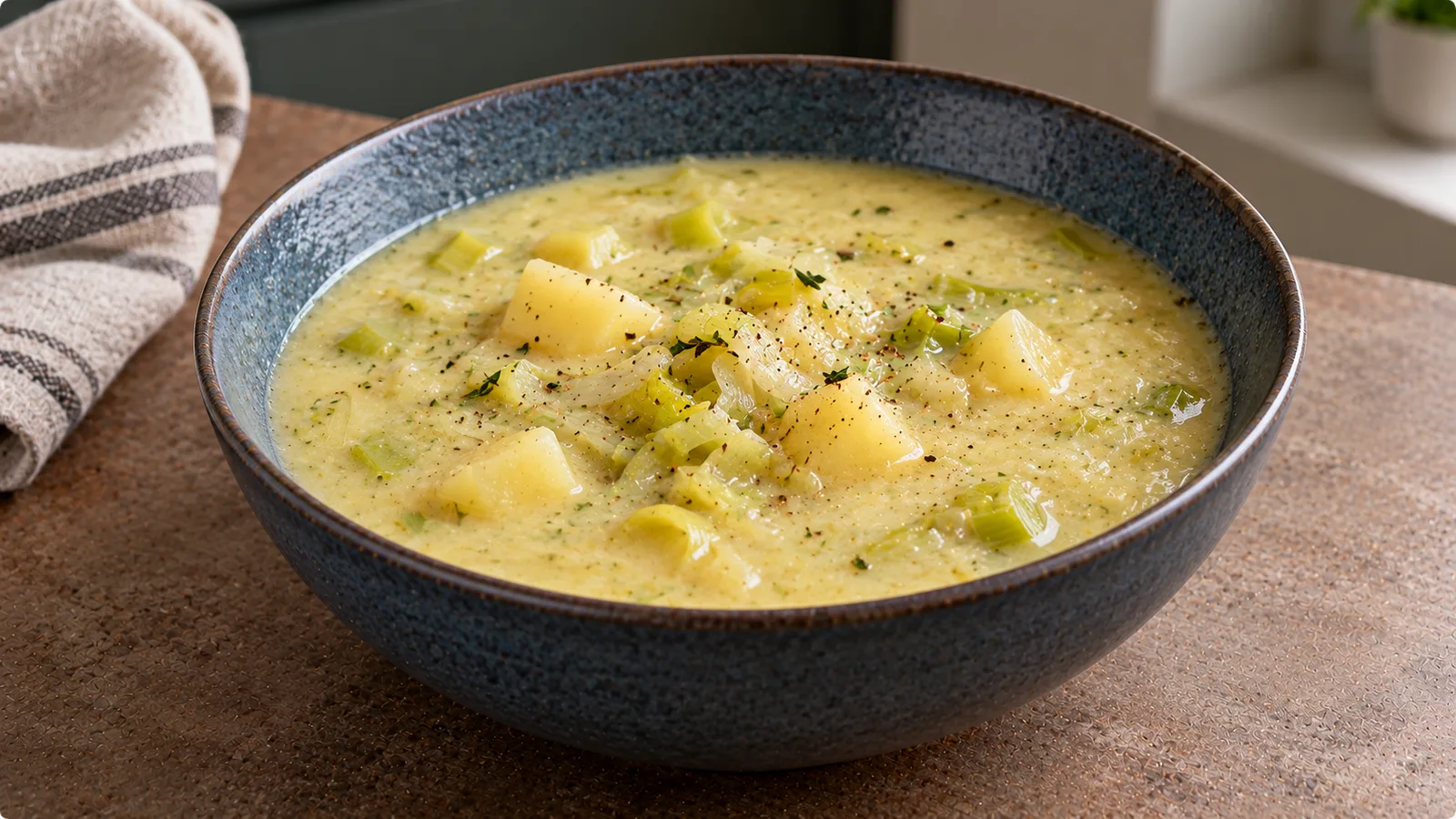
Leek and potato soup is a simple, comforting dish made with softened leeks, potatoes, vegetable stock and a small amount of fat. The potatoes create a naturally creamy texture when blended, so heavy cream is optional rather than essential.
This recipe uses everyday ingredients and takes approximately 40 minutes from start to finish. It works as a light main course with bread or as a starter.
Recipe at a glance
| Detail | Amount |
|---|---|
| Servings | 4 |
| Preparation | 10 minutes |
| Cooking | 30 minutes |
| Total time | 40 minutes |
| Difficulty | Easy |
| Texture | Smooth or partly chunky |
| Main ingredients | Leeks, potatoes, vegetable stock |
Ingredients
For four servings:
| Ingredient | Quantity |
|---|---|
| Leeks, trimmed and cleaned | 400 g |
| Potatoes, peeled | 500 g |
| Onion | 100 g |
| Olive oil | 15 g |
| Vegetable stock | 900 ml |
| Garlic | 2 cloves, approximately 6 g |
| Dried thyme | ½ teaspoon |
| Black pepper | To taste |
| Salt | To taste, depending on the stock |
| Lemon juice | 1–2 teaspoons, optional |
| Fresh parsley or chives | Optional garnish |
Choose a potato variety suitable for boiling. Floury potatoes produce a particularly smooth soup, while waxy potatoes retain more structure if you prefer a chunkier result.
The stock should be suitable for your dietary requirements. Its salt content can vary substantially between products.
How to make leek and potato soup
1. Clean the leeks thoroughly
Cut off the root ends and remove any damaged outer leaves. Trim away the toughest dark-green sections.
Slice the leeks lengthwise and rinse between the layers to remove trapped soil. Then cut into thin slices.
Leeks often hold grit inside their leaves, so this step is worth doing carefully.
2. Prepare the remaining vegetables
Peel the potatoes and cut them into roughly 2 cm cubes.
Peel and finely chop the onion and garlic.
Keeping the potato pieces similar in size helps them cook evenly.
3. Soften the leeks and onion
Heat the olive oil in a large saucepan over medium-low heat.
Add the onion and leeks. Cook for approximately 8–10 minutes, stirring occasionally.
The vegetables should soften without developing a dark brown colour.
Add the garlic and thyme during the final minute.
4. Add potatoes and stock
Add the potatoes and pour in the vegetable stock.
Bring the liquid to a gentle boil, then reduce to a simmer.
Cover partially and cook for approximately 15–20 minutes, until the potatoes are tender when pierced with a fork.
The exact cooking time depends on the size and variety of the potatoes.
5. Blend to the desired consistency
Remove the saucepan from the heat.
Use an immersion blender to blend the soup until smooth.
For a more rustic texture, blend only part of the soup and leave some potato pieces intact.
If using a countertop blender, follow its instructions for hot liquids. Work in small batches and allow steam to escape safely.
6. Adjust and serve
Return the soup to low heat if necessary.
Add black pepper and taste before adding salt, particularly if the stock is already salted.
If the soup is too thick, stir in a little hot water or additional stock.
A small amount of lemon juice can brighten the flavour.
Serve with chopped parsley or chives.
How to make the soup creamy without cream
Potatoes contain starch that helps thicken the soup when cooked and blended.
For a naturally creamy result:
- Cook the potatoes until fully tender.
- Blend the soup thoroughly.
- Add liquid gradually rather than all at once.
- Let the blended soup stand briefly before making final adjustments.
Avoid blending for an unnecessarily long time, especially with very starchy potatoes, because the texture can become gluey.
Cream is not required for a smooth soup.
If you prefer a richer version, stir in a small amount of cream after blending and include it in the nutrition calculation.
Texture and flavour variations
| Variation | Adjustment |
|---|---|
| Chunky soup | Blend only half the mixture |
| Thicker soup | Start with slightly less stock |
| Thinner soup | Add hot stock after blending |
| Richer soup | Add a little cream or butter |
| Vegan soup | Use vegetable stock and olive oil, without dairy |
| More herbs | Add parsley, chives or a small amount of fresh thyme |
| Brighter flavour | Finish with a little lemon juice |
Changes to the ingredients will also change the nutritional values.
What to serve with leek and potato soup
For a light lunch, the soup can be served with wholegrain bread.
For a more substantial meal, add a protein-containing side such as beans, a boiled egg or a sandwich with a suitable filling.
The soup itself is based mainly on vegetables and potatoes, so its protein content is relatively modest.
A balanced meal does not require every dish to contain the same proportions of nutrients. Consider the whole meal and the rest of the day's intake.
Estimated nutrition per serving
The following estimate is based on the four-serving recipe with 400 g leeks, 500 g potatoes, 100 g onion, 15 g olive oil, 6 g garlic and 900 ml vegetable stock.
Actual values depend on the potatoes, stock and ingredient database used.
| Nutrient | Approximate amount per serving |
|---|---|
| Energy | 200 kcal |
| Protein | 5 g |
| Carbohydrates | 36 g |
| Fat | 4.5 g |
| Fibre | 4–5 g |
These are rounded estimates, not laboratory-tested values.
Salt is not listed because its amount depends heavily on the stock and additional seasoning.
If cream, butter, bread or toppings are added, calculate them separately.
How to calculate the calories accurately
For precise food tracking, calculate the complete recipe from the ingredients you actually use.
- Weigh each ingredient before cooking.
- Record the energy and nutrients of each ingredient.
- Add the values together.
- Weigh the finished soup if you divide it by weight.
- Calculate the fraction of the finished soup that you eat.
For example, if a completed batch contains 800 kcal and is divided into four equal portions, each portion contains approximately 200 kcal.
If the soup is divided unevenly, weighing the servings is more accurate.
Water evaporating during cooking changes the calories per 100 g, but does not by itself add calories to the batch.
Common cooking problems
The soup is too watery
Simmer it uncovered for a few minutes to reduce the liquid, or blend more of the potatoes.
Remember that evaporation concentrates the soup without removing the energy of the ingredients.
The soup is too thick
Add warm stock or water in small amounts until the consistency is right.
The soup tastes bland
Check whether the leeks softened sufficiently. Add pepper, herbs or a little lemon juice.
Add salt gradually after tasting.
The soup tastes bitter
Very dark, tough leek leaves or excessive browning can contribute an unpleasant flavour.
Use the tender white and light-green sections and cook them gently.
The soup has a gluey texture
Excessive blending of starchy potatoes can create a sticky consistency.
Blend only until smooth and avoid prolonged high-speed processing.
Can you prepare it in advance?
Yes. Leek and potato soup is suitable for preparing ahead.
Cool it promptly and refrigerate it in a covered container.
For practical food safety, refrigerate perishable cooked food within two hours and keep the refrigerator at approximately 4°C or below.
Use refrigerated leftovers within 3–4 days, following applicable food-safety guidance.
Reheat thoroughly before serving.
Can leek and potato soup be frozen?
Yes, although the texture may change after thawing.
Freeze the cooled soup in airtight, freezer-safe containers, leaving some space for expansion.
For best quality, use it within approximately 2–3 months.
Thaw in the refrigerator and reheat thoroughly.
Stir or briefly blend after reheating if the texture has separated.
Cream-based versions may separate more noticeably than the basic recipe.
Is leek and potato soup healthy?
Leeks, potatoes and other vegetables contribute nutrients and can fit into a balanced eating pattern.
Potatoes provide carbohydrates and potassium, while leeks contribute fibre and other plant compounds.
The soup's overall nutritional profile depends on the ingredients, serving size and accompaniments.
The basic recipe contains relatively little added fat, but also has limited protein.
For someone seeking a more protein-rich meal, adding an appropriate protein source alongside the soup can help.
There is no need to label the dish universally healthy or unhealthy without considering the wider diet.
Frequently asked questions
Do you need to peel the potatoes?
Peeling gives a smoother texture. Clean, suitable potato skins can be retained for a more rustic version, provided damaged or green areas are removed appropriately.
Can you use milk instead of stock?
Milk can be used for part of the liquid, but it changes the flavour, nutrients and cooking behaviour. Avoid vigorous boiling after adding dairy.
Can you make it without onion?
Yes. Increase the leek quantity slightly or simply omit the onion.
Which part of the leek should you use?
The white and tender light-green sections work best for a smooth soup. Tough dark-green sections can be saved for stock if appropriate.
Can you make the soup without a blender?
Yes. Cook the potatoes until tender and mash them in the saucepan for a chunky texture.
References
- USDA FoodData Central — ingredient composition and nutrition estimates.
- USDA Food Safety and Inspection Service — safe storage and handling of cooked foods.
- World Health Organization: Healthy diet — general guidance on varied dietary patterns.
Nutritional figures are approximate. Use the actual ingredients and weights for individual food tracking.