
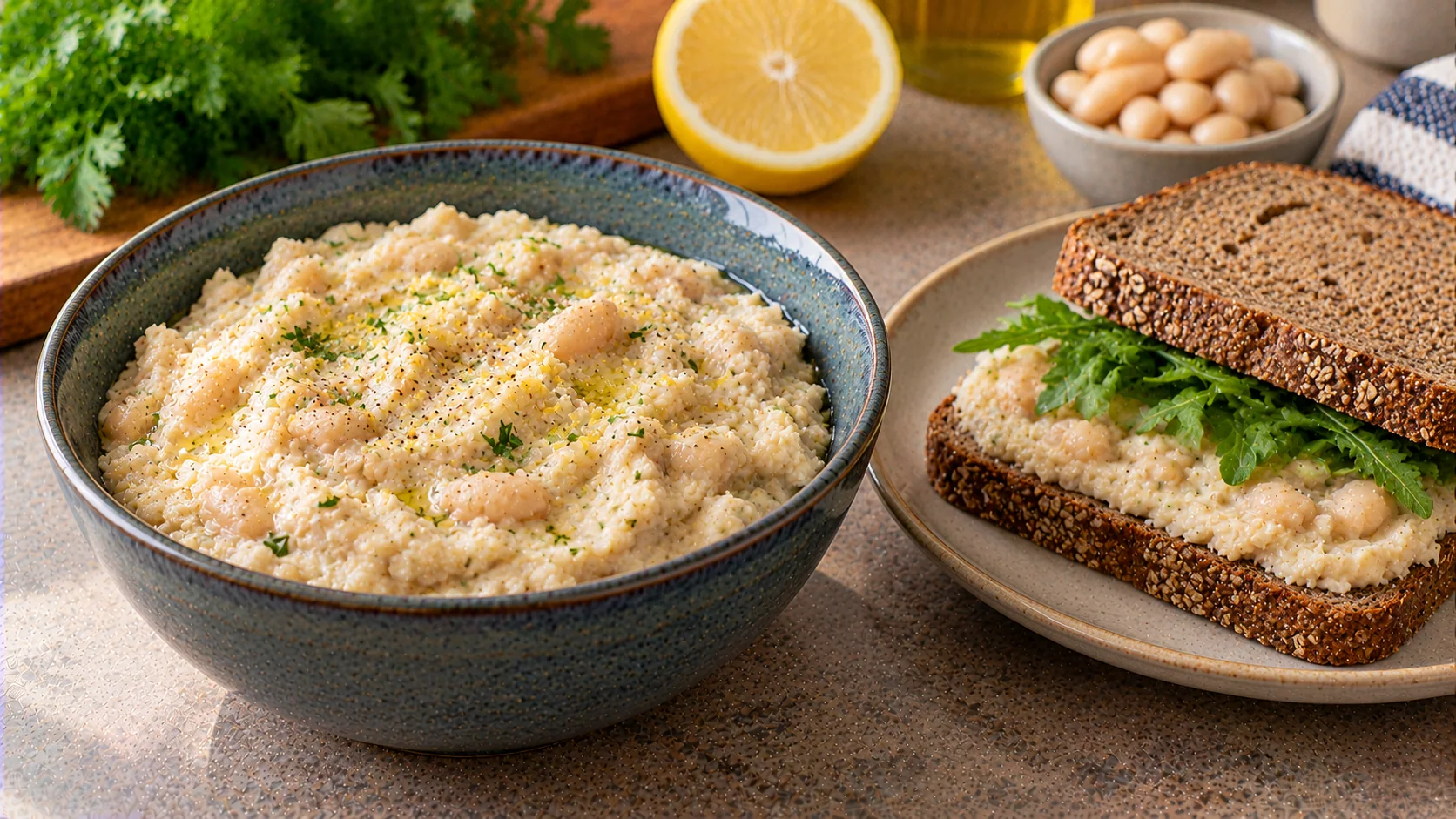
Lemon White Bean Spread for Wholegrain Sandwiches
A jar of white beans can become a satisfying sandwich filling in about ten minutes. This spread uses lemon, olive oil and garlic to turn drained beans into a thick, spoonable filling that stays in bread better than a watery dip. It is a single measured recipe, not a roundup of bean fillings or a substitute for a complete balanced meal. The method also explains how much spread you get and how to keep fresh vegetables crisp until lunch.
Recipe at a glance
- Yield: about 345 g spread; three portions of approximately 115 g.
- Preparation: 10 minutes; no cooking if the beans are ready to eat.
- Serving idea: 70 g wholegrain bread, 115 g spread and 60 g crunchy vegetables per sandwich.
- Equipment: sieve, bowl, fork or mini food processor, clean airtight container.
- Allergens: the spread has no intended wheat ingredient; the sandwich bread contains wheat unless a suitable alternative is chosen. Read canned-bean and bread labels.
Ingredients for three spread portions
| Ingredient | Quantity | Measuring note |
|---|---|---|
| Canned white beans | 240 g drained | Often from a 400 g net-weight can; check the actual drained weight |
| Lemon juice | 30 g | About 2 tablespoons; start with 20 g if your lemon is sharp |
| Extra-virgin olive oil | 15 g | Weigh instead of estimating a large pour |
| Garlic | 4 g | One small clove, finely grated |
| Flat-leaf parsley | 15 g | Chopped; optional for a less herb-forward version |
| Water | 30–45 g | Add gradually; affects yield and thickness |
| Black pepper | To taste | No salt assumed in the nutrition estimate |
This makes approximately 334–349 g depending on the water used and losses on utensils. Portion into three containers rather than calling the entire can one serving. Drain, rinse if desired, and weigh the edible beans, not the can with its packing liquid. how to use the drained weight of canned beans explains why this distinction affects bean-based calculations.
Make the spread in four steps
- Drain the canned beans in a sieve. Rinse briefly if you prefer a milder taste, then let excess water run off for a minute. Weigh 240 g of drained beans.
- Mash beans with garlic, lemon juice and olive oil. A fork makes a rustic texture; a processor makes it smoother. Keep some beans partially intact if you want more bite.
- Stir in the parsley and 30 g water. Add the remaining 15 g water only when needed: the spread should mound on a spoon, not drip from it. Season with pepper. Taste, then add a little more lemon if necessary.
- Divide into three roughly equal portions using a scale. Refrigerate promptly in clean, lidded containers. Do not leave ready-to-eat spread standing on the counter for an extended period.
Build one wholegrain sandwich
Spread one portion (about 115 g) across two slices of wholegrain bread weighing 70 g in total. Add 60 g of dry, crisp vegetable slices—such as cucumber or grated carrot—just before serving. If taking the sandwich to work, pack the vegetables and bread separately until lunchtime to reduce sogginess. A little pepper or a squeeze of fresh lemon is sufficient; no mayonnaise is required.
Wholegrain bread varies in fibre, sodium and actual wholegrain content. Check the ingredients list, not the colour or a multigrain name. For a focused explanation, see how to check wholegrain bread ingredients.
Estimate nutrition using weighed foods
These figures are illustrative arithmetic, not laboratory measurements. Suppose the drained beans contain 7.0 g protein, 6.0 g fibre and 110 kcal per 100 g; oil has 9 kcal/g; lemon, garlic and parsley contribute smaller amounts. Under those assumptions, the beans contribute 16.8 g protein, 14.4 g fibre and 264 kcal to the full batch. The 15 g oil adds about 135 kcal. With other ingredients, the spread is approximately 420–450 kcal per batch, or 140–150 kcal per portion. The exact number changes with the bean label and oil weighed.
| Quantity | Illustrative amount | What it includes |
|---|---|---|
| Spread batch | 420–450 kcal | Entire measured mixture |
| Spread portion | 140–150 kcal | One third of batch |
| Protein in spread portion | ~5.6 g | Bean protein only; other ingredients may add a little |
| Fibre in spread portion | ~4.8 g | Bean fibre only; excludes bread |
| One sandwich | Varies by bread | Add the actual nutrition of 70 g bread and 60 g vegetables |
For more precise tracking, use the specific canned bean and bread labels. USDA FoodData Central is a reference for food composition, but record whether foods are canned, drained or cooked. Do not treat numbers from dry white beans as values for the wet spread.
Illustrative ingredient cost
A low-cost recipe should show its assumptions instead of promising the cheapest price at every shop. In this scenario, a 400 g can with 240 g drained beans costs €0.85; lemon juice from one lemon €0.20; 15 g oil €0.14; garlic €0.05; parsley €0.25. The batch totals €1.49, or approximately €0.50 per spread portion. Bread and fresh vegetables are additional.
| Item | Model cost |
|---|---|
| Drained beans from one can | €0.85 |
| Lemon + oil | €0.34 |
| Garlic + parsley | €0.30 |
| Three-portion spread batch | €1.49 |
| Spread per portion | €0.50 (rounded) |
If only part of a parsley bunch is used, distinguish cash paid for the whole bunch from the ingredient cost allocated to this batch. Compare two cans using their drained weights when prices differ.
Texture fixes that actually work
Too thick? Add 5 g water, mash and reassess rather than adding a large pour. Too thin? Fold in more well-drained beans if available, or use less water next time. Bitter? Too much raw garlic or bitter olive oil can dominate; reduce garlic first. Flat? A few grams of lemon juice can sharpen flavour without more salt. Different bean brands soften differently, so no single water quantity suits every can.
Swaps without changing the method
Cannellini, butter beans and other ready-to-eat white beans all work, but sizes and moisture levels change the texture. Replace parsley with dill, or use a small amount of cumin. For a richer spread replace 5 g of water with 5 g olive oil, then update calories by roughly 45 kcal for the whole batch. Do not call that swap nutritionally identical. A garlic-free version with lemon and parsley is also possible.
Food safety and make-ahead schedule
The canned beans are shelf-stable until opened, not after turning them into a moist ready-to-eat spread. Refrigerate promptly at 4°C or below in a clean covered container. A practical conservative plan is to use the prepared spread within 3–4 days; discard sooner if storage conditions were poor or the product smells or looks wrong. Never taste a suspicious spread to decide whether it is safe. For a packed lunch, use an insulated bag with a cold pack if refrigeration is not available. Follow USDA FSIS guidance on leftovers and FDA food-storage advice.
How to use the extra portions
Make one sandwich today and refrigerate two spread portions separately. On another day, spoon a portion onto a grain bowl or serve it as a dip with cut vegetables; that changes the whole meal's nutrition, so count accompanying foods separately. Keep salad vegetables away from the spread until eating. This flexibility helps use a whole can without suggesting that bread, spread and raw vegetables are nutritionally interchangeable.
When this sandwich is a useful choice
It suits someone who needs a quick meat-free sandwich filling, inexpensive pantry ingredients and a measured way to use one can of beans. It is not necessarily a high-protein main meal by itself; pair it with additional protein-rich food when needed. Total salt depends mostly on the beans and bread chosen. The main advantage is practicality: a short preparation, three measurable servings and flavour from lemon rather than a heavy dressing.