
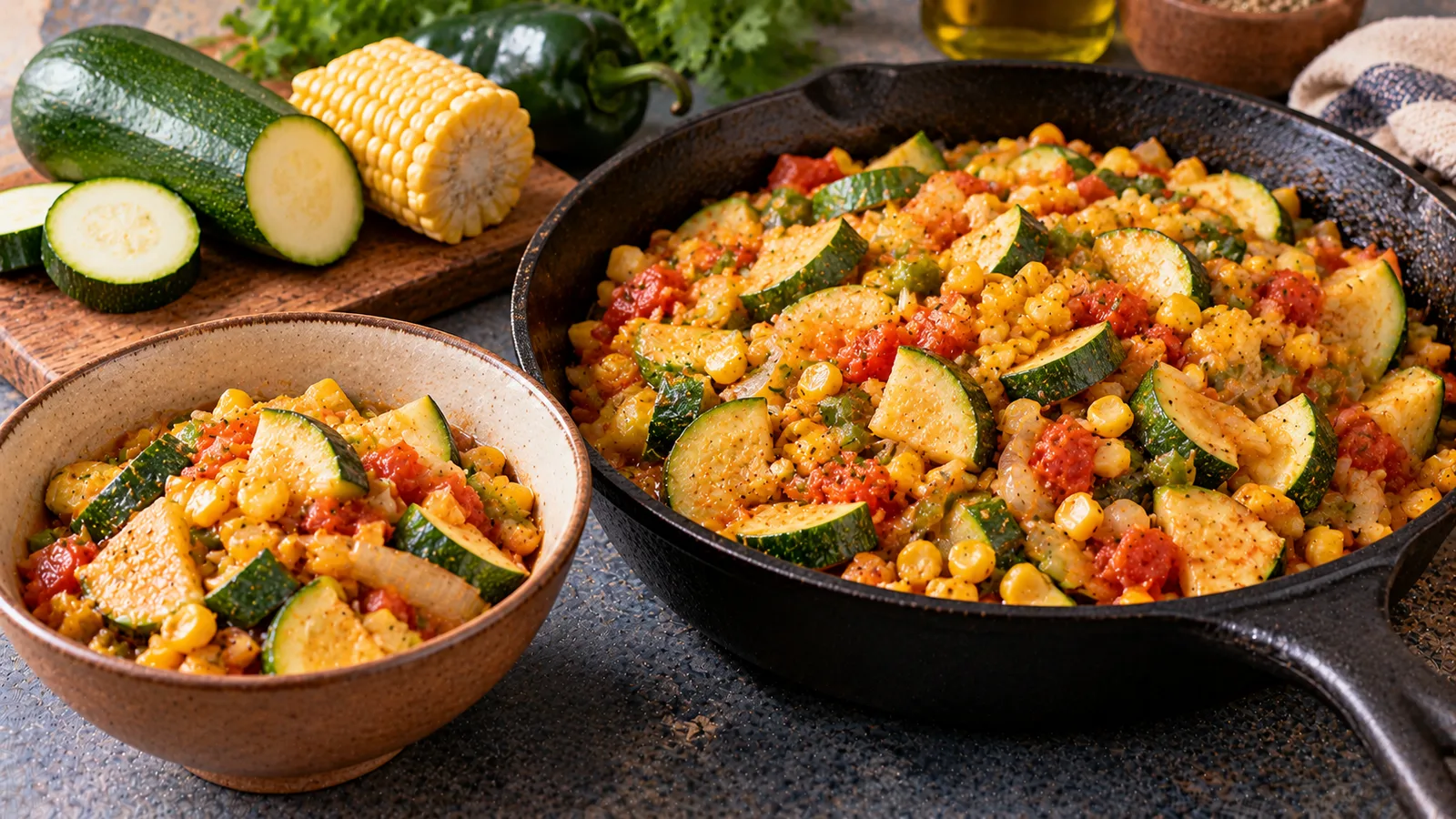
Calabacitas is a name used for preparations built around tender summer squash, often accompanied by corn and chile. Versions vary across Mexico and the American Southwest: some use tomato, some add cheese or cream, and the squash may be diced or sliced. This recipe is a calabacitas-style vegetable skillet, not a claim that every Mexican household makes the same dish. It stays close to a familiar combination of squash, corn and green chile, but gives every substantial ingredient a gram weight so the finished portions can be measured.
The New Mexico tourism recipe for calabacitas likewise combines summer squash, corn and green chile, with optional dairy. Here the base recipe deliberately omits butter, cheese and cream. Those can be served separately if you want them; they are not silently counted in the nutrition figures. The practical result is a quick side dish or vegetable filling that can also become part of a larger meal.
Ingredients for four portions
A scale is more reliable than calling one courgette “medium” or estimating a cup of corn. Weigh the prepared edible ingredients, not the discarded ends, cobs or skins. Fresh and frozen corn both work; for the calculation, use 200 g of kernels, with frozen kernels measured without large pieces of ice. The chile can be a mild, roasted, seeded green chile or poblano; actual heat and energy vary.
| Ingredient | Prepared weight | Why it is here |
|---|---|---|
| Zucchini, skin on | 600 g | Tender summer squash, the centre of the dish |
| Sweet corn kernels | 200 g | Sweetness and firmer texture |
| Ripe tomatoes | 150 g | Juices and acidity |
| Onion | 120 g | Savoury background |
| Roasted mild green chile | 80 g | Gentle warmth and regional character |
| Olive oil | 15 g | Measured cooking fat |
| Garlic | 6 g | Aromatic seasoning |
| Salt, black pepper, oregano, lime | To taste | Not included as a significant calorie addition |
The weighed batch begins at 1,171 g before water evaporates. Add no unrecorded oil halfway through cooking: even a small extra pour can change the calculation more than the zucchini itself. Use a wide skillet so the vegetables soften without being drowned in their juices.
How to cook calabacitas without turning the squash to mush
- Wash the produce. Cut 600 g zucchini into even 1–2 cm pieces. Chop 120 g onion, 150 g tomatoes and the 80 g roasted chile. Mince 6 g garlic. Measure 200 g corn kernels and 15 g olive oil separately.
- Heat the oil over medium heat. Sweat the onion for about 3–4 minutes until translucent rather than dark brown. Stir in the garlic for roughly 30 seconds; it should smell fragrant, not scorched.
- Add the zucchini and turn the heat up slightly. Cook uncovered for around 5–7 minutes, stirring occasionally. The edges should start to soften while the centres still keep their shape.
- Add the corn, tomatoes and chile. Cook for another 5–8 minutes until the corn is heated through and the zucchini is tender. If the tomatoes release much liquid, keep the pan uncovered so some evaporates.
- Taste, season and finish with oregano or a squeeze of lime. Turn off the heat while the zucchini still has some bite. Rest briefly before weighing the entire edible cooked batch.
These times are guides, not a safety measure for a particular stove. Chunks, cookware and fresh versus frozen corn affect the pace. Frozen corn should be thoroughly heated; canned kernels can be used if drained, but their nutrition label should replace the sample corn figure.
Calories: calculate the whole skillet first
The following values are rounded illustrative per-100-g ingredient references, using ordinary raw-food entries from USDA FoodData Central. They are not a laboratory measurement of this specific batch. The oil figure uses 884 kcal per 100 g, and the corn figure of 86 kcal per 100 g is for the example corn, not every canned or seasoned product.
| Food | Calculation from weighed amount | Approximate calories |
|---|---|---|
| Zucchini | 600 × 17 / 100 | 102 kcal |
| Sweet corn | 200 × 86 / 100 | 172 kcal |
| Tomatoes | 150 × 18 / 100 | 27 kcal |
| Onion | 120 × 40 / 100 | 48 kcal |
| Green chile | 80 × 30 / 100 | 24 kcal |
| Olive oil | 15 × 884 / 100 | 133 kcal |
| Garlic | 6 × 149 / 100 | 9 kcal |
| Whole skillet | Sum of rounded ingredient values | 515 kcal |
Rounding each ingredient yields 515 kcal for the whole skillet. If you use the exact unrounded products, you may obtain a slightly different answer. Salt, herbs and a squeeze of lime are not the reason for substantial changes; a large cheese topping or a different oil measurement is. Check packaged ingredients and adjust the inputs rather than treating 515 as a universal value for calabacitas.
Portion size: four servings or calories per 100 g
Dividing the batch into four equal servings gives approximately 129 kcal per serving (515 ÷ 4 = 128.75). To make the weight example concrete, suppose the cooked skillet weighs 1,000 g after evaporation. That would be four 250 g portions and approximately 52 kcal per 100 g (515 ÷ 1,000 × 100 = 51.5). The 1,000 g yield is a worked example, not a measured result promised by the recipe.
If your pan finishes at 900 g, each quarter is 225 g; if it finishes at 1,080 g, each quarter is 270 g. In both cases the same ingredients still provide approximately 515 kcal total, assuming nothing is discarded. A 200 g serving from the hypothetical 1,000 g batch contains about 103 kcal, not automatically 129. To log a plate accurately, record the final cooked weight, then multiply the plate weight by the whole-batch calorie total divided by that final weight.
This distinction matters because zucchini and tomato lose water while cooking. Cooking does not create extra calories merely because the food becomes more concentrated. It changes the denominator: the number of grams of cooked food.
Make it a meal: practical variations and additions
Serve the vegetables alongside beans, tortillas, rice, eggs or a protein food if you want a more substantial meal. Count those foods separately: this is primarily a vegetable skillet, not a complete protein-rich main course by itself. A spoonful of cheese or a dollop of cream can suit some versions, but changes both energy and, for dairy products, allergens.
For a spicier version, swap the mild chile for a hotter variety, tasting cautiously. For a softer texture, cover the skillet briefly; for vegetables that keep their shape, cook uncovered and do not overload a small pan. If you add 5 g olive oil, that adds about 44 kcal to the whole recipe. An extra 100 g of the example corn adds approximately 86 kcal. Neither change can be accounted for by simply assuming the original four portions still contain 129 kcal each.
A useful serving strategy is to divide the dish first and then add your extras to individual plates. That preserves a clear reference batch and avoids confusing the calories of beans, cheese or tortillas with the basic zucchini-and-corn mixture.
If you are tracking ingredients separately, compare calories and serving sizes for zucchini · corn calories and common servings.
Food safety, storage and reheating
Serve freshly cooked calabacitas hot. Cool leftovers promptly in shallow containers and refrigerate at 4 °C or below; do not leave perishable cooked food at room temperature for more than 2 hours, or 1 hour when the surroundings exceed 32 °C. The USDA guidance on leftovers recommends using refrigerated leftovers within 3–4 days, or freezing them for longer storage. Reheat leftovers to 74 °C throughout.
The zucchini may become softer after refrigeration or freezing. That is a texture issue rather than a reliable indicator that food is safe. A sour smell is a reason to discard food, but the absence of a smell is not proof that improperly stored leftovers are safe. If you keep a portion for lunch, transport it chilled rather than leaving it on a warm desk.
Sources
- New Mexico tourism: Calabacitas recipe and regional ingredients.
- USDA FoodData Central: ingredient composition reference database. Approximate values use the stated raw ingredients; actual products may differ.
- USDA FSIS: Leftovers and Food Safety.