
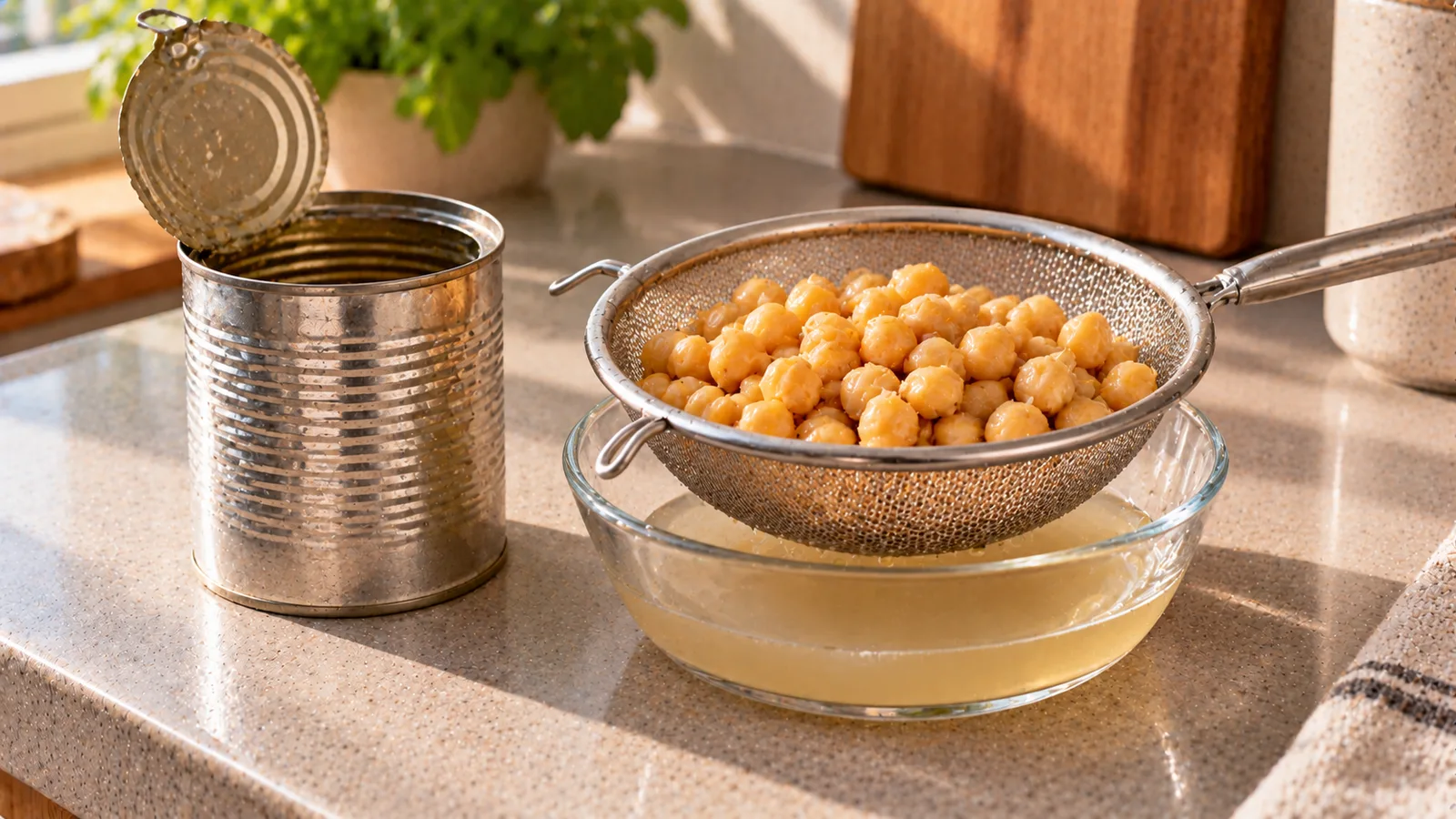
A can can show several different weights: net weight, drained weight and sometimes a serving size. Choosing the wrong one can noticeably change a calorie calculation.
The key question is not simply how much the unopened can weighs. It is:
What part of the product did you actually eat, and what quantity does the nutrition label describe?
That distinction is especially important for beans, chickpeas, corn, tuna, vegetables, fruit and other foods packed in water, brine, syrup or oil.
Net weight and drained weight are different
Net weight is generally the total amount of food and packing liquid inside the container.
Drained weight is the amount of solid food remaining after the specified liquid has been removed.
For example, a can might state:
- net weight: 400 g;
- drained weight: 240 g.
If you drain the liquid and eat the solids, you did not eat 400 g of solid food. You ate up to about 240 g of the drained product.
But this does not automatically mean that every nutrition value on the can should be multiplied by 240 g. First check what the label's nutrition values refer to.
The label basis comes first
Before calculating anything, read the wording around the nutrition table.
The values might describe:
- the product as sold;
- the drained product;
- a stated serving;
- the food including its packing liquid;
- a prepared product.
The correct weight depends on that basis.
A useful rule is:
match the weight you log to the form of food described by the nutrition values.
If the nutrition values explicitly apply to the drained product, use the amount of drained food you ate.
If the values apply to the product including its liquid, do not automatically apply them to a drained weight without checking whether the manufacturer also provides drained-product information.
Example 1: beans with nutrition values for the drained product
Suppose a can of beans says:
- net weight: 400 g;
- drained weight: 240 g;
- nutrition: 110 kcal per 100 g drained.
You drain the can and eat all the beans.
Calories:
110 × 240 ÷ 100 = 264 kcal
In this case, 240 g is the relevant amount because both the stated weight and the nutrition values refer to the drained food.
Using 400 g would give:
110 × 400 ÷ 100 = 440 kcal
That would incorrectly treat the packing liquid as another 160 g of drained beans.
Example 2: eating only part of the drained can
The same beans contain 110 kcal per 100 g drained.
After draining, you weigh your portion and get 150 g.
Calories:
110 × 150 ÷ 100 = 165 kcal
You do not need to calculate from the full can if you can weigh the actual portion.
For food tracking, this is often the simplest method.
Drained weight on the package is not always your exact measured weight
The stated drained weight is useful, but the amount you obtain at home can differ slightly.
Differences can result from:
- how long the food is drained;
- how much liquid remains on the food;
- natural variation between pieces;
- the draining method;
- small manufacturing tolerances.
If accuracy matters and you have a kitchen scale, weighing the food after draining gives you the amount you actually consumed.
Use the package's drained weight when weighing is impractical or when you eat the whole drained contents.
Beans and chickpeas
Canned beans and chickpeas are commonly packed in water or brine.
If you discard the liquid, the drained weight is usually much more relevant than the total net weight when the nutrition data also describe the drained food.
Example:
- drained beans eaten: 180 g;
- label: 105 kcal per 100 g drained.
Calories:
105 × 180 ÷ 100 = 189 kcal
The same method works for protein, carbohydrate, fiber and other nutrients.
If the label provides 7 g protein per 100 g drained:
7 × 180 ÷ 100 = 12.6 g protein
Canned vegetables
The same principle applies to products such as:
- peas;
- corn;
- carrots;
- green beans;
- mixed vegetables.
If you drain the packing liquid, use nutrition information that corresponds to the drained product whenever available.
Do not assume that the gross amount inside the can equals the amount of vegetables eaten.
Tuna in water or brine
Tuna creates another common tracking problem because database entries may refer to different states.
You may encounter entries such as:
- tuna in water, drained;
- tuna in brine, drained;
- tuna in oil, drained;
- tuna with packing liquid.
These are not necessarily interchangeable.
If you drain tuna in water and eat 120 g, choose an entry that describes drained tuna and log 120 g.
Avoid using an entry for undrained tuna simply because the product name looks similar.
Tuna in oil requires extra attention
Oil is energy-dense, and some oil remains with the tuna even after draining.
Therefore:
tuna in oil, drained is not necessarily nutritionally equivalent to tuna in water, drained.
If the package provides nutrition values specifically for the drained tuna, those values are preferable.
If you consume the oil as well—for example by adding it to a salad—the consumed oil should not simply disappear from the log.
Use the package information where possible and account for the portion actually eaten.
Why rinsing is different from draining
Draining removes the free packing liquid.
Rinsing adds another step and may remove some substances from the surface of the food, particularly some sodium from products packed in salty liquid.
However, rinsing does not provide a reliable reason to recalculate calories using an arbitrary percentage reduction.
Unless you have product-specific information, use the appropriate drained-food nutrition data rather than inventing a calorie adjustment for rinsing.
Foods packed in syrup
Canned fruit can be packed in:
- water;
- juice;
- light syrup;
- heavier syrup.
Here, whether you consume the liquid can materially affect the result.
If you drain fruit packed in syrup, look for nutrition information corresponding to the drained fruit if the manufacturer provides it.
If you eat or drink the syrup too, the full consumed product needs to be represented.
Do not automatically use a generic “fruit, drained” entry for fruit consumed together with syrup.
Foods packed in oil
The same logic applies to foods such as:
- tuna;
- sardines;
- artichokes;
- peppers;
- sun-dried tomatoes.
If oil is discarded, choose data that correspond as closely as possible to the drained product.
If some or all of the oil is eaten, include it through the appropriate product values or separately when necessary.
Because oil contains about 9 kcal per gram, seemingly small differences in consumed oil can meaningfully affect total calories.
What if the label only gives values per serving?
Suppose a can says:
- serving size: 120 g drained;
- calories per serving: 150 kcal.
You eat 180 g drained.
First calculate the number of servings:
180 ÷ 120 = 1.5 servings
Then:
150 × 1.5 = 225 kcal
The same multiplier can be applied to the other nutrients on the label.
What if the label gives values per 100 g?
This is straightforward when the nutrition basis matches the food state you ate.
Formula:
calories eaten = kcal per 100 g × grams eaten ÷ 100
For example:
- 135 kcal per 100 g drained;
- 170 g eaten.
Calculation:
135 × 170 ÷ 100 = 229.5 kcal
Rounded appropriately, that is about 230 kcal.
What if you eat the entire drained can?
If the label gives a drained weight and nutrition per 100 g drained, you can calculate directly.
Example:
- drained weight: 285 g;
- energy: 80 kcal per 100 g drained.
80 × 285 ÷ 100 = 228 kcal
If you routinely eat the whole can, you can also save the full drained can as a custom serving in your tracker.
What if there is no drained weight?
Not every product needs or provides a drained-weight declaration.
If you discard liquid but no drained weight is stated, the most practical method is to use a scale:
- drain the food as you normally would;
- place a bowl on the scale and tare it;
- add the drained food;
- record the measured weight;
- use nutrition data that describe the drained food.
If you cannot weigh it, a reliable database entry for the same food in the same state can provide an estimate, but the product's own label should generally take priority when it gives the necessary information.
Do not confuse can size with food weight
A “400 g can” does not necessarily mean you will eat 400 g of solid food.
That 400 g can include a substantial amount of:
- water;
- brine;
- juice;
- syrup;
- oil.
If the liquid is discarded, logging the full net weight as solid food can create a large error.
A worked example with macros
Suppose canned chickpeas provide per 100 g drained:
- 130 kcal;
- 7.0 g protein;
- 18.0 g carbohydrate;
- 3.0 g fat;
- 6.0 g fiber.
You eat 160 g drained.
Multiply each value by:
160 ÷ 100 = 1.6
Your portion contains approximately:
- calories: 130 × 1.6 = 208 kcal;
- protein: 7 × 1.6 = 11.2 g;
- carbohydrate: 18 × 1.6 = 28.8 g;
- fat: 3 × 1.6 = 4.8 g;
- fiber: 6 × 1.6 = 9.6 g.
The same portion multiplier keeps the entire nutrition profile internally consistent.
A worked example with two different weights
A jar of vegetables states:
- net weight: 650 g;
- drained weight: 360 g;
- 70 kcal per 100 g drained.
You eat half of the drained vegetables.
Estimated amount:
360 ÷ 2 = 180 g
Calories:
70 × 180 ÷ 100 = 126 kcal
Using half the net weight instead:
650 ÷ 2 = 325 g
would not represent the amount of drained vegetables you ate.
When weighing leftovers
If you drain an entire can but eat only part of it, you can track the amount directly.
For example:
- total drained food measured: 250 g;
- food remaining after the meal: 90 g.
Amount eaten:
250 − 90 = 160 g
If the product contains 115 kcal per 100 g drained:
115 × 160 ÷ 100 = 184 kcal
This can be easier than estimating fractions of a can.
Batch recipes with canned foods
When canned ingredients go into a recipe, decide whether the packing liquid enters the recipe too.
For example, if a chili recipe uses:
- one drained can of kidney beans;
- one drained can of corn;
log the drained amounts.
If a soup uses an entire can including its liquid, use data corresponding to the entire consumed contents when available.
The recipe should represent what actually goes into the pot.
Do not mix incompatible database entries
A common mistake is combining:
- the drained weight from the package;
- with nutrition data for an undrained product from a database.
Or the reverse:
- the total net weight;
- with nutrition data that describe only the drained solids.
The weight and nutrition basis need to describe the same state of the food.
A simple decision process
When logging canned or jarred food, ask:
1. Did I consume the packing liquid?
If yes, use information representing the consumed product including that liquid where available.
If no, continue with the drained product.
2. Does the label say the nutrition values are for the drained product?
If yes, use those values with the drained amount eaten.
3. Is a drained weight printed?
If you ate the entire drained contents, that weight can be used directly.
4. Did I eat only part?
Weigh the drained portion if possible.
5. Is the product packed in oil or syrup?
Pay extra attention because consuming or discarding the liquid can have a larger effect on calories.
Quick reference
| Situation | Weight to use |
|---|---|
| Whole drained can, label values for drained food | Drained weight |
| Part of drained can | Actual drained portion weight |
| Liquid also consumed | Amount corresponding to food + consumed liquid |
| Tuna in oil, oil discarded | Drained amount with drained tuna-in-oil data |
| Tuna in oil, oil consumed | Include the consumed oil through appropriate product data |
| Beans drained and rinsed | Drained/rinsed amount with suitable drained-food data |
| No drained weight available | Weigh after draining if possible |
The main rule
The most reliable way to log canned food is to match three things:
food state + nutrition-label basis + amount actually eaten
If you drained the food, use drained-food nutrition data with the drained amount.
If you consumed the packing liquid, make sure the liquid is represented too.
The printed net weight, drained weight and serving size are not competing answers. They describe different quantities. The correct one depends on what you ate and what the nutrition table is measuring.