
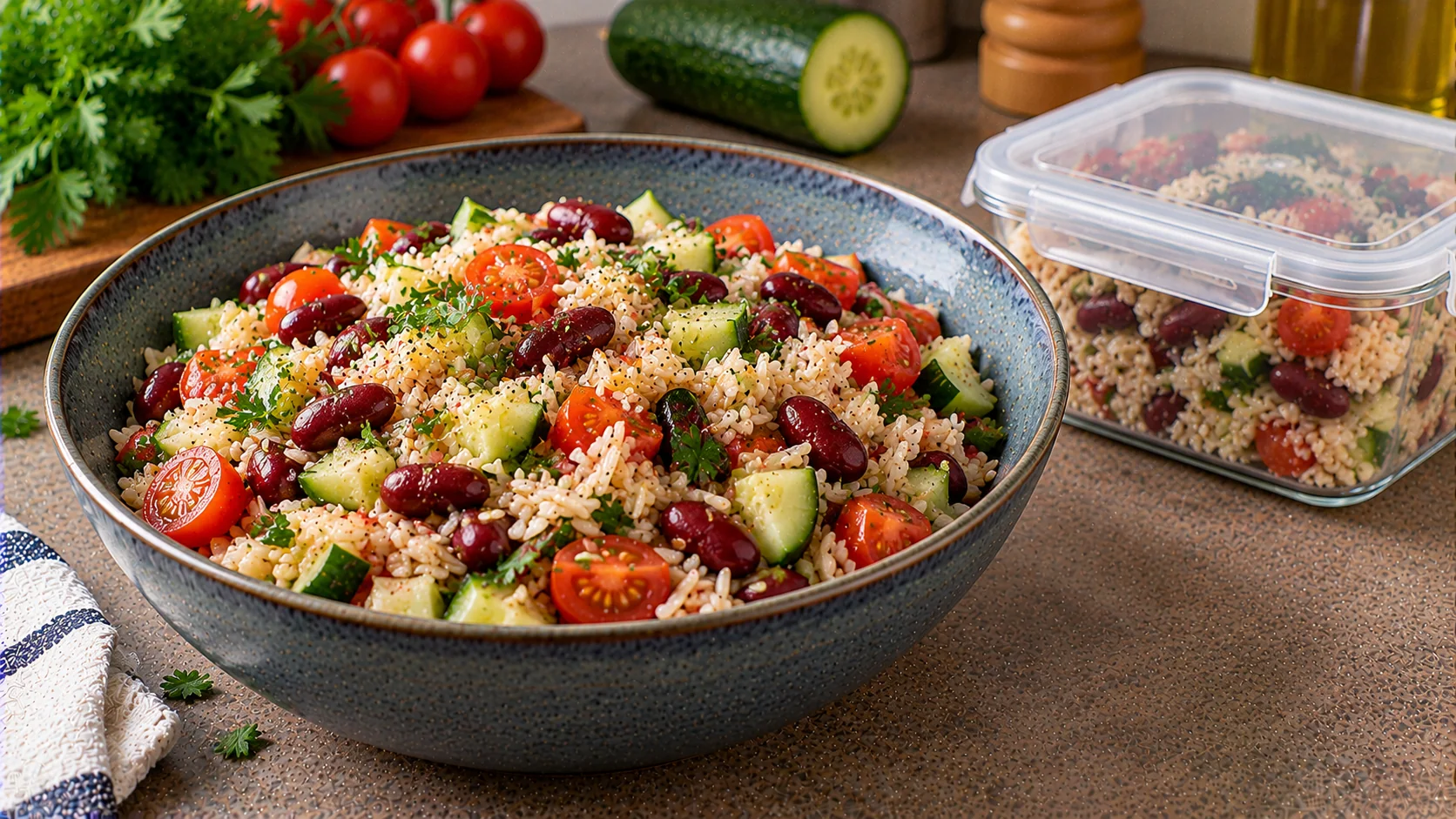
Chilled Rice Salad With Beans: Cooling and Storage Guide
A practical lunch — with a cooling rule
Rice, white beans and crisp vegetables make an inexpensive packed lunch that can be served cold. The important preparation step is not the dressing but cooling freshly cooked rice promptly. Cooked rice can contain Bacillus cereus spores; if rice stays warm for too long, bacteria may grow and some toxins are not reliably destroyed by reheating. This recipe uses freshly cooked rice, cooled rapidly, and is not intended for unrefrigerated travel. For the broader rice safety issue, see our guide to cooling and reheating rice.
Ingredients for two lunch portions
The stated 80 g rice is dry weight; 240 g canned beans means drained weight, not the mass of the can and its liquid. Choose vegetables that are washed and suitable to eat raw.
| Ingredient | Amount for two | Preparation |
|---|---|---|
| White rice, dry | 80 g | Cook according to package |
| Canned white beans, drained | 240 g | Drain and rinse |
| Cucumber | 150 g | Dice finely |
| Red bell pepper | 120 g | Dice |
| Olive oil | 12 g | Measure before mixing |
| Lemon juice | 30 g | Fresh or unsweetened bottled |
| Fresh parsley | 10 g | Wash and chop |
| Black pepper | To taste | Optional |
The recipe yields two substantial bowls; actual weight depends on water absorbed by the rice and vegetable preparation. The uncooked rice is not a ready-to-eat portion. Rice usually increases notably in weight when cooked, but the exact yield must be weighed if tracking cooked portions.
Cooking and rapid cooling: step by step
- Wash hands, clean the work surface and prepare a clean, shallow container for the cooked rice.
- Cook the 80 g dry rice in water following the package's time and water instructions. Cook it freshly for this recipe; do not start with rice left on a counter overnight.
- As soon as it is cooked, spread the rice in a thin layer in a shallow container. Do not leave a covered, deep pot to cool slowly on the stove.
- Cool the rice promptly and refrigerate it within one hour, following the more cautious UK Food Standards Agency guidance for rice. Divide into two shallow containers if needed. Keep chilled at 5°C or colder; a refrigerator set near 4°C is preferable.
- While the rice is cooling, drain 240 g of beans and wash and dice the vegetables. Keep them cold rather than leaving everything out as the rice cools.
- Mix the thoroughly chilled rice with the drained beans, vegetables, oil, lemon and parsley using clean utensils. Divide between two lidded containers; return to the fridge immediately.
Active preparation takes approximately 15 minutes plus the rice's cooking and cooling time. The amount of cooling time varies with container depth, starting temperature and refrigeration. Do not treat an approximate minute count as proof that a deep container is cold.
A useful food-safety timeline
| Stage | Action | Key check |
|---|---|---|
| Immediately after cooking | Spread rice thinly | No deep warm pot |
| Within 1 hour | Refrigerate rice | Prompt cooling |
| Once cold | Add cold vegetables and beans | Clean tools, cold ingredients |
| Until serving | Hold in refrigerator | 5°C or colder |
| Next day | Eat cold if properly stored | Use within 24 hours |
The UK Food Standards Agency advises rice to be eaten within 24 hours when refrigerated and cooled correctly. This is intentionally more conservative than generic 3–4 day advice for many cooked leftovers. See FSA guidance on reheating rice.
Two ways to pack lunch
For a home lunch, divide into two shallow, airtight food containers and refrigerate promptly. For commuting, use an insulated lunch bag with an ice pack and keep the food chilled until eating. If you cannot keep it cold, choose a separate shelf-stable lunch instead. A cold salad is not safe merely because it has lemon juice: this recipe has not been validated as an acidified preserved food. our guide to storing prepared salad bowls discusses another prepared-lunch storage problem.
Calories and macros: transparent estimate
These are illustrative calculations, not laboratory results. Using typical reference values per 100 g — dry white rice 365 kcal, 7 g protein, 0.7 g fat and 80 g carbohydrates; drained white beans 110 kcal, 7 g protein, 0.5 g fat and 17 g carbohydrates; cucumber 15 kcal; red pepper 31 kcal; olive oil 884 kcal per 100 g; lemon juice 22 kcal; parsley 36 kcal — this batch is approximately 732 kcal before optional seasoning, or 366 kcal per half. The rice and beans supply most protein and carbohydrate; the oil supplies most fat. Values vary substantially by brand, processing and drained weight. Use the labels of the products you buy for precise tracking.
| Component | Illustrative batch energy |
|---|---|
| Rice, 80 g dry | 292 kcal |
| Beans, 240 g drained | 264 kcal |
| Cucumber and pepper | 59.7 kcal |
| Oil, 12 g | 106.1 kcal |
| Lemon and parsley | 10.2 kcal |
| Total, rounded | 732 kcal |
| Per serving, rounded | 366 kcal |
The table arithmetic is more precise than the prose estimate; use 732 kcal per batch / 366 kcal per serving for this worked model. All example values are rounded and vegetable energy assumes 15 and 31 kcal per 100 g respectively.
Estimated grocery cost, not a shop quote
For an example calculation, charge €0.16 for 80 g dry rice, €0.90 for 240 g drained beans, €0.35 for cucumber, €0.45 for pepper, €0.13 for olive oil, €0.20 for lemon juice and €0.15 for parsley. That totals €2.34 per batch or €1.17 per serving in used ingredients. At checkout, you may have to buy whole bags, tins and bottles, so the amount paid can be higher; leftover ingredients remain available for later meals. Prices are hypothetical and not verified current German supermarket offers.
Why the texture changes
Chilled rice firms as starch retrogrades. A little oil and lemon helps keep the grains separated but will not stop firming. Cucumber releases water, particularly after salting; adding cucumber shortly before eating produces a crisper bowl. Beans can break if overmixed, so fold the dressing gently through cold rice rather than stirring vigorously. If you prefer brown rice, follow its package instructions and recalculate the dry-rice values.
Food safety: what not to do
Do not keep warm rice on the worktop all afternoon, rely on a sniff test, cool a deep pot slowly, or assume that extra lemon sterilises a finished salad. Do not add hot rice straight to an already packed salad and leave it at room temperature. Reheating is not a guaranteed rescue for rice mishandled earlier. Discard improperly stored rice instead of testing it by tasting.
Useful substitutions
Swap white beans for drained chickpeas at the same drained weight, but check nutrition labels because energy and texture change. Frozen vegetables need adequate cooking before addition, followed by rapid cooling. For a fuller lunch add a separately stored protein food; keep its own safety requirements in mind. These substitutions should not turn the recipe into a mixed leftover bowl containing rice of unknown storage history.
Sources
- UK Food Standards Agency — Home Food Fact Checker: guidance on cooling, refrigerating and reheating rice, including the one-hour cooling advice and 24-hour use.
- USDA FoodData Central: ingredient composition reference for the illustrative energy calculations; actual labels take precedence.
- USDA FSIS — Leftovers and Food Safety: general context for chilling and transporting perishable food.