
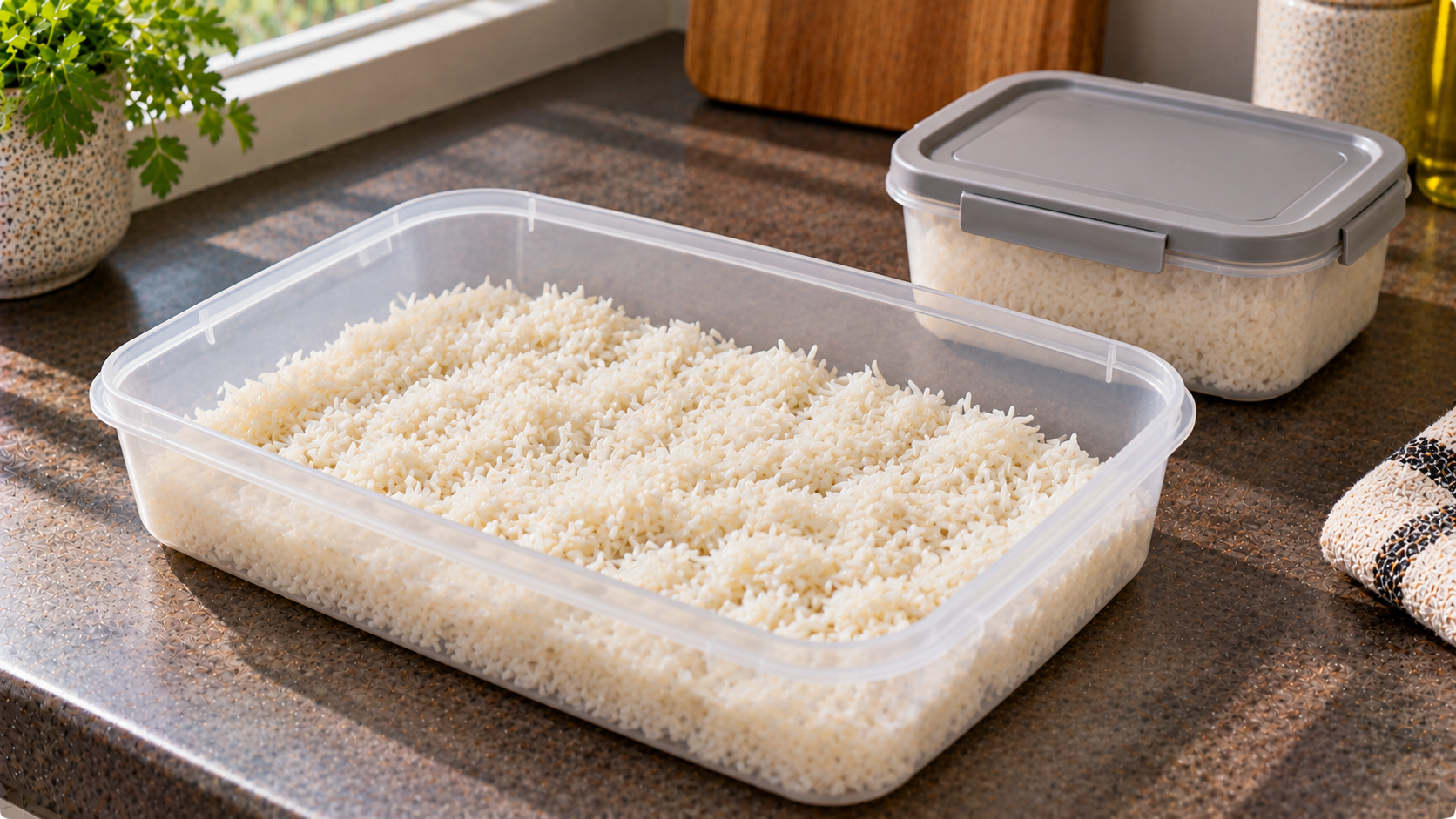
Cooked rice is convenient for meal planning, but safe storage starts as soon as cooking ends. Cool rice promptly, refrigerate it cold, and reheat only a portion you intend to eat. Rice deserves particular attention because Bacillus cereus spores may survive ordinary cooking. If the cooked grains sit warm for too long, surviving spores can germinate and bacteria may multiply; some strains can produce a heat-stable vomiting toxin. Reheating a badly stored batch is not a reliable rescue method. German Federal Institute for Risk Assessment (BfR).
The practical answer: what to do after cooking rice
| Step | What to do | Why it matters |
|---|---|---|
| After cooking | Serve what you need and move the remaining rice into clean, shallow containers | A deep pot of rice cools slowly in the middle |
| Cooling | Aim to chill rice as quickly as possible, ideally within one hour under UK rice-specific advice | Limits time spent at temperatures favorable for bacterial growth |
| Refrigeration | Put portions promptly in a refrigerator operating at 5°C or below; follow any stricter local food-safety guidance | Chilling slows growth; it does not reverse poor prior storage |
| Eating later | The UK Food Standards Scotland advice is to eat refrigerated cooked rice within 24 hours | This is a conservative rice-specific rule, not a universal limit for every leftover food |
| Reheating | Heat the whole portion until steaming hot throughout, stirring if using a microwave | Avoids cold centers; never treat reheating as a way to remove toxins already formed |
| Remaining rice | Reheat rice only once under UK rice-specific advice; freeze other portions promptly rather than repeatedly warming one container | Repeated warming and cooling add opportunities for unsafe handling |
These rice-specific precautions are summarized by Food Standards Scotland. Other agencies provide different general leftover windows: do not automatically substitute a general three- or four-day leftover rule for the more cautious UK rice instructions.
Why rice needs a different conversation from ordinary leftovers
The main issue is not that cooked rice is inherently unsafe or that it becomes dangerous the instant it cools. The risk is time and temperature after cooking. B. cereus spores can occur on rice and other starchy foods. Normal boiling may kill vegetative bacteria while leaving spores capable of surviving. When cooked rice remains in a warm pot or on the counter, the conditions can allow surviving spores to grow into bacteria. Certain strains produce toxins associated with vomiting or diarrhea. BfR: Bacillus cereus.
A rice cooker is not automatically safe storage: a cooker that truly keeps food hot is different from a cooker that has been switched off and is merely cooling gradually. Without an independently verified safe holding temperature, do not assume that a closed appliance protects rice for hours. Similarly, rice left in a sealed lunch box at room temperature is not protected merely because the lid stays shut.
Food can be unsafe without a strange smell, visible mold or an unusual taste. Appearance is not a dependable test for the bacterial growth or toxins discussed here. If you cannot establish how long a batch spent unrefrigerated, discard it rather than trying a second boil.
Cooling a pot of rice without leaving it on the counter
The easiest time to protect rice is immediately after cooking. Remove the amount you will eat now. Transfer the rest from the deep cooking vessel to one or more clean, shallow food-safe containers. A thin layer exposes more surface area and loses heat faster than a tall, dense mass. Divide a large batch into individual meal portions so you can chill or freeze it without repeatedly opening and handling a single family-sized box.
Do not wait for a pot to reach room temperature over several hours before taking any action. UK guidance calls for quick cooling, ideally within one hour, and prompt refrigeration. The broader USDA guidance is to refrigerate perishable leftovers within two hours, or within one hour when ambient temperatures exceed 90°F (32°C). These are different agencies' guidance, not contradictory promises of the same safe interval; using the stricter rice-specific approach is a straightforward household choice. Food Standards Scotland · USDA FSIS.
A clean shallow container can go into the refrigerator while the food is still warm, provided the quantity is manageable and it does not significantly warm the rest of the fridge. For a very large batch, divide it first and use an ice-water bath around the containers to speed cooling; keep the water out of the rice. Do not stack tightly closed, hot containers into a single insulated pile. Once chilled, close and label containers with their preparation date and time.
How long does cooked rice last in the fridge?
There is no single worldwide shelf-life rule that can be quoted without context. The UK rice-specific consumer advice is to refrigerate promptly and consume within 24 hours. Food Standards Scotland explicitly differentiates rice from the more general two-day advice for other leftovers. The USDA's broad guidance commonly allows three to four days for properly handled leftovers, while Germany's BfR says meal-prep storage cannot be assigned a universal duration and advises eating heated prepared meals within two to three days or freezing them. Those more general statements should not be presented as a direct experiment proving rice is safe for that entire window in every household. FSS · USDA · BfR meal prep.
For an easy and conservative plan, cook today's rice, chill the next day's portion immediately, and freeze portions needed for later days promptly. Refrigeration slows bacterial growth; it cannot undo toxin formation that happened during unsafe cooling. Freezing also does not sterilize contaminated food. Start with safe, freshly prepared rice.
Freezing rice for several meal-prep days
Freezing is useful when you want rice on Thursday but cooked a batch on Monday. Portion and cool it promptly, then freeze without first keeping it for several days in the fridge. Use freezer-safe containers or bags, expel excess air where suitable, label each portion and keep your freezer at its recommended operating temperature (commonly around −18°C). The clock for time spent warm still matters before the grains are frozen.
When you need a portion, follow safe defrosting and reheating instructions. Reheat from frozen where your cooking method allows even heating, or defrost in the refrigerator; do not leave a frozen rice container to thaw overnight on the kitchen counter. If defrosting in a microwave, heat through and eat promptly. Reheating times differ by portion size and appliance: a fixed number of minutes is not a reliable safety guarantee.
For the broader storage and waste-reduction side of batch cooking, see how freezing food can reduce waste. The rice-specific cooling and reheating precautions above still apply.
How to reheat rice evenly: microwave, pan and oven
Microwave: Put one cold rice portion into a microwave-safe bowl. Add a small splash of water if it has dried out, cover with a suitable vented lid, heat, stir thoroughly, and continue until no cold pockets remain. Allow the recommended standing time for your appliance. The USDA's general leftover guidance uses an internal temperature of 74°C / 165°F, measured with a food thermometer. This temperature is useful to verify even reheating, not proof that previously formed heat-stable toxin has disappeared. USDA FSIS.
Pan or steamer: Put a single portion into a clean pan with a little water, cover, and heat while breaking up lumps and stirring. The entire portion should be steaming hot. Avoid holding it over very low heat for an extended period.
Oven: Spread a larger portion in a shallow oven-safe dish, add enough moisture to prevent hard edges, cover, and heat until the middle is fully hot. Check the center rather than judging from a hot dish rim. If reheating rice mixed with chicken, eggs or sauce, assess the entire dish, not just the grains. Never reuse the same rice repeatedly through a heat–cool–heat cycle.
A safe rice meal-prep example
Suppose you cook enough rice for four lunch portions on Sunday. Eat Sunday's rice fresh. Rapidly divide the remaining three portions in separate shallow containers. Under the conservative UK rice-specific 24-hour guidance, refrigerate Monday's lunch portion immediately and freeze Tuesday's and Wednesday's portions promptly. On each later day, reheat only the portion you intend to eat. Pack any cold lunch with suitable chilling so it stays cold until reheating; a bag sitting on a warm desk for hours is not refrigerated storage.
This example is a handling workflow, not a guarantee that every kitchen, batch and transport arrangement is safe. Adapt to local official guidance, the refrigerator's real temperature and the needs of anyone at greater risk from foodborne illness.
Five decisions when something went wrong
| Situation | Safer action |
|---|---|
| Rice sat on the counter overnight | Discard it; do not attempt to make it safe by frying |
| You cannot establish how takeaway rice was previously handled | Do not store and reheat it again without reliable handling information |
| A big pot is still warm long after dinner | Do not rely on a late chill to reverse earlier unsafe storage; assess elapsed time and discard when in doubt |
| Rice smells normal but was stored incorrectly | Smell does not prove safety; discard |
| Cold rice was reheated, then some remained | Under UK rice-specific guidance, do not reheat it a second time |
Sources and scope of this guidance
- Food Standards Scotland — Food storage, cooked rice: rapid chilling, 24-hour refrigerated use and reheating once.
- Food Standards Scotland — Cooking safely: rice-specific reheating advice and cold storage.
- BfR — Bacillus cereus: bacterial spores, growth and toxins.
- BfR — Preparing meals for several days: limits of generalized meal-prep storage advice.
- USDA FSIS — Leftovers and Food Safety: general cooling and thermometer guidance.
Guidance differs among agencies and jurisdictions. This article uses conservative UK rice-specific instructions for the ready-to-follow workflow, clearly labeling USDA and German guidance when discussing broader practices. It does not assign an unsupported universal refrigerator lifetime to rice.