
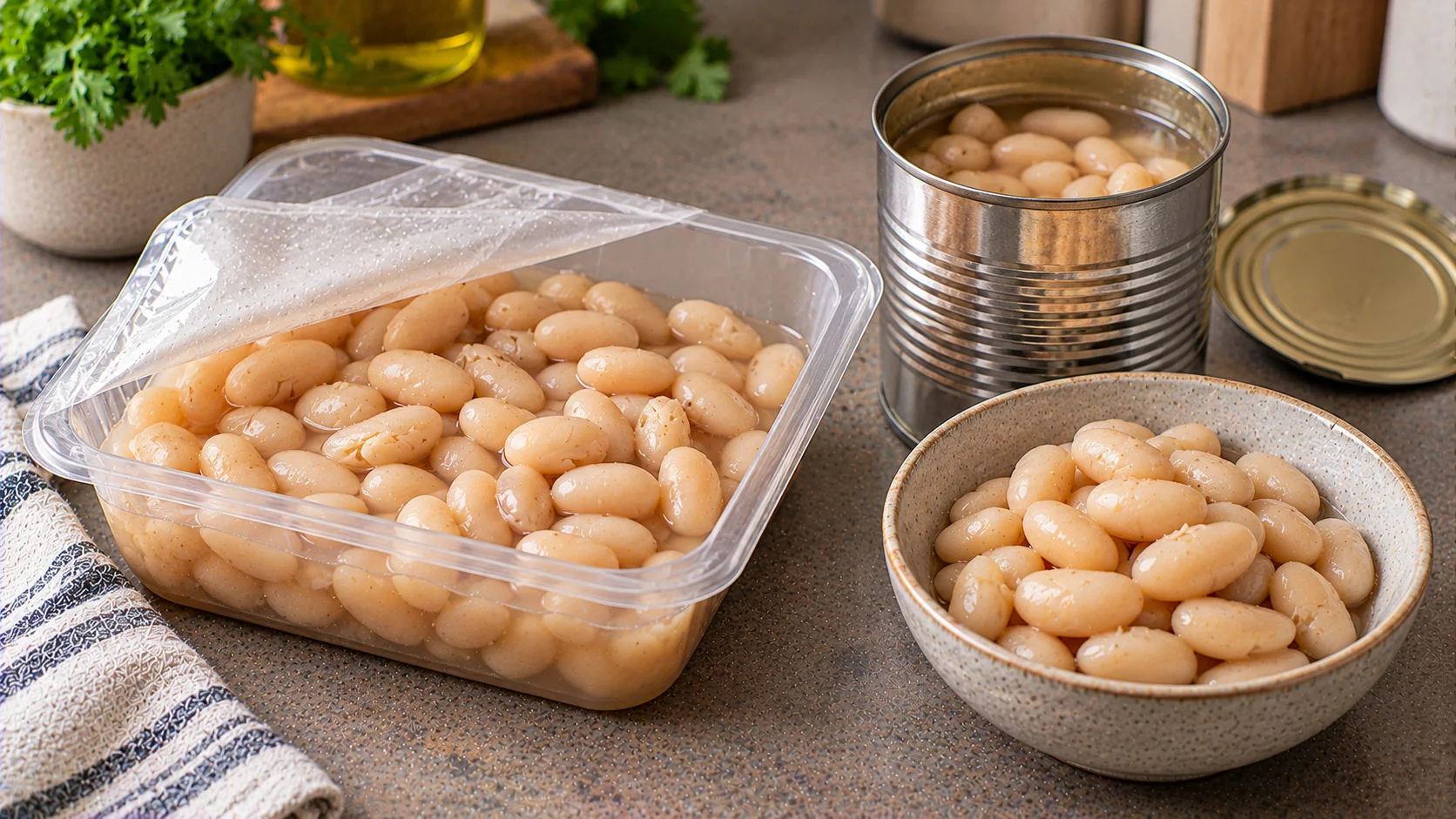
Which ready-to-eat beans offer better value?
Refrigerated cooked beans and shelf-stable canned beans can both save time when you want a bowl, soup or sandwich filling without soaking or simmering dry pulses. Yet their prices cannot be compared fairly using the sticker alone. A chilled 300 g tub may be almost all edible beans, while a 400 g can may yield only 240 g after draining. Ingredients, salt, preparation and expiry dates can also differ. This guide compares ready-to-eat beans, not home-cooked dried beans, and does not repeat our guide to ready-to-eat lentils.
The useful comparison is an equivalent edible amount of the same bean variety, for example 100 g of drained cooked kidney beans. our guide to balanced lunches using canned beans can help put canned beans into a balanced lunch; this article focuses on the retail pack, labels and cold storage.
Define the products before comparing them
Refrigerated cooked beans are sold in the chilled section, generally in a sealed tub or pouch. They might be cooked in water, seasoned, packed in a sauce or mixed with oil. Read the ingredient list: a product with oil and dressing is not nutritionally equivalent to plain beans. Some chilled products need reheating according to their instructions; do not assume every chilled bean product is ready to eat cold.
Canned beans are heat-processed in a sealed tin or jar and ordinarily stored unopened at room temperature according to the label. Cans can contain water and salt, tomato sauce, or other ingredients. A drained-weight comparison is meaningful for plain beans in liquid. Sauce-based beans may be intended to be eaten with their liquid, so choose a different comparison basis when that is how you use them.
Do not substitute the weight of a dry, uncooked product into either comparison. Also keep bean varieties matched: white beans, kidney beans and chickpeas differ in texture and composition. The fair test uses the same type and intended serving.
Price per 100 g: a transparent worked example
These are hypothetical prices and pack weights, not verified supermarket offers. Imagine chilled plain kidney beans costing €1.79 for 300 g ready-to-eat beans and canned kidney beans costing €0.89 for 400 g net / 240 g drained. Assume that the whole chilled portion is edible and no sauce is discarded.
| Measure | Refrigerated cooked beans | Canned beans |
|---|---|---|
| Pack price | €1.79 | €0.89 |
| Labelled total weight | 300 g | 400 g |
| Beans used in comparison | 300 g | 240 g drained |
| Cost per 100 g edible beans | €0.60 | €0.37 |
| Cost for 150 g edible beans | €0.90 | €0.56 |
| Beans remaining after 150 g serving | 150 g | 90 g |
Formula: pack price ÷ usable bean grams × 100. Chilled: €1.79 ÷ 300 × 100 = €0.5967, or €0.60/100 g. Canned: €0.89 ÷ 240 × 100 = €0.3708, or €0.37/100 g. If you mistakenly divided the can's €0.89 by 400 g, you would get €0.22/100 g and understate the cost of the drained beans. That is the difference between net weight and drained net weight; our explanation of drained weight for canned chickpeas discusses this issue for chickpeas specifically.
At these example prices canned beans cost €0.23 less per 100 g. That is a result of the example, not a universal statement about supermarket prices. A discounted chilled pack, a larger can or a different usable yield could reverse it. Check the actual shelf labels and purchase sizes before deciding.
Whole-pack price versus cost of food used
You must still pay for whole packs at checkout. Buying two €0.89 cans costs €1.78, even if your recipe only needs 300 g of drained beans. The consumed-ingredient cost is 300 × €0.89/240 = €1.11; the remaining edible beans belong to another meal or must be safely stored. Buying one 300 g chilled pack costs €1.79 with no bean remainder in this example. The difference between €1.11 and €1.78 is leftover ingredient value, not money already returned to your wallet.
For a 600 g bean batch, two chilled 300 g packs would cost €3.58. Three cans would give 720 g drained for €2.67, leaving 120 g beans; the consumed-ingredient cost of 600 g is approximately €2.23. Distinguish the total purchase cost (€2.67) from the 600 g allocated to the dish (€2.23). A small leftover with no planned use may reduce practical savings.
Compare nutrition on an equal basis
EU prepacked-food nutrition declarations usually list figures per 100 g or 100 ml, allowing a direct comparison when the labelled preparation states are alike. See Regulation (EU) 1169/2011. For canned beans, establish whether the declared figures refer to drained beans or the product as sold, and follow preparation instructions when relevant. If one product gives drained values and another gives beans in sauce, they are not directly comparable.
| Label line | Why check it | How to compare |
|---|---|---|
| Protein | Beans contribute plant protein | Grams per 100 g edible product |
| Fibre | Values vary by type and processing | Grams per 100 g prepared product |
| Salt | Brine and seasoning can change it | Grams per 100 g, then multiply by portion |
| Fat | Oil-packed chilled beans may be higher | Check ingredient list and 100 g line |
| Energy | Sauces and oils affect calories | Compare equivalent 150 g servings |
For example, if a label reports 0.80 g salt/100 g, a 150 g portion provides 1.20 g salt. If another reports 0.25 g/100 g, its 150 g portion provides 0.375 g, approximately 0.38 g salt. These numbers are illustrative, not measurements of a particular brand. Rinsing canned beans can remove some surface sodium, but the amount removed is variable; do not automatically subtract a fixed percentage from the label.
Protein comparisons also need consistent denominators. A hypothetical 6.8 g protein/100 g chilled product supplies 10.2 g per 150 g; a 7.2 g protein/100 g drained canned product supplies 10.8 g. Small differences may reflect moisture, variety and labelling rather than a meaningful advantage. For ingredient composition look up an appropriately specified cooked or canned entry in USDA FoodData Central, but use your actual product label for tracking a branded food.
Storage before opening: the largest practical difference
A shelf-stable unopened can normally belongs in a cool, dry cupboard within the storage directions on its label. Check the best-before date, avoid damaged or bulging cans, and follow any specific manufacturer's advice. It is not necessary to refrigerate an unopened shelf-stable can merely because you will later eat the beans cold.
A refrigerated bean pouch or tub must be kept at the temperature stated on its package from purchase onward. A chilled item with a use-by date should not be treated like a long-life pantry product. Use a cool bag for extended journeys home; if cold-chain conditions are uncertain, follow product safety guidance rather than relying on smell alone. Some chilled products are pasteurised and some are not. The label is the authority for their unopened shelf life.
After opening: handle both as perishable food
Once either product is opened, place unused beans promptly into a clean, covered, food-safe container and refrigerate at 4 °C or below. Follow the shorter of the manufacturer's post-opening instructions and general food-safety guidance. A common general rule for cooked leftovers is 3–4 days, but a chilled pack saying “consume within 24 hours after opening” overrides that rule. See FoodSafety.gov's food-safety guidance.
Do not store leftover beans in an opened metal can; transferring them makes covering and portioning easier. Do not leave prepared bean salads or opened beans at room temperature for more than two hours, or one hour above 32 °C. If you add cooked rice, seafood or dairy dressing, the combined dish needs safe cooling and its own storage assessment.
Freezing: cooked drained beans can often be frozen in meal-size portions with a little cooking liquid or water to prevent drying. Texture may soften after thawing; they are often best in soups and stews. Freeze promptly while safe, label the date and thaw in the refrigerator. Freezing does not repair food already stored unsafely. Check whether the chilled package explicitly advises against freezing.
A practical 150 g serving decision
If you want a cold lunch with 150 g beans, drain and weigh canned beans, or weigh 150 g of the chilled ready-to-eat product according to its directions. Add vegetables and a grain separately; dressing and oil change the meal's nutrition and price. For a salad eaten at work, both products require refrigeration after opening or assembly, even though a sealed can could travel safely at room temperature before opening.
Choose chilled beans if they have a texture or seasoning you prefer, a useful small pack or a good promotion that reduces leftovers. Choose canned beans when cupboard storage, long planning flexibility and low cost per drained 100 g matter most. Neither format is inherently more nutritious: the real choice depends on the specific variety, nutrition label, edible yield and cold-storage conditions.
Quick shopping checklist
- Match the bean variety and whether you intend to eat sauce or drain liquid.
- Identify usable cooked bean grams: total edible chilled weight versus canned drained weight.
- Calculate euro per 100 g and then euro for your planned serving.
- Compare protein, fibre, salt, fat and energy on a consistent prepared-food basis.
- Check use-by or best-before dates, required refrigeration and after-opening instructions.
- Plan how to consume or safely freeze leftovers; they are part of the true value calculation.