
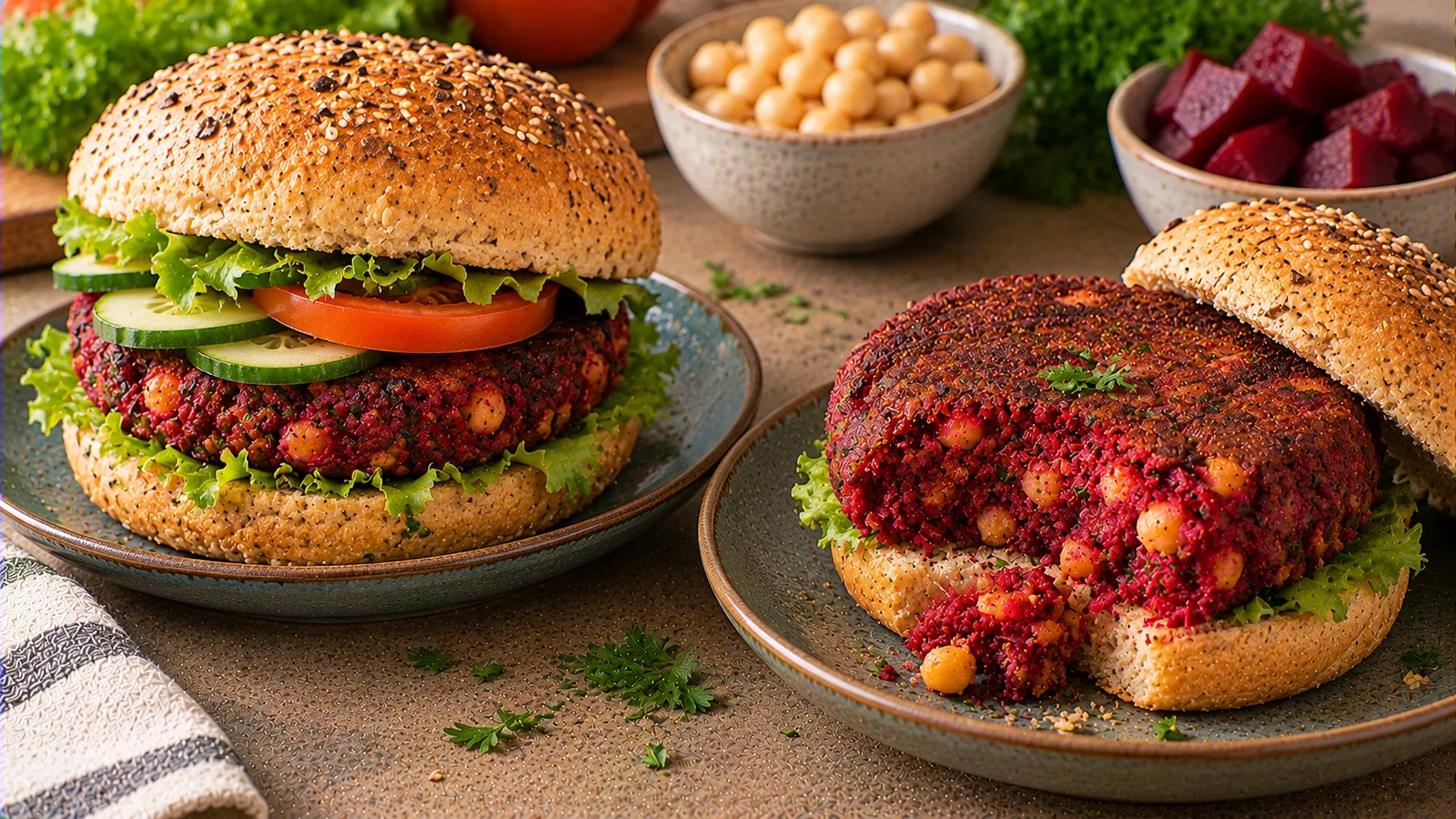
These chickpea and beetroot burgers are soft in the centre, lightly crisp outside and deliberately made from cooked chickpeas and cooked beetroot. They are an alternative to a meat burger, not a commercial plant-based patty or a recipe for falafel from soaked raw chickpeas. The key technique is simple: dry the vegetables, mash rather than purée the beans, and give the oat binder time to absorb moisture before shaping.
This recipe makes 6 patties, enough for 3 servings of two patties. Buns, sauces and sides are optional and are not included in the quantities. Their size, calories and cost would need to be counted separately. You can cook the patties in a pan or oven; the pan version provides more direct control over browning.
Recipe at a glance
| Detail | Amount or method |
|---|---|
| Yield | 6 patties; 3 servings of 2 |
| Preparation | About 20 minutes |
| Chilling | 20 minutes, to firm the mixture |
| Pan cooking | About 12–16 minutes per batch |
| Total elapsed time | About 55–60 minutes, allowing for shaping and transfers |
| Main ingredients | 240 g drained cooked chickpeas; 180 g cooked beetroot |
| Binding | 60 g rolled oats plus 1 egg |
| Cooking equipment | Grater, bowl, masher, frying pan with lid |
Timing is a kitchen guide, not a food-safety substitute. Larger or thicker patties take longer. This version contains an egg: cook it thoroughly, and use a probe thermometer where practical. FoodSafety.gov lists 71°C (160°F) for egg dishes; check the thickest centre of a patty rather than judging safety from its red colour. See the official safe-temperature chart.
Ingredients for six patties
| Ingredient | Quantity | Preparation |
|---|---|---|
| Cooked canned chickpeas | 240 g drained | Rinse, drain, pat dry |
| Cooked beetroot, unpickled | 180 g | Grate, then press excess liquid out |
| Rolled oats | 60 g | Standard or quick oats, not sweetened |
| Onion | 70 g | Finely dice |
| Egg | 1 medium, about 50 g edible portion | Beat lightly |
| Garlic | 6 g | Crush or finely mince |
| Flat-leaf parsley | 15 g | Chop |
| Lemon juice | 10 ml | Fresh or bottled |
| Ground cumin | 2 g | Approximately 1 teaspoon, depending on grind |
| Sweet paprika | 2 g | Approximately 1 teaspoon |
| Olive or rapeseed oil | 15 g | For cooking, not mixed into raw dough |
| Black pepper and salt | To taste | Adjust for salted canned chickpeas |
Weigh the chickpeas after draining, not with their canning liquid. A can marked 400 g does not necessarily provide 400 g of beans. Use beetroot that is already cooked and cooled. If your beetroot is preserved in vinegar, the flavour and moisture will be different; an unpickled, cooked vacuum-packed beetroot is easier to use here. Remove surface moisture with a clean towel before grating.
The oats are intentionally ordinary rolled oats, not wheat flour. They absorb the remaining liquid and contribute structure. If you must avoid gluten, use oats specifically labelled gluten-free and check the rest of the ingredients for cross-contact. The egg makes this a vegetarian, not vegan recipe; it is not suitable for someone avoiding eggs.
Step-by-step method
- Dry the vegetables — about 5 minutes. Drain and rinse the chickpeas, then leave them in a sieve and pat dry. Grate 180 g cooked beetroot. Squeeze small handfuls over a sieve or press between clean kitchen towels until they stop dripping. Do not squeeze all flavour and tenderness away; the goal is to remove free liquid, not make powder.
- Prepare the aromatics — about 5 minutes. Finely dice 70 g onion and mince 6 g garlic. For a gentler onion taste, soften the onion for 2–3 minutes in a dry non-stick pan or with a splash of water and cool it briefly; the base version uses it finely chopped and cooks the burgers thoroughly later.
- Make a coarse mixture — about 4 minutes. Mash 240 g drained chickpeas with a fork or potato masher. Leave some visible pieces, roughly pea-sized. Stir in the squeezed beetroot, onion, garlic, parsley, 2 g cumin, 2 g paprika, 10 ml lemon juice and the beaten egg. Fold in 60 g oats last. Do not add water at this stage.
- Check and rest — 20 minutes. Cover and refrigerate the mixture for 20 minutes. The oats swell and the dough should become scoopable, not pourable. Shape a tablespoon-sized test piece: if it holds when lightly pressed, proceed. If it spreads like wet porridge, squeeze out additional liquid or work in a little more oats, weighing and recording any extra because it changes the formula.
- Shape six patties — about 5 minutes. Divide the dough into six portions. Press each into a round approximately 1.5–2 cm thick. The raw mixture is roughly 620 g before cooking oil, but actual mass depends on how much beetroot water you removed. Aim for similar thickness rather than claiming an exact patty weight.
- Pan-cook in batches — 12–16 minutes per batch. Heat part of the 15 g oil in a medium non-stick pan. Lay in patties with space to turn; avoid crowding. Cook over medium heat for 6–8 minutes on each side, turning carefully with a broad spatula. Reduce the heat if the outside browns too early. A lid can help heat the centre, but finish uncovered to restore a crisp surface. Continue cooking until the egg-containing centre is thoroughly set; a food probe is the reliable check.
- Rest and serve — 2 minutes. Transfer cooked patties to a clean plate and allow them to settle before moving to buns or plates. Serve two per person. Do not reuse a plate or utensil contaminated with the raw egg mixture without washing it first.
The 12–16-minute cooking estimate is for one pan batch. A small pan may need two or three batches, increasing elapsed time. If cooking all six at once is important, use the oven method below instead.
Oven method for all six
Heat a conventional oven to 200°C (or around 180°C fan, subject to your oven's instructions). Place six shaped patties on parchment on a baking tray, leaving space between them. Brush or lightly coat with the total 15 g oil. Bake for approximately 25–30 minutes, flipping gently halfway, until firm and thoroughly cooked through. Use the food-safety temperature check for the egg-containing centre; ovens and patty thicknesses vary. An oven-baked patty will generally be less crisp than a pan-fried one unless the surface has dried sufficiently.
Do not add more oil merely to make the recipe appear crispier. If you do, count that oil separately. A thinner shape may brown faster but will be easier to break at the edges; a very thick patty may darken before the egg in its centre is completely cooked.
Why beetroot burgers fall apart—and the fix
There are three independent causes of crumbling: water that was not squeezed from the beetroot, chickpeas processed into a slippery smooth paste, and patties moved before a crust has formed. You can correct them without turning the recipe into a dry flour cake.
Too wet: Press the grated beetroot again before combining it with the beans. If the whole dough is already mixed, add oats in 10 g increments, allow a further 10 minutes to absorb, and record how much was added. Avoid dusting enormous amounts of flour into the pan: it alters the texture without addressing excess liquid.
Too dry or crumbly: Do not over-squeeze the cooked chickpeas. The beans should mash into a cohesive base, with some small pieces remaining. If needed, stir in 5 ml water once, mix and retest. Only add another 5 ml if it still will not hold together. Too much water reverses the benefit of chilling.
Sticking: Preheat the pan, use the measured oil and wait for an actual crust before turning. An intact patty should lift with a broad spatula. Do not keep rotating it every minute; the crust cannot develop that way. A heavy-bottomed non-stick frying pan is easier for a first attempt than an unseasoned metal pan.
Poor colour: Beetroot colours the interior strongly; red does not mean raw, and deep brown does not guarantee the egg is cooked. Use a thermometer where possible. Food colour is not a reliable safety test.
Serving suggestions and useful comparisons
Two patties fit into a substantial lunch or dinner with sliced tomato, lettuce and a plain yoghurt-lemon sauce. If serving on buns, choose a bun that supports the patties rather than masking them with very sweet sauce. Crunchy cucumber or a vinegar-light slaw adds a useful contrast to the soft beetroot centre. Keep all toppings separate from the six-patty yield.
For a distinctly different legume burger method, see black bean burgers with oats, made with black beans and oats rather than beetroot and chickpeas. If you have cooked beetroot left, roasted beetroot and feta salad is a different salad preparation rather than another way of serving these patties. The two recipes need their own ingredient lists and should not be counted as part of this burger batch.
Storage, freezing and reheating
Refrigerate cooked patties promptly, within 2 hours of cooking. The UK Food Standards Agency advises using refrigerated leftovers within 48 hours, or freezing them if you will not use them in that period. Reheat only the portion you need, once, until steaming hot throughout. See Food Standards Agency guidance. Use clean, shallow containers and mark the storage date.
Freeze patties separately on a lined tray first if you want them to remain easy to separate; once frozen, transfer to a suitable sealed container. Thaw in the fridge rather than on the counter, and reheat fully. A microwave may soften the outside, so a covered pan or oven often preserves texture better. If the patty was left at room temperature for too long, reheating does not automatically make it safe.
For planning nutrition, add values for each exact purchased product in its measured state: 240 g drained cooked chickpeas, 180 g cooked beetroot, 60 g dry oats, one 50 g edible egg, plus the other ingredients and measured oil. Divide totals by 6 patties or by 3 two-patty servings. Do not attach a precise calorie or protein claim to this recipe without product-specific values and an accounting of oil left in the pan.