
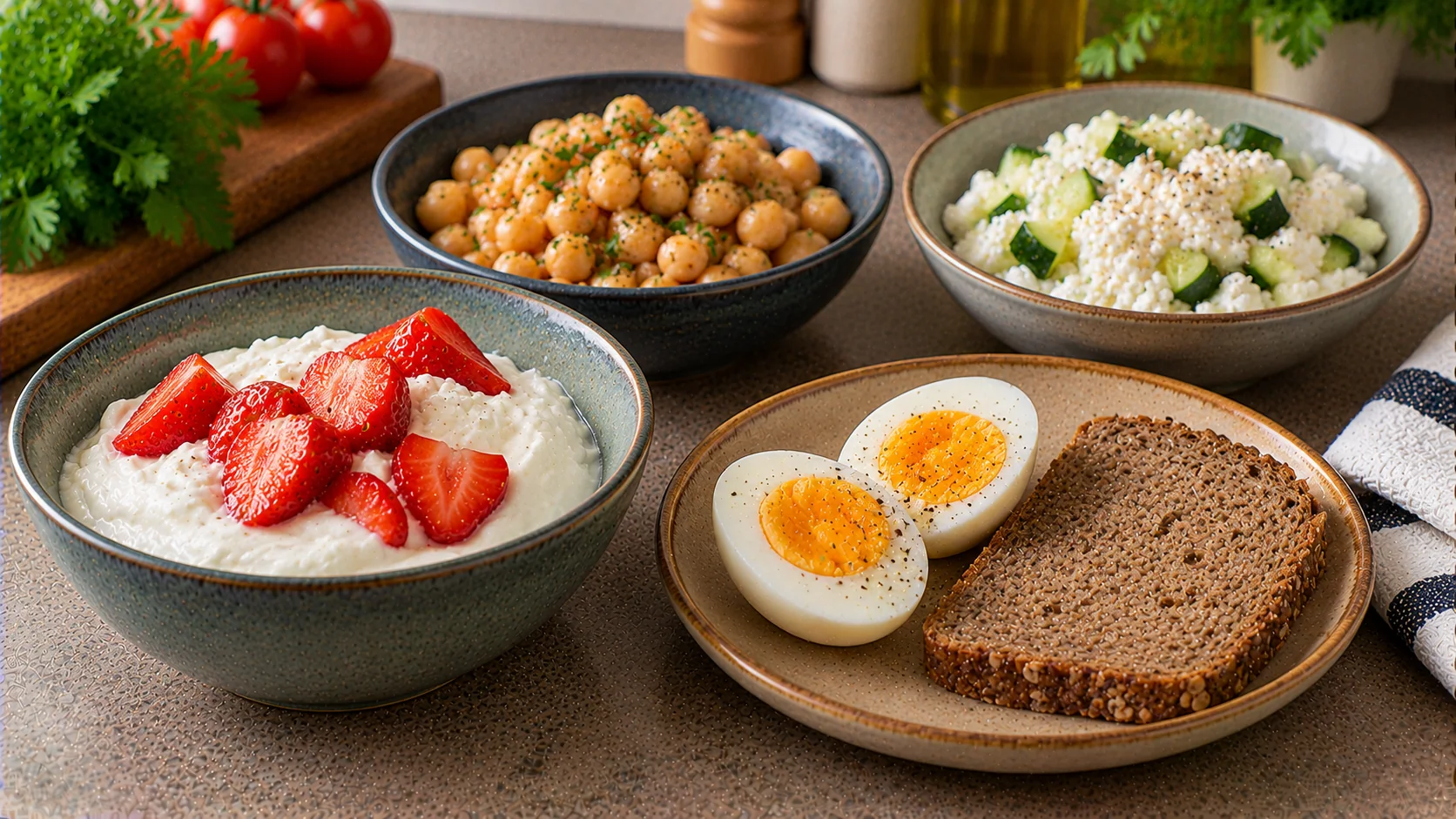
Six affordable protein snacks can come from ordinary supermarket food rather than bars, powders or “fitness” branding. The practical goal is not to chase the highest possible protein figure: choose a realistic portion that is convenient, filling and fits your food budget. These six snacks are individual examples, not a fixed meal plan. Prices and nutrients are illustrative estimates, not current offers or laboratory-tested recipes.
Six snack portions at a glance
| Snack | Ingredients for one portion | Approximate protein | Illustrative cost |
|---|---|---|---|
| Skyr and berries | 170 g plain skyr + 80 g berries | 19 g | €1.20 |
| Cottage cheese and tomato | 150 g cottage cheese + 120 g tomato | 19 g | €1.10 |
| Boiled eggs and carrot | 2 large eggs + 100 g carrot | 13 g | €0.85 |
| Edamame with lemon | 150 g cooked, shelled edamame + lemon | 17 g | €1.25 |
| Hummus and wholegrain bread | 100 g hummus + 60 g wholegrain bread | 12 g | €1.05 |
| White beans with tuna | 100 g drained white beans + 60 g drained canned tuna | 21 g | €1.65 |
These values use plausible generic food-composition assumptions rounded to the nearest gram. Actual brands, drained weights, bread recipes and egg sizes change the figures. The tuna option contains fish; the other five are vegetarian, and the edamame snack is vegan. For individually verified nutrient values, compare the relevant foods and cooked states in USDA FoodData Central.
1. Plain skyr with berries
Put 170 g plain skyr in a bowl and top with 80 g washed berries. Frozen berries can be thawed safely in the refrigerator; if the package instructs heating, follow those instructions. No powder or sweetener is necessary. Plain skyr is convenient for a cold snack, although sweetened varieties may have more sugar. Read the nutrition label and compare protein per actual tub, not just per 100 g.
2. Cottage cheese and tomato
Measure 150 g cottage cheese and slice 120 g tomato. Add pepper or herbs if available; they are optional and not counted in the comparison. Cottage cheese often supplies substantial protein without preparation, but sodium varies considerably by brand. Check salt per 100 g before assuming that any particular tub is low in salt. Choose a sealed, refrigerated product and do not leave it warm in a bag for hours.
3. Two eggs with raw carrot
Hard-boil two large eggs until the white and yolk are firm, cool promptly and eat with 100 g cleaned carrot sticks. This is a relatively low-cost portable option when a refrigerator or insulated lunch bag is available. Eggs supply protein, while carrot adds crunch and some fibre; they are not equivalent to a high-fibre meal. Fully cooked eggs and other perishables need appropriate cold storage. See USDA guidance on eggs.
4. Warm edamame with lemon
Cook 150 g shelled edamame according to package directions, then season with lemon juice. The 150 g weight here refers to the cooked beans without pods, not the total mass of frozen pods. If buying pods, you will need more than 150 g to obtain this edible amount. Edamame has both protein and fibre; verify its labelled serving and allergens. Soy is a major allergen and should be identified clearly when preparing snacks for other people.
5. Hummus with wholegrain bread
Spread 100 g hummus on 60 g wholegrain bread or serve as a dip with bread strips. Hummus protein depends on its chickpea-to-oil ratio; a product with more oil is not automatically better value for protein. Read both labels. This option tends to contain less protein than skyr or tuna but also supplies plant foods, carbohydrates and some fibre. To check whether bread is wholegrain, read the ingredients rather than relying on dark colour.
6. White beans and canned tuna
Drain and rinse 100 g canned white beans; combine with 60 g drained canned tuna and lemon or pepper if desired. The quantities are drained edible weights. If one can contains 240 g of beans after draining, it provides two 100 g portions with 40 g remaining. The tuna portion must likewise be measured after draining; do not multiply nutrient values by the liquid-inclusive can weight. Choose tuna according to local fish-consumption advice, especially during pregnancy; variety across protein sources is preferable to eating tuna every day.
Which snack is cheapest per 10 g protein?
For any item, divide its cost by protein grams, then multiply by ten. The skyr example costs €1.20 ÷ 19 × 10 = €0.63 per 10 g protein. The egg example is €0.85 ÷ 13 × 10 = €0.65. The tuna-and-bean example is €1.65 ÷ 21 × 10 = €0.79. These are hypothetical price models; a supermarket deal, pack size or regional price can change the ranking. Use receipts and the product's actual label for your own comparison.
How to price a portion rather than a package
A 500 g tub of skyr priced at €2.00 costs €0.004 per gram; a 170 g portion costs €0.68 before berries. A 300 g package of cottage cheese at €1.50 costs €0.75 for 150 g. A €2.40 bag of frozen shelled edamame weighing 400 g costs €0.90 for 150 g, assuming no meaningful waste. The figures are worked examples, not claims about current retail prices. For canned foods, apply drained weight; for eggs, divide the package price by the number of eggs used.
Shopping once for several days
Choose two or three snacks with overlapping ingredients instead of buying all six at once. For example, skyr and frozen berries cover two snack days, eggs with carrots cover another two, and a tub of hummus with wholegrain bread covers one or two more. Use the product's use-by date and storage directions. Do not prepare a full week of egg, dairy or fish snacks just to avoid shopping; food safety comes before convenience.
Protein is one number, not the whole snack
These choices differ in fibre, carbohydrates, saturated fat, sodium and allergens. Dairy foods contain milk allergens; edamame contains soy; bread contains gluten if made from wheat or barley; hummus may contain sesame tahini; eggs and fish have their own allergens. A snack can fit a balanced diet even if it has less than 15 g protein. The daily diet and individual needs matter more than a marketing claim on a bar.
Cold storage and packing
Keep skyr, cottage cheese, cooked eggs, edamame, hummus and opened canned foods cold, normally at 4°C / 40°F or below. Refrigerate perishable food within 2 hours, or 1 hour when ambient temperature is above 32°C / 90°F. Use a cool bag with frozen packs during travel. Refrigerate cooked leftovers promptly; generally use within 3–4 days when correctly handled, but follow shorter package instructions. See USDA FSIS leftovers guidance.
Three common comparison mistakes
First, a 40 g snack bar and a 200 g yogurt are not equal-sized portions: compare both total protein and total calories for the amount you actually eat. Second, chickpea, lentil and bean products vary with processing and water content; cooked and dry nutrient figures cannot be interchanged. Third, a package displaying “protein” does not prove low price, high fibre or low added sugar. A simple grocery snack can be the better purchase, but the label and checkout price decide.
Related Mealisa reading
For food-based snack ideas, see related Mealisa nutrition guides. To understand how different protein sources add up across ordinary meals, see our guide to food-based protein combinations.
Sources
- USDA FoodData Central — reference nutrient data; actual brands and edible states differ.
- USDA FSIS: Leftovers and Food Safety — time and temperature controls.
- USDA FSIS: Eggs — egg cooking and handling.