
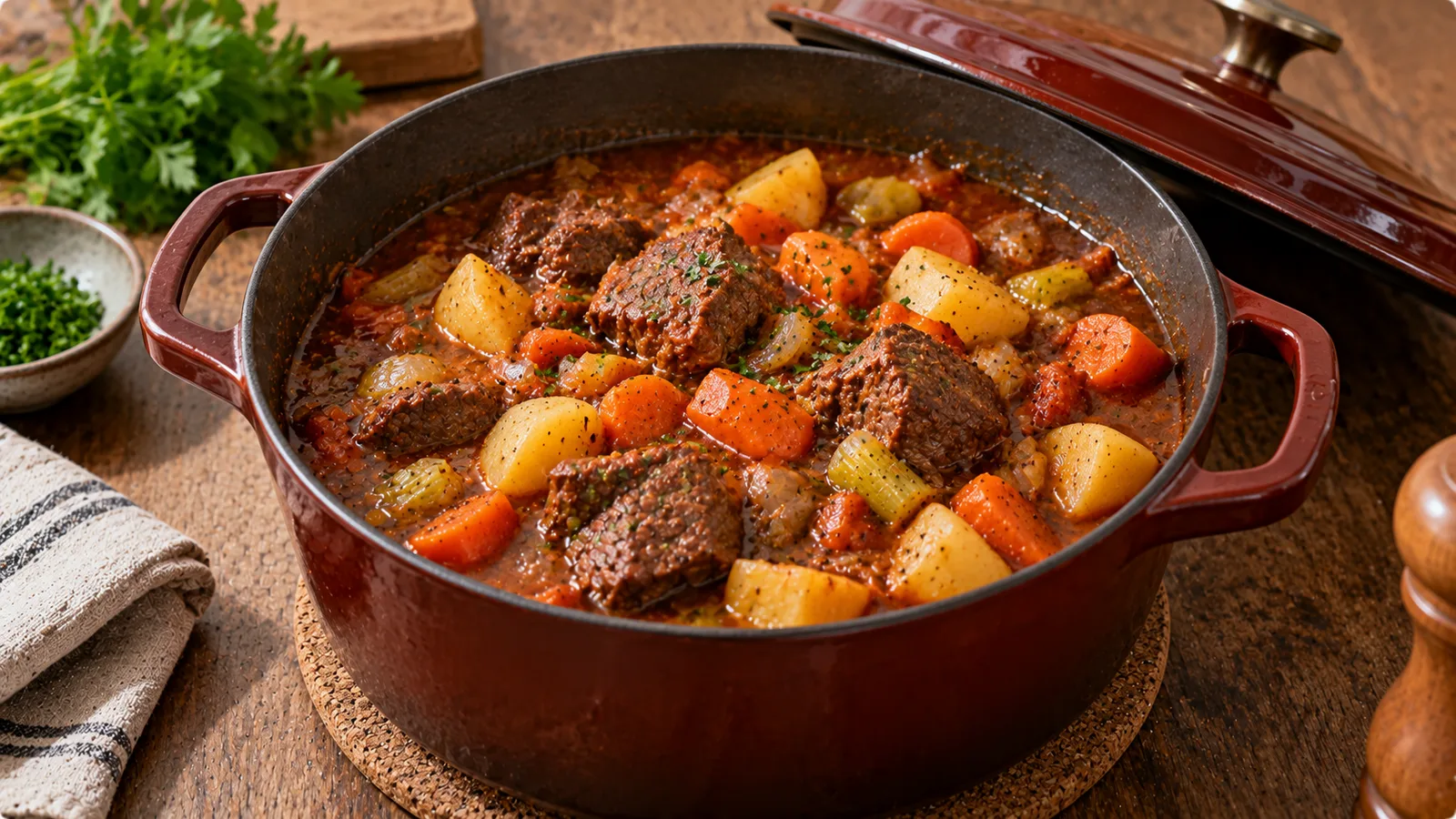
Beef and vegetable stew is a practical one-pot meal built around slowly cooked beef, potatoes, carrots and a flavorful broth. The vegetables absorb the cooking liquid while the beef gradually becomes tender.
A good stew does not require expensive ingredients or complicated equipment. What matters most is choosing a suitable cut of beef, browning it in batches and allowing enough time for the connective tissue to soften.
This version makes six generous portions and uses ingredients commonly available in supermarkets.
Recipe overview
| Detail | Amount |
|---|---|
| Servings | 6 |
| Preparation | 25 minutes |
| Stovetop cooking | Approximately 2–2½ hours |
| Total time | Approximately 2½–3 hours |
| Equipment | Large heavy-bottomed pot with lid |
| Difficulty | Easy to moderate |
| Cooking method | One-pot, stovetop |
The cooking time is a guide. Beef tenderness matters more than an exact number of minutes.
Ingredients
Main ingredients
- 900 g boneless beef chuck or another cut suitable for slow cooking, trimmed and cut into 3–4 cm cubes
- 600 g potatoes, peeled if desired and cut into large pieces
- 300 g carrots, cut into thick slices
- 200 g mushrooms, halved or quartered
- 200 g onion, diced
- 150 g celery, sliced
- 3 garlic cloves, minced
- 20 g olive oil
- 25 g tomato paste
- 20 g plain flour, optional
- 800 ml low-salt beef stock
- 200 g canned chopped tomatoes
- 2 bay leaves
- 1 teaspoon dried thyme
- 1 teaspoon sweet paprika
- Black pepper to taste
- Salt to taste
- 10 g chopped parsley, optional
Optional adjustments
- 100–200 ml additional water or stock if the stew becomes too thick
- 1 teaspoon Worcestershire sauce for additional savory flavor, checking ingredients if dietary restrictions apply
- A small splash of lemon juice at the end for brightness
The recipe does not require wine or alcohol.
Choosing beef for stew
Beef chuck is a useful choice because it contains connective tissue that softens during long, moist cooking.
Other cuts sold specifically for braising or stewing can also work.
Very lean, tender steaks are usually not the most economical option for this recipe. They can become dry when cooked for an extended period.
Cut the beef into pieces of similar size so they cook evenly.
Pieces around 3–4 cm are large enough to remain substantial after simmering.
If the meat contains large, hard pieces of external fat, trim them according to preference. Some internal connective tissue is useful for texture.
Step 1: Prepare the ingredients
Pat the beef dry with paper towels.
Cut it into approximately equal cubes.
Dice the onion, slice the celery and carrots, and cut the potatoes into large pieces.
Halve or quarter the mushrooms depending on their size.
Mince the garlic.
Keeping the vegetables in relatively large pieces helps them retain their shape during cooking.
Do not cut the potatoes too small if you prefer distinct pieces rather than a thickened, partially mashed stew.
Step 2: Brown the beef
Heat half the olive oil in a large heavy-bottomed pot over medium-high heat.
Add a portion of the beef in a single layer.
Leave space between the pieces.
Brown for approximately 2–3 minutes on each of several sides, then transfer to a plate.
Repeat with the remaining beef and oil.
The goal is to develop browned surfaces, not to cook the beef completely.
Avoid putting all the meat into the pot at once.
Overcrowding lowers the pan temperature and encourages the beef to release moisture and steam.
The browned residue left in the pot contributes flavor to the finished stew.
Step 3: Build the flavor base
Reduce the heat to medium.
Add the onion and celery.
Cook for approximately 5–6 minutes, stirring regularly.
If the bottom of the pot looks dry, add a small splash of water.
Add the garlic and tomato paste.
Cook for another minute, stirring to prevent burning.
Sprinkle in the flour if using it.
Stir for approximately one minute to coat the vegetables.
The flour helps thicken the broth later, but it can be omitted.
Add a little stock and scrape the bottom of the pot with a wooden spoon.
This releases the browned pieces into the cooking liquid.
Step 4: Start the slow simmer
Return the beef and any accumulated juices to the pot.
Add the remaining stock, chopped tomatoes, bay leaves, thyme, paprika and black pepper.
Bring the liquid just to a gentle simmer.
Reduce the heat to low.
Cover with the lid slightly ajar.
Cook for approximately 75–90 minutes, stirring occasionally.
The liquid should bubble gently rather than boil rapidly.
A vigorous boil can reduce the liquid too quickly and make the meat seem firmer.
If necessary, add a little water or stock.
Step 5: Add the vegetables
After the initial cooking period, add the carrots and potatoes.
Stir gently.
Continue simmering for approximately 30 minutes.
Add the mushrooms.
Cook for another 15–25 minutes, or until the beef is tender and the vegetables are cooked.
The exact timing depends on the cut of beef and the size of the pieces.
If the vegetables become tender before the beef, remove them temporarily with a slotted spoon and continue cooking the meat.
Return the vegetables before serving.
Step 6: Adjust the texture
When the beef is tender, remove the bay leaves.
Taste the broth.
Add salt gradually, taking into account the salt already present in the stock.
If the stew is too thin, simmer uncovered for several minutes.
You can also mash a few potato pieces against the side of the pot to thicken the liquid naturally.
If it becomes too thick, add water or stock in small amounts.
Finish with chopped parsley and, if desired, a small amount of lemon juice.
The final stew should be spoonable, with enough broth to coat the ingredients without resembling a thin soup.
How to tell when the beef is tender
A fork should enter the beef with little resistance.
The meat should be easy to cut with the side of a spoon or fork, but it does not need to fall apart completely.
If the beef is still chewy after the suggested time, it may simply need longer.
Continue simmering gently and check every 15–20 minutes.
Do not judge doneness by the color of the cooking liquid.
For food safety, beef pieces must be thoroughly cooked. For texture, braising cuts generally need much more time than the minimum time required to reach a safe internal temperature.
Estimated nutrition per serving
The following estimates assume six equal servings and the ingredient quantities listed above.
| Nutrient | Approximate amount |
|---|---|
| Calories | 490 kcal |
| Protein | 39 g |
| Carbohydrates | 32 g |
| Fat | 22 g |
| Fiber | 5 g |
These are planning estimates, not laboratory-tested values.
The actual nutrition depends strongly on the beef cut, fat trimming, stock, potato variety and final serving size.
For a more accurate calculation, use the labels of your ingredients and a food composition database such as USDA FoodData Central.
The estimates should not be used as exact clinical dietary measurements.
Why slow cooking works
Cuts suitable for stewing often contain collagen-rich connective tissue.
During prolonged moist cooking, some collagen changes into gelatin, contributing to a softer texture and richer mouthfeel.
This transformation takes time.
Turning up the heat dramatically does not necessarily make the process better.
A gentle simmer allows the beef to soften while limiting excessive evaporation.
The cooking time can vary between pieces of beef, even when their weight is similar.
Potatoes: waxy or floury?
Waxy potatoes hold their shape relatively well.
They are useful when you want visible potato pieces in the finished stew.
Floury potatoes break down more easily.
That can help thicken the broth, but the pieces may become less distinct.
Both work.
If you want a balance, use mostly waxy potatoes and mash a few pieces at the end.
Add potatoes after the beef has already simmered for some time so they do not become overcooked.
Which vegetables work best?
Carrots, onions, celery, potatoes and mushrooms create a familiar flavor combination.
Other vegetables can also work, but their cooking times differ.
| Vegetable | When to add | Result |
|---|---|---|
| Parsnips | With carrots | Slightly sweet flavor |
| Turnips | With potatoes | Earthier flavor |
| Green beans | Last 15–20 minutes | Firmer texture |
| Frozen peas | Last 5 minutes | Fresh color and sweetness |
| Zucchini | Last 10–15 minutes | Softer texture |
| Bell peppers | Last 20–25 minutes | Sweeter aroma |
Avoid adding all vegetables at the beginning unless you want them very soft.
How to make stew without flour
Flour is optional.
To thicken the broth without wheat flour, remove the lid near the end and allow some liquid to evaporate.
Alternatively, mash a few cooked potatoes into the broth.
A small amount of cornstarch mixed with cold water can also be used.
Add the mixture gradually to the simmering stew until it reaches the desired consistency.
If you need a gluten-free meal, check the stock and any sauces as well as omitting the wheat flour.
Can you make it in a slow cooker?
Yes, with adjustments.
For the best flavor, brown the beef and cook the onion and tomato paste in a pan first.
Transfer everything to the slow cooker.
Because less liquid evaporates, start with approximately 500–600 ml stock rather than the full stovetop quantity.
Add the tomatoes, seasonings and vegetables.
Cook according to the appliance manufacturer's instructions.
A typical starting range is approximately 7–9 hours on low or 4–6 hours on high, but actual timing depends on the cooker and the beef.
Check that the beef is tender and the food is thoroughly cooked.
If the potatoes become too soft, add them later during a future preparation.
Can you make it in a pressure cooker?
A pressure cooker can shorten the cooking time.
Brown the beef using the sauté function if available.
Add the flavor base and enough liquid to meet the appliance's minimum requirement.
Follow the manufacturer's instructions for beef stew and the maximum fill level.
Because pressure cookers vary, use the recommended pressure-cooking time for your model rather than treating one number as universal.
Vegetables may need to be added after the initial beef-cooking stage to avoid overcooking.
Release pressure using the method specified for your appliance.
Common mistakes
Boiling too aggressively
Rapid boiling can evaporate liquid quickly and may leave the beef less pleasant in texture.
Maintain a gentle simmer.
Adding potatoes too early
Potatoes can become overly soft before the beef is tender.
Add them after the first long cooking stage.
Not browning the beef
The stew will still cook, but browning creates additional savory flavors.
Work in batches for better results.
Using too much salt at the beginning
Stock may already contain substantial salt.
Taste near the end before adding more.
Stopping before the beef softens
Stewing cuts can remain chewy until they have cooked long enough.
Extend the cooking time when needed.
Make-ahead preparation
Beef stew is suitable for cooking in advance.
The flavors often become more integrated after the dish has rested and been reheated.
Prepare the stew, cool it promptly and divide it into shallow containers.
Refrigerate as soon as practical.
If you are preparing several meals, portioning the stew immediately makes reheating easier.
Do not leave a large pot of hot stew at room temperature for an extended period.
How long does beef stew keep?
A conservative general guideline for cooked meat leftovers is 3–4 days in a refrigerator at 4°C or colder.
Cool the stew promptly, refrigerate in covered shallow containers and reheat thoroughly.
For general guidance, see the FoodSafety.gov cold food storage charts.
Storage conditions and individual circumstances can affect safety.
If you will not eat the stew within the recommended refrigeration period, freeze it instead.
Freezing beef and vegetable stew
Beef stew generally freezes well.
Allow it to cool promptly.
Transfer portions to freezer-safe containers, leaving some space for expansion.
Label the containers with the date.
For best quality, aim to use frozen portions within approximately 2–3 months.
The food may remain safe longer when continuously frozen at an appropriate temperature, but texture and flavor can decline.
Potatoes sometimes become softer or grainier after freezing and reheating.
Thaw in the refrigerator when possible and reheat thoroughly.
What to serve with beef stew
Because the recipe already contains potatoes and vegetables, it can be served as a complete meal.
If you want an accompaniment, consider:
- A slice of whole-grain bread.
- A simple green salad.
- Steamed green vegetables.
- A small serving of rice if you prefer additional starch.
Choose the accompaniment according to appetite and the overall meal.
Adding bread or rice increases the energy and carbohydrate content beyond the recipe estimates.
Lower-calorie adjustments
The most effective adjustments depend on the ingredients used.
A leaner cut of stewing beef can reduce fat, although it may change the final texture.
Trimming visible excess fat also changes the energy content.
You can increase the amount of non-starchy vegetables and adjust the potato quantity.
If the stew is cooled before reheating, some solidified fat may be removable from the surface.
Do not assume these changes produce a particular calorie reduction without recalculating the ingredients.
Higher-energy version
For a more energy-dense meal, use a larger serving or add bread, rice or another accompaniment.
A little additional olive oil can also increase the energy content.
These changes may be useful when a person needs more calories, but portion choices depend on individual needs.
The nutritional estimates for the original recipe no longer apply unchanged.
Shopping and budget planning
This recipe uses several ingredients that can also be used in other meals.
Potatoes, carrots, onions and celery are flexible staples.
If a large package of mushrooms or potatoes is more economical, plan another dish using the remainder.
To calculate the recipe cost, add the cost of the actual quantities used.
For example, if the ingredients used cost a hypothetical €18 in total:
€18 ÷ 6 portions = €3 per portion.
This is an illustrative calculation, not a verified current supermarket price.
Real costs depend on the beef cut, store, country, package sizes and ingredients already available.
Final cooking checklist
Before serving, check that:
- The beef is fork-tender.
- The potatoes and carrots are cooked but not completely broken down.
- The broth is thick enough for your preference.
- The seasoning has been adjusted after simmering.
- The bay leaves have been removed.
- The stew has rested briefly before serving.
Beef and vegetable stew rewards patient cooking. With a suitable beef cut, gentle heat and vegetables added at the right time, it becomes a reliable family dinner that also works well for planned leftovers.