
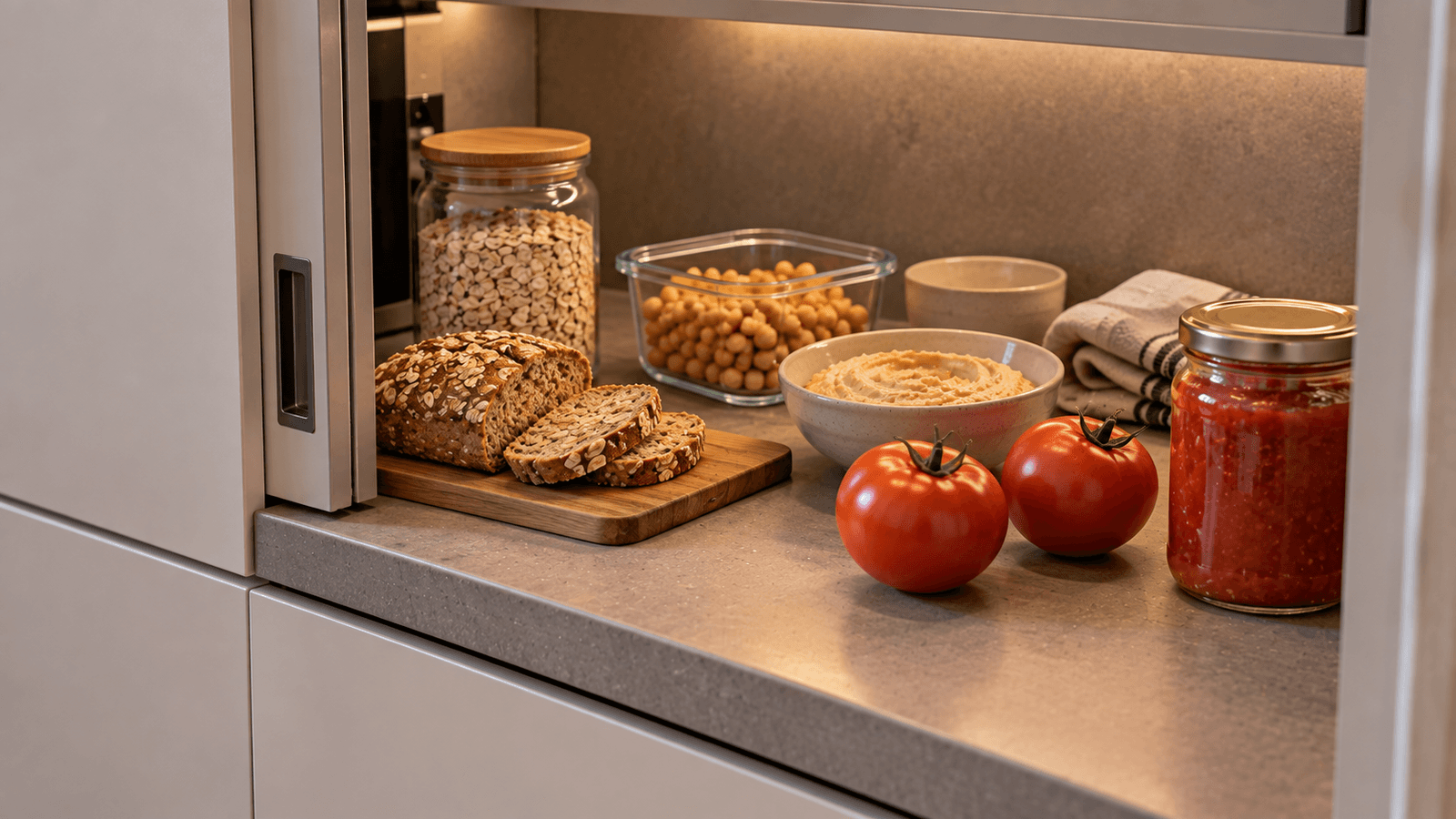
Whole foods and processed foods are often presented as two completely separate categories: one healthy and one unhealthy.
Real food choices are more complicated.
Washing, freezing, grinding, fermenting, pasteurizing, cooking and canning are all forms of food processing. A bag of frozen vegetables is processed. So is plain yogurt. So are oats, canned beans and whole-grain bread.
The useful question is therefore not simply:
Is this food processed?
It is:
How has it been processed, what does it contain and how does it fit into the overall diet?
Whole foods and processed foods at a glance
| Feature | Whole or minimally processed foods | More processed foods |
|---|---|---|
| Original food structure | Largely preserved | May be substantially changed |
| Added ingredients | Usually none or few | Can range from few to many |
| Convenience | Varies | Often higher |
| Shelf life | Often shorter, but not always | Often longer |
| Nutrient profile | Depends on the food | Depends on product and processing |
| Examples | fruit, vegetables, eggs, plain nuts | bread, flavored yogurt, sauces, ready meals |
These are broad patterns, not rules.
A processed food can still be nutritionally useful, while a minimally processed food is not automatically appropriate in unlimited quantities.
What is a whole food?
"Whole food" does not have one universally precise regulatory definition.
In everyday nutrition language, it usually refers to foods that remain close to their original form and have undergone little processing.
Examples include:
- fresh fruit
- vegetables
- potatoes
- eggs
- plain nuts and seeds
- dried lentils and beans
- plain meat or fish
Some foods that people commonly treat as whole foods have still undergone basic processing before reaching the kitchen.
That is one reason minimally processed is often a more useful description.
What counts as food processing?
Processing can be extremely simple.
Examples include:
- washing
- cutting
- drying
- freezing
- grinding
- pasteurizing
- fermenting
- cooking
- canning
- mixing ingredients
- adding salt, sugar, oils or preservatives
These processes do not all have the same nutritional consequences.
Freezing peas and formulating a confectionery product from multiple refined ingredients are both technically processing, but they are not equivalent transformations.
Minimally processed foods
Minimal processing can make food safer, easier to store or easier to prepare while leaving much of the original food intact.
Examples include:
- frozen vegetables without sauce
- frozen fruit without added sugar
- rolled oats
- pasteurized milk
- plain yogurt
- roasted unsalted nuts
- dried beans
- bagged washed salad
Processing in these cases can improve convenience without fundamentally turning the food into a different type of product.
Processed foods can still be useful
A practical diet does not need to consist exclusively of foods in their original state.
Consider:
Canned beans
They are processed, but they can provide protein, fiber and convenient access to legumes.
Whole-grain bread
Grain has been milled and combined with other ingredients, but bread can still contribute useful nutrients.
Plain yogurt
Milk has been pasteurized and fermented. It is processed, yet it can still be a practical nutrient-dense food.
Frozen vegetables
They have been harvested, prepared and frozen, but can make vegetables easier to keep available.
Calling these foods "processed" does not tell you whether they fit your diet.
Processing can change nutrition
Processing can affect food in different ways.
Depending on the method, it may change:
- water content
- energy density
- fiber structure
- vitamin content
- mineral availability
- digestibility
- sodium
- added sugar
- added fat
- shelf life
Some changes can be beneficial, some neutral and some less desirable depending on the context.
Cooking, for example, can reduce certain heat-sensitive nutrients while improving digestibility or availability of other compounds.
There is no single nutritional effect shared by all processed foods.
Added sugar, sodium and fat
Some processed products contain substantial amounts of:
- added sugars
- sodium
- saturated fat
- refined starches
But these ingredients are not present at high levels in every processed food.
Compare:
Plain frozen broccoli
with:
Broccoli in a rich cheese sauce
Both are processed products, but their ingredient lists and nutrition profiles are very different.
This is why the nutrition label and ingredient list provide more useful information than the word "processed" alone.
Processing can also preserve nutrients and reduce waste
Processing is not only about adding ingredients.
Freezing and canning can preserve food for longer periods.
That can:
- make seasonal foods available for longer
- reduce spoilage
- make meal planning easier
- provide convenient ingredients when fresh options are unavailable
The nutritional comparison between fresh, frozen and canned foods depends on the specific food and product.
A fresh food that spoils before it is eaten provides no nutritional benefit to the person who bought it.
Convenience has nutritional value in real life
Convenience is sometimes treated as irrelevant to nutrition.
In practice, preparation time can determine whether a food is actually eaten.
Examples of useful convenience foods include:
- frozen vegetables
- canned lentils
- canned beans
- pre-cut vegetables
- plain microwaveable grains
- unsweetened yogurt
- canned fish
A food that reduces cooking time may make a balanced meal more realistic on a busy day.
The practical comparison is not always between a convenience product and an ideal meal cooked from scratch.
Sometimes it is between the convenience product and skipping the planned meal or ordering something else.
Compare products within the same category
Instead of asking whether all processed foods are good or bad, compare similar products.
For example, when choosing breakfast cereal, compare:
- fiber
- added or total sugars where available
- protein
- serving size
- ingredient list
When comparing bread, look at:
- whole-grain content
- fiber
- sodium
- ingredient list
When comparing yogurt, consider:
- protein
- added or total sugars depending on labeling
- fat level if relevant to your goals
- ingredients
This produces a more useful decision than judging the entire category by processing alone.
A practical supermarket example
Imagine you need a quick source of legumes.
You could choose:
- dried chickpeas
- canned chickpeas
- a heavily seasoned ready-to-eat chickpea snack
All three started with chickpeas, but they serve different purposes.
Dried chickpeas require soaking or cooking.
Canned chickpeas are more convenient and may contain added salt.
A snack product may contain additional oil, salt and flavorings and may have a different energy density.
The question is not which one is morally "cleaner."
The question is which product fits the meal, nutrition needs, time available and portion you intend to eat.
Whole foods can also be energy-dense
Minimal processing does not automatically mean low calorie.
Examples of relatively energy-dense whole or minimally processed foods include:
- nuts
- seeds
- avocado
- some cheeses
- dried fruit
These foods can fit well in a nutritious diet.
But if calorie intake matters for a specific goal, portion size can still matter.
Likewise, some processed foods can be relatively low in energy.
Processing level and calorie density are related in some food patterns but they are not the same concept.
Processing and satiety are not identical concepts
Food structure, fiber, protein, water content, energy density, palatability and eating rate can all influence how filling a food or meal feels.
Processing can affect some of these properties, but the word "processed" alone does not tell you how satiating a specific food will be.
For example, two processed foods may differ dramatically in:
- protein
- fiber
- water
- calories per gram
- portion size
Compare the actual foods rather than assuming they will behave identically because both are processed.
What about ultra-processed foods?
"Ultra-processed" is a more specific term used in classification systems such as NOVA.
It does not simply mean "very processed" in an informal sense.
Ultra-processed foods are generally industrial formulations made using combinations of ingredients and processes that distinguish them from minimally processed foods and ordinary culinary preparations.
Examples can include certain:
- soft drinks
- confectionery products
- packaged snacks
- instant products
- reconstituted meat products
- ready-to-eat formulations
However, classification can sometimes be less intuitive than consumers expect, and products that appear similar can fall into different categories depending on their formulation.
Mealisa covers that concept separately in Ultra-Processed Foods: What the Term Means.
Do you need to eliminate processed food?
For most people, treating all processed foods as something that must be eliminated is neither necessary nor particularly practical.
A more useful pattern is to make nutrient-rich whole and minimally processed foods a substantial part of the diet while evaluating processed products according to what they actually contain and the role they play.
That can mean combining:
- fresh vegetables
- frozen vegetables
- canned beans
- whole-grain bread
- plain yogurt
- fruit
- eggs
- minimally processed protein sources
- convenient packaged foods selected according to your needs
A meal does not become nutritionally poor simply because one ingredient came from a can, freezer or package.
Use the ingredient list for context
The ingredient list can help you understand how a packaged food was made.
It can show:
- which ingredients are present
- their approximate order by weight
- whether sugars, oils or other ingredients were added
- allergens
- components that may not be obvious from the front of the package
But ingredient count alone is not a complete measure of nutritional quality.
A food with several ingredients can still be useful, while a product with a short ingredient list can still be high in sugar, sodium or saturated fat.
Use the ingredient list together with the nutrition information.
See How to Read an Ingredient List on a Food Label.
Use the nutrition label for quantities
The nutrition label helps answer questions that the processing category cannot.
For example:
- How many calories does the portion contain?
- How much protein?
- How much fiber?
- How much saturated fat?
- How much sodium or salt?
- How much sugar?
If you are comparing two products designed for the same purpose, these values can be more actionable than broad labels such as "natural" or "processed."
Build meals from a mixture of practical foods
A realistic meal might include:
- frozen vegetables
- canned beans
- cooked rice
- bottled sauce
Another might include:
- fresh vegetables
- eggs
- packaged whole-grain bread
- plain yogurt
Neither meal needs to be classified as entirely "whole" or entirely "processed."
Instead, evaluate the combination:
- Does it provide useful protein?
- Are vegetables, fruit or other fiber-rich foods present?
- Does the meal fit your energy needs?
- Are sodium, added sugars or saturated fat relevant in this context?
- Is it practical enough that you will actually prepare it?
This is a more useful everyday framework.
A simple comparison method
When deciding between foods, use this sequence:
- Identify what role the food will play in the meal.
- Compare it with realistic alternatives in the same category.
- Check the nutrition label where relevant.
- Check the ingredient list when formulation matters.
- Consider portion size.
- Consider convenience, storage and price.
- Look at your overall dietary pattern rather than one isolated product.
The goal is not to minimize processing at any cost.
It is to choose foods that collectively support nutrition, practicality and your individual goals.