
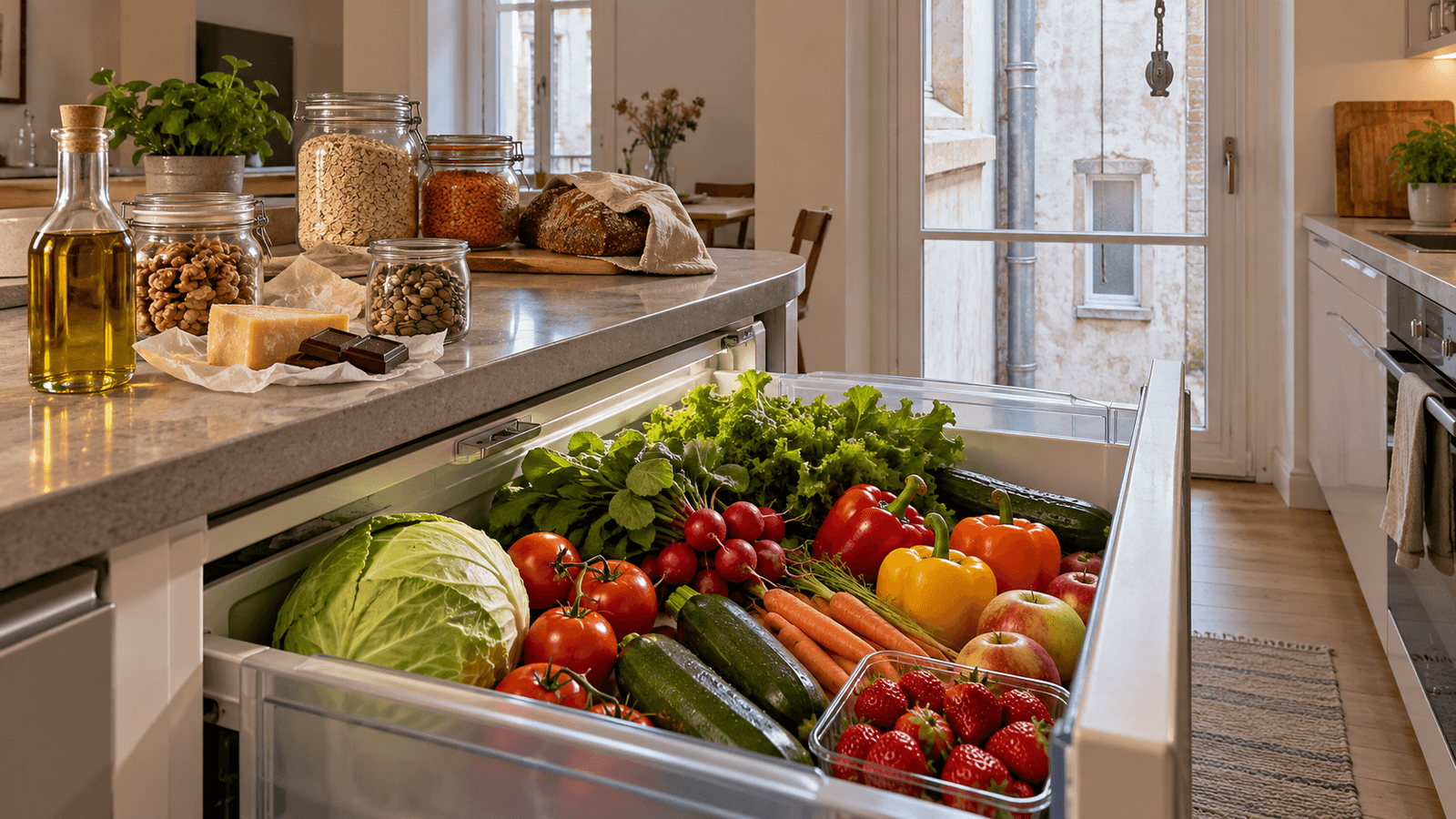
Calorie density describes how much energy a food provides relative to its weight.
Two foods can weigh the same but contain very different amounts of calories.
That difference can matter when you are trying to understand portions, hunger, fullness or overall calorie intake.
The concept is useful because it explains why the physical size of a food does not always tell you how much energy it contains.
What does calorie density mean?
Calorie density, also called energy density, is the amount of energy contained in a given weight of food.
A food with lower calorie density provides fewer calories for the same weight.
A food with higher calorie density provides more calories for the same weight.
For example, foods containing a lot of water often weigh relatively much without containing a large amount of energy.
Foods containing more fat or less water can provide considerably more energy in a smaller physical amount.
Calorie density is not the same as portion size
Portion size describes how much food you actually eat.
Calorie density describes how concentrated the energy is within that food.
These concepts interact, but they are not identical.
A small portion of a calorie-dense food can contain substantial energy.
A physically larger portion of a lower-calorie-density food may contain fewer calories.
For more on the terminology, see Portion Size vs Serving Size: What’s the Difference?.
Why water matters
Water adds weight and volume without adding calories.
This is one major reason foods such as many fruits and vegetables tend to have relatively low calorie density.
Foods with naturally high water content can occupy more physical space for a given amount of energy.
Examples include:
- tomatoes
- cucumber
- zucchini
- berries
- oranges
- many soups with a high proportion of water and vegetables
This does not mean all foods containing water have the same calorie density.
The other ingredients still matter.
Why fat matters
Dietary fat contains more energy per gram than protein or carbohydrate.
Foods with a high proportion of fat can therefore become calorie-dense relatively quickly.
Examples may include:
- oils
- butter
- nuts
- nut butters
- some cheeses
- chocolate
This does not make these foods unhealthy.
It simply means that a relatively small amount can contribute meaningful energy.
Calorie density describes energy concentration, not overall food quality.
Fiber can influence calorie density and fullness
Many fiber-rich foods also contain substantial water or have a structure that adds bulk.
Examples include:
- vegetables
- fruit
- legumes
- some whole grains
These characteristics can make certain fiber-rich foods useful for building satisfying meals.
Fiber also has functions beyond calorie density.
For more information, see How Much Fiber Do You Need Per Day?.
Protein and calorie density
Protein-rich foods can have very different calorie densities.
For example, a lean protein source and a higher-fat protein source may provide similar amounts of protein but different amounts of total energy.
Preparation also matters.
A food that is grilled with little added fat can differ from the same food fried in substantial oil.
Calorie density should therefore not be used as a substitute for looking at the full nutritional profile.
Low-calorie-density foods
Foods with relatively low calorie density often contain a substantial amount of water, fiber or both.
Examples can include:
- many vegetables
- many fruits
- broth-based vegetable soups
- some low-fat dairy foods
- cooked legumes
- potatoes prepared without large amounts of added fat
The exact value depends on the food and preparation.
A food does not need to be extremely low in calorie density to fit into a balanced diet.
Higher-calorie-density foods
Foods with higher calorie density often contain more fat, less water or both.
Examples can include:
- oils
- butter
- nuts
- seeds
- nut butter
- chocolate
- some cheeses
- pastries
- fried foods
Again, higher calorie density does not automatically mean poor nutrition.
Nuts and seeds, for example, can provide protein, unsaturated fats, fiber and micronutrients while also being calorie-dense.
Calorie density is not a health score
It is important not to treat calorie density as a ranking of “good” and “bad” foods.
A lower-calorie-density food is not automatically nutritionally superior.
A higher-calorie-density food is not automatically unhealthy.
Different foods provide different combinations of:
- protein
- carbohydrates
- fats
- fiber
- vitamins
- minerals
- enjoyment
- convenience
Calorie density answers one specific question: how concentrated is the energy in this food?
Calorie density and satiety
Calorie density can influence how much physical food you can eat for a given calorie intake.
For some people, including more lower-calorie-density foods can make meals physically larger and more satisfying.
But fullness is not controlled by food volume alone.
Protein, fiber, fat, meal composition, eating speed and individual factors can all influence satiety.
For a broader explanation, see What Is Satiety and Which Foods Help You Feel Full?.
Calorie density and weight loss
Lower-calorie-density foods can be useful during weight loss because they may help increase the physical volume of meals without increasing calories as quickly.
For example, adding vegetables to a meal can increase its volume.
Replacing every calorie-dense food, however, is neither necessary nor automatically desirable.
A practical weight-loss diet can still include:
- olive oil
- nuts
- cheese
- chocolate
- other calorie-dense foods
Portion size and the overall dietary pattern remain important.
How cooking changes calorie density
Cooking can change the amount of water in food.
That can change calorie density even when no energy is added.
Water loss
Roasting, baking or grilling can remove water.
The cooked food may then contain more calories per unit of weight because the same nutrients are concentrated into a smaller weight.
Water absorption
Foods such as rice, pasta and oats can absorb water during cooking.
Their cooked weight increases.
As a result, the calories per 100 g of the cooked food can be much lower than the calories per 100 g of the dry food.
This is why raw, dry and cooked nutrition entries should not be mixed casually.
Added oil can change calorie density quickly
Oil is highly energy-dense.
Adding oil during roasting, frying or dressing can therefore increase the calorie density of a dish.
This does not mean oil needs to be avoided.
It means that preparation method is relevant when estimating calories.
If accurate tracking matters to you, include meaningful amounts of cooking oil rather than assuming the base ingredient tells the whole story.
Food volume vs calories
Visual size can be misleading.
A large bowl of vegetables may contain less energy than a much smaller amount of nuts or chocolate.
The larger food is not necessarily “better,” and the smaller food is not necessarily “worse.”
They simply have different energy concentrations.
This is one reason estimating calories only from visual volume can be difficult.
Why calorie density matters for photo-based tracking
A food photo can show:
- visible volume
- shape
- ingredients
- relative portion size
But it cannot directly reveal the exact energy density of every ingredient.
A small amount of oil, butter, cheese or sauce can add meaningful calories without dramatically changing the visible size of the food.
This is one reason photo-based calorie estimates should remain reviewable.
See How Accurate Is Calorie Counting?.
Mixed dishes are more complicated
Calorie density becomes harder to judge in mixed dishes.
Consider a pasta dish.
Its calorie density may depend on:
- amount of cooked pasta
- vegetables
- meat or other protein
- oil
- cheese
- cream
- sauce
Two dishes that look similar can therefore have different energy densities.
For homemade dishes, tracking ingredients or using a recipe calculation can improve the estimate.
Soups are a useful example
Soup demonstrates how water can influence calorie density.
A broth-based vegetable soup may contain a large amount of water.
A creamy soup containing cream, cheese or substantial oil can have a very different energy density despite occupying a similar bowl.
The name “soup” alone therefore does not determine calorie density.
Potatoes are another useful example
Plain boiled potatoes contain substantial water.
Their calorie density changes considerably when preparation adds a significant amount of fat.
For example, frying changes the nutritional situation because oil contributes additional energy.
The underlying ingredient may be the same, but preparation changes the result.
Nuts illustrate the opposite pattern
Nuts are relatively compact and contain substantial fat.
A small handful can therefore provide meaningful energy.
At the same time, nuts can provide:
- unsaturated fats
- protein
- fiber
- vitamins
- minerals
This is a useful reminder that calorie density and nutritional quality are different concepts.
Should you only eat low-calorie-density foods?
No.
That would unnecessarily exclude many nutritious foods.
Higher-calorie-density foods can be useful when:
- you enjoy them
- they provide important nutrients
- you need more energy
- they make meals satisfying
- they fit your overall intake
The goal is understanding the concept, not turning it into a rigid food rule.
How to use calorie density practically
You can use the concept without calculating the energy density of every food.
1. Build meals around several minimally processed foods
Vegetables, fruit, legumes, potatoes, whole grains and protein foods can create a useful foundation.
2. Notice concentrated calorie sources
Oil, nuts, cheese, spreads and sauces can add substantial energy in relatively small amounts.
They do not need to be removed, but their portions can matter.
3. Use preparation method as context
Boiled, baked and fried versions of the same food may have different calorie densities.
4. Consider the whole meal
A meal can combine lower- and higher-calorie-density foods.
There is no requirement that every ingredient belong to one category.
5. Choose portions that fit your needs
Calorie density can help explain portions, but your energy needs, hunger and preferences still matter.
Calorie density vs nutrient density
These terms sound similar but describe different things.
Calorie density refers to energy relative to food weight.
Nutrient density generally refers to the amount of useful nutrients a food provides relative to its energy or amount.
A food can be both calorie-dense and nutrient-rich.
Nuts are a common example.
A food can also be low in calories without being especially rich in essential nutrients.
See Nutrient-Dense Foods: What They Are and How to Eat More.
Calorie density vs calories per serving
Calories per serving depend on both calorie density and serving size.
A calorie-dense food can have a moderate calorie total if the portion is small.
A lower-calorie-density food can still contribute substantial calories if the portion is extremely large or if calorie-dense ingredients are added.
This is why both food composition and quantity matter.
Common mistakes
Treating low calorie density as automatically healthy
Calorie density is not a complete nutrition score.
Avoiding all calorie-dense foods
Many calorie-dense foods can fit into a nutritious diet.
Ignoring preparation
Oil, frying, sauces and water loss can change calorie density.
Comparing dry and cooked foods directly
Water absorption can make the same food look dramatically different per 100 g.
Assuming visual size equals calories
Small foods can be calorie-dense, while physically large foods can be relatively low in calories.
Focusing only on volume
Protein, fiber, fat and personal preferences also influence satisfaction.
Frequently asked questions
What is calorie density in simple terms?
It describes how many calories are concentrated into a given weight of food.
Are low-calorie-density foods better for weight loss?
They can be useful because they may provide more food volume for a given amount of calories, but overall calorie intake and diet quality still matter.
Are calorie-dense foods unhealthy?
No. Foods such as nuts, seeds and olive oil are calorie-dense but can still provide useful nutrients.
Does cooking change calorie density?
Yes. Cooking can remove or add water, and added fats can change the energy content.
Why does cooked rice have fewer calories per 100 g than dry rice?
Cooked rice absorbs water, increasing its weight without adding calories from the water itself.
Can I use calorie density without counting calories?
Yes. You can use the concept to understand why foods differ in energy concentration without calculating every meal.
Does calorie density determine how filling a food is?
Not by itself. Volume can matter, but protein, fiber, fat and individual factors also influence fullness.
The bottom line
Calorie density describes how much energy is contained in a given weight of food.
Foods with more water often have lower calorie density, while foods with more fat or less water are often more calorie-dense.
The concept can help explain:
- why equal weights of foods can contain different calories
- why cooking changes calories per 100 g
- why small amounts of oil or nuts can contribute meaningful energy
- why physically larger meals are not always higher in calories
Use calorie density as a practical tool for understanding food, not as a system for labeling foods as good or bad.
This article provides general educational nutrition information and is not individualized medical or dietary advice.