
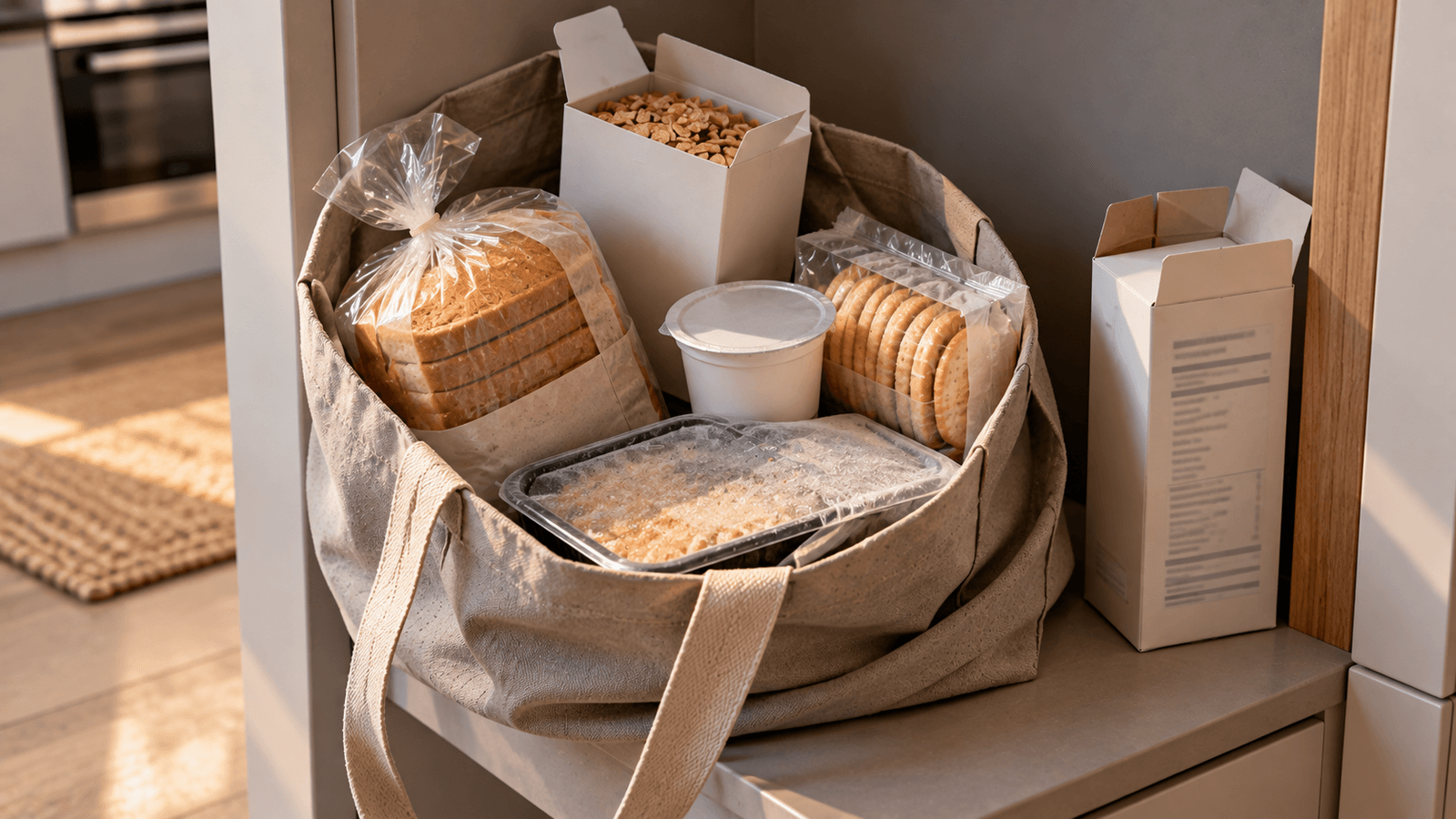
The term ultra-processed food is now common in nutrition research, news articles and everyday discussions about food.
But it is often used loosely.
A frozen vegetable is processed. Milk is usually processed. Canned beans are processed. Bread and cheese are processed too.
That does not automatically make them ultra-processed.
The distinction comes from a classification system called NOVA, which groups foods according to the extent and purpose of the industrial processing used to make them.
Understanding that system makes the term much more useful.
Ultra-processed does not simply mean "processed a lot"
Almost all food undergoes some form of processing before it is eaten.
Examples include:
- washing
- cutting
- grinding
- pasteurizing
- freezing
- drying
- fermenting
- canning
- cooking
Processing itself is therefore not enough to classify something as ultra-processed.
NOVA looks at both what has been done to the food and why.
It separates foods into four groups.
| NOVA group | General description | Examples |
|---|---|---|
| 1 | Unprocessed or minimally processed foods | fruit, vegetables, eggs, milk, plain grains, meat, frozen vegetables |
| 2 | Processed culinary ingredients | oil, butter, sugar, salt |
| 3 | Processed foods | simple breads, cheese, canned vegetables, canned fish, salted nuts |
| 4 | Ultra-processed foods | many soft drinks, packaged snacks, confectionery, instant products, reconstituted meat products and some ready meals |
The groups are about processing rather than a simple ranking of individual foods by calories or nutrients.
Group 1: unprocessed and minimally processed foods
Group 1 contains foods that remain recognizably close to the original food.
Examples include:
- fresh fruit
- frozen berries
- vegetables
- dried lentils
- plain oats
- rice
- eggs
- milk
- plain meat
- fish
- unsalted nuts
These foods may still have been processed.
Milk can be pasteurized.
Vegetables can be frozen.
Oats can be rolled.
Coffee beans can be roasted.
The key point is that these processes generally preserve the basic food rather than turn it into an industrial formulation.
This is why frozen does not mean ultra-processed.
A bag of plain frozen broccoli can still belong to NOVA group 1.
Group 2: processed culinary ingredients
The second group consists primarily of substances used to prepare and season other foods.
Examples include:
- vegetable oils
- butter
- sugar
- salt
They are typically obtained from foods or nature through processes such as pressing, refining, grinding or extraction.
They are usually used as ingredients rather than eaten alone.
Olive oil is therefore processed, but processing alone does not make it an ultra-processed food.
Group 3: processed foods
This is where an important distinction appears.
A food can clearly be processed without being ultra-processed.
NOVA group 3 generally contains relatively simple products made by adding ingredients such as salt, sugar or oil to group 1 foods.
Examples can include:
- vegetables canned in brine
- fish canned with oil or salt
- salted nuts
- traditional cheese
- relatively simple freshly made breads
- fruit preserved with sugar
These foods are still usually recognizable as modified versions of the original food.
Consider canned beans.
Plain dried beans
Usually group 1.
Beans canned with water and salt
Generally group 3.
Neither example automatically belongs to the ultra-processed category.
Group 4: ultra-processed foods
NOVA describes ultra-processed foods as industrial formulations made largely from substances derived from foods, modified food substances and additives, often with little intact whole food remaining.
Production may involve processes and ingredients that are uncommon in ordinary home cooking.
Examples commonly classified in this group include many:
- soft drinks
- packaged sweet or savory snacks
- confectionery products
- mass-produced packaged baked goods
- instant noodles
- instant desserts
- reconstituted meat products
- some breakfast cereals
- some frozen ready meals
- some packaged breads
The word some matters.
A product category alone does not always tell you how a specific product will be classified.
Two breads, cereals or prepared meals can have very different ingredient lists and manufacturing methods.
Processed vs ultra-processed: a practical comparison
Consider bread.
Bread A
Ingredients:
- flour
- water
- yeast
- salt
This resembles a traditional bread formulation and may fit the processed-food category.
Bread B
Ingredients include:
- refined flour
- added sugars
- modified starch
- protein isolates
- emulsifiers
- flavorings
- colors
This formulation is much more characteristic of an ultra-processed product.
Both products are "processed" in ordinary language.
NOVA attempts to distinguish the nature and purpose of that processing.
Ingredients that can help identify ultra-processed products
The NOVA framework often looks for ingredients characteristic of industrial formulations.
Depending on the product, these may include substances such as:
- protein isolates
- hydrolyzed proteins
- modified starches
- hydrogenated or interesterified oils
- certain sweetening agents
It also considers classes of additives used to modify sensory characteristics, such as:
- flavors
- flavor enhancers
- colors
- emulsifiers
- some sweeteners
- thickeners
- glazing agents
- foaming or anti-foaming agents
However, an ingredient list should be interpreted in context.
The presence of a long or unfamiliar chemical name does not by itself tell you whether a food is nutritionally poor.
And not every additive has the same function.
Does a long ingredient list automatically mean ultra-processed?
No.
Ingredient count can provide a clue, but it is not the definition.
Imagine a packaged soup containing:
- tomatoes
- carrots
- lentils
- onions
- beans
- potatoes
- celery
- olive oil
- herbs
- spices
- salt
It has many ingredients, but that fact alone does not make it ultra-processed.
Now consider another product with fewer ingredients, but several are industrially modified food substances and additives characteristic of an ultra-processed formulation.
The second product may fit NOVA group 4 more closely despite having fewer total ingredients.
The type and purpose of ingredients and processing matter more than simply counting lines on a label.
Is every packaged food ultra-processed?
No.
Packaging is not the defining feature.
Examples of packaged foods that can still be minimally processed include:
- plain frozen vegetables
- plain oats
- dried lentils
- plain nuts
- pasteurized milk
- plain rice
Likewise, canned foods are not automatically ultra-processed.
Canned tomatoes containing tomatoes and perhaps salt are fundamentally different from a complex ready-to-eat industrial formulation.
Is every frozen food ultra-processed?
No.
Freezing is a preservation method.
Plain frozen:
- peas
- spinach
- berries
- fish
- vegetables
can remain minimally processed.
A frozen ready meal with multiple industrially formulated components may fall into a different category.
The freezer aisle therefore contains foods from several processing groups.
Are all breakfast cereals ultra-processed?
Not necessarily.
Plain rolled oats are minimally processed.
A cereal made from a short list of recognizable ingredients may differ from an extruded, flavored and heavily formulated breakfast product.
Instead of assuming that every cereal belongs to the same category, inspect the actual product.
Is yogurt ultra-processed?
It depends on the product.
Plain yogurt made primarily from milk and bacterial cultures is different from a highly formulated dessert-style product containing multiple flavoring, sweetening, thickening and other ingredients.
The word yogurt on the front of the package is therefore not enough to determine the NOVA group.
The formulation matters.
What about plant-based alternatives?
The same principle applies.
A product being vegan, vegetarian, gluten-free, organic or high-protein does not determine whether it is ultra-processed.
Some plant-based products are simple foods.
Others are complex industrial formulations using isolates, modified ingredients, flavorings and other additives.
NOVA classification and dietary labels answer different questions.
Ultra-processed does not mean exactly the same thing as high-calorie
Processing level and calorie content are separate characteristics.
A food can be:
- minimally processed and calorie-dense
- ultra-processed and relatively low in calories
- minimally processed and low in calories
- ultra-processed and high in calories
For example, plain nuts are energy-dense but minimally processed.
A low-calorie artificially sweetened drink may be ultra-processed despite containing little energy.
So ultra-processed is not another word for high-calorie.
It also does not mean exactly the same thing as high sugar, fat or salt
Many ultra-processed products are formulated with substantial amounts of sugar, fat or sodium.
But NOVA classification is not determined simply by crossing a nutrient threshold.
A traditional cheese can contain substantial sodium and fat while still being classified as processed rather than ultra-processed.
Conversely, an industrially formulated product may qualify as ultra-processed even if its calories or sugar are relatively low.
Processing classification and nutrient composition provide different information.
Why are ultra-processed foods studied?
Researchers have investigated whether diets containing larger amounts of ultra-processed foods are associated with health outcomes.
Observational research has repeatedly found associations between higher ultra-processed-food intake and several adverse health outcomes.
There is also experimental evidence.
In a controlled NIH inpatient trial, participants offered an ultra-processed diet consumed more energy and gained weight compared with when they were offered an unprocessed diet matched for several presented nutrients and other characteristics.
That result is important, but it does not mean every individual food classified as ultra-processed has the same effect.
Nor does it prove that one single feature of ultra-processing explains all observed associations.
Why the evidence needs careful interpretation
Several questions remain actively researched.
For example, foods classified as ultra-processed can differ greatly in:
- calories
- fiber
- protein
- sodium
- added sugar
- food structure
- energy density
- texture
- eating rate
- portion size
- formulation
People who consume different amounts of ultra-processed foods can also differ in other dietary and lifestyle characteristics.
Researchers therefore continue to investigate which aspects of ultra-processed diets may contribute to observed health effects.
The category can be useful without assuming that every product inside it is nutritionally identical.
NOVA also has limitations
NOVA is widely used in research, but its definitions and classifications have also been debated.
Critiques include:
- some products can be difficult to classify without detailed manufacturing information
- classification can sometimes depend on information not obvious from the package
- foods within the same group can differ substantially in nutritional composition
- processing level does not replace information about calories, protein, fiber, vitamins, minerals, sodium or other nutrients
Researchers have also debated how consistently individual foods can be classified.
For practical use, this means NOVA is best understood as one way of describing food, not the only information that matters.
A food can be nutritious and convenient without being unprocessed
Processing can provide useful functions.
It can:
- improve food safety
- extend shelf life
- reduce preparation time
- make foods available outside their harvest season
- reduce some forms of food waste
- make certain foods easier to store and transport
Examples such as frozen vegetables, pasteurized milk and canned beans show why simply telling people to "avoid processed food" is too broad.
The more useful distinction is what kind of processing occurred and what the final food provides.
How to evaluate a packaged food in practice
If you want to understand a product, use several layers of information rather than one label.
1. Identify what the product actually is
Is it primarily:
- a whole or minimally altered food?
- a simple preserved food?
- an industrial formulation?
2. Read the ingredient list
Look at what the product is made from rather than relying only on claims on the front.
3. Read the nutrition information
Depending on your goals, examine:
- calories
- protein
- fiber
- saturated fat
- sugars
- sodium or salt
4. Consider the portion you actually eat
Nutritional values per 100 g and the amount you consume answer different questions.
5. Consider what role the food plays in your diet
A convenient packaged food eaten occasionally is different from a dietary pattern in which highly formulated ready-to-eat products displace most meals based on less processed foods.
A practical supermarket example
Imagine you are choosing a tomato product.
Option 1
Whole tomatoes.
Option 2
Canned tomatoes with tomatoes and salt.
Option 3
A ready-to-eat tomato-based product containing modified starches, flavorings, sweeteners, emulsifiers and several other industrial ingredients.
All three involve different levels or purposes of processing.
Calling all three simply "processed food" hides those differences.
That is the type of distinction NOVA is designed to capture.
The useful question is not simply "processed or not?"
For everyday decisions, a better set of questions is:
- How was this food processed?
- What is it made from?
- What nutrients does it provide?
- What portion am I eating?
- How often does it appear in my diet?
- What does it replace?
These questions provide more information than treating processing as a simple yes-or-no characteristic.
Ultra-processed food is a specific classification concept.
It should not become a synonym for "bad food."