
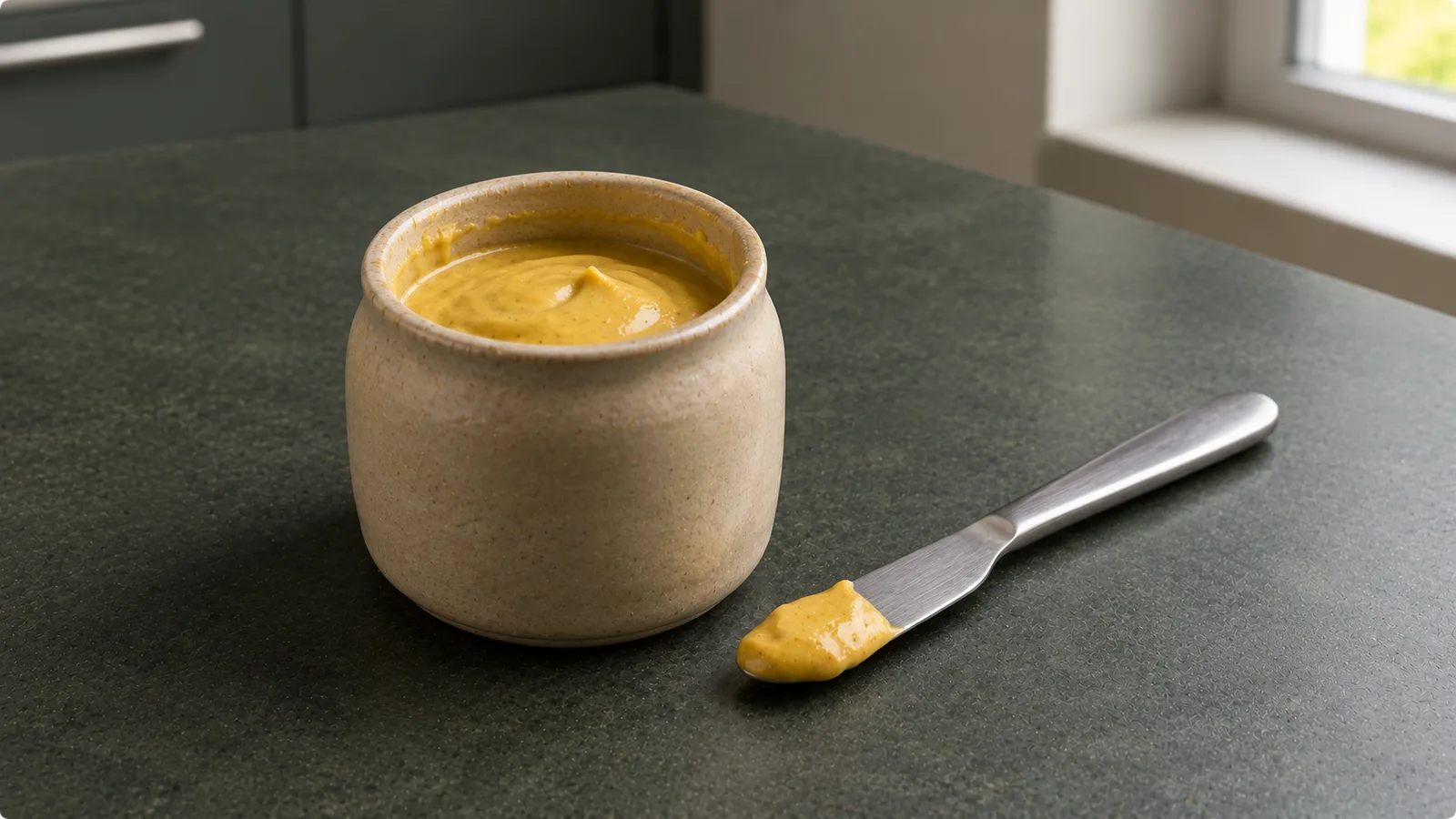
Mustard is a condiment made from mustard seeds, water, vinegar or another acidic liquid, and seasonings. Some varieties also contain sugar, honey, oil or other ingredients.
Most plain yellow and Dijon mustards are relatively low in calories when eaten in typical condiment portions. Sweetened varieties, particularly honey mustard sauces and dressings, can contain substantially more energy.
A typical 5 g teaspoon of plain mustard may provide around 3–8 calories, but the exact amount depends on the product.
The most reliable calculation uses the nutrition label and the actual weight of the serving.
How many calories are in mustard?
Mustard does not have one universal calorie value. Different recipes use different proportions of mustard seeds, water, vinegar, sweeteners and oil.
The table below provides illustrative ranges for common product categories, not guaranteed values for every brand.
| Mustard type | Approximate calories per 100 g | Main reason for variation |
|---|---|---|
| Yellow mustard | 50–100 kcal | Seed concentration and recipe |
| Dijon mustard | 60–150 kcal | Seed content and added ingredients |
| Wholegrain mustard | 80–180 kcal | Proportion of whole seeds |
| Sweet mustard | 120–250 kcal | Added sugar or other sweeteners |
| Honey mustard sauce | 150–400 kcal | Honey, sugar and sometimes oil or mayonnaise |
These are broad comparison ranges. A particular product may fall outside them.
Honey mustard sauce is especially variable: a mustard-and-honey mixture is not nutritionally equivalent to a creamy honey mustard dressing.
Always check whether the product is a mustard condiment, a sauce or a salad dressing.
Mustard calories by serving size
For a practical calculation, suppose a mustard contains 70 kcal per 100 g.
A teaspoon is assumed to weigh 5 g and a tablespoon 15 g. Actual spoonfuls can weigh more or less.
| Serving | Assumed weight | Estimated calories |
|---|---|---|
| 1 teaspoon | 5 g | 4 kcal |
| 2 teaspoons | 10 g | 7 kcal |
| 1 tablespoon | 15 g | 11 kcal |
| 2 tablespoons | 30 g | 21 kcal |
| 3 tablespoons | 45 g | 32 kcal |
| 50 g | 50 g | 35 kcal |
| 100 g | 100 g | 70 kcal |
Values are rounded to whole calories.
For any product:
Calories eaten = calories per 100 g × serving weight in grams ÷ 100.
For example, 20 g of mustard containing 125 kcal per 100 g provides:
125 × 20 ÷ 100 = 25 kcal.
This formula is more dependable than using a single calorie value for all mustards.
Yellow mustard vs Dijon mustard
Yellow mustard and Dijon mustard can both be relatively low-calorie condiments.
Yellow mustard is often made with mustard seeds, vinegar, water, salt and spices. Turmeric commonly contributes to its bright colour.
Dijon mustard typically has a sharper flavour and may contain a different concentration or combination of mustard seeds and liquids.
Neither name guarantees a particular calorie value.
Consider two hypothetical products:
| Product | Calories per 100 g | Calories in 15 g |
|---|---|---|
| Yellow mustard A | 65 kcal | 10 kcal |
| Dijon mustard B | 120 kcal | 18 kcal |
The difference is approximately 8 kcal per tablespoon-sized serving.
That may be modest for one meal, but the actual nutritional comparison should also consider salt, sugar and ingredients.
Is wholegrain mustard higher in calories?
Wholegrain mustard contains visible whole or partly crushed mustard seeds.
Mustard seeds themselves contain fat, protein and fibre, so their concentration can affect the condiment's energy density.
However, a wholegrain mustard with plenty of water and vinegar may have fewer calories than a sweetened smooth mustard.
The word wholegrain alone does not establish the calorie content.
Compare the values per 100 g rather than assuming one texture is always more or less caloric.
Honey mustard calories
Honey mustard is not one standardized product.
It may refer to:
- Mustard mixed with honey.
- Sweetened prepared mustard.
- A dipping sauce containing mustard, honey and mayonnaise.
- A salad dressing containing mustard, sweetener and oil.
These versions can have very different nutritional profiles.
For illustration:
| Hypothetical product | Calories per 100 g | Calories in 30 g |
|---|---|---|
| Plain mustard | 70 kcal | 21 kcal |
| Sweet honey mustard | 180 kcal | 54 kcal |
| Creamy honey mustard dressing | 350 kcal | 105 kcal |
These values are examples, not brand-specific nutrition data.
A 30 g portion of the creamy dressing in this example provides five times the calories of the plain mustard.
The difference is mainly explained by the complete ingredient formulation, not by mustard itself.
Mustard nutrition: fat, carbohydrates and protein
The nutritional composition of mustard varies according to the amount of mustard seed and other ingredients.
| Nutrient | What to know |
|---|---|
| Carbohydrates | Usually modest in plain mustard; can be higher in sweetened products |
| Sugars | Often low in unsweetened varieties; potentially higher in sweet mustard |
| Fat | Naturally present in mustard seeds; additional oil can raise the amount |
| Protein | Present in mustard seeds but usually limited per small serving |
| Fibre | Depends on seed content and processing |
| Salt | Can be significant even when calories are low |
For most people, a teaspoon of mustard contributes relatively little protein or fibre to the overall diet.
Mustard should not be treated as a major source of nutrients simply because mustard seeds contain them.
Serving size matters.
How much sugar does mustard contain?
Plain mustard may contain little sugar, but sweet mustard and honey mustard can contain considerably more.
Suppose a sweet mustard contains 25 g sugars per 100 g.
| Portion | Calculated sugars |
|---|---|
| 5 g | 1.25 g |
| 15 g | 3.75 g |
| 30 g | 7.5 g |
| 50 g | 12.5 g |
These values apply only to the example product.
Sugar in a serving = sugar per 100 g × serving weight ÷ 100.
The nutrition declaration for sugars does not automatically distinguish naturally occurring sugars from added sugars.
For products marketed as honey mustard, the ingredient list helps identify whether honey, sugar, syrup or other sweetening ingredients are present.
Is mustard high in salt?
Salt may be more nutritionally relevant than calories when comparing small portions of plain mustard.
Suppose a Dijon mustard contains 5 g salt per 100 g.
| Serving | Salt |
|---|---|
| 5 g | 0.25 g |
| 10 g | 0.50 g |
| 15 g | 0.75 g |
| 30 g | 1.50 g |
These are hypothetical values.
A tablespoon can contribute a noticeable amount of salt even when it provides relatively few calories.
The World Health Organization recommends that adults consume less than 5 g of salt per day.
The appropriate way to compare products is to read both the salt value per 100 g and the amount normally eaten.
Mustard vs ketchup vs mayonnaise
Mustard is often compared with other sandwich and burger condiments.
The following example uses representative illustrative values.
| Condiment | Assumed calories per 100 g | Calories in 15 g |
|---|---|---|
| Plain mustard | 70 kcal | 11 kcal |
| Regular ketchup | 100 kcal | 15 kcal |
| Regular mayonnaise | 680 kcal | 102 kcal |
| Honey mustard dressing | 350 kcal | 53 kcal |
The comparison demonstrates why product type matters.
Plain mustard and ketchup may be relatively similar in calories at small serving sizes, although ketchup often contains more sugar.
Regular mayonnaise is generally much more energy-dense because of its oil content.
A creamy honey mustard dressing can be closer to an oil-based sauce than to plain mustard.
These figures should not replace actual package labels.
Does mustard add many calories to a sandwich?
Consider a sandwich containing bread, cheese, vegetables and mustard.
If you add 10 g of mustard containing 70 kcal per 100 g, the mustard contributes 7 kcal.
If you replace it with 10 g of mayonnaise containing 680 kcal per 100 g, that condiment contributes 68 kcal.
The difference is 61 kcal for the condiment alone.
This does not establish the sandwich's total calories, which depend on bread, fillings and other ingredients.
For a food diary, count the mustard separately unless it is already included in the recipe calculation.
Calories in homemade mustard
Homemade mustard may be prepared using mustard seeds, vinegar, water, salt and spices.
Some recipes also contain honey, sugar or oil.
To calculate the finished condiment:
- Weigh each ingredient.
- Find its energy value.
- Calculate and add the ingredient calories.
- Weigh the finished edible mustard.
- Divide the total calories by the final weight and multiply by 100.
For example, suppose the ingredients contribute 280 kcal and the finished mustard weighs 350 g.
280 ÷ 350 × 100 = 80 kcal per 100 g.
A 15 g serving provides:
80 × 15 ÷ 100 = 12 kcal.
The final weight matters because added water and evaporation change the energy concentration.
Do not use the calorie value of dry mustard seeds as though it represented prepared mustard.
Is mustard suitable for weight management?
Plain mustard can be a practical lower-calorie flavouring option compared with many oil-rich sauces.
However, weight management depends on the overall dietary pattern and energy balance rather than the choice of one condiment.
A person who prefers honey mustard can still include it in their diet by accounting for its portion and nutritional composition.
Choosing a sauce solely because it contains fewer calories is not always necessary.
Taste, salt, sugar, allergies and the rest of the meal also matter.
Mustard allergy and ingredient labels
Mustard is a recognized food allergen.
In the European Union, mustard and products made from mustard must be declared as allergens when used as ingredients in foods subject to the relevant labelling rules.
People with a mustard allergy should not assume that a sauce is safe because it contains only a small amount of mustard.
Check ingredient lists and allergen information, including for dressings, marinades and prepared foods.
Some mustard products may also contain other allergens or ingredients relevant to dietary restrictions.
How to track mustard accurately
The simplest approach is to use a kitchen scale.
- Place the plate on the scale.
- Reset the scale to zero.
- Add mustard.
- Record the weight.
- Use the nutrition values from the specific product label.
Alternatively, weigh the mustard container before and after serving.
If mustard is mixed into a larger recipe, record the total amount added and divide it across the portions consumed.
Avoid counting the same mustard twice.
Common questions
How many calories are in a teaspoon of mustard?
A 5 g teaspoon of mustard containing 70 kcal per 100 g provides approximately 4 kcal. Other varieties differ.
How many calories are in a tablespoon?
At 15 g and 70 kcal per 100 g, approximately 11 kcal.
Is Dijon mustard calorie-free?
No. Dijon mustard contains some energy, although a small portion may provide relatively few calories.
Does wholegrain mustard contain more calories?
Not necessarily. The answer depends on the proportion of seeds and other ingredients.
Is honey mustard high in calories?
Some honey mustard dressings are considerably higher in calories than plain mustard, especially when they contain oil or mayonnaise.
Is mustard healthier than mayonnaise?
They have different nutritional profiles. Plain mustard usually contains fewer calories and less fat, while salt and individual dietary needs should also be considered.
Sources and calculation notes
- USDA FoodData Central — reference food-composition data for mustard and other condiments.
- Regulation (EU) No 1169/2011 — nutrition declarations and allergen labelling, including mustard.
- World Health Organization: Sodium reduction — public-health guidance on salt intake.
The calorie ranges and comparisons in this article are illustrative rather than verified values for named products. Use the label and measured serving for accurate individual tracking.