
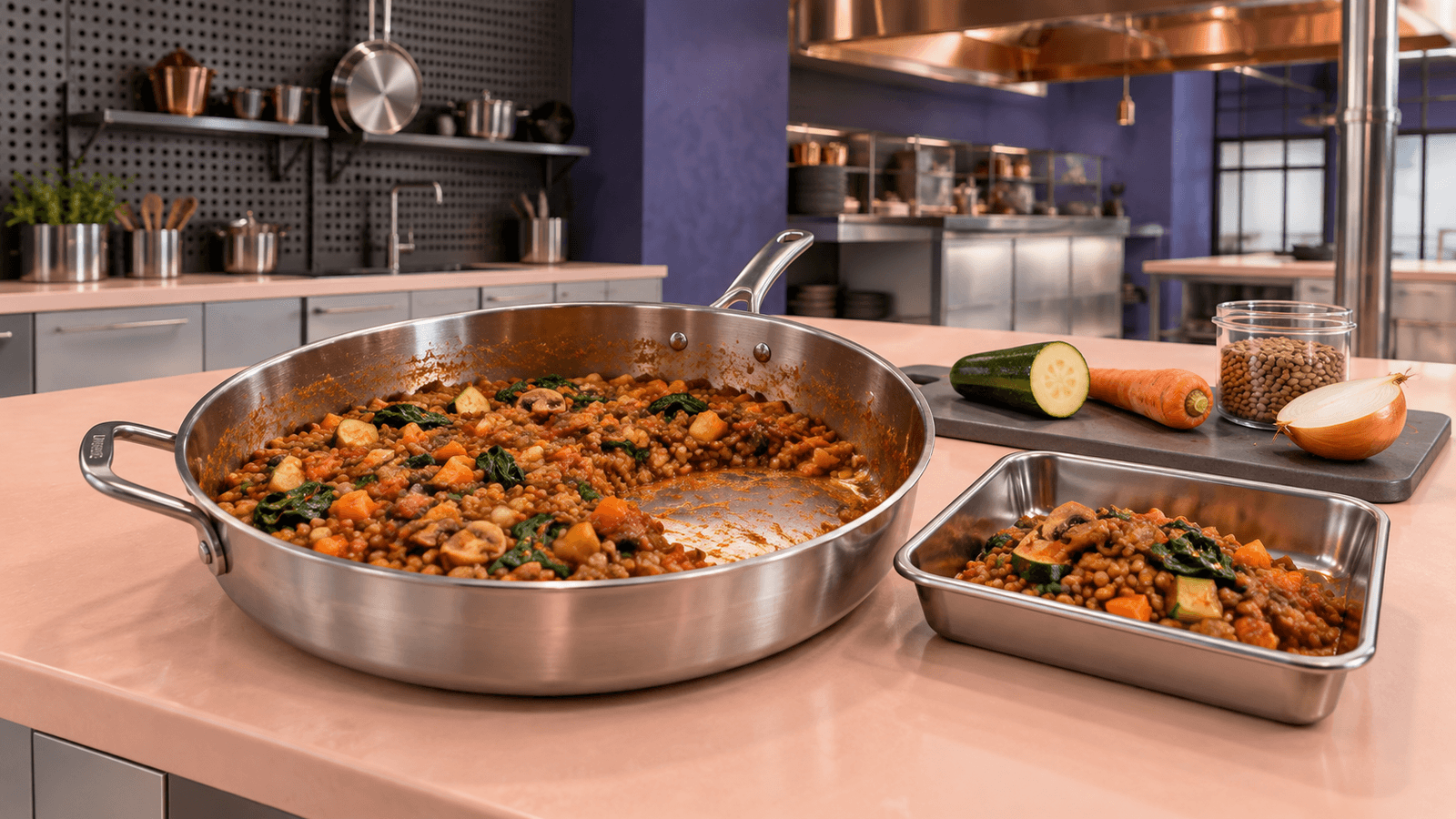
Tracking a packaged yogurt or a banana is relatively simple.
Tracking a homemade lasagna, curry, soup, casserole or pasta dish can feel much harder.
A mixed dish may contain many ingredients, cooking changes its total weight, and each serving may be slightly different.
Fortunately, you do not need to calculate every plate from scratch.
The most practical approach is to treat the entire recipe as one unit, calculate its total nutrition once and then divide that total according to the amount you actually eat.
Why homemade meals are harder to track
A homemade dish can contain:
- several ingredients
- cooking oil
- sauces
- liquids
- ingredients with different calorie densities
- ingredients that gain or lose water during cooking
You may also cook several portions at once.
This makes a mixed dish different from tracking a single packaged food.
The basic method
For most homemade dishes, use this workflow:
- record the ingredients
- calculate the nutrition of the entire recipe
- cook the dish
- determine the finished amount
- record the amount you eat
- calculate your share of the total recipe
This method works for many foods, including:
- soups
- stews
- curries
- casseroles
- pasta dishes
- rice dishes
- chili
- lasagna
- homemade sauces
- baked dishes
Step 1: record every meaningful ingredient
Before cooking, record the ingredients that contribute meaningfully to calories or macros.
For example, a simple pasta dish might contain:
- 300 g dry pasta
- 400 g minced meat
- 500 g tomato sauce
- 100 g onion
- 15 g olive oil
- 30 g grated cheese
You do not necessarily need to track tiny amounts of low-calorie herbs and spices with extreme precision.
The important thing is not to forget ingredients that can meaningfully change the total.
Do not forget cooking fats
Oil is one of the easiest ingredients to miss.
If you use oil for frying, roasting or dressing, include it in the recipe when a meaningful amount is used.
The same applies to:
- butter
- cream
- cheese
- mayonnaise
- nut butter
- coconut milk
- calorie-dense sauces
A small visual amount can still contribute a meaningful number of calories.
Step 2: use the correct nutrition information
For packaged ingredients, use the nutrition information for the actual product when possible.
For example, different:
- pasta
- cheese
- yogurt
- sauces
- minced meats
- plant-based products
can have different nutrition values.
Barcode information or a nutrition label can therefore be more useful than a generic database entry.
Raw or cooked weight?
This is one of the most common sources of confusion.
If the nutrition information refers to the uncooked product, use the uncooked weight.
For example, dry pasta nutrition is normally based on the dry product unless the label says otherwise.
The same principle applies to rice and other foods that absorb water.
Water changes weight but does not add calories.
Example: dry pasta
Suppose 300 g of dry pasta contains 350 kcal per 100 g.
The total is:
300 ÷ 100 × 350 = 1,050 kcal.
After cooking, the pasta may weigh much more because it has absorbed water.
The total calories are still approximately the same before other ingredients are added.
This is why mixing raw and cooked database entries can create large tracking errors.
Step 3: calculate the entire recipe
Add the calories and macros of all meaningful ingredients.
Example:
Pasta: 1,050 kcal
Minced meat: 800 kcal
Tomato sauce: 200 kcal
Onion: 40 kcal
Olive oil: 135 kcal
Cheese: 120 kcal
Total recipe:
2,345 kcal.
You can do the same for:
- protein
- carbohydrates
- fat
- fiber
depending on what you track.
Step 4: determine the finished amount
After cooking, you need a way to divide the total recipe.
There are several practical methods.
Method 1: finished weight
This is usually the most flexible method.
Weigh the finished dish.
Suppose the entire cooked dish weighs 1,850 g.
The recipe contains 2,345 kcal.
Calories per gram:
2,345 ÷ 1,850 ≈ 1.27 kcal per gram.
Calories per 100 g:
approximately 127 kcal.
If you eat 420 g:
420 × 1.27 ≈ 533 kcal.
This allows different people to take different portions without needing identical servings.
Method 2: divide into equal portions
If you prepare four approximately equal portions, you can divide the recipe total by four.
2,345 ÷ 4 ≈ 586 kcal per portion.
This is convenient when portions are deliberately made similar.
It is less accurate if one serving is much larger than another.
Method 3: divide by a known fraction
Sometimes you can estimate that you ate:
- one quarter
- one third
- one half
of the total recipe.
This is less precise than weighing the finished dish but can still be useful.
The goal is practical consistency, not laboratory precision.
How to weigh a finished dish
If you want to use finished weight:
- know the weight of the empty cooking container
- weigh the container with the finished food
- subtract the empty container weight
For example:
Pot + food: 3,400 g
Empty pot: 1,250 g
Finished food:
3,400 − 1,250 = 2,150 g.
You can then use 2,150 g as the finished recipe weight.
Save the container weight
If you regularly cook with the same:
- pot
- pan
- casserole dish
- mixing bowl
you can save its empty weight.
That removes one step the next time you prepare a recipe.
Water loss changes weight, not total calories
Roasting and simmering can remove water.
That makes the finished food lighter and more calorie-dense per 100 g.
For example, a stew that loses water during cooking may contain the same total calories but fewer grams.
That is another reason the finished weight can be useful.
Added water changes weight, not calories
The opposite happens with:
- soup
- rice
- pasta
- grains
Adding or absorbing water increases the finished weight without adding meaningful calories.
The recipe total remains based on the calorie-containing ingredients.
Example: homemade soup
Suppose a soup contains:
- lentils
- potatoes
- carrots
- onion
- tomato
- olive oil
- water
- seasoning
Calculate the calories from the calorie-containing ingredients.
Plain water adds weight and volume but no calories.
If the finished soup weighs 3,000 g and contains 1,800 kcal:
1,800 ÷ 3,000 = 0.6 kcal per gram.
A 500 g bowl would contain approximately:
500 × 0.6 = 300 kcal.
Example: casserole
Suppose the complete casserole contains 2,800 kcal.
After baking, it weighs 2,100 g.
Calories per 100 g:
2,800 ÷ 2,100 × 100 ≈ 133 kcal.
If your portion weighs 450 g:
450 × 1.33 ≈ 599 kcal.
You do not need to calculate each ingredient again when eating the leftovers.
Save the recipe and use the finished-food value.
What about uneven mixed dishes?
A recipe calculation assumes the ingredients are reasonably distributed throughout the dish.
That works well for foods such as:
- soups
- chili
- curries
- casseroles
- pasta sauces
- mixed rice dishes
But some dishes are less uniform.
For example, one serving of stew may contain more meat while another contains more broth.
You cannot eliminate every difference.
Mixing the dish reasonably before serving can improve consistency.
Over several servings, small differences often matter less than consistently forgetting major ingredients.
Layered dishes
Lasagna and similar layered dishes can be divided by:
- finished weight
- number of pieces
- fraction of the baking dish
If the pieces are intentionally similar, counting pieces may be convenient.
If sizes differ, weighing the portion is more reliable.
Homemade pizza
For homemade pizza:
- record dough ingredients
- record sauce
- record cheese
- record toppings
- calculate the whole pizza
- divide by slices or finished weight
If slices are unequal, the slice method is approximate.
You can also weigh the full pizza and then the portion you eat.
Homemade sauces
Sauces are easy to underestimate because they may contain:
- oil
- cream
- cheese
- nuts
- sugar
Treat a homemade sauce as its own recipe.
Calculate the total batch and divide it by weight or number of uses.
If you prepare the same sauce repeatedly, save it.
Recipes with meat and bones
If an ingredient contains parts that are not eaten, the purchased weight may not equal the edible amount.
Examples include:
- bone-in meat
- whole fish
- fruit with large pits
When possible, use nutrition information and weights that correspond to the edible portion.
Perfect precision is not always practical, so use a consistent method.
Drained canned foods
For foods packed in liquid, check whether the nutrition information refers to:
- total contents
- drained product
- prepared product
Beans, tuna and similar foods may be listed differently depending on the product.
Use the label instructions when available.
Ingredients added after cooking
Do not forget ingredients added at the end.
Examples:
- grated cheese
- oil
- dressing
- cream
- seeds
- nuts
- sauces
If everyone adds different amounts individually, it may be easier to track those additions separately from the base recipe.
Separate shared recipe from personal toppings
This can simplify household meals.
For example:
Base chili:
track as one recipe.
Personal additions:
- cheese
- yogurt
- avocado
- tortilla chips
Track these separately for each person.
The shared recipe stays reusable.
What if you do not know the exact recipe?
Sometimes someone else cooked the food.
You may not know:
- exact oil amount
- ingredient weights
- exact sauce
- recipe proportions
In that case, use a reasonable estimate.
Look at:
- visible ingredients
- portion size
- cooking method
- likely added fats
- similar database meals
An estimate with acknowledged uncertainty is better than pretending the value is exact.
Restaurant-style homemade meals
Some homemade dishes can be highly variable.
For example:
- creamy pasta
- fried rice
- homemade burgers
- loaded wraps
Pay particular attention to:
- oil
- cheese
- sauces
- fatty meat
- toppings
These can change the total substantially even when the main ingredients look similar.
Do you need perfect accuracy?
No.
Calorie tracking always contains some uncertainty.
Food labels have tolerances.
Ingredient sizes vary.
Cooking changes water content.
Portions are not always perfectly homogeneous.
The useful goal is to reduce avoidable errors and use a consistent method.
Precision where it matters most
You can spend more effort tracking:
- cooking oils
- butter
- cheese
- nuts
- nut butter
- cream
- calorie-dense sauces
- dry grains and pasta
You can often be more relaxed with very small quantities of:
- herbs
- spices
- leafy greens
- low-calorie seasoning ingredients
This keeps the process practical.
Do not double-count ingredients
If an ingredient is already included in the saved recipe, do not add it again when logging your serving.
For example, if the recipe already includes olive oil used during cooking, your portion calculation already contains your proportional share of that oil.
Only track additional oil separately if you add more to your individual serving.
Save recipes you repeat
The first calculation takes the most time.
After that, a saved recipe can make tracking much faster.
Save recipes you cook regularly, such as:
- spaghetti Bolognese
- lentil soup
- casserole
- curry
- chili
- homemade sauce
- breakfast bake
Next time, update only ingredients or quantities that actually changed.
When should you create a new recipe version?
Update the saved recipe if the new version is meaningfully different.
For example:
- different meat
- much more oil
- different amount of cheese
- substantially different ingredient quantities
- major sauce change
If only the spices changed, a new version may not be necessary.
Tracking leftovers
If the recipe is saved using finished weight, leftovers are simple.
Suppose the saved dish contains 1.27 kcal per gram.
Today you eat 350 g.
Tomorrow you eat 500 g.
You can calculate each portion from the same recipe without rebuilding it.
Homemade meals and macros
The same method works for macronutrients.
If the whole recipe contains:
120 g protein
200 g carbohydrates
80 g fat
and you eat 25% of the recipe, your approximate intake is:
30 g protein
50 g carbohydrates
20 g fat.
If you divide by finished weight, the calculation can be even more flexible.
For more background, see How to Calculate Your Macros.
Portion size matters
The nutritional value of the whole recipe is only part of the calculation.
You also need to estimate your share.
A recipe may contain 2,000 kcal, but that does not mean your meal contains 2,000 kcal.
Your intake depends on the portion consumed.
See Portion Size vs Serving Size.
What if you do not want to weigh everything?
You do not need to use the maximum-precision method every time.
A practical hierarchy can be:
Most precise
Record ingredients + finished weight + individual portion weight.
Moderate
Record ingredients + divide into approximately equal portions.
Fast estimate
Use a similar saved recipe or database entry and estimate portion size.
Choose the level that fits the situation.
See How to Track Calories Without Weighing Everything.
Photo-based tracking of mixed dishes
A food photo can reduce manual entry, but mixed dishes remain more difficult than visually separate foods.
A photograph may show:
- approximate portion size
- visible ingredients
- type of dish
- relative composition
But it may not reveal:
- hidden oil
- exact cheese amount
- cream
- sugar
- ingredients underneath
- exact recipe proportions
For homemade meals, combining photo recognition with a saved recipe can therefore be more useful than relying on appearance alone.
How Mealisa can help
Mealisa is designed to reduce repeated calculations.
For a homemade dish, you can create or save the recipe once.
The system can then reuse:
- ingredients
- quantities
- calorie information
- macro information
- finished amount
- previous portions
A photo can help identify the dish and estimate the amount, while the saved recipe provides information that cannot be seen from the image alone.
This is especially useful for repeated homemade meals.
Instead of rebuilding a recipe every time, the goal is to reuse known information and only adjust what changed.
A practical workflow for recurring recipes
First time
- record the main ingredients
- include cooking fats and calorie-dense additions
- calculate the recipe total
- determine finished weight or number of portions
- save the recipe
Next time
- reuse the saved recipe
- update ingredients that changed significantly
- update finished weight if necessary
- log your portion
This can turn a complicated mixed dish into one of the easiest foods to track.
Common mistakes
Forgetting cooking oil
This can meaningfully underestimate the recipe.
Mixing raw and cooked weights
Use nutrition data that corresponds to the state of the food you measured.
Dividing by the wrong number of portions
Track the amount actually eaten rather than assuming every serving is identical.
Forgetting ingredients added after cooking
Cheese, dressings and toppings still count.
Recalculating the same recipe every time
Save recurring recipes.
Treating a visual estimate as exact
Mixed dishes contain ingredients that may not be visible.
Trying to achieve impossible precision
A consistent useful estimate is better than making tracking too difficult to maintain.
Frequently asked questions
How do I calculate calories in a homemade meal?
Calculate the calories of all meaningful ingredients, add them together and then divide the recipe total according to the amount you eat.
Should I weigh a homemade meal before or after cooking?
Record ingredients using the form that matches their nutrition information. If you want to divide the finished recipe by weight, weigh the complete dish after cooking as well.
How do I calculate calories per 100 g of a homemade recipe?
Divide the total recipe calories by the finished recipe weight and multiply by 100.
Does water change the calories of a recipe?
Plain water changes weight and volume but does not add calories.
What happens when food loses water during cooking?
The total calories remain approximately the same, but the calories per 100 g increase because the finished food weighs less.
How do I track soup?
Calculate the calorie-containing ingredients, determine the finished amount and then calculate your portion from the total recipe.
How do I track a casserole or lasagna?
Calculate the whole recipe and divide it by finished weight, similar pieces or a fraction of the complete dish.
Do I need to weigh every ingredient?
For better accuracy, focus on ingredients that contribute meaningful calories. Tiny quantities of very low-calorie ingredients usually matter less.
Can I use a photo to track a homemade mixed dish?
A photo can help estimate the dish and portion, but hidden ingredients may not be visible. A saved recipe can improve the estimate when available.
Should I save homemade recipes in my tracker?
If you eat the dish repeatedly, yes. Saving the recipe can make future tracking much faster.
The bottom line
Homemade meals do not need to be difficult to track.
Calculate the whole recipe once.
Include the ingredients that meaningfully affect calories and macros.
Use nutrition information that matches the measured form of each ingredient.
Then divide the finished recipe by weight, portions or another practical method.
For repeated dishes, save the recipe.
The goal is not perfect laboratory accuracy.
It is a consistent method that captures the major ingredients and makes homemade food easy enough to track repeatedly.
This article provides general nutrition information and is not individualized medical or dietary advice.