
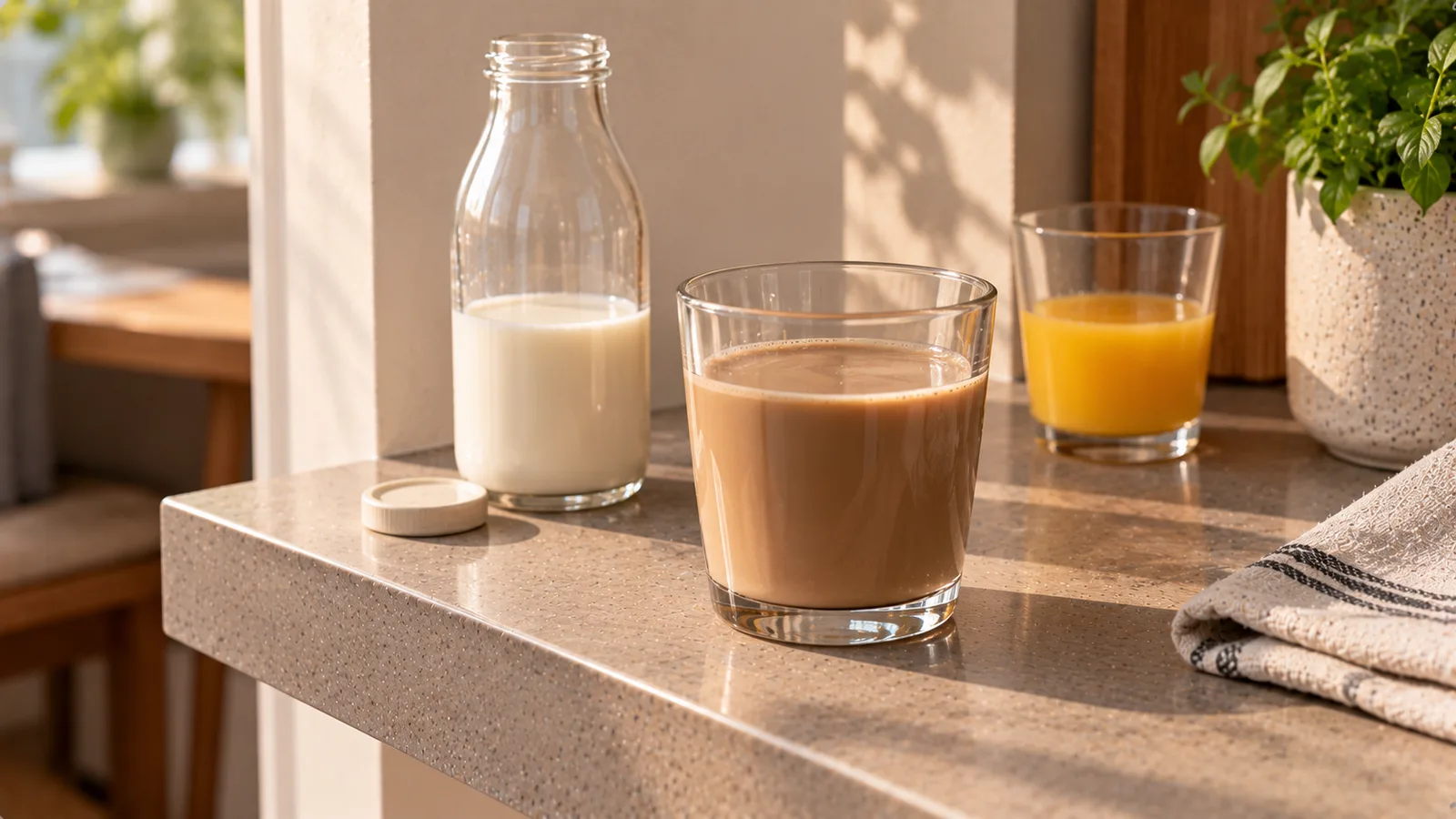
Drinks can be easy to overlook when tracking food because they do not always feel like part of a meal. But milk, juice, smoothies, sweetened coffee, soft drinks and other calorie-containing beverages can contribute meaningful energy.
The most reliable approach is simple: identify the exact drink, measure the amount actually consumed and use nutrition information that matches that product and unit.
You do not need to estimate every beverage. Plain water and many unsweetened drinks contribute little or no energy. The important distinction is whether something has been added or whether the drink itself contains calories.
Start with the amount you actually drank
A bottle, carton or café cup is not automatically the amount you consumed.
If a bottle contains 500 ml but you drink only 300 ml, calculate the nutrition for 300 ml.
For a drink containing 46 kcal per 100 ml:
300 × 46 ÷ 100 = 138 kcal
If you finish the entire 500 ml bottle:
500 × 46 ÷ 100 = 230 kcal
This sounds obvious, but logging the package serving instead of the amount consumed is one of the easiest ways to distort a drink entry.
Use the nutrition label when you have one
For packaged beverages, the product label is usually the best starting point.
Check whether the calories are given:
- per 100 ml;
- per serving;
- per bottle or carton;
- for the prepared drink rather than the concentrate.
If the label gives calories per 100 ml, the calculation is:
millilitres consumed × calories per 100 ml ÷ 100
For example, a 330 ml drink containing 42 kcal per 100 ml provides:
330 × 42 ÷ 100 = about 139 kcal
When a product has its own label, prefer that information over a generic database entry whenever practical.
For a broader guide to labels, see How to Read a Nutrition Label for Calorie and Macro Tracking.
Millilitres and grams are not always interchangeable
For water, 1 ml is approximately 1 g, but that relationship should not automatically be applied to every liquid food.
Milk, syrups, concentrated drinks and other liquids can have densities different from water.
If the label gives nutrition per 100 ml, the simplest method is to measure the drink in millilitres.
If your tracking app accepts only grams, use a reliable product-specific conversion when available rather than assuming every liquid has a density of exactly 1 g/ml.
The unit mismatch is covered in more detail in How to Log Food Sold by Volume When Your App Uses Grams.
Milk in coffee and tea
Plain black coffee and unsweetened tea contain very little energy. What often changes the total is what goes into the cup.
Suppose you drink coffee with:
- 120 ml milk at 64 kcal per 100 ml;
- 8 g sugar at about 4 kcal per gram.
Milk:
120 × 64 ÷ 100 = about 77 kcal
Sugar:
8 × 4 = about 32 kcal
Total additions:
77 + 32 = about 109 kcal
If you drink three similar coffees during the day, those additions become approximately:
109 × 3 = 327 kcal
The useful tracking habit is therefore not simply “log coffee.” Record the ingredients that materially change it.
Measure milk instead of estimating a splash
“A splash of milk” can mean very different amounts.
If you regularly add milk to coffee, you can measure your usual amount once.
For example:
- place the cup on a scale and tare it;
- add the milk;
- record the amount;
- repeat for a few typical drinks.
You may discover that your normal addition is relatively consistent.
Once you know that your usual coffee contains, for example, about 80 ml of milk, future estimates can be much more useful than selecting an arbitrary “coffee with milk” database entry.
If you use different amounts each time, measure them separately.
Sweetened coffee drinks need the full recipe
A latte, mocha or flavoured coffee can contain calories from several components:
- milk;
- sugar;
- syrup;
- chocolate;
- cream;
- toppings.
Do not log only the coffee base.
For a homemade drink, calculate the ingredients individually.
For a packaged drink, use its label.
For a café drink, use official nutrition information when the chain provides it. If that is unavailable, choose the closest realistic match and treat the result as an estimate.
Cup size matters. A small and a large drink made from the same ingredients can have very different totals.
Soft drinks and other sweetened beverages
For a packaged soft drink, the label makes the calculation straightforward.
Imagine a drink contains 40 kcal per 100 ml.
| Amount consumed | Approx. calories |
|---|---|
| 150 ml | 60 kcal |
| 250 ml | 100 kcal |
| 330 ml | 132 kcal |
| 500 ml | 200 kcal |
| 750 ml | 300 kcal |
The calculation is always based on the amount actually consumed.
German Nutrition Society guidance notes that sugar-sweetened drinks can contain substantial amounts of sugar and energy, while water and unsweetened tea are suitable calorie-free or very-low-calorie options.
For tracking purposes, however, the goal is not to label a drink as “good” or “bad.” It is to record what you actually consumed.
Juice still contains calories
Fruit juice can contain vitamins and minerals, but it also contains naturally occurring sugars and energy.
Do not treat juice as equivalent to water simply because it has no added sugar.
If orange juice contains 45 kcal per 100 ml:
| Juice | Approx. calories |
|---|---|
| 100 ml | 45 kcal |
| 150 ml | 68 kcal |
| 200 ml | 90 kcal |
| 250 ml | 113 kcal |
| 300 ml | 135 kcal |
Nutrition guidance differs somewhat between countries. For example, the UK's NHS recommends limiting fruit juice and smoothies to a combined 150 ml per day, while German DGE guidance treats juice as an energy-containing food and recommends water or other calorie-free drinks as the main source of hydration.
Those recommendations are separate from calorie tracking. When you drink juice, record the actual amount and the nutrition information for that juice.
Smoothies should be tracked as food, not water
Smoothies vary too much for one generic calorie estimate to be reliable.
A smoothie may contain:
- fruit;
- vegetables;
- milk;
- yoghurt;
- juice;
- oats;
- nut butter;
- seeds;
- protein powder;
- sweeteners.
Two drinks of the same size can therefore have very different calorie and macro totals.
For a homemade smoothie, track the recipe.
Example:
- banana: 105 kcal;
- 200 ml milk: 128 kcal;
- 100 g berries: 50 kcal;
- 20 g peanut butter: 118 kcal.
Total smoothie:
105 + 128 + 50 + 118 = 401 kcal
If the finished smoothie weighs 500 g and you drink 300 g:
401 × 300 ÷ 500 = about 241 kcal
This is more accurate than searching for a generic “300 ml smoothie.”
For a commercial smoothie, use the product label and actual amount consumed.
Protein shakes depend on what you mix them with
A protein shake should include both the powder and the liquid used to prepare it.
Suppose the shake contains:
- protein powder: 120 kcal;
- 300 ml milk at 47 kcal per 100 ml.
Milk:
300 × 47 ÷ 100 = 141 kcal
Total:
120 + 141 = 261 kcal
If the same powder is mixed with water, the total may remain close to the powder's 120 kcal.
That is why “one protein shake” is not a sufficiently precise entry unless the recipe is defined.
Powdered and concentrated drinks
Some drinks are prepared from powder, syrup or concentrate.
In these cases, check whether the nutrition information refers to:
- the dry powder;
- the concentrate;
- a specified prepared serving.
If a powder provides 380 kcal per 100 g and you use 25 g:
25 × 380 ÷ 100 = 95 kcal
Then add any calorie-containing liquid used to prepare it.
If a syrup or concentrate has nutrition information per 100 ml, record the amount of concentrate rather than the total volume after adding calorie-free water, unless the label specifically provides nutrition for the prepared drink.
Do not forget refills
Refills can make drink tracking less obvious.
Suppose a restaurant glass holds approximately 300 ml and you drink:
- the first glass;
- one full refill;
- about half of another refill.
Estimated total:
300 + 300 + 150 = 750 ml
If the drink contains approximately 42 kcal per 100 ml:
750 × 42 ÷ 100 = about 315 kcal
You do not need perfect precision. Remembering the number of refills is usually more useful than logging only the first glass.
Ice changes volume, not necessarily the drink consumed
A glass filled with ice does not contain the same amount of beverage as an identical glass without ice.
For packaged drinks poured at home, measuring the liquid before adding ice is easiest.
In a restaurant, the exact amount may be unknown. Use the best reasonable estimate based on cup size, ice and refills.
Do not create false precision when the serving cannot realistically be measured.
Zero-calorie and very-low-calorie drinks
Water contributes no calories.
Unsweetened coffee and tea generally contribute negligible energy. Some diet or zero drinks may contain very small amounts even when marketed as zero or low calorie, depending on the product and labelling rules.
For packaged products, use the label.
If a drink genuinely contributes negligible calories and tracking it provides no useful information for your goal, it may not need the same attention as milk, juice, smoothies or sweetened drinks.
Mixed drinks should be broken into components
When a drink is prepared from several calorie-containing ingredients, think of it as a small recipe.
For example:
- 200 ml milk: 128 kcal;
- espresso: negligible calories;
- 15 g flavoured syrup: 45 kcal;
- 10 g whipped cream: 35 kcal.
Estimated total:
128 + 45 + 35 = 208 kcal
If you change the milk or syrup amount, update the calculation rather than continuing to use the old entry.
This article focuses on non-alcoholic drinks. Alcohol has different tracking considerations and should be handled separately rather than folded into a generic liquid-calorie estimate.
What if you do not know the exact amount?
Not every drink can be measured.
For an unknown café or restaurant serving:
- identify the drink as specifically as possible;
- estimate the cup volume;
- note whether it contains milk, syrup, sugar, juice or cream;
- use official restaurant nutrition information if available;
- otherwise choose a realistic comparable drink;
- treat the result as an estimate.
A reasonable estimate is generally more useful than either ignoring the drink or pretending an uncertain number is exact.
A practical daily workflow
When tracking a calorie-containing drink:
- Identify the exact beverage or recipe.
- Check the label or reliable nutrition source.
- Record the amount actually consumed.
- Match the unit: ml, g or serving.
- Add milk, sugar, syrup, powder and other calorie-containing additions.
- Account for refills.
- Use recipe totals for smoothies and mixed homemade drinks.
- Keep uncertain restaurant estimates appropriately approximate.
The key principle is consistency.
Liquid calories are not fundamentally different from calories in solid food. The tracking challenge is simply that drinks are easy to consume without thinking about portion size and often contain additions that are not represented by a generic beverage entry.
Measure what you can, use the product label when available and estimate only where measurement is impractical.