
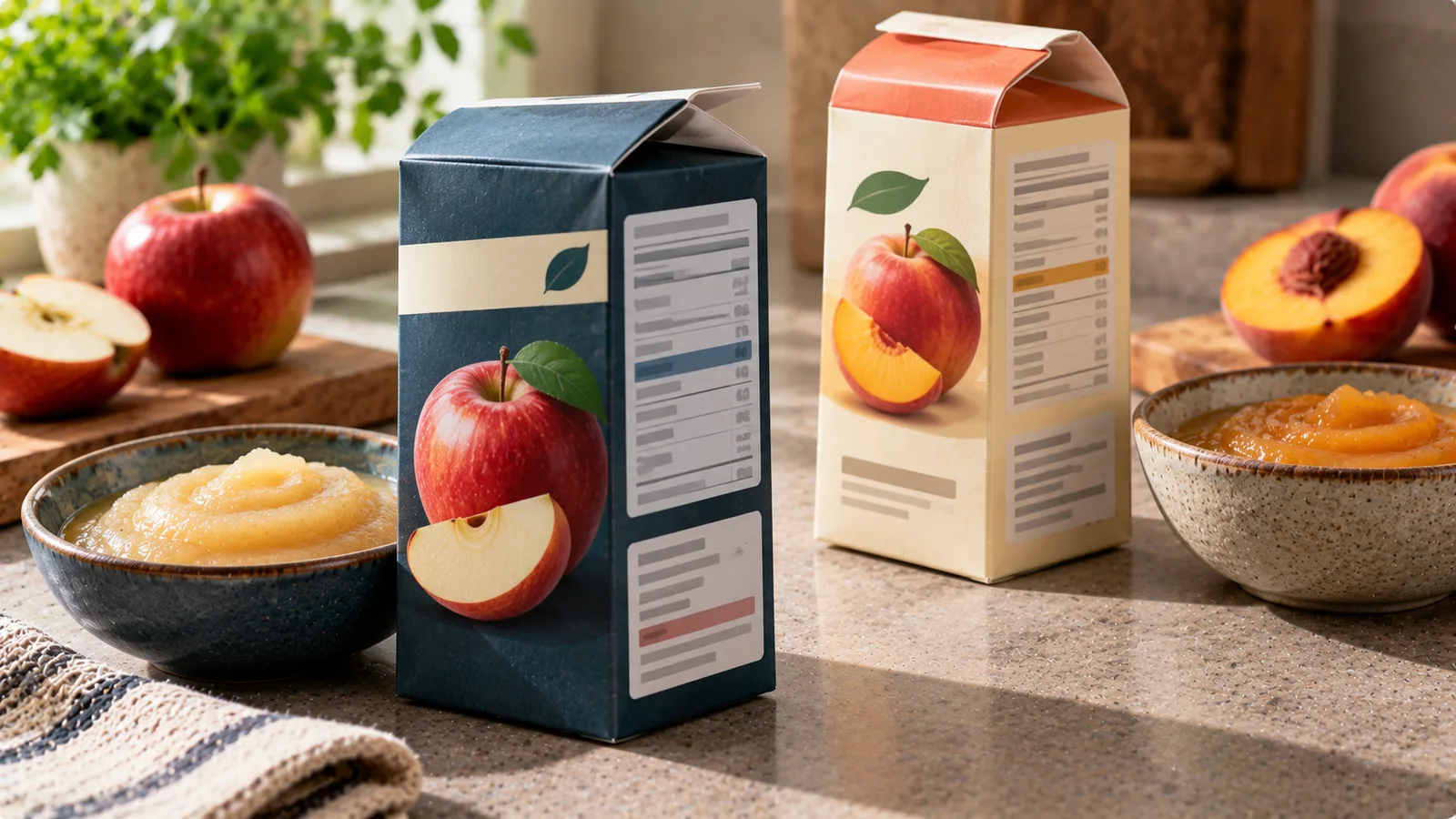
“Sugar-free” and “no added sugar” may sound similar, but they describe different things.
The simplest distinction is:
- sugar-free is about how little sugar is present in the finished food;
- no added sugar is about whether sugars or ingredients used for their sweetening effect were added during production.
That means a product can have no added sugar and still contain naturally occurring sugars.
It is also possible for a sugar-free product to taste sweet because manufacturers may use sweeteners that are not classified as sugars.
Exact legal definitions depend on the country or region, so the wording on a package should be interpreted under the rules that apply where the product is sold.
Sugar-free vs no added sugar at a glance
| Claim | Main question it answers |
|---|---|
| Sugar-free | How much sugar does the finished product contain? |
| No added sugar | Was sugar or another qualifying sugar-containing ingredient added during production? |
These claims therefore cannot be used interchangeably.
What does sugar-free mean?
A “sugar-free” claim generally indicates that the finished food contains only a very small amount of sugars, according to the legal threshold that applies in the market where it is sold.
In the European Union, the nutrition claim “sugars-free” may generally be used only when a product contains no more than 0.5 g of sugars per 100 g or 100 ml.
The exact terminology and requirements can differ in other jurisdictions.
The important point is that “sugar-free” does not necessarily mean mathematically zero sugar.
A small amount may still be permitted under the applicable labeling threshold.
What does no added sugar mean?
“No added sugar” describes the production of the food rather than simply its final sugar concentration.
Under EU rules, a “with no added sugars” claim generally means that the product contains no added mono- or disaccharides and no other food used for its sweetening properties.
If sugars occur naturally in the food, the label should also indicate that the product contains naturally occurring sugars.
This distinction is important because many foods naturally contain sugar.
A product can contain sugar without added sugar
Consider plain milk.
Milk naturally contains lactose.
If no sugar or other qualifying sweetening ingredient is added, the product can still contain several grams of sugars per 100 ml even though those sugars were not added during manufacturing.
The same principle can apply to foods containing:
- milk;
- fruit;
- vegetables;
- other ingredients that naturally contain sugars.
“No added sugar” therefore does not mean “zero sugar.”
Example: plain dairy product
Imagine a plain dairy product contains:
- 4.5 g sugars per 100 g;
- no added sugar.
Those sugars may come naturally from lactose in the milk.
The product could potentially meet the conditions for a no-added-sugar claim if the applicable legal requirements are satisfied.
But with 4.5 g of sugars per 100 g, it would not meet the EU threshold for a sugar-free claim.
This example shows why the two terms answer different questions.
Example: fruit product
Fruit naturally contains sugars.
A product made from fruit without adding sugar can therefore still show a substantial amount of sugars in its nutrition information.
For example, suppose a fruit product contains:
10 g sugars per 100 g
If those sugars originate naturally from the ingredients and no qualifying sugars were added, a no-added-sugar claim may still be possible under the applicable rules.
That does not make the product sugar-free.
Does no added sugar mean unsweetened?
Not always.
The wording and legal treatment of claims vary by jurisdiction.
A product marketed without added sugars may still have a sweet taste because:
- its ingredients naturally contain sugars;
- its ingredients are naturally sweet;
- certain non-sugar sweeteners may be used where permitted.
For this reason, the ingredient list and nutrition information are more informative than relying on the front-of-pack claim alone.
Can sugar-free foods contain sweeteners?
Yes.
“Sugar-free” refers to sugar content under the applicable definition. It does not automatically mean that the product contains no sweet-tasting ingredients.
Depending on the product and local rules, sweetness may come from ingredients such as:
- low-calorie or non-caloric sweeteners;
- polyols, also called sugar alcohols;
- other permitted sweetening ingredients.
The presence of a sweetener does not automatically mean that the product contains a significant amount of sugar.
Sugar alcohols are not the same as sugars
Polyols such as erythritol, xylitol, sorbitol and maltitol are commonly called sugar alcohols.
They are chemically and nutritionally different from ordinary sugars.
Their treatment on nutrition labels differs by jurisdiction.
They may also contribute different amounts of energy.
For example, a product labeled sugar-free may still contain polyols and therefore may not be calorie-free.
Sugar-free does not mean calorie-free
Removing or reducing sugar does not automatically remove all calories.
A sugar-free product can still contain:
- fat;
- starch;
- protein;
- polyols;
- other energy-providing ingredients.
Consider a sugar-free chocolate product.
Even if its sugar content meets the legal threshold for a sugar-free claim, cocoa butter, nuts, milk ingredients or other components may still make it energy-dense.
Always check total calories if energy intake matters to you.
No added sugar does not mean low calorie
The same applies to “no added sugar.”
A food can contain no added sugar and still be high in calories.
Examples can include foods rich in:
- naturally occurring sugars;
- fat;
- starch;
- nuts or seeds;
- concentrated fruit ingredients where permitted under the relevant claim rules.
The claim describes sugar addition, not the total energy density of the food.
What does the nutrition table show?
The nutrition table provides information about the finished food.
In the EU, carbohydrate labeling normally includes a line for “of which sugars.”
This value includes sugars present in the final product, regardless of whether they:
- occurred naturally in the ingredients;
- were added during production.
That is why the “of which sugars” value alone does not tell you how much sugar was added.
Why the ingredient list matters
If you want to understand a no-added-sugar claim, check the ingredient list as well as the nutrition table.
Depending on the product, ingredients that contribute sweetness may include:
- sugar;
- glucose syrup;
- fructose;
- honey;
- syrups;
- fruit-derived ingredients;
- sweeteners.
Whether a specific ingredient is compatible with a regulated “no added sugar” claim depends on how the ingredient is used and on the rules of the jurisdiction.
Do not assume that every ingredient containing naturally occurring sugars automatically counts as “added sugar,” or that every sweet ingredient is treated identically.
Naturally occurring sugar vs added sugar
The chemical molecule can be the same even when its source differs.
For example, glucose and fructose can occur naturally in fruit and can also be added separately during manufacturing.
From a labeling perspective, the distinction behind a no-added-sugar claim concerns how the sugars entered the product.
This is different from total sugar content.
European Union example
Under EU nutrition-claim rules, “sugars-free” generally requires no more than:
0.5 g sugars per 100 g or 100 ml
For “with no added sugars,” the product must generally contain no added mono- or disaccharides or other foods used for their sweetening properties.
When sugars are naturally present, the indication:
“contains naturally occurring sugars”
should accompany the claim.
These are regulated nutrition claims, not simply marketing phrases manufacturers can define however they want.
What about the United States?
Food-label terminology and the structure of nutrition information differ between the United States and the European Union.
In the United States, the Nutrition Facts label includes Total Sugars and a separate Includes X g Added Sugars line for many foods.
This makes it possible to distinguish total sugars from the amount classified as added sugars directly on the nutrition panel.
Claims such as “sugar free” and “no added sugar” are also subject to specific regulatory requirements.
Do not automatically apply an EU threshold to a US product or vice versa.
Total sugars and added sugars answer different questions
Suppose a US nutrition label says:
- Total Sugars: 12 g
- Includes 0 g Added Sugars
This means the product contains sugar, but none of the amount shown is classified as added sugar under the applicable labeling rules.
A consumer looking only at “12 g sugar” might incorrectly assume that 12 g of sugar was added.
A consumer looking only at “0 g added sugar” might incorrectly assume that the food contains no sugar.
Both interpretations would be wrong.
Example comparison
Imagine three hypothetical products:
| Product | Total sugars | Added sugar | Possible interpretation |
|---|---|---|---|
| A | 0.3 g/100 g | 0 g | May potentially qualify as sugar-free under an applicable low-sugar threshold |
| B | 6 g/100 g | 0 g | Contains sugar but it may be naturally occurring |
| C | 12 g/100 g | Some added | Neither “sugar-free” nor necessarily “no added sugar” |
The exact legal claim depends on the jurisdiction and complete formulation.
The table illustrates why total and added sugars should not be treated as synonyms.
Does no added sugar mean healthier?
Not automatically.
A no-added-sugar product may be a useful choice in some situations, but the claim does not describe the entire nutritional quality of the food.
You may also want to consider:
- calories;
- protein;
- fiber;
- saturated fat;
- sodium or salt;
- portion size;
- overall ingredient profile.
Two foods can both say “no added sugar” and still have very different nutritional profiles.
Is sugar-free always the better choice?
No.
A sugar-free version can be useful when reducing sugar intake, but it should not automatically be considered superior in every context.
The replacement ingredients matter.
For example, sugar may be replaced or accompanied by:
- sweeteners;
- polyols;
- starches;
- fats;
- other ingredients.
Compare the complete nutrition information rather than judging a product from one front-of-pack phrase.
Can a product be both sugar-free and no added sugar?
Potentially, yes.
If a product contains sufficiently little sugar to meet the relevant sugar-free threshold and also meets all conditions for a no-added-sugar claim, both concepts may apply.
But one claim does not automatically guarantee the other.
A naturally sweet food can have no added sugar while containing too much naturally occurring sugar to be sugar-free.
Can fruit juice be no added sugar?
A juice can naturally contain substantial sugar from fruit.
Whether and how a no-added-sugar claim can be used depends on the product category and applicable food-labeling rules.
The important nutritional point is that “no added sugar” does not mean that fruit juice contains no sugars.
Check the total sugars and portion size rather than interpreting the claim as zero sugar.
What about dried fruit?
Dried fruit can contain a high concentration of naturally occurring sugars because much of the water has been removed.
An unsweetened dried fruit may therefore contain no added sugar while still providing a large amount of total sugar per 100 g.
Again:
no added sugar ≠ sugar-free
What about flavored yogurt?
A flavored yogurt can obtain sweetness from different sources.
Depending on the formulation, it may contain:
- naturally occurring lactose;
- fruit sugars;
- added sugar;
- sweeteners.
Two yogurts that taste similarly sweet can therefore have very different label claims and nutrition values.
Check both the ingredient list and nutrition panel.
What about jam and fruit spreads?
Traditional jam commonly contains added sugar.
Products marketed as having no added sugar may use different formulations, such as fruit ingredients and permitted sweeteners.
They can still contain naturally occurring sugars from fruit.
The total sugar and calorie content can therefore remain meaningful even when no sugar was added in the conventional sense.
How to compare two products
When comparing a sugar-free product with a no-added-sugar product, use this order:
- identify the exact claim;
- check the serving size;
- check total sugars;
- where available, check added sugars;
- check total calories;
- review the ingredient list;
- compare other nutrients relevant to your goal.
This prevents one marketing claim from dominating the entire decision.
Example: comparing breakfast products
Suppose Product A says “no added sugar” and contains per 100 g:
- 8 g total sugars;
- 5 g fiber;
- 380 kcal.
Product B says “sugar-free” and contains:
- 0.4 g sugars;
- 2 g fiber;
- 410 kcal.
The sugar-free claim tells you Product B has very little sugar.
It does not tell you that Product B has fewer calories, more fiber or is automatically the better breakfast.
The appropriate choice depends on what you are comparing.
How to log these foods
When tracking food, use the actual nutrition values rather than converting a claim into an assumed number.
Do not log:
- “sugar-free” as zero calories;
- “no added sugar” as zero carbohydrates;
- “no added sugar” as zero total sugar.
Instead, enter the calories, carbohydrates and sugars shown for the amount you actually consume.
Front-of-pack claims are shortcuts, not complete nutrition profiles
Claims are designed to communicate a specific characteristic quickly.
“Sugar-free” focuses on sugar content.
“No added sugar” focuses on the absence of qualifying added sugars or sweetening ingredients.
Neither tells you everything about:
- energy;
- protein;
- fiber;
- fat quality;
- sodium;
- micronutrients;
- overall dietary value.
The nutrition panel and ingredient list provide the broader context.
A simple way to remember the difference
Ask two different questions.
For sugar-free:
How much sugar is actually in the finished product?
For no added sugar:
Was sugar added while the product was being made?
Those questions are related, but they are not the same.
A product can contain naturally occurring sugar without added sugar, while a sugar-free product can still contain other ingredients that provide sweetness or calories.
Reading the exact claim together with the nutrition table and ingredient list gives a much clearer picture than relying on the front of the package alone.