
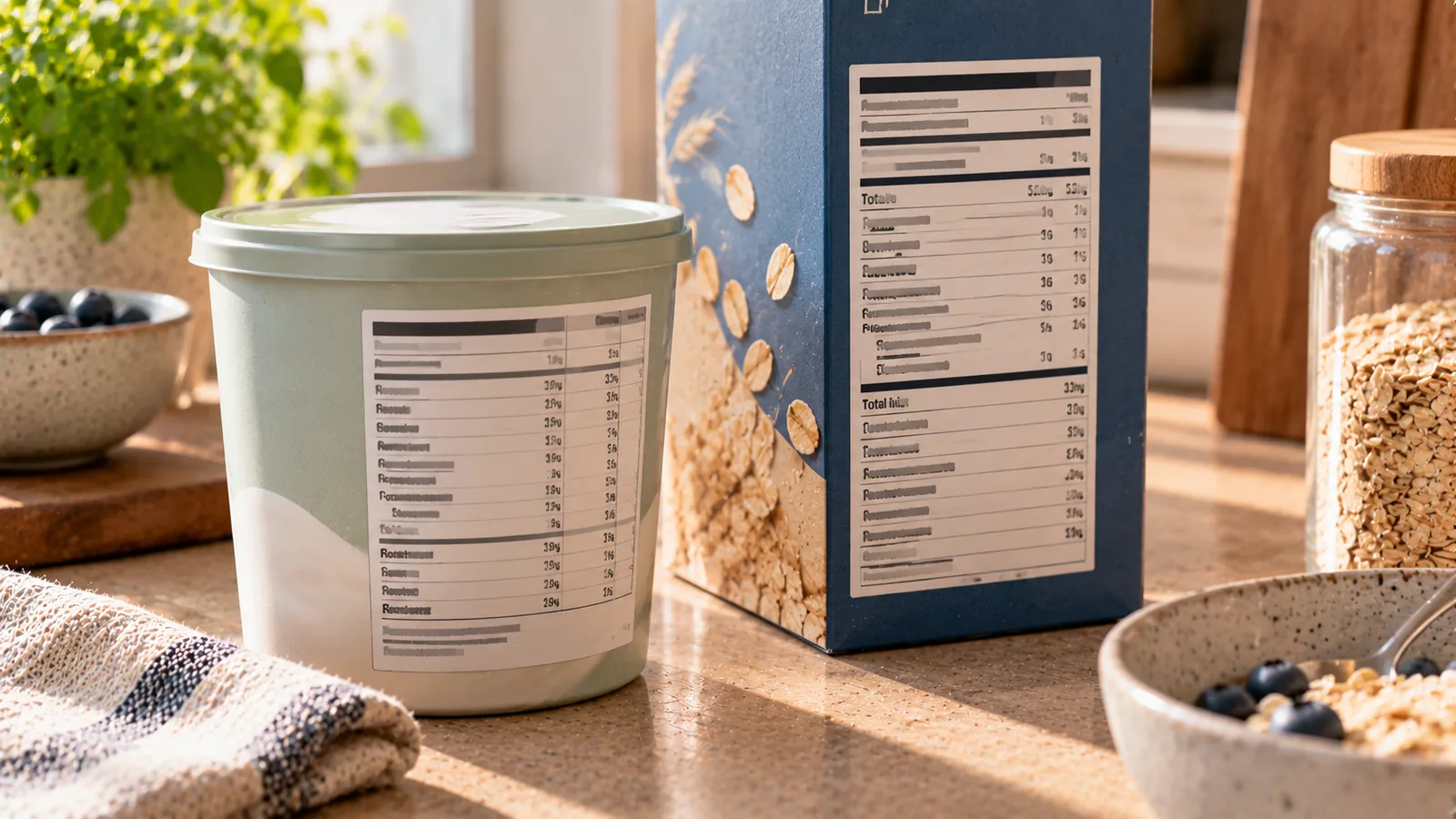
A yogurt can contain sugar even when no sugar was added to it. A sweetened yogurt can contain both naturally occurring sugar and sugar added during manufacturing.
That distinction explains the difference between total sugar and added sugar.
The complication is that nutrition labels do not present this information in exactly the same way everywhere. In the United States, packaged foods generally show both total sugars and added sugars. In the European Union, the nutrition declaration normally shows "of which sugars", but does not generally provide a separate mandatory line for added sugars.
Understanding that difference helps prevent a common mistake: assuming that every gram of sugar shown on a nutrition label was added by the manufacturer.
Added sugar vs total sugar at a glance
| Term | What it represents |
|---|---|
| Total sugar | The sugars present in the food from all relevant sources |
| Added sugar | Sugars added during processing or preparation, according to the applicable labeling definition |
| Naturally occurring sugar | Sugar naturally present in foods such as fruit and milk |
| "Of which sugars" on an EU label | The amount of sugars within total carbohydrate; it is not a separate measure of added sugar |
The exact terminology and regulatory definitions vary by jurisdiction, so the label format matters.
What is total sugar?
Total sugar represents the sugars contained in a serving or stated quantity of food, regardless of whether those sugars occurred naturally in an ingredient or were added during manufacturing.
Consider plain milk.
Milk naturally contains lactose. A nutrition label can therefore show several grams of sugar even when the ingredient list contains no added sugar.
The same principle applies to foods containing ingredients such as:
- fruit;
- milk;
- plain yogurt;
- vegetables;
- other ingredients containing naturally occurring sugars.
So:
total sugar does not automatically mean added sugar.
What is added sugar?
Added sugars are sugars added to foods or beverages during processing, preparation or manufacturing under the applicable regulatory definition.
Common examples can include:
- table sugar;
- glucose syrup;
- corn syrup;
- honey;
- syrups;
- concentrated sweetening ingredients that meet the relevant regulatory definition.
The important distinction is the source of the sugar.
If a product contains sugar naturally and also has sugar added during production, total sugar includes both.
A simplified example:
- naturally occurring sugar: 6 g;
- added sugar: 8 g;
- total sugar: approximately 14 g.
The exact relationship on a real label depends on the product, serving basis and applicable labeling rules.
How U.S. labels show added sugar
On a U.S. Nutrition Facts label, you may see a structure such as:
Total Carbohydrate: 25 g
Total Sugars: 14 g
Includes 8 g Added Sugars
The 8 g of added sugars are included within the 14 g of total sugars.
They are not an additional 8 g on top of the 14 g.
This is one of the most important points when reading the label.
Example
Suppose a yogurt label says:
- Total Sugars: 12 g
- Includes 7 g Added Sugars
That does not mean the yogurt contains 19 g of sugar.
It means:
- 12 g total sugar;
- of that total, 7 g are classified as added sugars;
- the remaining sugar may come from naturally occurring sources such as lactose in milk.
How EU labels show sugar
European Union nutrition declarations use a different format.
A typical label may show:
Carbohydrate: 15 g
of which sugars: 7 g
The "of which sugars" value indicates how much of the carbohydrate consists of sugars.
It does not tell you directly how much of those sugars were added.
This means that an EU consumer often needs to combine two pieces of information:
- the nutrition declaration;
- the ingredient list.
The nutrition table tells you the total amount of sugars.
The ingredient list can help identify whether sugar-containing sweetening ingredients have been added.
"Of which sugars" does not mean "added sugars"
This is especially important when comparing European and American labels.
Imagine an EU yogurt label showing:
- carbohydrate: 10 g;
- of which sugars: 8 g.
You cannot conclude from that table alone that 8 g of sugar were added.
Some or all of that sugar could come naturally from milk or fruit ingredients.
The phrase "of which sugars" is not the EU equivalent of the U.S. "Added Sugars" line.
They answer different questions.
Example: plain yogurt
Imagine plain yogurt with this simplified nutrition profile per 100 g:
- carbohydrate: 5 g;
- of which sugars: 5 g.
Ingredient list:
Milk, live cultures.
The sugar shown on the label can largely reflect lactose naturally present in milk.
Seeing 5 g of sugars does not by itself indicate that the manufacturer added 5 g of table sugar.
Example: sweetened yogurt
Now imagine another yogurt:
- carbohydrate: 14 g;
- of which sugars: 12 g.
Ingredient list:
Milk, strawberries, sugar, modified starch, cultures.
This product contains a specifically listed added sugar ingredient.
However, the EU nutrition declaration still does not normally tell you exactly how many of the 12 g of sugars came from the added sugar and how many came from milk or fruit.
That information cannot reliably be calculated just by looking at the total sugar number.
Example: fruit product
Suppose an unsweetened fruit product contains:
- carbohydrate: 13 g;
- of which sugars: 11 g.
A high proportion of its carbohydrate may be sugar naturally present in the fruit.
Again, the sugar line alone does not establish that 11 g were added during production.
This is why the ingredient list matters.
How to use the ingredient list
If the nutrition table does not separately state added sugars, the ingredient list can provide useful context.
Look for ingredients used to sweeten the product, such as:
- sugar;
- glucose syrup;
- fructose syrup;
- honey;
- agave syrup;
- other syrups or sweetening ingredients.
Ingredient lists are generally ordered according to the applicable labeling rules, commonly by weight at the time of manufacture.
If sugar or syrup appears near the beginning of the list, it can indicate that it represents a substantial ingredient by weight.
But the ingredient list usually does not tell you the exact number of grams of added sugar per serving.
It should therefore not be used to invent a precise added-sugar value that the package does not provide.
Can a food contain total sugar but no added sugar?
Yes.
Examples can include:
- plain milk;
- plain yogurt;
- whole fruit;
- some unsweetened fruit products;
- foods containing other naturally sugar-containing ingredients.
The presence of sugar in the nutrition declaration does not prove that sugar was added.
Can added sugar be lower than total sugar?
Yes.
In fact, when both values are provided, added sugar is part of the total sugar amount rather than a separate additional amount.
For example:
Total sugars: 15 g
Includes 9 g added sugars
The food has 15 g of total sugars, not 24 g.
Can total sugar and added sugar be the same?
They can be in some products.
If essentially all the sugar in a food comes from added sugars, the values may be similar or identical under the applicable labeling rules.
But you should not assume this without the relevant label information.
Sugar and total carbohydrate are not the same thing
Sugar is generally part of the carbohydrate value rather than something that should be added to carbohydrate again.
For example:
Carbohydrate: 30 g
Total sugars: 12 g
The 12 g of sugars are included within the 30 g of carbohydrate.
It would be incorrect to calculate 30 + 12 = 42 g of carbohydrate.
The same nested relationship appears elsewhere on nutrition labels and is a common source of tracking errors.
A practical way to compare two products
Suppose you are comparing two yogurts.
Yogurt A
Per 100 g:
- 70 kcal;
- carbohydrate: 6 g;
- sugars: 5 g;
- protein: 8 g.
Ingredients:
Milk, cultures.
Yogurt B
Per 100 g:
- 105 kcal;
- carbohydrate: 14 g;
- sugars: 12 g;
- protein: 7 g.
Ingredients:
Milk, fruit preparation, sugar, cultures.
The useful conclusion is not simply that Yogurt A contains sugar and Yogurt B contains sugar.
Both do.
The labels indicate different overall compositions, and the ingredient list for Yogurt B identifies added sugar as an ingredient.
Depending on your purpose, you might also compare:
- calories;
- protein;
- portion size;
- fiber;
- fat;
- ingredients;
- price;
- taste and how the food fits your overall diet.
Sugar is one part of the comparison rather than the only number that matters.
Check the serving basis before comparing labels
One product may display values:
- per 100 g;
- per serving;
- per package.
Another may emphasize a different basis.
Before comparing sugar numbers, make sure you are comparing equivalent quantities.
For example:
Product A: 6 g sugar per 100 g
Product B: 8 g sugar per 150 g serving
Those numbers cannot be compared directly until they are converted to the same amount.
Product B contains about 5.3 g sugar per 100 g.
On an equal-weight basis, Product B would therefore contain less sugar despite showing the larger number on the front-facing serving comparison.
Do not infer exact added sugar when the label does not provide it
Suppose an EU product says:
- sugars: 10 g per 100 g;
and its ingredients include milk, fruit and sugar.
You know the product contains an added sugar ingredient.
You do not know from those facts alone exactly how many of the 10 g are added sugar.
Estimating an exact value without sufficient information creates false precision.
If your goal is food logging, use the nutrient information actually provided by the manufacturer rather than inventing a missing added-sugar number.
What about honey, syrups and similar sweeteners?
A product does not become free of added sugars simply because its sweetening ingredient has a different name from table sugar.
Honey, syrups and other caloric sweetening ingredients can still contribute sugars.
The exact classification depends on the labeling jurisdiction and product formulation, but replacing the word "sugar" with a different sweetener name does not make the sugars nutritionally disappear.
What about fruit?
Whole fruit contains naturally occurring sugars together with water, fiber and other nutrients.
That is different from simply adding table sugar to a product.
It is also why the total-sugar number should not be interpreted without context.
Two foods can contain the same grams of total sugar while being very different foods overall.
Does "no added sugar" mean sugar-free?
No.
A product can contain no added sugars and still contain naturally occurring sugars.
For example, a product made with milk or fruit may contain sugars even if no sugar was added during manufacturing.
Claims such as "no added sugars" and "sugar-free" are therefore not interchangeable.
They are regulated claims with different conditions.
Does lower sugar always mean a better product?
Not necessarily.
Nutrition is not determined by one nutrient in isolation.
A useful comparison may also consider:
- total energy;
- protein;
- fiber;
- fat composition;
- sodium or salt;
- portion size;
- ingredients;
- overall dietary pattern.
For example, choosing between two breakfast foods solely on the basis of a one-gram difference in sugar may overlook much larger differences in protein, fiber or portion size.
How to read sugar on a label in five steps
When comparing packaged foods:
- Check the quantity basis. Is the information per 100 g, per serving or per package?
- Find total carbohydrate and sugars. Remember that sugars are included within carbohydrate.
- Check whether added sugars are separately declared. This is common on U.S. Nutrition Facts labels but not the standard mandatory format on EU nutrition declarations.
- Read the ingredient list. It can show whether sugar or sweetening ingredients were added.
- Compare the whole food. Consider calories, protein, fiber, fat, portion size and other factors relevant to your goal.
This approach is more reliable than treating the sugar line as a simple score for whether a food is "good" or "bad."
The key distinction
The easiest way to remember the difference is:
Total sugar tells you how much sugar is present.
Added sugar tells you how much sugar was added under the applicable labeling definition.
And on many European labels, only the first of those quantities is directly available in the nutrition declaration.
When the package does not provide a separate added-sugar value, use the ingredient list for context rather than trying to calculate a number the label does not contain.
Sources
- U.S. Food and Drug Administration (FDA), guidance on the Nutrition Facts label and Added Sugars.
- Regulation (EU) No 1169/2011 on the provision of food information to consumers.
- European Commission, food labeling and nutrition information guidance.
- World Health Organization (WHO), guidance on free sugars and healthy diets.