
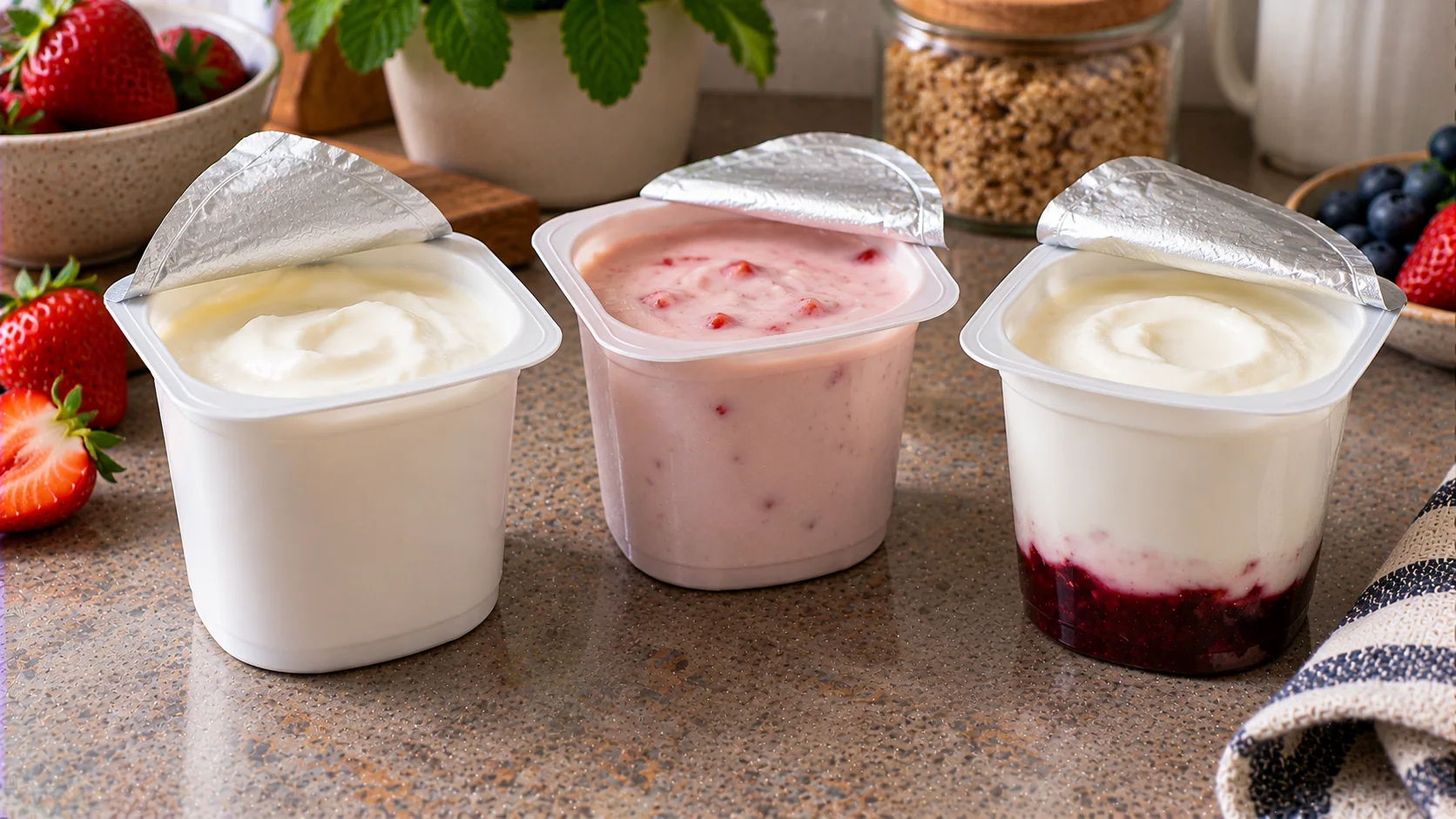
How to Read Added Sugar Claims on European Yogurt Labels
What a yogurt label can—and cannot—tell you
A plain yogurt can contain several grams of sugar per 100 g without any sugar being added. The milk sugar lactose is naturally present. Conversely, a fruit-flavoured yogurt may have a similar figure in the “of which sugars” row yet include sugar, syrup or fruit preparations intended to sweeten it. The EU nutrition table does not require a separate declaration of added sugar. To evaluate a product, combine the ingredients list, the per-100-g nutrition table and any claim printed on the front.
This guide concerns packaged yogurt sold in the EU. It explains the legal claims, gives reproducible calculations for a pot, and shows why total sugars cannot be treated as added sugars. For a broad explanation of sugar claims across foods, the difference between sugar-free and no-added-sugar claims; for comparisons of different yogurt types, our soy-versus-Greek yogurt comparison.
Three parts of the package to read
- Ingredient list: ingredients normally appear in descending order by weight as used. Look for sugar, glucose syrup, fructose, honey, concentrated juice used for sweetening, sweetened fruit preparations and similar ingredients. If a food ingredient is present for its sweetening properties, it matters for the claim even if it is not named “sugar.”
- Nutrition declaration: find “carbohydrate — of which sugars,” usually per 100 g. This counts mono- and disaccharides together, regardless of whether they occur naturally or were added. The line is not an added-sugar figure.
- Front-of-pack claim: read the exact wording. “No added sugars,” “low sugars” and “sugars-free” have different meanings and conditions. A brand name such as “natural,” “protein” or “fitness” is not a substitute for either the ingredients list or the nutrition values.
EU thresholds and rules, side by side
| Label wording | What EU rules mean | What it does not promise |
|---|---|---|
| With no added sugars | No added mono- or disaccharides and no other food added for sweetening; if sugars occur naturally, the label should also say contains naturally occurring sugars | Zero total sugar or zero lactose |
| Low sugars | No more than 5 g sugars per 100 g of solid food (or 2.5 g per 100 ml of liquid) | No sugar added |
| Sugars-free | No more than 0.5 g sugars per 100 g or 100 ml | Zero calories, lactose-free or nutritionally superior |
| No specific sugar claim | Read the ingredients and nutrition facts | Automatically more or less sugar than a claimed product |
These are the claim conditions in Regulation (EC) No 1924/2006, Annex, also summarized by the European Commission. For an ordinary spoonable yogurt, compare grams per 100 g, not the 100-ml rule for liquids. A claim is a regulated statement, not a guarantee that you will prefer the taste or nutritional balance.
Lactose, fruit sugars and added sweeteners
Milk contributes lactose. Unsweetened yogurt fermented from milk commonly retains some lactose; fermentation may reduce it but does not mean the result is sugar-free. Fruit may contribute naturally occurring glucose and fructose, while a fruit preparation may also include added sweeteners. The nutrition table combines all of those sugars.
A yogurt containing strawberries is not automatically a yogurt with added sugar; inspect whether the fruit is unsweetened and whether sugar or sweetening ingredients were included. Similarly, an ingredient such as concentrated fruit juice may have a sweetening function: do not infer that “fruit-based” means “not added.” If the packaging says no added sugars, check for the required naturally occurring sugars qualification where applicable.
A lactose-free yogurt has undergone processing to reduce or break down lactose, often into glucose and galactose. “Lactose-free” is not interchangeable with “sugars-free,” and a lactose-free product may taste sweeter even without added table sugar. Check the product's declared figures rather than presuming it contains fewer total sugars.
Worked example: compare two 150 g pots
The following figures are hypothetical label examples, not measured products or current supermarket listings.
| Label detail | Pot A: plain yogurt | Pot B: flavoured yogurt |
|---|---|---|
| Pot weight | 150 g | 150 g |
| Sugars per 100 g | 4.5 g | 10.0 g |
| Total sugars per pot | 6.75 g | 15.0 g |
| Ingredient clue | Milk, cultures | Milk, fruit preparation, sugar, cultures |
| Added sugars quantifiable from mandatory table? | No | No |
To calculate the total sugars in the pot, multiply the per-100-g value by 150 ÷ 100 = 1.5. Thus 4.5 × 1.5 = 6.75 g; 10 × 1.5 = 15 g. Their difference is 8.25 g of total sugars per pot, not a verified 8.25 g difference in added sugars. The ingredient list indicates that Pot B includes added sugar, but the ordinary EU nutrition table alone does not reveal its exact quantity.
A 200 g pot with 6 g sugars per 100 g contains 12 g total sugars. Comparing a 150 g pot with a 200 g pot by package total alone can be misleading; start with the same 100 g reference amount, then calculate the amount you actually eat.
A practical five-check shopping method
- Read the exact sugar claim, if any; do not equate “no added sugars” with “sugars-free.”
- Scan the complete ingredients list for sugar, syrups and foods used as sweeteners, not merely words on the front.
- Compare “of which sugars” per 100 g between comparable yogurts, ideally plain with plain or fruit with fruit.
- Multiply by your actual pot size or weighed serving to calculate total sugar consumed.
- Also assess protein, saturated fat, price and portion size according to your needs. Lower sugar is not the sole criterion for a healthy or affordable yogurt.
What the rules do not require
Under Regulation (EU) No 1169/2011, the standard nutrition declaration distinguishes carbohydrate and sugars, but does not require a numerical line for added sugars. Do not assign an invented added-sugar gram figure by subtracting a generic lactose estimate from the printed sugars number. Milk type, fruit and manufacturing vary. If you need an exact added-sugar amount, contact the producer or look for voluntarily supplied and substantiated information.
“Sugar-free” is also not the same as “no added sugars”: the EU sugar-free threshold of 0.5 g/100 g is very low, while a legitimate no-added-sugars yogurt can contain naturally occurring milk sugars well above it. Marketing claims must be read alongside the actual table.
Related food-label questions
The same principle applies to other dairy-based and plant-based alternatives, but ingredients and fortification are different. In plant yogurts, sugars can be naturally present in base ingredients or added during manufacturing. If comparing soy yogurt to Greek yogurt, additionally check protein and calcium fortification rather than judging only sugar. For people managing a medical condition, individualized dietary advice may matter more than a marketing claim.
Sources
- European Commission — Nutrition claims: authorized meanings and thresholds of “low sugars,” “sugars-free” and “with no added sugars.”
- Regulation (EC) No 1924/2006, Annex: legal conditions for claims and naturally occurring sugars indication.
- Regulation (EU) No 1169/2011: mandatory nutrition declaration and ingredients information.