
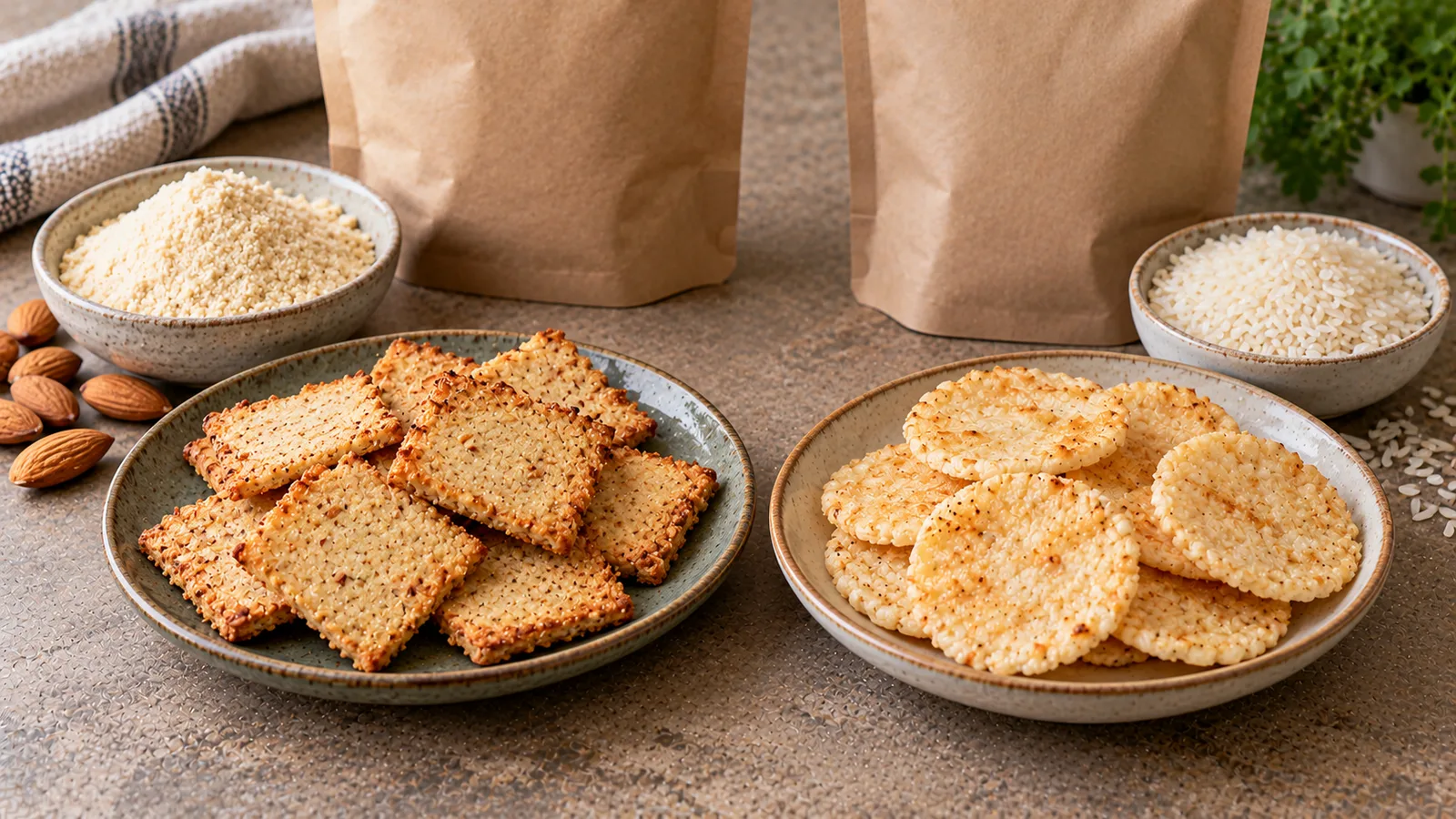
“Grain-free” and “gluten-free” describe different properties of a food. Grain-free is a recipe or marketing description about which grain ingredients are used. Gluten-free is a specific regulated claim on packaged foods in the European Union and on foods under US FDA jurisdiction. One does not prove the other. A grain-free biscuit can be made without conventional grain flour yet lack any assurance about traces from shared production equipment. A gluten-free loaf, meanwhile, may contain rice, maize or other grains. The distinction matters when you are choosing a product rather than comparing two recipe styles.
This guide decodes the actual package wording, explains the limited role of ingredient lists and shows what to do when the front of a pack uses vague claims. It is about labels and food selection, not diagnosis or treatment of coeliac disease or a prescription to eliminate foods.
What the two claims describe
Grain-free usually tells you that the maker has omitted ingredients it considers grains. There is no single EU or US legal definition for this exact marketing term comparable to the specific gluten-free claim discussed below. General rules against misleading food labeling still apply. The category can be less clear when a recipe contains buckwheat, quinoa or other seeds commonly used like cereals. Read the ingredient list rather than assuming every brand interprets “grain” the same way.
Gluten-free addresses gluten, a group of proteins associated with certain cereals, and has conditions for the labeled finished product. It does not mean no carbohydrates, no starch, organic, minimally processed, lower calorie or more nutritious. Gluten-free bread made with rice flour is still grain-based. Likewise, a product can contain no wheat but contain barley or rye ingredients. “Wheat-free” is not a substitute for the specific gluten-free claim.
The key question changes with the purpose: avoiding grains as a recipe preference means checking the grain ingredients; selecting a product specifically represented as gluten-free means checking the actual regulated gluten-free wording and any applicable allergy information.
| Front-of-pack words | What you can infer | What you cannot infer |
|---|---|---|
| Grain-free | Recipe intended to omit grains | Compliance with gluten-free claim |
| Gluten-free | Regulated gluten statement on relevant packaged food | Absence of all grains or carbohydrates |
| Wheat-free | No wheat as represented | Absence of barley, rye or all gluten |
What EU rules actually require
In the EU, Commission Implementing Regulation (EU) No 828/2014 permits a gluten-free statement only when food as sold contains no more than 20 mg/kg of gluten. This is a concentration in the final product, not the weight of cereal or flour in the recipe. The separate statement very low gluten has a 100 mg/kg limit and is restricted to foods using specially processed ingredients from specified gluten-containing cereals; it is not another spelling of gluten-free.
A useful unit conversion is 1 mg/kg = 1 part per million (ppm). Thus the EU gluten-free ceiling of 20 mg/kg is numerically 20 ppm. That number alone cannot certify an untested homemade food and should not be treated as an individual medical tolerance level. The rule also sets particular conditions for oats in foods described as gluten-free or very low gluten: the oats must be handled to avoid contamination with the listed cereals, and their gluten content cannot exceed 20 mg/kg.
Regulation (EU) No 1169/2011 separately governs the declaration of cereals containing gluten, including wheat, rye, barley and oats, in applicable ingredient and allergen information. The ingredient declaration and gluten-free claim answer related but not identical questions. A manufacturer making the claim remains responsible for compliance; reading a list cannot measure accidental cross-contact.
How the US FDA claim differs
For foods regulated by the US Food and Drug Administration, “gluten-free” is a voluntary claim with legally defined conditions in 21 CFR 101.91. Among other restrictions on ingredients, unavoidable gluten must be less than 20 ppm. The FDA explains that a food cannot intentionally include a gluten-containing grain or an ingredient made from one that has not been processed to remove gluten and still use the claim merely because the measured gluten is below the threshold.
The US rule does not mean that every food without gluten must carry a special label. Naturally gluten-free foods can be sold without such a claim, and a label without the words does not by itself prove that gluten is present. Conversely, “grain-free” on a US package does not establish compliance with the FDA gluten-free rule. The FDA also notes that some foods are regulated by other US agencies; do not mechanically apply one agency’s labeling provisions to every product category.
Four shopping examples
Consider four fictional shopping situations, not real brand assessments. A grain-free nut-and-seed cracker lists almonds, seeds and oil but has no gluten-free claim; its recipe omits grains, yet its pack does not provide the same assurance as a compliant gluten-free claim. A gluten-free rice cracker clearly contains rice, so it is gluten-free as labeled but not grain-free. A wheat-free barley snack cannot be assumed gluten-free merely because wheat is absent. Finally, plain oats are grains; in the EU, oats in a product claiming gluten-free must meet the special handling and gluten limit just described.
The examples show why front-of-package words and ingredient panels should be read together. “Made with almonds,” “paleo-style,” “flourless,” “no added wheat” or “natural” are not equivalent to the prescribed gluten-free wording. A certification symbol can offer additional program-specific checks, but the rules of the certification scheme are not identical to the legal meaning of the underlying label statement. Never infer a lab result from a decorative badge.
A practical label-reading method
Start by identifying the exact wording: does the package say grain-free, gluten-free, both, or neither? Next, read the complete ingredient list and, where relevant, the clearly presented allergen declaration. Check for wheat, barley, rye, oats, malt-containing ingredients or flour blends; note that ingredient naming varies by market. Do not conclude that a food is free of cross-contact simply because a certain ingredient is absent.
Then distinguish the region and the product. The EU and the US have similar numerical gluten thresholds but different legal wording and detailed conditions. For foods prepared in a café or sold unpackaged, request specific ingredient and handling information instead of applying a packaged-food label rule automatically. For mixed foods such as sauces, marinades or spice blends, focus on the full product and not just the main ingredient.
Finally, match the decision to the real purpose. For someone merely experimenting with grain-free cooking, recipe composition may be the important point. If reliable gluten avoidance is necessary for a diagnosed medical condition, do not use “grain-free” as a safety shortcut; follow individual guidance from a qualified healthcare professional and the labeling guidance for your location. This article does not assess whether an individual food is medically suitable for a particular person.
For another practical example of how ingredients are labeled, see the nutrition-label reading guide · the whole-grain ingredient guide.
What neither claim tells you
Neither term indicates calories or overall diet quality. A grain-free cookie can be high in sugar and fat; a gluten-free cake can be a dessert; whole-grain products can contain gluten. Compare nutrition information per 100 g, the serving size and the actual ingredients separately from the gluten claim. Do not use the grain-free logo as a weight-loss promise or assume that removing grains improves a diet for everyone.
The two most common mistakes are (1) treating “no grains” as proof that a production line has had no gluten contact, and (2) treating the regulated gluten-free claim as proof of a grain-free or carbohydrate-free recipe. A third mistake is assuming that the EU phrase “very low gluten” qualifies as gluten-free: it is a different permitted statement with a different defined limit and ingredient conditions. Clear shopping decisions begin with the question you need answered, not the biggest lettering on the front of the package.