
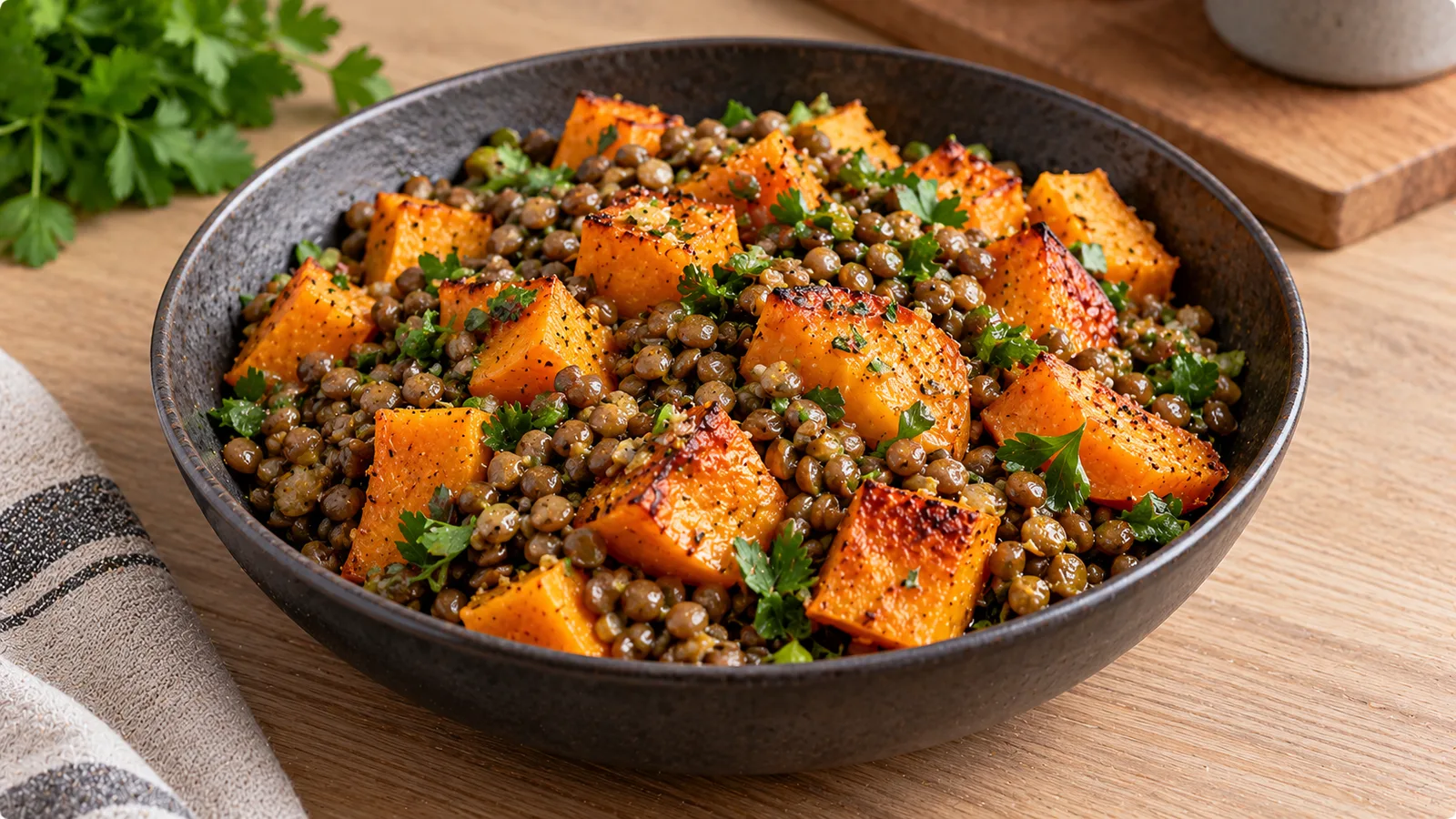
Roasted pumpkin and lentil salad combines sweet, caramelized pumpkin with earthy lentils, fresh spinach, crunchy pumpkin seeds and a sharp lemon-mustard dressing. It works as a substantial lunch, a light dinner or a side dish for a larger meal.
This recipe makes four servings and uses 600 g of edible pumpkin flesh and 400 g of already cooked, drained lentils. Those distinctions matter: pumpkin skin and seeds may be discarded, while dry lentils weigh much less than the same lentils after cooking.
Recipe overview
| Detail | Amount |
|---|---|
| Servings | 4 |
| Preparation time | 15 minutes |
| Roasting time | 25–35 minutes |
| Total time | Approximately 45–50 minutes |
| Oven | 200°C conventional / 180°C fan |
| Main ingredients | Pumpkin, cooked lentils, spinach |
| Dressing | Olive oil, lemon and Dijon mustard |
| Serving style | Warm or at room temperature |
The roasting time depends on the pumpkin variety, cube size and oven. The pumpkin should be tender when pierced with a fork, with some browned edges.
Ingredients for four servings
| Ingredient | Amount | How to measure |
|---|---|---|
| Pumpkin flesh | 600 g | Edible flesh, without discarded seeds or peel |
| Cooked lentils | 400 g | Cooked and drained weight |
| Red onion | 100 g | Peeled weight |
| Baby spinach | 100 g | Washed and dried |
| Pumpkin seeds | 40 g | Shelled |
| Olive oil | 35 g | 20 g for roasting, 15 g for dressing |
| Lemon juice | 30 g | Fresh or bottled |
| Dijon mustard | 15 g | Check label for salt and allergens |
| Black pepper | To taste | Optional |
| Ground cumin | 1 teaspoon, optional | Not included in nutrition estimate |
| Salt | To taste | Add after tasting |
Choose a pumpkin variety suitable for roasting. Butternut squash can be used instead, although its nutrition and roasting time may differ.
Step 1: Prepare the pumpkin
Preheat the oven to 200°C conventional or 180°C fan.
Remove the seeds and any peel you do not intend to eat. Weigh 600 g of edible pumpkin flesh, then cut it into approximately 2–3 cm cubes.
Peel the red onion and cut it into wedges.
Put the pumpkin and onion on a large baking tray. Add 20 g olive oil, black pepper and optional cumin.
Toss thoroughly so the vegetables are lightly coated.
Spread everything in one layer. If the tray is overcrowded, use two trays to avoid excessive steaming.
Step 2: Roast until tender
Roast for approximately 25–35 minutes.
Turn the vegetables once halfway through cooking.
The pumpkin is ready when a fork enters easily and the edges are lightly browned.
If the onion browns faster than the pumpkin, remove it earlier.
Allow the vegetables to cool for about five minutes before combining them with the spinach.
Step 3: Prepare the lentils
If using canned lentils, drain them and rinse if desired. Weigh 400 g after draining.
If using dry lentils, cook them according to the package instructions until tender but not falling apart. Drain thoroughly, then weigh 400 g of the cooked lentils.
Do not substitute 400 g dry lentils for 400 g cooked lentils. The dry amount would produce a much larger batch and substantially change the recipe's calories.
Green or brown lentils generally hold their shape better than red split lentils, making them particularly suitable for this salad.
Warm the lentils briefly if you want to serve the salad warm.
Step 4: Mix the dressing
In a small bowl, combine:
- 15 g olive oil.
- 30 g lemon juice.
- 15 g Dijon mustard.
- Black pepper to taste.
Whisk until combined.
The mustard helps the dressing mix, although some separation is normal.
Taste before adding salt, especially if using canned lentils or a salty mustard.
Step 5: Assemble the salad
Place the cooked, drained lentils in a large bowl.
Add the roasted pumpkin and red onion.
Fold in the 100 g baby spinach. The residual warmth may soften the leaves slightly.
Pour over the dressing and toss gently.
Sprinkle 40 g shelled pumpkin seeds over the salad just before serving so they retain some crunch.
Divide into four approximately equal portions.
Estimated calories and macros
The calculation uses the ingredient weights listed above. The pumpkin value represents an illustrative plain pumpkin-flesh entry; varieties differ.
| Nutrient | Whole recipe | Per serving |
|---|---|---|
| Energy | 1233 kcal | 308 kcal |
| Protein | 58.9 g | 14.7 g |
| Fat | 58 g | 14.5 g |
| Carbohydrates | 139.5 g | 34.9 g |
| Fibre | 41.5 g | 10.4 g |
These are estimated values, not laboratory measurements. Actual nutrition depends on pumpkin variety, lentil type, mustard and oil retained on the tray.
The calculation assumes all 35 g olive oil and the entire dressing are consumed. If dressing or oil remains uneaten, actual intake will be lower.
Why cooked lentil weight matters
Dry lentils absorb water during cooking. This changes their weight and nutrient concentration per 100 g, although water does not add calories.
For example, 100 g of dry lentils and 100 g of cooked lentils are not nutritionally equivalent.
This recipe uses 400 g cooked and drained lentils.
If you start with dry lentils, cook enough to obtain 400 g after draining. The exact dry quantity depends on variety and cooking conditions.
For food tracking, use the nutritional entry corresponding to cooked lentils, not dry lentils.
How much does one portion weigh?
The raw ingredient weights do not establish the final salad weight.
Pumpkin and onion lose water during roasting, while the lentils are already cooked. Some dressing may remain in the mixing bowl.
To measure portions accurately:
- Weigh the finished salad.
- Subtract the weight of the bowl.
- Divide the edible salad weight by four.
If the finished salad weighs 1,100 g, each quarter weighs approximately 275 g.
That is an example, not a guaranteed yield.
If portions differ, calculate the share eaten by weight rather than assuming every plate contains one quarter.
Variations that work
Add feta: Crumbled feta creates a saltier, creamier salad. Add its weight and calories separately.
Use butternut squash: It roasts well but may have different energy values from the pumpkin used in the calculation.
Replace spinach: Rocket or mixed salad leaves can provide a more peppery flavour.
Change the seeds: Sunflower seeds or chopped walnuts provide different textures and nutrition.
Make it more substantial: Serve with a measured portion of whole-grain bread or another protein source.
Prepare it without mustard: Use lemon juice and oil alone, or another dressing that suits your dietary needs.
If preparing for someone with allergies, check mustard and seed products carefully.
Common preparation problems
| Problem | Likely cause | Solution |
|---|---|---|
| Pumpkin is soggy | Tray overcrowded | Roast in a single layer |
| Pumpkin remains firm | Pieces too large or insufficient cooking | Cut evenly and roast longer |
| Lentils become mushy | Overcooking or unsuitable variety | Use green or brown lentils and stop when tender |
| Spinach wilts excessively | Vegetables too hot | Let roasted vegetables cool briefly |
| Salad tastes flat | Insufficient acidity | Adjust lemon juice after tasting |
| Seeds lose crunch | Added too early | Sprinkle on immediately before serving |
Storage and meal preparation
For meal preparation, store the roasted vegetables and lentils separately from the fresh spinach and pumpkin seeds when possible.
Cool cooked components promptly and refrigerate in covered containers.
As a cautious general guideline, use properly refrigerated leftovers within 3–4 days.
Add the dressing and seeds closer to serving time for a better texture.
Do not leave cooked lentils or roasted vegetables at room temperature for extended periods.
General storage guidance is available from the USDA Food Safety and Inspection Service.
How to log this recipe in a food diary
Record the ingredients using the exact measurement basis:
- 600 g edible pumpkin flesh.
- 400 g cooked, drained lentils.
- 100 g peeled red onion.
- 100 g baby spinach.
- 40 g pumpkin seeds.
- 35 g olive oil.
- 30 g lemon juice.
- 15 g Dijon mustard.
Set the recipe to four servings, or use the measured final weight if your food diary supports portions in grams.
Do not enter dry lentils and cooked lentils as separate ingredients for the same lentils.
Sources and calculation notes
Reference food-composition data can be checked using USDA FoodData Central.
For safe cooling and storage, consult USDA FSIS.
The recipe provides reproducible ingredient weights and estimated nutritional calculations. Cooking losses, final yield and texture can vary between kitchens.