
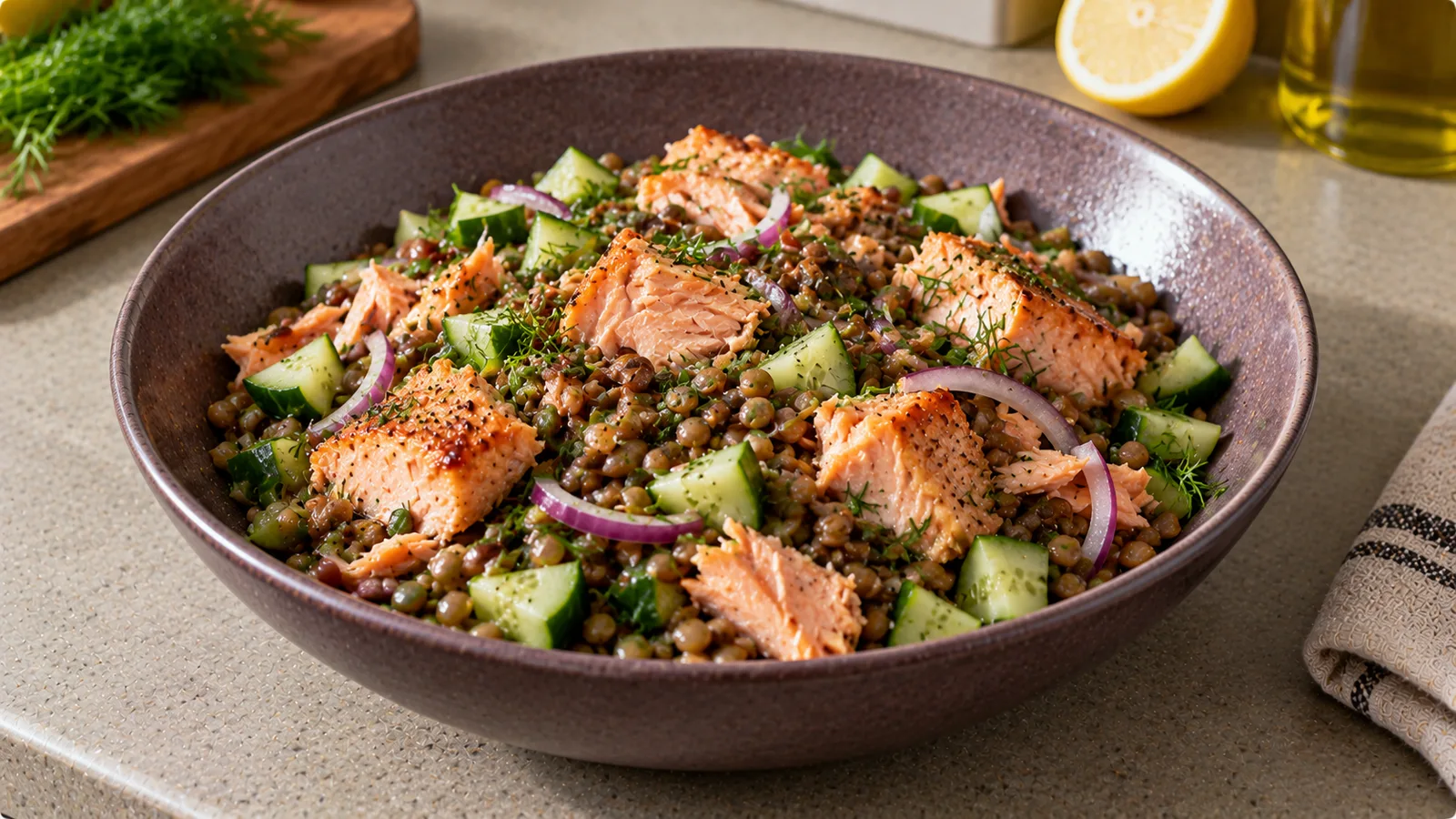
This salmon and lentil salad combines tender salmon, cooked lentils, crisp vegetables and a bright lemon-mustard dressing.
It works as a substantial lunch or a light dinner and can be served warm or chilled.
The lentils provide fiber and plant protein, while salmon contributes protein and omega-3 fats. Fresh vegetables add texture, color and volume.
The recipe makes 4 main-course servings and takes approximately 35–40 minutes when starting with dry lentils. Using precooked lentils reduces the preparation time to around 20–25 minutes.
Recipe overview
| Detail | Amount |
|---|---|
| Servings | 4 |
| Preparation | 15 minutes |
| Cooking | 20–25 minutes |
| Total time | 35–40 minutes |
| Main protein | Salmon and lentils |
| Serving style | Warm or chilled |
| Difficulty | Easy |
| Main allergens | Fish, mustard |
The cooking time assumes the lentils and salmon can be prepared partly in parallel.
Ingredients for 4 servings
Salmon and lentil salad
| Ingredient | Amount | Preparation |
|---|---|---|
| Skinless salmon fillets | 480 g | Four portions of approximately 120 g |
| Dry green or brown lentils | 200 g | Rinsed |
| Cucumber | 200 g | Diced |
| Cherry tomatoes | 200 g | Halved |
| Red onion | 80 g | Finely diced |
| Baby spinach | 100 g | Washed |
| Fresh parsley | 20 g | Chopped |
| Olive oil for salmon | 10 g | Approximately 2 tsp |
| Salt | To taste | Adjust as needed |
| Black pepper | To taste | Freshly ground |
Lemon-mustard dressing
| Ingredient | Amount |
|---|---|
| Olive oil | 25 g |
| Fresh lemon juice | 40 ml |
| Dijon mustard | 15 g |
| Garlic | 5 g |
| Water | 15–30 ml, as needed |
| Black pepper | To taste |
The dressing contains mustard. Check packaged ingredients if cooking for someone with food allergies.
Which lentils work best?
Green or brown lentils are particularly suitable because they generally retain their shape after cooking.
French-style green lentils are another option.
Red split lentils soften more quickly and tend to break down, producing a softer salad texture.
For this recipe, choose lentils that remain separate rather than turning into a purée.
Step 1: Cook the lentils
- Rinse 200 g dry lentils under running water.
- Check for small stones or damaged pieces.
- Transfer to a saucepan with approximately 650–750 ml water.
- Bring to a gentle boil.
- Reduce the heat and simmer until tender, usually around 20–25 minutes for many green or brown lentils.
- Check the package instructions because cooking times vary.
- Drain any remaining water.
- Let the lentils cool slightly.
The lentils should be tender but not mushy.
The final cooked weight will typically be around 450–550 g, depending on the variety and water absorption.
This is an approximate yield rather than a guaranteed conversion factor.
Using canned or precooked lentils
Replace the 200 g dry lentils with approximately 500 g drained, cooked lentils.
Rinse canned lentils if desired and drain thoroughly.
If the product contains added salt, adjust the seasoning of the salad.
Using precooked lentils eliminates the lentil-cooking step.
Step 2: Cook the salmon
- Pat the salmon dry with paper towels.
- Brush with 10 g olive oil.
- Season lightly with salt and black pepper.
- Heat the oven to 200°C conventional / 180°C fan.
- Place the fillets on a lined baking tray.
- Bake for approximately 12–16 minutes, depending on thickness.
- Check doneness using a food thermometer.
- Allow to rest briefly before breaking into large pieces.
For a straightforward conservative food-safety target, cook fish to an internal temperature of 63°C (145°F).
Cooking time alone cannot reliably establish safety because fillet thickness and oven performance vary.
Reference: USDA Food Safety and Inspection Service.
Pan-cooked alternative
Salmon can also be cooked in a nonstick frying pan.
Use the measured oil, cook over moderate heat and turn as needed.
Check the internal temperature rather than relying only on the color of the surface.
Avoid breaking the salmon into tiny flakes; larger pieces provide a better texture in the finished salad.
Step 3: Prepare the vegetables
While the salmon and lentils cook:
- Dice the cucumber.
- Halve the cherry tomatoes.
- Finely chop the red onion.
- Wash and dry the spinach.
- Chop the parsley.
Drying the vegetables helps prevent the dressing from becoming excessively diluted.
For a milder onion flavor, soak the chopped onion briefly in cold water and drain before adding it.
Step 4: Make the dressing
In a small bowl, combine:
- 25 g olive oil.
- 40 ml fresh lemon juice.
- 15 g Dijon mustard.
- 5 g finely grated garlic.
- Black pepper.
Whisk until combined.
Add 15–30 ml water if a thinner dressing is preferred.
Taste and adjust the acidity or seasoning.
The lemon provides brightness, while the mustard helps the dressing combine.
There is no need to add sugar for the basic recipe.
Step 5: Assemble the salad
- Place the drained lentils in a large bowl.
- Add cucumber, tomatoes, red onion and parsley.
- Pour over most of the dressing.
- Toss gently to coat.
- Fold in the spinach.
- Divide the mixture between four plates or bowls.
- Place approximately 120 g raw-weight salmon portion, now cooked, on each serving.
- Spoon over the remaining dressing.
For a warm salad, combine the vegetables with lentils that have cooled slightly but are still warm.
For a chilled salad, cool the cooked components safely before assembly.
Avoid leaving cooked fish or lentils at room temperature for extended periods.
Estimated nutrition per serving
The following figures are approximate recipe estimates based on the specified ingredients and four equal portions.
| Nutrient | Per serving |
|---|---|
| Energy | Approximately 550–600 kcal |
| Protein | Approximately 37–43 g |
| Fat | Approximately 27–32 g |
| Carbohydrates | Approximately 35–42 g |
| Fiber | Approximately 8–12 g |
Estimated serving size: approximately 400–450 g of prepared salad, depending on lentil yield, salmon cooking loss and vegetable moisture.
These are planning estimates, not laboratory-tested values.
The exact numbers depend on the salmon species, lentil variety, mustard brand, edible yield and whether all the dressing is consumed.
For precise food tracking, use the nutritional values of the ingredients actually purchased and the measured cooked yield.
Reference for ingredient-level composition: USDA FoodData Central.
Why salmon type matters
Atlantic farmed salmon and wild salmon varieties can differ considerably in fat and energy content.
A recipe calculated using a leaner salmon may contain fewer calories than one using a fattier variety.
The protein content can also vary.
If you track calories or macronutrients closely, select the exact salmon type in your food database rather than assuming all salmon fillets are identical.
How to make the salad more filling
The basic recipe already combines protein, fiber and vegetables.
To create a larger meal, consider adding:
- Extra cooked lentils.
- Roasted potatoes.
- Whole-grain bread.
- Additional vegetables.
- A small portion of avocado.
Each addition changes the calories and macronutrients.
For example, increasing lentils adds carbohydrates, fiber and plant protein.
Adding avocado or extra olive oil increases fat and energy.
Adjust the quantities according to your needs rather than assuming every larger portion has the same nutrition values.
Variations
Mediterranean-style salmon lentil salad
Add chopped fresh dill, extra parsley and a small amount of capers.
Reduce added salt if using salty capers.
A little lemon zest can intensify the citrus flavor without adding much liquid.
Salmon lentil salad with roasted vegetables
Replace cucumber with roasted zucchini or bell pepper.
Allow the vegetables to cool slightly before mixing with spinach.
This version works particularly well as a warm salad.
Salmon and lentil salad with yogurt dressing
Replace part of the olive oil with plain yogurt.
Keep the lemon, garlic and mustard, adjusting the consistency with water.
The nutritional values will change according to the yogurt's fat content and the amount of oil replaced.
This version also introduces milk as an allergen.
Salmon lentil salad with canned salmon
Use canned salmon that is ready to eat, following the product's instructions.
Drain it before adding it to the salad.
Check whether it contains bones, skin, added salt or oil.
The calorie and sodium values may differ from fresh baked salmon.
Can you prepare it ahead?
Yes, but the components are best stored separately.
For meal preparation:
- Cook the lentils.
- Cook the salmon thoroughly.
- Cool both promptly.
- Refrigerate them in covered containers.
- Store washed vegetables separately.
- Keep the dressing in a small sealed container.
- Assemble shortly before eating.
This helps the vegetables retain their texture and prevents the spinach from becoming soggy.
How long does it keep?
As a conservative quality recommendation, use refrigerated prepared salmon and lentils within 1–2 days for this salad.
Keep the refrigerator at 4°C or below.
Refrigerate perishable food promptly, generally within two hours of preparation, or within one hour in very hot conditions.
If the salad has been left out too long, do not rely on smell alone to determine safety.
Follow local food-safety guidance and the storage instructions of packaged ingredients.
Source: USDA Food Safety and Inspection Service.
Common recipe problems
The lentils become mushy
They may have been cooked too long or a quick-softening variety was used.
Choose green or brown lentils and begin checking for doneness before the end of the suggested cooking time.
The salad tastes watery
Cucumber and tomatoes release moisture.
Dry the vegetables after washing, drain the lentils thoroughly and add the dressing close to serving.
The salmon becomes dry
Cooking time varies with fillet thickness.
Use a thermometer and avoid unnecessarily prolonged cooking.
The dressing is too acidic
Add a little water or slightly more olive oil.
Adjust gradually rather than adding a large amount at once.
The salad needs more flavor
Try fresh herbs, lemon zest, black pepper or a small amount of additional mustard.
Taste before adding extra salt, particularly if using canned lentils or salmon.
Serving and portion guidance
The recipe makes four main-course servings.
For consistent food logging, divide the prepared lentil-and-vegetable mixture into four equal portions and distribute the salmon evenly.
If you want to track the recipe by weight:
- Weigh the empty serving container.
- Weigh the finished salad without the container.
- Record the total cooked weight.
- Divide the total nutrition by the actual finished weight.
- Log the amount served in grams.
This method is more accurate than assuming the final cooked weight is always identical.
Recipe summary
Salmon and lentil salad is a practical combination of fish, legumes and vegetables.
Green or brown lentils provide structure, baked salmon adds substantial protein, and lemon-mustard dressing brings the ingredients together.
The salad can be served warm or chilled, adapted with different vegetables and prepared partly in advance.
For the best texture, keep the dressing and delicate vegetables separate until serving.
Sources
- USDA FoodData Central — ingredient nutrition reference.
- USDA Food Safety and Inspection Service — cooking temperatures, refrigeration and safe food handling.
Nutrition values are approximate and should be recalculated when ingredient brands, salmon varieties or portion sizes change.