
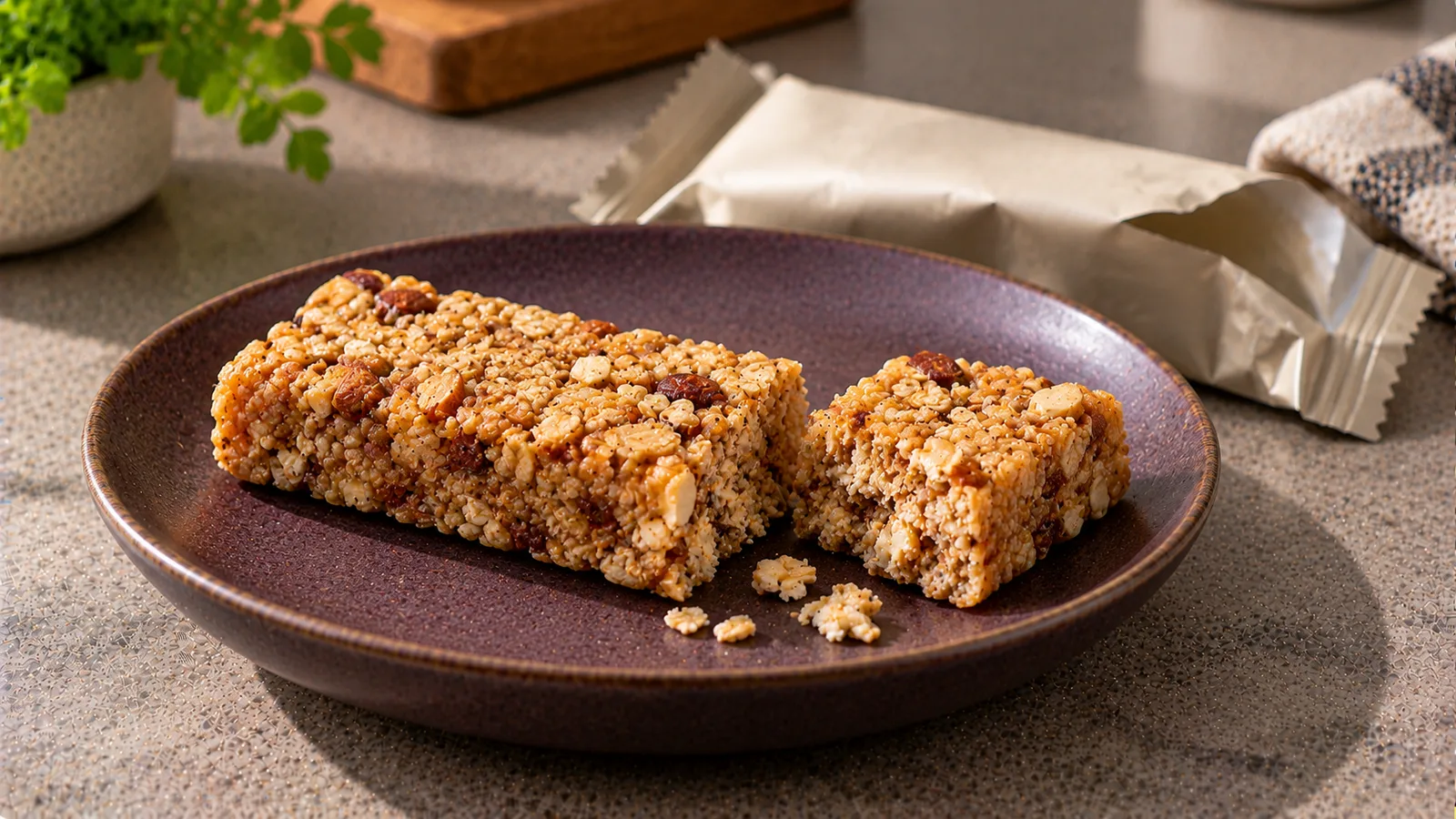
A wrapper marked “prebiotic”, “gut-friendly” or “protein” does not tell you how many grams of dietary fibre you actually eat. A 25 g bar and a 60 g bar may both carry attractive fibre messages yet contribute very different amounts to your day. The practical answer is to read the nutrition declaration, convert any per-100-g figures to the whole bar you will eat, and check which fibre ingredients are being promoted. Then look at calories, sugar, protein and tolerance rather than judging the product by one front-of-pack word.
This guide focuses on prebiotic snack and protein bars, not all packaged snacks. It uses four explicitly hypothetical label examples to teach the arithmetic. They are not sampled products, brand reviews or verified market averages. The regulatory thresholds and physiological claims are supported by official sources; invented brands, prices and product-specific test results are deliberately excluded.
What does a prebiotic label actually tell you?
A prebiotic is broadly understood as a substrate used selectively by microorganisms in a way that confers a health benefit, but a marketing phrase alone does not establish the dose, type or individual effect in the product in your hand. Manufacturers may add chicory-root inulin, fructooligosaccharides (FOS), or other ingredients described as prebiotic. Some bars get much of their labelled fibre from these additions; others combine them with fibre from oats, nuts, seeds or fruit.
Three separate questions matter. How much total dietary fibre is declared? Which ingredients contribute to it? Is a specific benefit actually substantiated for the specific ingredient and intake? A product's ingredient list may name chicory root fibre without identifying the grams of that particular substance. Do not read “5 g fibre” as “5 g inulin” unless the manufacturer separately documents it.
The European Commission's health-claims rules require health claims to be assessed and authorised; the presence of a prebiotic-related ingredient is not, by itself, a licence to promise improvements in digestion, immunity or the microbiome. Equally, fibre from a naturally fibre-rich food is not automatically inferior just because it is not marketed as “prebiotic”.
Fibre per 100 g is not fibre per bar
Many European packages emphasise values per 100 g. To discover what you eat, multiply the value by the edible portion in grams and divide by 100. If a 45 g bar lists 12 g fibre per 100 g, its fibre contribution is 12 × 45 ÷ 100 = 5.4 g. If the pack contains two 25 g pieces and the listed serving is one piece, eating both doubles the serving calculation. Never treat one retail package as one portion without checking the number of servings.
The following worked examples are fictional labels chosen solely for mathematical clarity. Their energy values and fibre densities are assumptions, not verified product compositions.
| Fictional bar | Bar weight | Fibre / 100 g | Fibre / bar | Energy / bar | Fibre / 100 kcal |
|---|---|---|---|---|---|
| A: oat-style | 40 g | 5 g | 2.0 g | 160 kcal | 1.25 g |
| B: inulin-style | 45 g | 12 g | 5.4 g | 180 kcal | 3.00 g |
| C: large protein-style | 60 g | 7 g | 4.2 g | 220 kcal | 1.91 g |
| D: small chicory-style | 25 g | 8 g | 2.0 g | 105 kcal | 1.90 g |
Bar B supplies 5.4 g, nearly three times A's 2.0 g. Bar C delivers 4.2 g although its per-100-g density is lower than B's, because the bar is larger. D has a higher density than A but supplies exactly the same 2.0 g per bar. This is why a statement about fibre concentration cannot replace the portion calculation.
For the wider distinction between manufacturer servings and the amount you actually eat, see Mealisa's portion size versus serving size guide. The size printed on a packet is a measurement convention, not a recommendation that every person should eat that amount.
What counts as “source of fibre” or “high fibre” in the EU?
The European Commission's nutrition-claims list specifies two alternative ways to qualify for each claim. A food can be a source of fibre at 3 g per 100 g OR 1.5 g per 100 kcal. It can be high in fibre at 6 g per 100 g OR 3 g per 100 kcal. These are rules for the claim, not guarantees of a large amount in an individual bar.
| EU wording | Per 100 g route | Per 100 kcal route | Meaning for one bar |
|---|---|---|---|
| Source of fibre | At least 3 g | At least 1.5 g | Calculate the actual bar weight separately |
| High fibre | At least 6 g | At least 3 g | Even a small qualifying bar may deliver only 2 g |
Under the first route, fictional A meets the source threshold but not high-fibre; B, C and D reach the high-fibre threshold because they have at least 6 g per 100 g. Yet D's small 25 g bar gives only 2 g per bar. B's 3.00 g/100 kcal also meets the alternative high-fibre route; values calculated from rounded package labels should not be used as proof that a borderline real product legally qualifies. The manufacturer's legal claim requires compliant actual product data, not our illustration.
European nutrition labels generally have to show energy, fat, saturates, carbohydrate, sugars, protein and salt; fibre is a voluntary addition to the standard declaration under the Commission's nutrition-labelling explanation. When you compare products in another country, label layouts, definitions and claim rules may differ. Do not assume an EU high-fibre claim means the same thing as a US high-%DV statement.
Is 2 g, 4 g or 6 g of fibre meaningful?
“Meaningful” depends on how much fibre your wider diet contains, your energy needs and the bar's other characteristics. There is no universal rule that a snack needs exactly 5 g before it is worthwhile. A bar with 2 g is not fibre-free; a 4.2 g bar can make a noticeable contribution; 5.4 g contributes more. None alone demonstrates gut-health benefits, guaranteed fullness or nutritional superiority.
On a US Nutrition Facts panel the FDA's fibre Daily Value is 28 g for the standard 2,000-kcal reference. The four worked amounts would be approximately 7%, 19%, 15% and 7% of that reference, respectively, before label rounding. This is a comparison aid, not a personal daily target and not an EU labelling percentage. The FDA generally describes 5% DV or less as low and 20% or more as high for a nutrient per serving.
Food-based fibre can also come from lentils, beans, oats, wholegrains, fruit and vegetables. A snack bar may be convenient on a journey; it does not have to replace these foods. For more ways to distribute fibre among normal foods, compare the high-fibre foods guide rather than attempting to reach an entire day's fibre intake through bars.
Inulin, chicory root and FOS are not interchangeable promises
An ingredient list mentioning chicory root fibre often points to inulin-type fructans, but exact ingredient chemistry and amount can vary. Other formulations may contain FOS, resistant dextrins or different plant-derived fibres. Their fermentation, tolerance and evidence for specific outcomes are not automatically identical. “Added fibre” is an ingredient description; “prebiotic” is a physiological concept; an authorised health claim is a separate legal matter.
An instructive, limited example is the EU regulation on native chicory inulin. It permits a particular normal-bowel-function claim under specified conditions connected to 12 g per day of native chicory inulin, including requirements for the qualifying food and information supplied to consumers. This does not establish that every “inulin” bar with 2–5 g total fibre has been shown to produce the same effect. Nor can you add all types of declared fibre together and compare that sum with a condition tied to one defined ingredient.
There is also a practical labelling gap: a bar can report total fibre per 100 g without giving a numerical breakdown for each fibre ingredient. If the manufacturer does not provide the inulin grams, the exact prebiotic ingredient dose is unknown, not “the total fibre amount”. Avoid reverse-engineering a dose from where inulin appears in the ingredient list; ingredient order is not a precise composition percentage.
Sugar, polyols, calories and protein change the picture
A “low sugar” bar may use sugar alcohols (polyols) as sweeteners; they are not the same declaration as sugar or fibre. Look for them in the ingredients and, where shown, in the carbohydrate breakdown. A bar can also combine added fibre, concentrated protein, a fat-rich coating and considerable energy. No single word on the wrapper tells you how it fits your usual meals.
Compare per bar first, then compare per 100 g if sizes differ. Check total energy, fibre, protein, sugars, saturated fat and, where relevant, polyols. For example, 180 kcal with 5.4 g fibre and 220 kcal with 4.2 g fibre are two distinct trade-offs in the fictional table; whether one suits you depends on the snack's role and the rest of the day. If a product claims “high protein”, examine its protein grams separately. Protein content neither proves fibre quality nor establishes prebiotic benefit.
The correct comparison with a protein-only snack is not merely whose packet displays a higher number. Match realistic eating occasions, calories and purchase cost where data exist. Mealisa's protein-and-fibre snacks versus protein-only snacks article covers that different decision, while this guide stays focused on interpreting prebiotic bars.
Can a high-fibre bar cause bloating?
Some people tolerate added fermentable fibre poorly, especially in larger doses or when they eat several bars close together. The Monash University FODMAP label-reading guidance identifies inulin, chicory root, FOS and certain polyols as ingredients that can be troublesome for some people with irritable bowel syndrome. This does not mean those ingredients harm everyone. The response is individual and depends on amount, fibre type and background diet.
If you are introducing a fibre-rich snack, a smaller initial portion and a gradual change in total fibre may be easier than abruptly eating multiple bars. Consider the combination of fermentable ingredients and sweeteners instead of blaming one substance without evidence. Persistent or severe gastrointestinal symptoms warrant appropriate medical advice. A “prebiotic” claim is not a treatment plan for constipation, irritable bowel syndrome or any other condition.
A bar rich in naturally occurring fibre can also cause discomfort if it markedly increases intake. Conversely, added inulin can be tolerated by many people. A balanced review separates measured content, scientific evidence for a specific effect, and how a particular person feels after eating it.
A six-step label check before buying
- Identify the whole edible bar weight, and whether one package contains more than one serving.
- Find the fibre value in grams per serving or grams per 100 g. If absent, do not infer a precise amount from “prebiotic” on the front.
- Calculate fibre per bar with `fibre / 100 g × bar grams ÷ 100`, and check the math against any per-serving line.
- Read the fibre ingredient names. Inulin, chicory fibre or FOS can be relevant, but their listed presence is not their measured dose.
- Check the entire trade-off: calories, protein, sugars, saturated fat, sugar alcohols, allergens and intended use.
- Separate regulated wording from advertising. A high-fibre claim follows legal thresholds; any proposed physiological benefit needs evidence and applicable authorisation.
For comparisons between very different snack sizes, Mealisa's fibre per 100 calories versus per serving guide explains why rankings change when you normalise by energy. Still keep the actual bar portion visible: a density score cannot tell you how many grams you consumed.
Three purchasing scenarios with different outcomes
Scenario one: an occasional small snack. A compact 25 g bar with 8 g fibre per 100 g contributes 2.0 g. It may be portable and enjoyable, but its impressive-looking density should not be mistaken for a large daily fibre contribution. If the wrapper emphasises gut health, check whether it names a concrete substantiated effect and dose.
Scenario two: replacing an ordinary afternoon snack. A 45 g bar with 12 g per 100 g contributes 5.4 g in the example. This is substantial relative to the smaller bar, but compare its energy, sweeteners, fat and price with foods you otherwise eat. Two such bars would deliver 10.8 g of declared fibre under the hypothetical formulation; they also double calories and the dose of any fermentable ingredients. More is not automatically better.
Scenario three: choosing a protein bar after training. A 60 g bar with 7 g per 100 g gives 4.2 g fibre, while its protein grams must be read separately. If the purpose is convenient protein, the bar's fibre may be an extra rather than the buying criterion. If the purpose is predominantly fibre, a simple food combination could be a more flexible choice. Do not infer prices or protein quantities from this exercise: none were supplied as real-world verified labels.
What the wrapper cannot prove
A legitimate label gives useful composition data, but it cannot show how every consumer's microbiome will respond, whether the bar will keep you full for a certain number of hours, or whether its added fibre is nutritionally equivalent to a varied high-fibre diet. A front label also cannot establish the exact amount of chicory inulin unless the numerical dose is disclosed.
The reproducible decision is modest: read the fibre grams per bar, verify the weight and claim rules, inspect ingredients and total nutrition, and judge personal tolerance. On those terms a prebiotic snack bar can provide a useful amount of fibre, but the word “prebiotic” alone cannot tell you whether this particular one does.
Sources
- European Commission: permitted nutrition claims and fibre thresholds.
- European Commission: mandatory and voluntary nutrition labelling.
- European Commission: authorisation of health claims.
- Commission Regulation (EU) 2015/2314: defined native chicory inulin claim.
- US FDA: nutrient Daily Values, including 28 g dietary fibre.
- Monash University: reading labels for FODMAPs and prebiotic ingredients.
Editorial method: All four numerical bar profiles are hypothetical teaching examples. No brand composition, actual shop price or measured individual gut effect is asserted.