
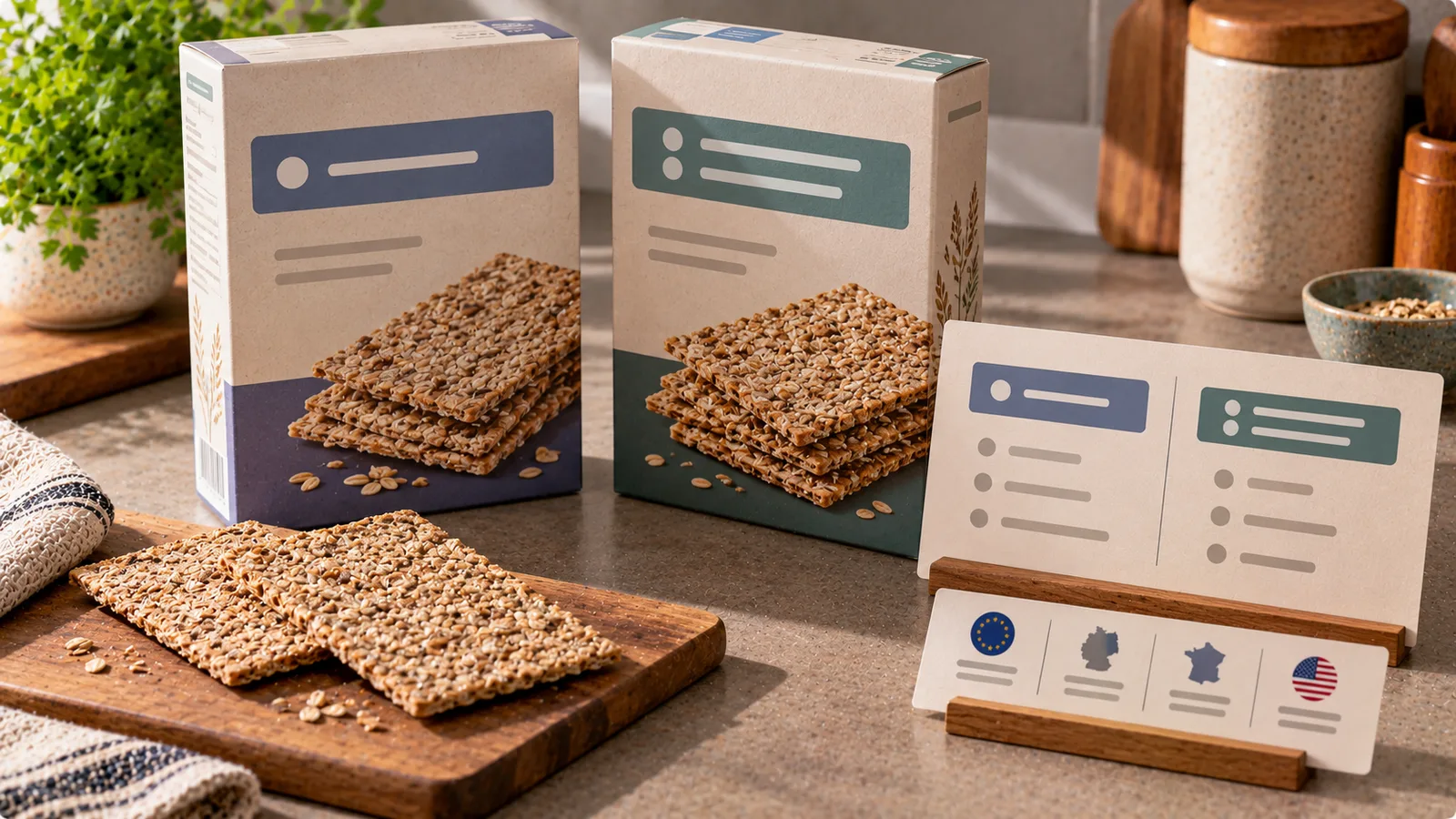
A package that says source of fiber, high fiber or good source of fiber is making a specific nutrition claim.
These phrases are more useful when you know what standard sits behind them.
The exact rules depend on the country or regulatory system. A product that qualifies for a particular fiber claim in one market does not necessarily use the same wording or threshold in another.
This guide focuses on how to interpret the claims on a food label rather than building a general list of high-fiber foods.
Source of fiber vs high fiber
In the European Union, the distinction is relatively straightforward.
A food may generally claim to be a source of fibre when it contains at least:
3 g of fibre per 100 g
or:
1.5 g of fibre per 100 kcal
A food may generally claim to be high in fibre when it contains at least:
6 g of fibre per 100 g
or:
3 g of fibre per 100 kcal
That means high fiber represents a higher threshold than source of fiber.
| EU claim | General criterion |
|---|---|
| Source of fibre | At least 3 g/100 g or 1.5 g/100 kcal |
| High in fibre | At least 6 g/100 g or 3 g/100 kcal |
The energy-based route matters because some foods may qualify relative to their calorie content even when the value per 100 g does not immediately appear to meet the weight-based threshold.
Example: a food with 4 g fiber per 100 g
Suppose a product contains:
4 g fiber per 100 g
On the weight-based EU criterion, it clears the:
3 g per 100 g
threshold for a source of fiber.
But it does not reach:
6 g per 100 g
for a high-fiber claim.
So based on that route, the product can qualify as a source of fiber but not as high fiber.
Example: 7 g fiber per 100 g
A product containing:
7 g fiber per 100 g
exceeds the general EU threshold of:
6 g per 100 g
for a high-fiber claim.
It also necessarily clears the lower source-of-fiber threshold.
The stronger claim is therefore possible if the other applicable labeling requirements are satisfied.
The calorie-based criterion
Consider a food containing:
2.5 g fiber per 100 g
At first glance it is below the 3 g per 100 g source threshold.
But suppose 100 g contains only:
150 kcal
Fiber per 100 kcal is:
2.5 ÷ 150 × 100 = 1.67 g
That exceeds:
1.5 g per 100 kcal
So the food may meet the source-of-fiber criterion through the energy-based route.
This is one reason simply memorizing the 3 g and 6 g numbers does not tell the whole story.
What does good source of fiber mean in the United States?
US labeling uses different terminology.
You are more likely to see claims such as:
- good source of fiber;
- contains fiber;
- provides fiber;
- high in fiber;
- rich in fiber;
- excellent source of fiber.
These claims are generally tied to the Daily Value per reference amount customarily consumed, rather than the EU's 3 g and 6 g per 100 g thresholds.
As a general framework:
10–19% of the Daily Value per reference amount can support a good-source type claim.
20% or more of the Daily Value per reference amount can support a high, rich-in or excellent-source type claim.
The regulatory basis is therefore different from the EU system.
Why the percentage matters
Suppose a US food provides:
15% Daily Value for fiber
for the relevant reference amount.
That sits within the general:
10–19% DV
range associated with a good-source claim.
If another food provides:
25% DV
it reaches the general:
20% or more
level associated with high or excellent-source terminology.
Do not translate these percentages directly into the EU 3 g and 6 g thresholds. They belong to different labeling frameworks.
Serving size can change how the claim looks
Fiber may be displayed per:
- 100 g;
- serving;
- reference amount;
- package.
These numbers answer different questions.
Suppose a cereal contains:
8 g fiber per 100 g
but your actual serving is:
40 g
Fiber in the serving:
8 × 40 ÷ 100 = 3.2 g
The food may have a strong fiber concentration per 100 g while your actual portion supplies 3.2 g.
Both numbers can be correct.
High fiber does not mean your serving contains 6 g
This is especially important with EU labels.
If a product qualifies as high fiber because it contains at least 6 g per 100 g, that does not mean every serving contains 6 g.
For example:
6 g fiber per 100 g
with a:
30 g serving
provides:
6 × 30 ÷ 100 = 1.8 g fiber
The claim describes the product under the regulatory criteria, not a guarantee that every portion supplies the threshold amount.
Example with crispbread
Suppose a crispbread contains:
15 g fiber per 100 g
A serving of two pieces weighs:
24 g
Fiber in the serving:
15 × 24 ÷ 100 = 3.6 g
The per-100-g number is useful for comparing products.
The 3.6 g figure is more useful when estimating how much fiber you actually ate.
Example with bread
Bread A contains:
4.5 g fiber per 100 g
Bread B contains:
8 g fiber per 100 g
On the EU weight-based criterion:
Bread A clears the source-of-fiber threshold.
Bread B clears the high-fiber threshold.
If you eat 80 g:
Bread A:
4.5 × 80 ÷ 100 = 3.6 g fiber
Bread B:
8 × 80 ÷ 100 = 6.4 g fiber
The claim gives a quick category, while the nutrition table allows a more precise comparison.
Compare equal quantities
When comparing two packaged foods, use the same basis.
For example:
Product A:
5 g fiber per 100 g
Product B:
9 g fiber per 100 g
Product B has the higher fiber concentration.
Comparing Product A per serving with Product B per 100 g could produce a misleading impression if the serving sizes are different.
Claims are shortcuts, not complete nutrition profiles
A high-fiber claim tells you something specific about fiber.
It does not automatically tell you whether the product is:
- low in calories;
- low in sugar;
- low in saturated fat;
- low in sodium;
- high in protein;
- minimally processed.
A food can legitimately qualify as high fiber while also containing substantial sugar, fat or calories.
Read the claim as one piece of information rather than an overall health rating.
High fiber vs whole grain
High fiber and whole grain are not interchangeable concepts.
A food can contain whole grains but not enough fiber to qualify for a particular high-fiber claim.
A different product may contain added fiber and meet the fiber threshold even if whole grains are not its main ingredient.
If you care about both characteristics, check:
- the fiber value;
- the ingredient list;
- any separate whole-grain information.
Added fiber can count
Packaged foods may contain added fiber ingredients such as certain isolated or manufactured fibers.
Whether a particular ingredient counts as dietary fiber for labeling purposes depends on the applicable regulatory definition.
The important practical point is that a high-fiber claim does not necessarily mean the fiber comes entirely from intact whole grains, beans, vegetables or fruit.
The ingredient list helps show where the product's fiber may be coming from.
Naturally occurring and added fiber
Consider two products that both contain:
8 g fiber per 100 g
One obtains most of its fiber naturally from whole-grain ingredients.
Another uses a refined base plus added fiber ingredients.
Their label fiber numbers may be similar, but their overall ingredient profiles can differ.
The fiber claim alone cannot describe those differences.
Check the nutrition table
A useful label-reading sequence is:
- notice the fiber claim;
- find the actual fiber amount in the nutrition information;
- check whether the value is per 100 g, per serving or another basis;
- compare products using equal quantities;
- calculate your actual portion if needed;
- look at the rest of the nutrition table and ingredient list.
This prevents the front-of-pack claim from becoming the only information you use.
Calculating fiber in your portion
The basic calculation is:
fiber per 100 g × portion weight ÷ 100
Suppose a product contains:
9 g fiber per 100 g
and you eat:
65 g
Then:
9 × 65 ÷ 100 = 5.85 g
Your portion provides approximately:
5.9 g fiber
This is more useful for food logging than simply recording that the product is high fiber.
What if the label gives fiber per serving?
Suppose a label says:
4 g fiber per 50 g serving
You eat:
75 g
First determine the number of servings:
75 ÷ 50 = 1.5 servings
Then:
4 × 1.5 = 6 g fiber
Your actual intake is approximately 6 g.
Per 100 g and per 100 kcal are different comparisons
The EU criteria demonstrate why these measures should not be treated as interchangeable.
Fiber per 100 g measures fiber concentration by food weight.
Fiber per 100 kcal measures fiber relative to energy.
A low-energy food can perform better on the calorie-based measure even if its fiber per 100 g is modest.
Which number is more useful depends on the question being asked.
Does high fiber mean more fiber than another product?
Not necessarily.
Imagine Product A contains:
6.1 g fiber per 100 g
and qualifies as high fiber under the weight-based EU threshold.
Product B contains:
10 g fiber per 100 g
and also qualifies.
Both can carry the same broad type of claim, but Product B contains considerably more fiber per equal weight.
Claims create categories. They do not rank every product within a category.
A source of fiber can still contribute meaningfully
The phrase source of fiber may sound weaker than high fiber, but the food can still make a useful contribution to total intake.
Suppose a bread contains:
4 g fiber per 100 g
and you eat 100 g across the day.
That provides:
4 g fiber
Other meals and snacks can provide the rest.
Fiber intake is determined by the complete diet, not by whether every individual food carries the strongest possible claim.
Portion size can reverse a practical comparison
Product A:
10 g fiber per 100 g
Actual portion:
20 g
Fiber eaten:
2 g
Product B:
5 g fiber per 100 g
Actual portion:
80 g
Fiber eaten:
4 g
Product A is more fiber-dense, but Product B contributes more fiber in these actual portions.
This is why both concentration and portion size matter.
Foods without a fiber claim
The absence of a front-of-pack fiber claim does not mean a food contains no fiber.
Manufacturers are not required to make every nutrition claim for which a product might potentially qualify.
Some minimally packaged or unpackaged foods may also have no promotional claims at all.
Use nutrition data where available rather than interpreting silence as zero fiber.
Fiber claims do not define your personal requirement
A package claim classifies the food.
It does not tell you how much fiber you personally need each day.
Daily fiber recommendations depend on the guideline and population group being considered.
The purpose of source-of-fiber and high-fiber claims is to communicate characteristics of the product, not to calculate an individual's dietary target.
A practical supermarket comparison
Suppose you are choosing between three breakfast cereals.
Cereal A:
2.5 g fiber per 100 g
Cereal B:
4.5 g fiber per 100 g
Cereal C:
9 g fiber per 100 g
Using the EU weight-based thresholds alone:
- Cereal A does not reach the 3 g source threshold;
- Cereal B reaches the source-of-fiber threshold;
- Cereal C reaches the high-fiber threshold.
But before choosing, you may also want to compare:
- sugar;
- saturated fat;
- salt;
- calories;
- ingredients;
- your usual serving size.
The fiber claim answers only the fiber question.
When labels from different countries look inconsistent
A product sold in different markets may use different front-of-pack wording because regulations are not identical.
You may see:
- source of fibre in one market;
- good source of fiber in another;
- high fibre;
- excellent source of fiber;
- no fiber claim at all.
Do not assume the wording can be converted word-for-word between jurisdictions.
Check the nutrition panel and the local labeling framework.
Fiber claim checklist
When you see a fiber claim:
- identify the country or labeling system;
- distinguish source/good source from high/excellent source;
- check the actual grams of fiber;
- note whether the value is per 100 g or per serving;
- calculate the amount in your real portion;
- compare competing foods on the same basis;
- review the rest of the nutrition information.
The key distinction is simple: source of fiber and high fiber are threshold-based claims, but the thresholds and terminology depend on the labeling system.
For practical food choices, use the claim as a shortcut, then verify the actual fiber amount and your serving size on the nutrition label.