
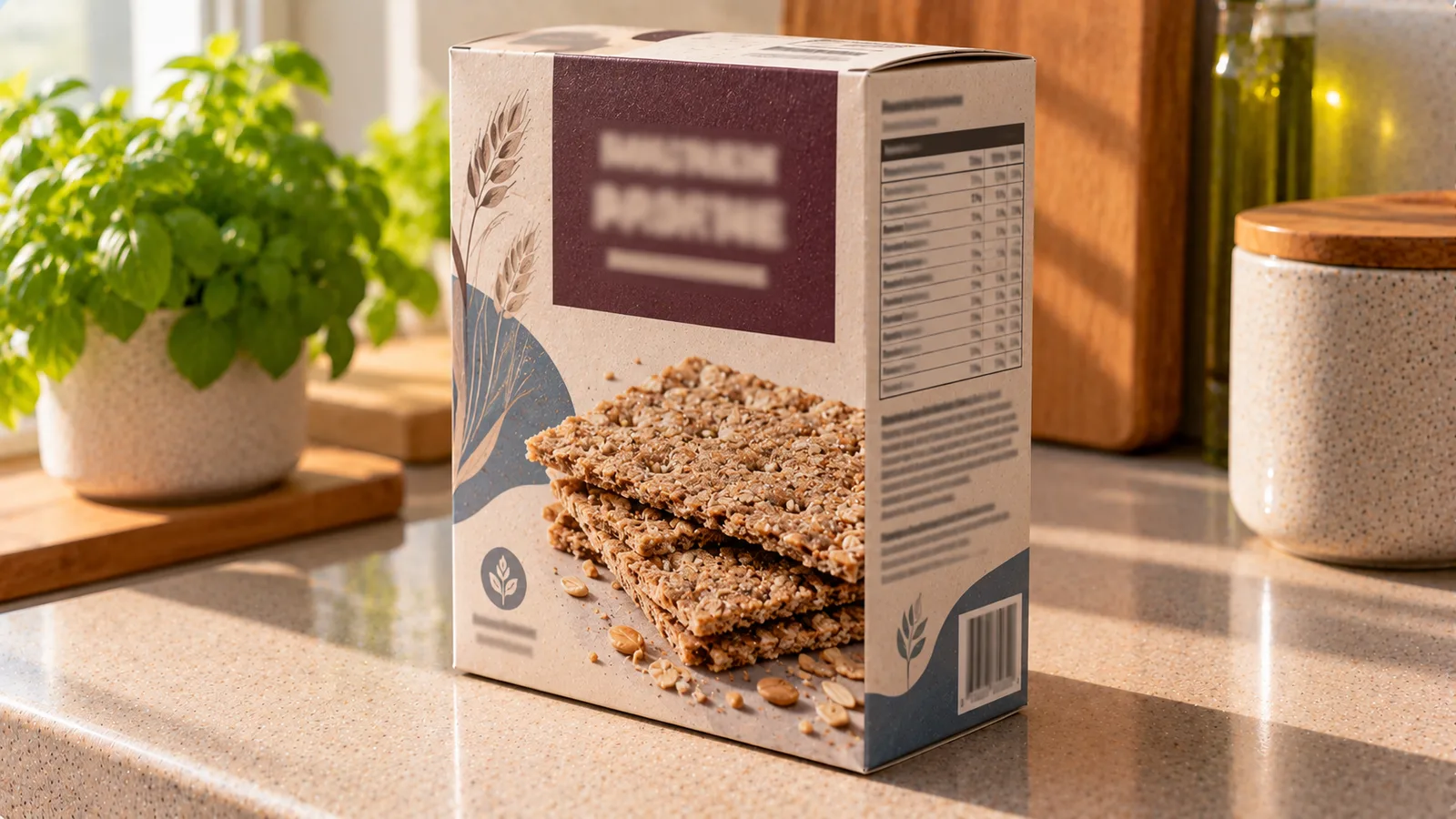
The words “high protein” on the front of a package are easy to notice. They are less useful if you do not know what the claim is based on.
A product can contain a meaningful amount of protein and still differ substantially from another high-protein product in calories, portion size, sugar, fat and overall composition.
The most useful way to read the claim is to move from the front of the package to the nutrition declaration.
A high-protein claim is not just a marketing phrase
In regulated markets, nutrition claims can have defined conditions.
In the European Union, the claim “high protein” may be used only when at least 20% of the food's energy value is provided by protein. (EU Regulation (EC) No 1924/2006, Annex)
The related claim “source of protein” has a lower threshold: at least 12% of the energy value must be provided by protein.
This is important because the rule is based on the share of energy from protein, not simply on a fixed number of protein grams per package.
How to calculate the protein share of energy
Protein provides approximately 4 kcal per gram.
Suppose a food contains per 100 g:
- 200 kcal;
- 12 g protein.
Approximate energy from protein:
12 × 4 = 48 kcal
Protein share of total energy:
48 ÷ 200 × 100 = 24%
About 24% of the product's energy comes from protein.
That is above the EU threshold for a “high protein” claim.
A second example
Suppose another food contains:
- 400 kcal per 100 g;
- 15 g protein per 100 g.
Protein energy:
15 × 4 = 60 kcal
Share of energy from protein:
60 ÷ 400 × 100 = 15%
The product contains more protein grams than the first example, but protein contributes a smaller percentage of its total energy.
This illustrates why grams of protein alone do not tell you whether an EU protein claim qualifies.
Why the calculation may not exactly reproduce the label
The simple 4-kcal-per-gram calculation is useful for understanding the concept, but official food-label energy calculations can include additional energy-yielding components and prescribed conversion factors.
Labels are also subject to rounding.
Therefore, a hand calculation may not always reproduce the manufacturer's regulatory calculation exactly.
Use it as a practical interpretation tool rather than as a substitute for formal compliance assessment.
Start with protein per 100 g or 100 ml
For comparing similar products, the per-100-g or per-100-ml column is often more useful than the front-of-pack claim.
Imagine two yogurts:
| Product | Protein | Energy |
|---|---|---|
| Yogurt A | 10 g/100 g | 70 kcal/100 g |
| Yogurt B | 6 g/100 g | 60 kcal/100 g |
Both may contribute protein, but Yogurt A provides considerably more protein for the same weight.
This does not automatically make it the better food for every person or meal. It simply gives you a clearer comparison than the phrase on the front.
Then check the portion you actually eat
A product may look protein-rich per 100 g while the normal portion is small.
Suppose a snack contains:
- 20 g protein per 100 g;
- package size: 35 g.
Protein in the whole package:
20 × 35 ÷ 100 = 7 g
The concentration is relatively high, but the amount you actually receive from the package is 7 g.
Now consider a 200 g yogurt containing 8 g protein per 100 g:
8 × 200 ÷ 100 = 16 g
Its protein concentration is lower, but the eaten portion provides more protein.
Both numbers matter:
protein concentration tells you how protein-dense the food is;
protein per actual portion tells you how much protein you consume.
Do not compare serving sizes without checking grams
Front labels often use serving-based numbers.
For example:
Product A:
- 15 g protein per serving;
- serving = 150 g.
Product B:
- 12 g protein per serving;
- serving = 80 g.
Product A provides more protein in the stated serving, but Product B is more concentrated.
Per 100 g:
Product A:
15 ÷ 150 × 100 = 10 g protein
Product B:
12 ÷ 80 × 100 = 15 g protein
Neither comparison is inherently better. They answer different questions.
Protein per calorie can be useful
If your goal is to understand how much of a food's energy comes with protein, compare protein with calories.
A simple practical measure is grams of protein per 100 kcal.
Example
Food A:
- 10 g protein;
- 100 kcal.
That equals:
10 g protein per 100 kcal
Food B:
- 15 g protein;
- 300 kcal.
Per 100 kcal:
15 ÷ 300 × 100 = 5 g protein per 100 kcal
Food B contains more protein in the stated amount, but Food A supplies more protein relative to its energy.
This can be useful when comparing similar foods, but it should not be the only criterion used to judge nutritional quality.
“High protein” does not mean “low calorie”
A common mistake is to interpret a high-protein claim as meaning the product is low in calories.
That is not what the claim says.
A high-protein food can also contain substantial amounts of:
- fat;
- carbohydrate;
- sugar;
- starch;
- other energy-yielding ingredients.
For example, nuts and some protein bars can contain significant protein while also being energy-dense.
Read the energy value separately.
“High protein” does not mean “low sugar”
Protein and sugar are separate characteristics.
A flavored dairy product can provide substantial protein while also containing more sugar than a plain version.
Likewise, a protein bar can combine:
- protein ingredients;
- sugars or syrups;
- fats;
- flavorings.
The protein claim does not cancel the rest of the nutrition declaration.
If sugar matters for your comparison, check it directly.
“High protein” does not mean “low fat”
Some protein-rich foods are naturally low in fat. Others are not.
Compare the actual nutrition values rather than assuming that one claim predicts another.
For example, two cheeses may both be protein-rich while differing substantially in fat and calories.
Check whether you are comparing similar foods
A protein pudding, canned tuna and a protein bar can all provide protein, but comparing them only by protein grams ignores their different roles.
They differ in:
- ingredients;
- energy density;
- micronutrients;
- fiber;
- fat;
- carbohydrate;
- convenience;
- typical portion.
Protein metrics are most informative when comparing foods that could realistically serve a similar purpose.
What “high protein” means in the United States
US labeling rules use different terminology and regulatory criteria from EU labels.
On US packages, you may see statements such as:
- “good source of protein”;
- “high in protein”;
- “excellent source of protein”;
- percentage Daily Value for protein in circumstances where it is declared.
US nutrient-content claims are generally linked to the Daily Value and the reference amount customarily consumed, rather than using the EU rule that at least 20% of total food energy must come from protein.
This means you should not apply the EU 20%-of-energy test to decide whether a US package legally qualifies for its protein claim.
Likewise, a US claim should not be interpreted as if it were made under EU rules.
Why protein quality can matter on US labels
Protein labeling in the United States can involve protein quality when determining the percentage Daily Value used for certain claims.
This means the grams of protein printed on the nutrition panel and the regulatory basis for a protein claim are not always as simple as multiplying grams by four.
For ordinary food tracking, the listed protein grams are still useful. For understanding whether a package claim complies with US rules, the regulatory definition matters.
EU and US claims are therefore not directly interchangeable
Consider two packages sold in different markets.
An EU product may qualify as “high protein” because at least 20% of its energy comes from protein.
A US product may use a protein nutrient-content claim based on US Daily Value and reference-amount rules.
The wording can look similar to a shopper while the regulatory tests differ.
When comparing international products, use the actual nutrition declaration rather than assuming that identical-looking front-of-pack language means identical criteria.
A practical package-reading sequence
When you pick up a product labeled “high protein,” check it in this order.
1. Protein per 100 g or 100 ml
This helps compare concentration across similar products.
2. Protein in the portion you will actually eat
Calculate it when the package size differs from the reference amount.
3. Total calories
Protein claims do not tell you the total energy content.
4. Protein relative to calories
This can help distinguish a protein-dense food from an energy-dense food that also contains protein.
5. Other nutrients relevant to the comparison
Depending on the food, that may include:
- fiber;
- sugars;
- saturated fat;
- salt or sodium.
6. Ingredients
The ingredient list helps explain where the protein and other nutrients come from.
Example: two protein snacks
Snack A per package:
- 180 kcal;
- 20 g protein;
- 6 g fat;
- 12 g carbohydrate.
Snack B per package:
- 280 kcal;
- 22 g protein;
- 14 g fat;
- 24 g carbohydrate.
Looking only at protein:
Snack B provides 2 g more.
Protein per 100 kcal:
Snack A:
20 ÷ 180 × 100 ≈ 11.1 g
Snack B:
22 ÷ 280 × 100 ≈ 7.9 g
Snack A provides more protein relative to its calorie content.
That does not automatically make Snack A nutritionally superior. It simply answers a more specific question than “which package has more protein?”
Example: yogurt portions
Yogurt A:
- 10 g protein per 100 g;
- 65 kcal per 100 g;
- pot size: 150 g.
Whole pot:
- protein: 15 g;
- calories: 97.5 kcal.
Yogurt B:
- 8 g protein per 100 g;
- 60 kcal per 100 g;
- pot size: 250 g.
Whole pot:
- protein: 20 g;
- calories: 150 kcal.
Yogurt A has more protein per 100 g.
Yogurt B provides more total protein because the pot is larger.
This is why the question “which has more protein?” needs a reference quantity.
Example: a food can be protein-rich and energy-dense
Suppose a food contains per 100 g:
- 25 g protein;
- 500 kcal.
Protein provides approximately:
25 × 4 = 100 kcal
Approximate protein share:
100 ÷ 500 × 100 = 20%
Protein represents a substantial share of the food's energy, yet the product still provides 500 kcal per 100 g.
The protein claim does not imply low energy density.
Do you need a high-protein label to find protein-rich foods?
No.
Many foods naturally provide meaningful amounts of protein without prominently advertising it on the front of the package.
Examples can include:
- eggs;
- fish;
- poultry;
- meat;
- dairy foods;
- legumes;
- tofu and other soy foods.
Whether a particular food suits your diet depends on the overall meal, portion and your individual requirements.
The absence of a large “high protein” message does not mean the food contains little protein.
Be careful with package redesigns and reformulations
A familiar product can change over time.
Manufacturers may alter:
- portion size;
- ingredients;
- protein content;
- sugar;
- fat;
- total calories.
If you track a packaged food regularly, compare the current label with the database entry rather than assuming an older saved entry is still correct.
When tracking the product in an app
A front-of-pack protein claim should not replace the nutrition label.
For accurate tracking:
- choose the exact product when possible;
- check protein and calories against the current package;
- verify whether values are per 100 g, per serving or per package;
- enter the amount you actually ate;
- correct or replace a database entry if it materially disagrees with the label.
For example, if a bar contains 20 g protein per 60 g bar, do not log 20 g protein as though it were the value per 100 g.
The reference quantity matters.
A quick high-protein label check
Before buying or logging a product, ask:
- How many grams of protein are there per 100 g or 100 ml?
- How much protein is in the portion I will actually eat?
- How many calories come with that portion?
- Is the claim being made under EU or another country's labeling rules?
- How does the product compare with similar alternatives?
- Do the other nutrition values fit what I am looking for?
This takes only a few seconds once you know where to look.
The main principle
“High protein” tells you something specific about a product, but it does not describe the whole food.
In the EU, the regulated claim is tied to the proportion of energy supplied by protein. Other markets, including the United States, use different regulatory frameworks.
For a practical comparison, look beyond the front of the package and check:
protein concentration + actual portion + calories + relevant nutrients + ingredients
That gives you a much clearer picture of what the product contributes to your meal.
Sources
- Regulation (EC) No 1924/2006 on nutrition and health claims made on foods, including conditions for protein claims.
- Regulation (EU) No 1169/2011 on food information to consumers.
- European Commission guidance on nutrition and health claims.
- U.S. Food and Drug Administration, nutrient content claims and Nutrition Facts labeling requirements.