
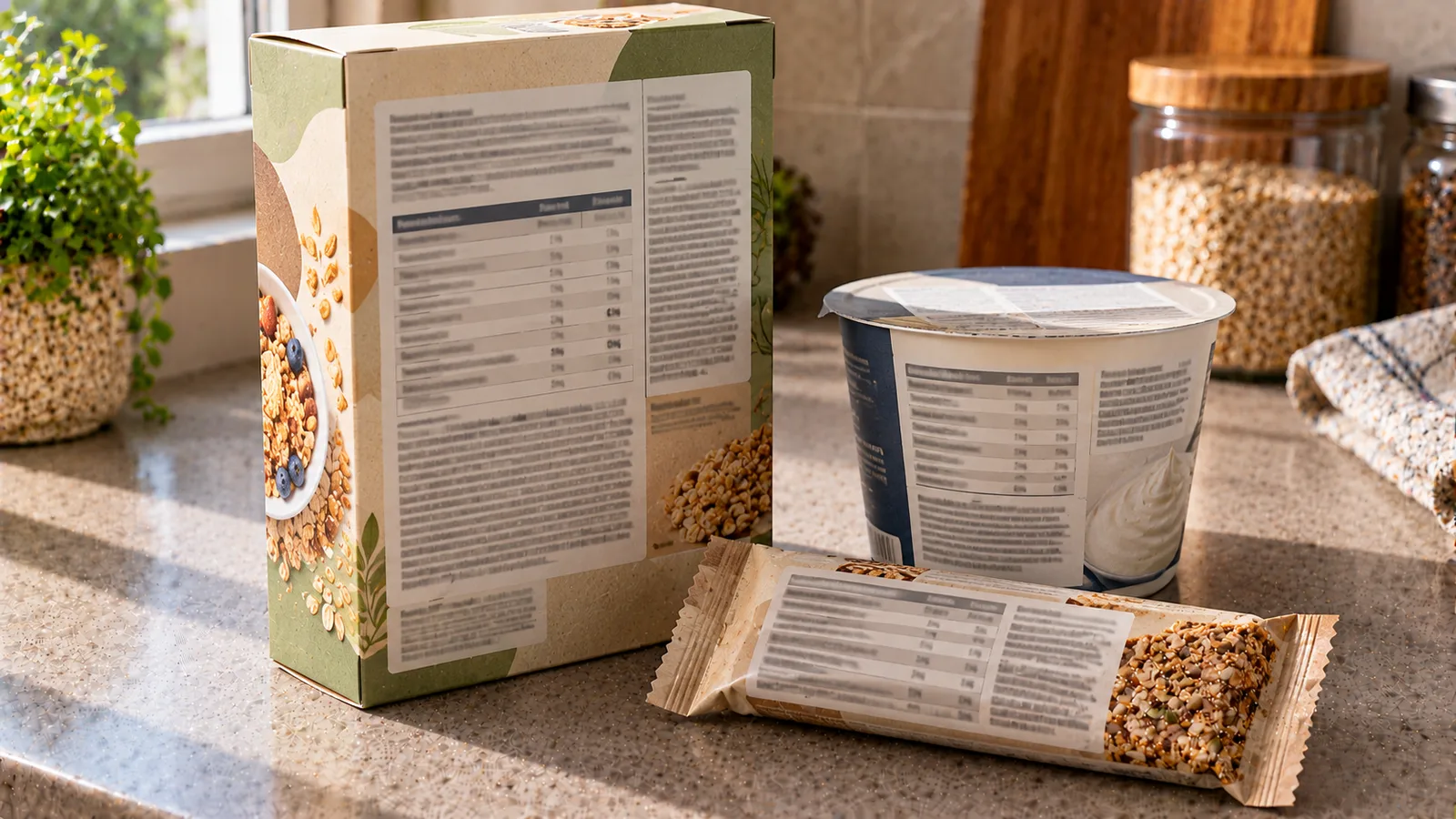
A food package may say “prebiotic”, “probiotic”, “microbiome friendly” or “supports gut health”. Those phrases do not all mean the same thing. Some describe ingredients, others suggest a benefit to the body, and the presence of a familiar fibre or bacterial culture does not establish that the finished product delivers a proven health effect.
For shoppers in Germany, France and the rest of the European Union, there are two distinct questions: What does the food actually contain? And is the particular health statement permitted under EU rules, with its required conditions? This guide provides a practical way to investigate both, without treating a marketing phrase as a medical recommendation.
First, separate the words on the front of the pack
The ISAPP scientific consensus on prebiotics describes a prebiotic as a substrate selectively used by host microorganisms that provides a health benefit. A probiotic, by contrast, involves live microorganisms given in adequate amounts that confer a health benefit. An added fibre, fermented food and probiotic are not automatically interchangeable categories.
| Expression on a package | What to identify | What it does not prove |
|---|---|---|
| “Contains inulin” | Specific ingredient and quantity, if stated | That the dose or type meets a permitted health claim |
| “With prebiotic fibre” | Which fibre; whether it meets the scientific concept | That every fibre is prebiotic or effective at that serving |
| “Live cultures” | Organisms or strain names; product and storage conditions | That all live-culture products have an approved gut-health claim |
| “Supports your microbiome” | The exact benefit implied and supporting authorised wording | That changing bacterial composition necessarily improves health |
| “High fibre” | Fibre grams per 100 g and relevant nutrition-claim conditions | That the food has an authorised gut-health effect |
The same package may truthfully identify an ingredient yet use a separate front-label phrase that requires scrutiny. Read the complete statement and any small-print qualification; do not decide from the largest word alone. The scientific definition also must not be confused with legal permission to advertise a claim in the EU.
Why EU nutrition claims and health claims differ
Under Regulation (EC) No 1924/2006, a nutrition claim concerns the nutrient composition of a food. “Source of fibre” and “high fibre” are examples with numerical conditions. A health claim links a food, ingredient or constituent to health, such as a statement about normal bowel function. A claim suggesting fewer disease cases raises further questions and must not be treated as a routine nutrition statement.
In the EU, health claims are generally prohibited unless authorised and used in accordance with their conditions. Article 10(3) says references to general, non-specific benefits for health or well-being may be used only when accompanied by an applicable specific health claim from the authorised lists. Article 10(2) also addresses related information, including the amount and pattern of intake needed for the claimed effect. These are legal conditions for a commercial claim, not a guarantee that an individual will experience a given result.
The European Commission's overview explains the separate systems for nutritional and health messaging. Our source-of-fibre versus high-fibre guide deals specifically with numerical fibre wording, rather than a claimed microbiome outcome. When a label says only “source of fibre”, it is not by itself permission to claim that the product “repairs the gut”.
Two authorised examples—and the limits people miss
The EU list of permitted health claims in Regulation (EU) No 432/2012 contains carefully delimited examples. They should not be stretched into general claims for all prebiotic drinks, probiotic snacks or fermented foods.
| Specified substance or food | Narrow authorised effect | Important condition |
|---|---|---|
| Native chicory inulin | Contributes to normal bowel function by increasing stool frequency | A food must provide at least 12 g daily intake of qualifying native chicory inulin; the consumer must be told that 12 g daily provides the benefit |
| Live yoghurt cultures in yoghurt or fermented milk | Improve lactose digestion of that product in people who have difficulty digesting lactose | At least 10^8 CFU per gram of specified live starter microorganisms in yoghurt or fermented milk |
For inulin, the authorised text is limited to a defined non-fractionated chicory inulin composition, including a specified mean degree of polymerisation. It is not an across-the-board approval for every ingredient labelled “inulin”, all fructooligosaccharides or any prebiotic product. A drink with 2 g of unspecified added fibre does not qualify for the 12 g example merely because its marketing looks similar.
The yoghurt-culture claim refers to digestion of lactose in the product, not general immunity, bacterial diversity or treatment of digestive disease. “10^8 CFU/g” means 100 million colony-forming units per gram, not per serving. The effect and microorganisms must match the entry. Other strains and other beverages do not automatically inherit that authorisation.
Both examples illustrate why “contains an ingredient” and “can display a specific authorised effect” are different statements. The wording and use conditions must be checked together against current law; a claimed number alone is insufficient.
How to check a claim in the official register
The European Commission EU Register of health claims lists authorised and non-authorised claims, their conditions and related legal acts. Search for the precise ingredient and claimed function, not merely “gut health”. The register's interface focuses on health claims; conditions for nutrition claims need to be checked through the relevant nutrition-claim legislation.
A sound check follows the chain: identify the full claim on the front; find its food or constituent in the register; inspect whether the specific effect is authorised; review the product type, minimum amount and required consumer information; then compare all of those with the item actually being sold. The result of a search is not necessarily a legal verdict on a brand's package. Wording, context, national interpretation and transitional cases can matter.
The EFSA process for health claims is scientific assessment. EFSA's evaluation is not itself the same as an EU authorisation: the EU decision and conditions must also be found in the legal acts and register. An absent search hit is a prompt for more investigation, not proof that every related phrase on the market is illegal.
What if the pack simply says “prebiotic” or “probiotic”?
The regulatory reading of these terms can depend on context and country. The French DGCCRF guidance on nutrition and health claims treats “prébiotique” and “probiotique” as non-specific health claims subject to the applicable requirements. It also describes a narrow case where “probiotique” can serve as a category descriptor for food-supplement ingredients, subject to conditions. That exception should not be generalised to every yoghurt or soft drink.
German consumer guidance similarly warns against confusing “präbiotische Ballaststoffe” marketing with proof of a special microbiome outcome. The Verbraucherzentrale Brandenburg advice, updated in May 2026 distinguishes general fibre-related benefits from inadequately substantiated special claims and notes that some added fibres can cause digestive discomfort in sensitive people.
There is no useful consumer shortcut such as “all prebiotic labels are legal” or “the word probiotic is always forbidden everywhere”. Assess the exact wording, category, accompanying specific claim and applicable local enforcement guidance. The EU framework is shared across Germany and France, but marketing context and national interpretations should still be checked if a claim looks questionable.
Three fictional packages: an audit at the supermarket shelf
Consider a fibre soda labelled “prebiotic, 5 g fibre per can, nourishes your gut microbiome”. The number “5 g” can be compared with its nutrition information, but it does not disclose which fibre is used, its identity, or whether the claimed microbiome effect has an authorised basis. Read the ingredients and check the precise outcome in the register. Our separate prebiotic soda versus regular soda comparison addresses nutritional trade-offs such as sugar and fibre; it is not evidence for a universal gut-health effect.
A cereal bar advertises “high fibre, supports digestion”. First confirm the fibre content and the conditions for the nutritional claim. The digestive-health phrase is a different question: seek the authorised health claim, matching ingredient and necessary amount. A bar may be high in fibre without meeting a particular inulin claim. To compare packaged snack portions rather than health-claim law, use our protein and fibre snack-label guide.
A fermented yoghurt says “live cultures, good for your gut”. Check what cultures are named and whether a specific authorised effect appears. If it instead makes the precisely delimited claim about improved digestion of lactose in the product, check the prescribed organisms and CFU threshold. Do not rewrite that narrow claim in your head as “prevents bloating”, “heals the microbiome” or “treats intolerance”. None follows automatically from the lactose-digestion permission.
These examples are illustrative labels, not allegations about actual brands. They teach what evidence to request and what inference to avoid.
Ingredient amounts: calculate the real serving, not the headline
Suppose an invented product declares 3 g inulin per 100 g, and you consume a 150 g portion. Its calculated inulin quantity is 4.5 g (3 × 150 / 100). That arithmetic verifies only an amount of the declared ingredient. It does not establish that it is the specific native chicory inulin covered by the EU authorised wording or that a single portion meets a 12 g daily-intake condition.
If the same product actually supplies qualifying native chicory inulin, obtaining 12 g from a 3 g-per-100-g concentration would require 400 g of food (12 / 3 × 100). Such a calculation is a hypothetical label-reading illustration, not a recommended portion or permission to use a health claim. The manufacturer's composition, full daily-use conditions and exact legal wording remain decisive.
Compare values on a consistent basis: grams per 100 g or 100 ml, then grams in your actual portion. Distinguish total fibre from a named type such as chicory inulin. The number for total fibre cannot be assumed to equal the weight of that specific ingredient. Our added-fibre versus naturally fibre-rich food guide explains the different food matrices; neither type receives a blanket medical benefit merely from being called fibre.
A buying checklist when the claim sounds impressive
Read the complete front-label phrase, then turn the pack over for the ingredient list. Identify the added fibre or microorganisms, their amounts if disclosed, the serving size and the preparation or storage instructions. Look up the exact claimed effect in the EU Register; do not replace it with a more ambitious promise. Finally examine the wider product: calories, sugar, salt, other ingredients, allergens, price per usable portion and whether it fits the food you actually like to eat.
If the ingredient amount is not declared, you can still compare the ordinary nutrition table, but you cannot confidently calculate an ingredient-specific claimed dose. If a product claims to treat irritable bowel syndrome, cure constipation or prevent illness, treat that as a substantially stronger statement requiring special scrutiny, not a normal consequence of eating fibre. Individual symptoms deserve healthcare advice rather than a self-prescribed marketing promise.
Sources and scope: EU Regulation 1924/2006, EU authorised-claim list, Commission Register, EFSA assessment procedure, ISAPP prebiotic consensus and national consumer or enforcement guidance linked above. This is a consumer-reading guide, not a brand-specific compliance determination or medical advice. Verify current legal entries and the actual package before relying on a claim.