
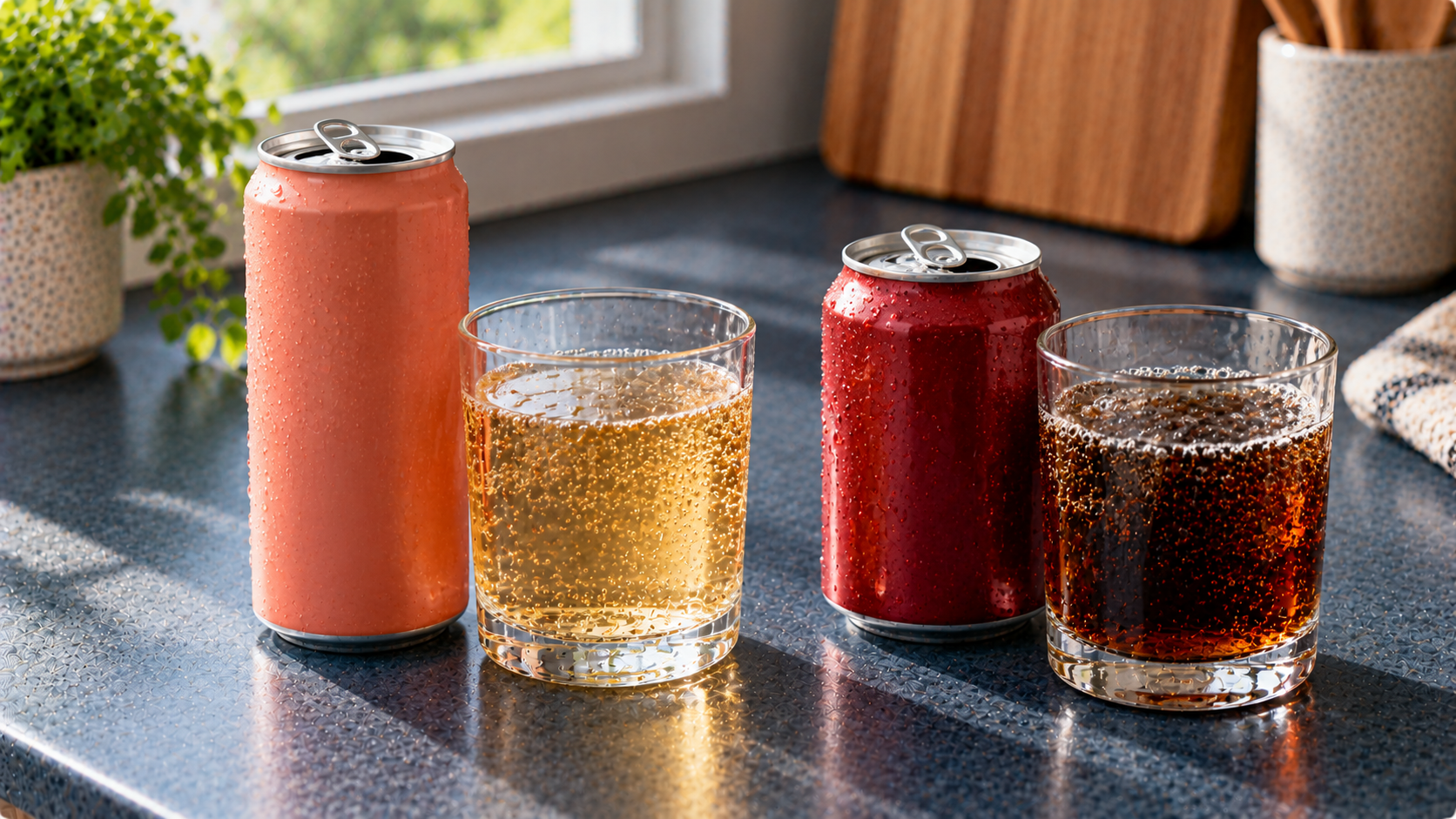
Prebiotic soda and regular soda can look almost identical in a glass, but they are formulated for different selling points. Conventional sweetened soda delivers flavour, carbonation and often a substantial amount of added sugar. A prebiotic soda typically combines carbonation and flavour with a fibre ingredient and may contain less sugar. The useful comparison is not “good soda versus bad soda”; it is the actual sugar, fibre, calories, ingredients and serving size on two labels. The word prebiotic alone does not establish that a drink improves your gut health.
Prebiotic soda vs regular soda: the quick comparison
| What to compare | Prebiotic soda | Regular sugar-sweetened soda |
|---|---|---|
| Main selling point | A flavoured drink with added prebiotic-type ingredients | Sweet fizzy refreshment |
| Sugar | Can be low, moderate or occasionally high; check the label | Usually contains added sugar; amount varies by product and size |
| Fibre | May provide several grams of added fibre | Usually 0 g |
| Calories | Often lower than a full-sugar soda, but not always | Mostly from sugars in standard varieties |
| Sweeteners | May combine small amounts of sugar with non-sugar sweeteners | Frequently sugar or glucose-fructose syrup; formulations vary |
| Caffeine | Depends on flavour and product | Cola may contain caffeine; other sodas may not |
| Microbiome claim | Depends on ingredient, dose and evidence | Not normally marketed as prebiotic |
| Main trade-off | Fibre and less sugar may come with digestive symptoms or a higher price | Familiar taste and availability, but potentially substantial free sugar |
Neither category is standardized nutritionally. A zero-sugar conventional soda differs greatly from a full-sugar cola, and some prebiotic drinks have more sugar than others. Compare the specific products you would actually buy, not a promotional category average.
What does “prebiotic” actually mean?
The International Scientific Association for Probiotics and Prebiotics (ISAPP) defines a prebiotic as a substrate selectively used by host microorganisms that confers a health benefit. Two parts matter: microorganisms must utilize it in a relevant way, and a benefit must be demonstrated. Merely adding an ingredient called fibre or displaying the phrase “gut-friendly” is not evidence that the finished drink delivers a meaningful clinical effect.
Many prebiotic-type sodas use inulin, chicory-root fibre, fructooligosaccharides (FOS), or other fermentable carbohydrates. Ingredients and amounts vary, and a product may not specify the exact amount of each type. Some fibres are fermentable, some are more viscous, and some have evidence for particular effects at particular doses. The words fibre and prebiotic are related but not interchangeable: not every dietary fibre meets the consensus definition of a prebiotic.
Prebiotics are also different from probiotics. Prebiotics are substrates; probiotics are live microorganisms that, when administered in adequate amounts, confer a health benefit. A shelf-stable carbonated drink described as prebiotic does not necessarily contain live cultures. Even a product that includes cultures requires strain-specific and dose-relevant evidence to substantiate a probiotic claim.
A positive change in a microbiome test, even if shown in a study, is not automatically proof that someone will experience less bloating, better digestion or improved long-term health. Human outcomes, the specific ingredient, population, dose and study quality all matter.
The numbers to check on the label
Start with the volume you plan to drink. Many cans are around 250–355 ml, while larger bottles may contain more than one listed serving. In the EU, nutrition information is generally given per 100 ml; manufacturers can also provide per-portion information. In the US, Nutrition Facts labels use serving sizes and include added sugars. These conventions cannot be treated as interchangeable.
For a transparent example, imagine three hypothetical 330 ml cans. These are calculation scenarios, not verified brand data or nutritional averages:
| Per 330 ml can | Prebiotic-style drink A | Regular soda B | Zero-sugar soda C |
|---|---|---|---|
| Energy | 45 kcal | 139 kcal | 3 kcal |
| Total sugar | 7 g | 35 g | 0 g |
| Added fibre | 5 g | 0 g | 0 g |
| Caffeine | Check ingredients | Check ingredients | Check ingredients |
In this illustrative case, choosing A instead of B removes 28 g of sugar and 94 kcal from that drink. It does not demonstrate a gut-health benefit, nor does it mean A is sugar-free. Choosing C removes still more sugar and calories, without providing the fibre in A. Which comparison matters depends on whether you are prioritizing sugar reduction, fibre intake, taste, cost or tolerance.
For labels stated per 100 ml, the calculation is simple: label value × volume consumed ÷ 100. A drink with 4.5 g sugar per 100 ml supplies 14.85 g in 330 ml. A product with 1.5 g fibre per 100 ml provides 4.95 g in the same can. Do this calculation before interpreting large front-of-pack claims.
Sugar: does a prebiotic soda automatically win?
No. Some prebiotic sodas are deliberately formulated with much less sugar than classic full-sugar soft drinks, but not all. The product’s actual sugar per serving is the comparison that counts. In Europe, sugars on the nutrition panel includes naturally present and added mono- and disaccharides; the ingredient list helps identify added sources. In the United States, the separate Added Sugars line provides another clue.
To judge the sugar claim, separate sugar naturally present from sugar added in manufacture; the added versus total sugar guide explains how.
The WHO recommends that free sugars contribute less than 10% of daily energy, with a further reduction below 5% offering additional health benefits. For someone consuming 2,000 kcal daily, the 10% threshold is equivalent to 50 g of free sugar; 5% corresponds to 25 g. These are population-oriented guidelines, not a target to use up with soda. Sugar-sweetened drinks can account for a large share because liquid sugar is easy to consume quickly.
A lower-sugar soda can be a practical substitution for someone who regularly drinks full-sugar soft drinks. But a low-sugar label does not make a drink a replacement for water, and it cannot erase dietary patterns elsewhere. Check whether the beverage is sweetened with sugar, juice concentrates, sweeteners or a combination, and distinguish no added sugar from no sugar.
Fibre is not just a number
Added fibre is the defining feature of many prebiotic sodas. A can containing 5 g fibre can contribute meaningfully to a person's overall fibre intake. But a beverage with added fibre is not nutritionally equivalent to beans, lentils, oats, vegetables or fruit. Those foods bring different fibre structures and often protein, vitamins, minerals and other food components. The goal is not to replace fibre-rich meals with cans.
Not all added fibre behaves like the fibre in whole foods; the comparison of added and naturally occurring fibre provides a useful distinction.
The relevant questions are which fibre is used, whether the amount is disclosed, what evidence exists for that ingredient at that dose, and whether you tolerate it. Inulin and FOS are fermentable; gut bacteria can break them down and produce gas. Responses vary considerably between people. Some people experience no discomfort with a small amount, while others experience bloating, flatulence, abdominal pain or changes in bowel habits.
If your usual fibre intake is low, suddenly taking several grams of fermentable fibre in a fizzy drink may be uncomfortable. Carbonation itself can also increase a feeling of fullness or belching, independently of the fibre. Try a smaller portion first, avoid stacking multiple high-inulin products in one sitting, and pay attention to your response. People with IBS or sensitivity to fructans may find some formulas particularly difficult to tolerate. A blanket claim that a drink “soothes bloating” would be misleading for them.
There is no universal rule that more added prebiotic fibre must produce a better effect. A studied dose for one ingredient cannot simply be transferred to a different ingredient, formulation or person. If a product makes a specific health promise, look for evidence tied to the claimed effect rather than relying on a vague statement about feeding good bacteria.
Calories, sweeteners and the dental question
Regular full-sugar soda contains energy from sugars. Lower-sugar prebiotic sodas may contain fewer calories, but added fibres can still contribute some energy depending on type and how energy is calculated. A label's displayed energy total is the practical figure to record in your nutrition app, rather than multiplying only sugar grams by four.
Sweetener choices differ: a drink may use stevia-derived sweeteners, sucralose, another permitted sweetener, sugar or combinations. The fact that something is sweetened without conventional sugar does not prove a particular microbiome outcome. Nor does it automatically make the drink unpalatable or unsafe for everyone; individual preference and medical circumstances matter.
Acidity is another separate consideration. Carbonated soft drinks are often acidic even when sugar-free. Frequent sipping exposes teeth repeatedly to acid; sugar adds another pathway for dental caries when it is present. Drinking with a meal, avoiding prolonged sipping and following dental guidance can be more sensible than treating the fibre label as dental protection.
How to compare cost fairly
Shelf prices are often misleading when a premium prebiotic drink comes in a smaller can than ordinary soda. Use price per litre and, if fibre is your priority, cost per gram of fibre actually provided. Also consider whether you would otherwise purchase a drink at all.
For example, suppose a hypothetical prebiotic can costs €2.20 for 330 ml and supplies 5 g fibre. Its price per litre is approximately €6.67, and the ingredient-specific cost is €0.44 per gram of declared fibre. A hypothetical €0.99 regular 330 ml can costs €3.00 per litre but provides no fibre, so “cost per gram of fibre” is not a meaningful comparator. A portion of oats, beans or fruit may supply dietary fibre for less money while contributing to an actual meal; local prices and portions determine the real difference.
Price does not validate a prebiotic claim. Premium packaging, retail positioning and flavour are not evidence of superior health benefits. On a budget, plain water alongside a fibre-rich meal may be a more efficient choice than either canned beverage.
Five label checks before buying
- Serving and container size: Is the nutrition panel per 100 ml, per can or per serving? Multiply if needed.
- Sugar and calories: Compare the whole amount you will consume, not just front-of-pack slogans.
- Fibre identity and quantity: Look for inulin, chicory-root fibre, FOS or other named ingredients and the actual grams of fibre.
- Ingredients and tolerance: Identify sweeteners, caffeine and fermentable fibres that may matter for you.
- Price and purpose: Are you paying for a flavour you like, a lower-sugar substitute or a fibre supplement? Those are different reasons.
A useful sixth check is the claim itself. “Contains fibre,” “prebiotic” and “supports gut health” do not all establish the same thing. In the EU, nutrition and health claims are subject to specific regulatory requirements. Evidence about an ingredient is not the same as authorization of a particular finished-product claim in a given market.
Real-world choices: which soda fits your goal?
| Your main goal | More useful starting point | What still needs checking |
|---|---|---|
| Reduce sugar versus full-sugar soda | Lower-sugar prebiotic soda or zero-sugar conventional soda | Sugar per whole can, sweeteners and taste |
| Add dietary fibre | Fibre-rich foods first; a tolerated fibre-containing drink can contribute | Ingredient, dose and overall diet |
| Avoid gastrointestinal discomfort | Plain still water or a drink without highly fermentable added fibre | Carbonation, inulin/FOS and personal tolerance |
| Save money | Water; compare all drinks per litre | Local unit price and habit frequency |
| Enjoy an occasional fizzy drink | Either, depending on preferences | Portion, caffeine, sugar and how often you sip |
| Seek proven treatment for digestive symptoms | Speak to a qualified clinician or dietitian | Symptoms, diagnosis and individual dietary needs |
The comparison changes if the “regular soda” is diet cola rather than sweetened cola. Zero-sugar soda may have negligible sugar and calories, so a prebiotic drink is not automatically lower in either measure. Conversely, a fibre-containing drink may add something a diet soda lacks, but that is a statement about fibre content, not demonstrated superiority for health.
Frequently confused claims
“Prebiotic” means probiotic. No: a prebiotic is a substrate, not necessarily a live microorganism.
Five grams of fibre guarantees five grams of health benefit. No: grams describe quantity, not the presence, size or certainty of a health outcome.
Lower sugar means sugar-free. No: inspect the full nutrition panel and serving size.
A soda with fibre replaces high-fibre food. No: whole foods supply a wider nutritional package.
If one prebiotic fibre has evidence, every added fibre does. No: source, dose, selective utilization, outcome and context matter.
Bloating after a prebiotic soda means the microbiome is becoming healthier. Not necessarily: gas and discomfort can reflect fermentation and individual tolerance, not a beneficial clinical change.
The bottom line for your shopping decision
If you currently drink full-sugar soda frequently, a lower-sugar alternative can reduce sugar intake, whether or not it is marketed as prebiotic. If you want more fibre, start with food sources and evaluate any added-fibre drink by ingredient, grams and tolerance. If you enjoy a particular drink occasionally, enjoyment and convenience can be reasonable considerations too. Choose using the actual label and your own goals, not the assumption that “prebiotic” automatically means healthier.
Sources and evidence notes
- ISAPP expert consensus on prebiotics (2017) — definition, mechanisms and evidence standards; not a clinical endorsement of a soda brand.
- WHO guideline: sugars intake for adults and children — free-sugar recommendations.
- EU Regulation (EC) 1924/2006 on nutrition and health claims — regulatory context for marketing claims.
- European Commission: nutrition labelling — understanding per-100-ml product information.
The drink profiles and prices above are explicitly hypothetical teaching examples. For actual purchasing, use the current label on the specific product in your market.