
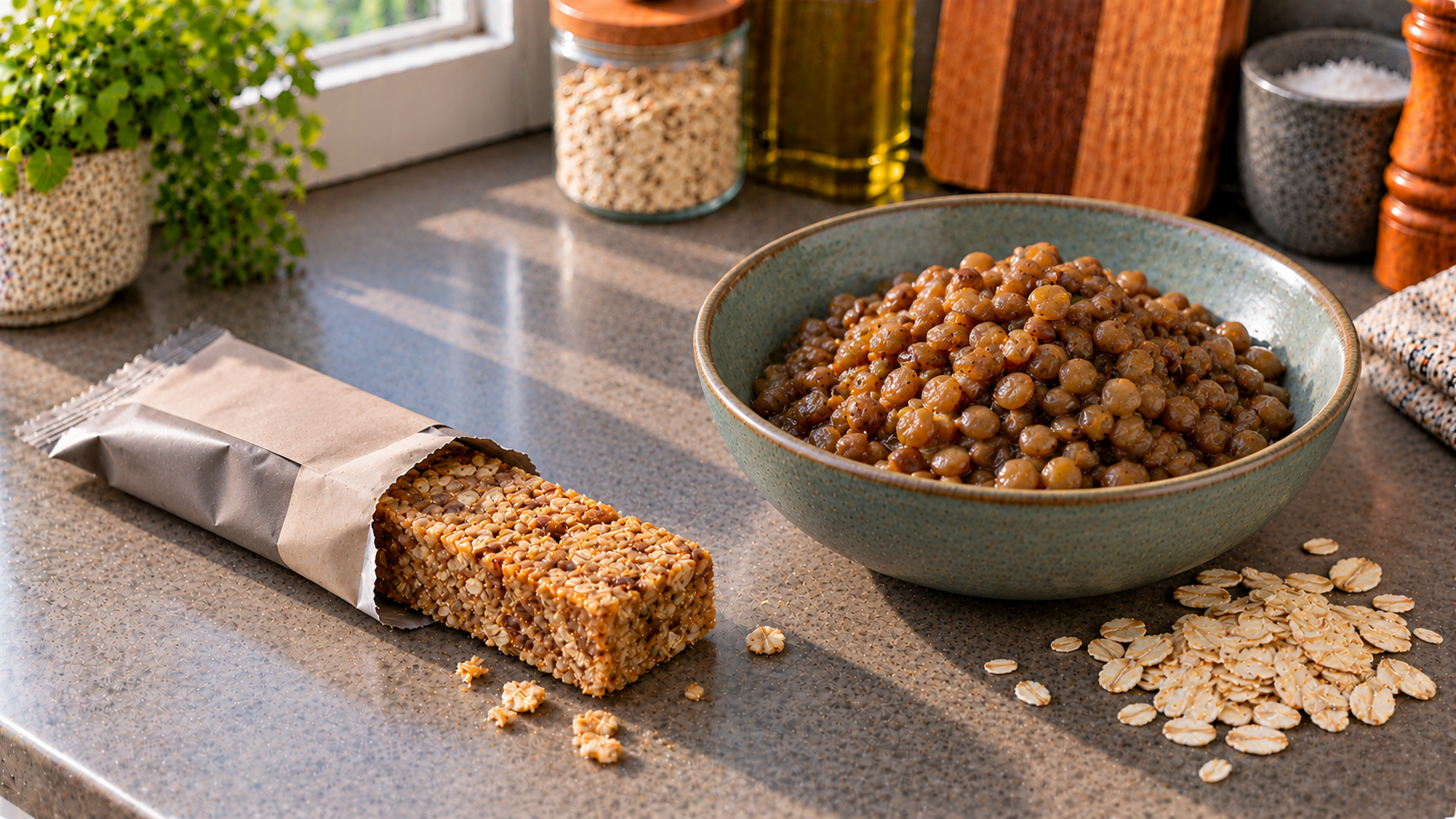
Fiber is found naturally in vegetables, legumes, fruits, nuts and whole grains. Manufacturers also add isolated fibers to drinks, bars, cereals and other packaged foods.
Both approaches can contribute to dietary fiber intake. But the same number of fiber grams does not mean that two foods have identical nutritional characteristics or proven health effects.
What is added fiber?
Added fibers may include inulin, chicory-root fiber, resistant dextrin, certain gums or other isolated or manufactured ingredients.
Their properties differ. Some are readily fermented by gut microorganisms, while others primarily influence stool bulk or food texture.
The physiological evidence for one specific fiber should not automatically be applied to every ingredient described as dietary fiber.
A product can contain several fiber sources, making the exact formulation important.
Read the ingredient list to identify which fibers have been added and in what form.
Why the complete food matters
A bowl of beans provides fiber together with protein, carbohydrates, minerals and other components of the food.
A fiber-fortified drink may supply isolated fiber with relatively little protein or other nutrients.
Neither statement establishes that the drink is inherently harmful or that beans are the only appropriate source.
Instead, consider the complete nutritional matrix, the food's role in a meal, the portion and the individual's dietary needs.
Harvard's Nutrition Source describes the broader importance of varied fiber-containing foods. Harvard Nutrition Source — Fiber.
Compare two hypothetical snacks
Imagine a 40 g snack bar that provides 6 g fiber, 180 kcal, 4 g protein and 12 g sugar.
Now compare it with a 150 g serving of cooked lentils that provides approximately 12 g fiber and contributes protein and other nutrients, using a suitable food-composition reference.
These are illustrative product quantities, not a matched controlled experiment or a claim that every lentil preparation has identical values.
The correct decision depends on whether the person needs a convenient small snack or a more substantial meal component.
Compare grams of fiber per actual portion, calories, protein, sugars, salt and other relevant ingredients rather than counting fiber alone.
What does “high fiber” mean in the EU?
European rules permit the claim “source of fibre” for a qualifying food with at least 3 g fiber per 100 g or 1.5 g per 100 kcal.
A “high fibre” label has a defined meaning under EU rules; compare the criteria in the source-of-fibre versus high-fibre guide.
“High fibre” generally requires at least 6 g per 100 g or 3 g per 100 kcal.
These thresholds refer to the claim conditions, not a guaranteed digestive or medical benefit for every consumer.
The European Commission explains the applicable nutrition-claim framework. European Commission — Nutrition Claims.
The presence of a legally qualifying claim also does not establish that a snack is low in sugar or salt.
Digestive tolerance and a practical decision
Some fermentable isolated fibers may cause gas or bloating, particularly when intake rises suddenly.
Regardless of whether fibre is added or naturally present, increasing your intake abruptly can cause discomfort; the gradual fibre increase guide offers a practical approach.
Tolerance varies by person and ingredient. It would be unjustified to generalize the result of one clinical study to every fortified product.
A useful approach is to eat a variety of naturally fiber-rich foods and use fortified products where their overall composition and convenience genuinely fit.
For packaged foods, inspect the complete nutrition declaration and ingredient list. The EU food-information regulation provides the labeling framework.
If a fiber ingredient causes persistent discomfort, review the particular product and seek individualized advice when appropriate.
Reading a real package: a five-step check
Start with the actual portion you expect to eat, not just the values for 100 g. Next compare its fiber grams and calories with the alternatives you would realistically buy or prepare. Third, inspect the ingredients to determine whether the fibers come from whole grains, legumes, isolated inulin or a mixture. Fourth, check protein, added sugars where declared, total sugars, saturated fat and salt; the most suitable balance depends on the meal. Finally, consider price and convenience. If a bar provides 6 g fiber for a certain price, dividing its price by six gives its price per gram of fiber, but that number does not capture the contribution of other nutrients.
In EU labelling, the nutrition declaration normally lists total sugars rather than a separate mandatory 'added sugars' quantity. The ingredient list can help identify added sugar sources; it cannot always tell you their precise proportion.
An example using label arithmetic
Suppose a fictional cereal snack lists 12 g fiber per 100 g and provides 45 g in one pack. That package supplies 5.4 g fiber, not 12 g. If its energy is 400 kcal per 100 g, the serving contains 180 kcal. This means 3 g fiber per 100 kcal for that specific example. The calculations are independent of whether fiber was added.
Compare this with a meal containing naturally fiber-rich foods by adding the fiber from each ingredient at its eaten weight. For foods cooked in water, use a corresponding cooked-food composition entry rather than values for uncooked dry ingredients. A dry weight of lentils must not be compared directly with the same number of grams of cooked lentils.
Practical choice by situation
For a sit-down lunch, a portion of lentils, vegetables and whole grains may deliver a wider range of nutrients and meaningful satiety. For travel, a well-formulated shelf-stable fortified snack may be more practical than cooked beans. If a person already eats enough fiber but wants more protein, a product's fiber claim may not be decisive.
Increasing overall fiber intake too abruptly can cause digestive discomfort. Adequate fluid intake and gradual changes can help some people, but tolerance varies. No individual snack or fiber ingredient replaces a varied diet.