
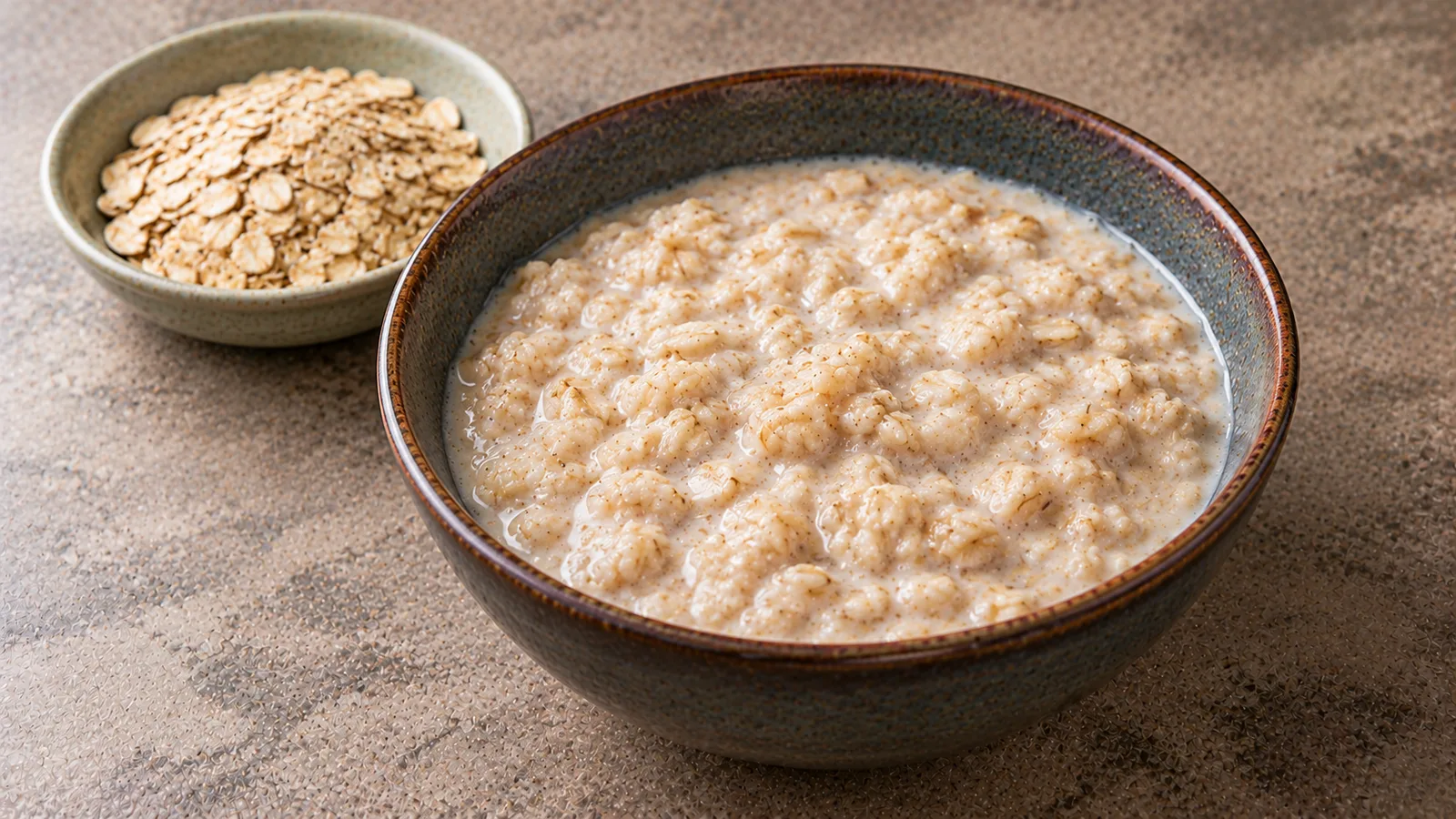
A bowl of porridge has no fixed calorie value. The amount of dry oats, the volume and type of milk, and everything added after cooking determine its energy. Water changes how heavy and thick the cooked porridge becomes, but it contributes no calories. The most reliable way to answer “how many calories are in oats with milk?” is therefore to calculate the ingredients before cooking and then allocate that total to the portion actually eaten.
This guide works through one repeatable recipe using specific published product labels. It distinguishes calories in the whole saucepan from calories per 100 g of cooked porridge, compares cow's milk with an oat-based drink, and shows how to record a smaller bowl without accidentally counting cooked oats as dry oats. It is a recipe calculation—not another generic list of oat or milk nutrition facts.
Start with the dry ingredients, not the cooked bowl
For the base recipe, weigh 50 g of dry dmBio fine oat flakes, measure 200 ml of REWE ja! 1.5% milk, and add 100 ml water. Cook without butter, sugar, fruit or other toppings. These quantities make one substantial bowl or two smaller bowls. There is no universal ideal portion: 50 g is simply a transparent example that readers can scale.
The dmBio oat label lists 372 kcal, 14 g protein, 59 g carbohydrate, 7 g fat and 10 g fibre per 100 g dry oats. The REWE milk label lists 47 kcal, 3.4 g protein, 4.9 g carbohydrate and 1.5 g fat per 100 ml. These figures belong to the specified products, not every oat variety or every type of milk. The European Commission explains the basis of the obligatory packaged-food nutrition declaration on its nutrition-labelling page.
| Ingredient | Measured amount | Energy basis | Calculated energy |
|---|---|---|---|
| Dry oat flakes | 50 g | 372 kcal / 100 g | 186 kcal |
| Milk, 1.5% fat | 200 ml | 47 kcal / 100 ml | 94 kcal |
| Water | 100 ml | 0 kcal | 0 kcal |
| Whole saucepan | All ingredients | Before cooking | 280 kcal |
The arithmetic is simple: 50 ÷ 100 × 372 = 186 kcal from oats; 200 ÷ 100 × 47 = 94 kcal from milk. Together they provide 280 kcal. If you eat the entire batch, that is your estimated energy intake before toppings. If you divide the batch into two equal servings, each contains 140 kcal.
Protein, carbohydrate, fat and fibre in the base bowl
Calories are the headline, but the same ingredient method also works for macros. The 50 g of oats contribute 7 g protein, 29.5 g carbohydrate, 3.5 g fat and 5 g fibre. The 200 ml milk contributes 6.8 g protein, 9.8 g carbohydrate and 3 g fat. Under the specified labels, the complete recipe contains approximately 13.8 g protein, 39.3 g carbohydrate, 6.5 g fat and 5 g fibre.
These are sums of declared, rounded label figures. They should not be treated as a laboratory assay or recalculated from the standard 4/4/9 factors to demand perfect agreement with the reported calories: fibre, rounding and labelling conventions affect the result. Also, lactose in regular milk is included in the total carbohydrate; it is not an additional ingredient to enter separately. The oatmeal contains naturally occurring fat and carbohydrate, even though nothing has been added to it.
For a detailed ingredient-only reference, use Mealisa's calories in oats guide. For milk fat levels, portions and milk-specific comparisons, see calories in milk. The calculation here uses both foods together in a measured cooked recipe.
Why cooking with water does not erase calories
The dry oats absorb liquid, soften and swell. Water can evaporate during simmering. None of those processes automatically subtracts the oats' calories or the energy supplied by the milk. The number 280 kcal remains the practical accounting total if the mixture stays in the saucepan and you eat it all. Actual cooking can create small measurement differences through spills, residue left in the pan or ingredients lost with liquid, but changes in concentration are not changes in the underlying recipe total.
Suppose you make the base mixture with 50 g oats, 200 ml milk and 100 ml water. For a demonstration, approximate the initial combined mass as 350 g, treating 1 ml liquid as roughly 1 g. Milk does not have exactly the same density as water, so this is a convenient kitchen illustration, not a precise weigh-in. Imagine the finished mixture weighs 310 g after evaporation. Both masses are illustrative; you should measure your own.
| Hypothetical stage | Weight | Total energy | Energy per 100 g |
|---|---|---|---|
| Ingredients before heating, approximate | 350 g | 280 kcal | 80.0 kcal |
| After cooking, measured example | 310 g | 280 kcal | 90.3 kcal |
| Half of this cooked batch | 155 g | 140 kcal | 90.3 kcal |
| A 200 g serving from this batch | 200 g | 280 × 200 ÷ 310 | 180.6 kcal |
The serving calculation is 280 × 200 ÷ 310 = 180.6 kcal. If your actual finished pot weighs 340 g, the per-100-g figure is different. This is why searching for “cooked oatmeal 100 g” can produce values that do not match your breakfast: the amount of water and milk per 100 g is not fixed.
Compare milk choices using the same amount of oats
Changing milk is easier to assess when the dry-oat weight stays fixed. In the next table, each scenario uses 50 g dry oats, 200 ml of the named milk or drink and enough water for your preferred texture. The plant drink is a specific dmBio sugar-free oat drink, not a nutritional stand-in for cow's milk. Its published label lists 42 kcal, 0.8 g protein, 5.6 g carbohydrate, 1.8 g fat and 1.1 g fibre per 100 ml.
| Liquid in the recipe | Liquid energy | Whole bowl energy | Protein in whole bowl | Fibre in whole bowl |
|---|---|---|---|---|
| 200 ml water only | 0 kcal | 186 kcal | 7.0 g | 5.0 g |
| 200 ml 1.5% cow's milk | 94 kcal | 280 kcal | 13.8 g | 5.0 g |
| 200 ml dmBio sugar-free oat drink | 84 kcal | 270 kcal | 8.6 g | 7.2 g |
Water-only oats are not the same food as milk porridge: their protein, taste and texture differ. The oat drink in this example adds less protein than cow's milk, even though their calorie totals are close. The label's “sugar-free” wording refers to that specific product; it does not mean that all oat drinks have zero sugar or the same fibre content. Some are fortified with calcium or vitamins, while others are not. Read the actual carton.
Do not confuse oat milk (a beverage) with oats cooked in cow's milk. The former is a different ingredient. A database entry for oat drink cannot replace a milk entry merely because both are white liquids.
What changes if you use 60 g of oats or more milk?
The most useful adjustments are linear. With the same dmBio flakes, every additional 10 g dry oats contributes 37.2 kcal. Going from 50 g to 60 g changes oat calories from 186 to 223.2. Keeping 200 ml of the same 1.5% milk then gives 317.2 kcal for the pot, before extras. If instead you keep 50 g oats and increase milk from 200 to 300 ml, milk energy rises from 94 to 141 kcal, making the whole pot 327 kcal.
The reverse works too. With 50 g oats, 150 ml of the labelled milk and added water for texture, the energy is 186 + 70.5 = 256.5 kcal. You have not created a special “low-calorie porridge recipe”; you have simply used less energy-providing liquid. That may or may not produce the taste, thickness and protein level you prefer.
It is especially easy to underestimate oats by using a spoon or loose cup measure. If one morning you pour 40 g and the next morning 70 g, the oats alone range from 148.8 to 260.4 kcal. A short initial period of weighing dry flakes can help you recognize a portion without needing to weigh every breakfast indefinitely.
Step-by-step: cook and log one reproducible batch
- Put a saucepan on the scale and tare it. Add 50 g dry oats. Record the exact dry mass before it touches liquid.
- Measure 200 ml of 1.5% milk in a measuring jug and add 100 ml water. Keep milk and water as two different recipe ingredients.
- Heat gently and stir frequently until the oats soften, typically several minutes depending on the flakes. Do not allow milk to scorch; add water if the mixture becomes too thick.
- Turn off the heat. Allow the porridge to settle briefly, then weigh the finished edible mixture in a tared bowl or pot. Subtract any empty-container weight.
- Enter oats and milk into your saved recipe once. Give the recipe 280 kcal total according to these labels, then record the actual cooked yield and amount you ate.
- Add toppings separately. If you cooked two identical bowls, divide the total by two; if bowls are unequal, weigh them or use your recorded cooked yield.
Do not enter 50 g dry oats plus 310 g cooked oatmeal: that records the same oats twice. Likewise, avoid logging the milk separately if the recipe entry already contains it. The point of recipe logging is to avoid this kind of double counting, not create extra work.
Toppings belong in the arithmetic, too
A plain 280-kcal bowl and the same bowl with nut butter, banana, yoghurt, honey or chocolate are not identical. Adding a teaspoon of honey or a large spoonful of peanut butter may look minor against a big bowl, but you should track the actual amount and its own label if numerical precision matters. There is no reliable generic calorie value for “a drizzle” or “one spoonful”.
If you divide the porridge first and add toppings to only one bowl, those topping calories belong to that bowl alone. If you stir a topping into the whole saucepan, include it in the recipe total before splitting. If fruit is cooked into the oats, weigh it when added rather than trying to deduce its original mass from the finished texture. For a broader way to decide what your portion actually represents, see the Mealisa article on portion size versus serving size.
The same rule applies to cooking fats: if you coat the pan with a meaningful amount of butter or oil, those calories are part of the recipe. Vanilla extract, cinnamon and salt may be small in ordinary quantities, but they should not be described as universally energy-free if used in substantial amounts.
Common logging errors and how to correct them
Using cooked weight with a dry-oats database entry. A label value of 372 kcal per 100 g is for dry oats. Multiplying that by 310 g of finished porridge would produce a gross overestimate. Conversely, entering the dry weight into a database profile for oats already cooked with water may underestimate the meal.
Treating 100 ml and 100 g as interchangeable with laboratory precision. The base calculations use millilitres because the liquid labels are expressed per 100 ml. The hypothetical yield illustration approximates the mass of milk and water for teaching; the accurate cooked-yield method actually weighs the finished batch.
Counting dilution as calorie reduction for the whole pot. Adding water changes energy per spoonful or per 100 g, not necessarily the calorie sum. It can help create a larger-volume portion, but it does not turn 280 kcal into 186 kcal while the milk remains in the recipe.
Mixing different products' labels. A 1.5%-fat cow's milk entry should not be used for whole milk or an oat drink; a sweetened instant-porridge sachet should not be logged as plain rolled oats. Use matching products and preparation states.
Forgetting leftovers. If you prepare two servings and eat only one, log a half-portion or a weighed share rather than the whole recipe. For a flexible, repeatable process, Mealisa's beginner calorie-tracking guide explains saving recipes and adjusting finished portions.
Two bowls from the same saucepan: unequal servings
Imagine the pot really weighs 310 g after cooking, as in the teaching example. One person serves 120 g and another takes 190 g. The energy per gram is 280 ÷ 310 ≈ 0.9032 kcal. Their portions therefore contain approximately 108.4 kcal and 171.6 kcal. The values add back to 280 kcal, apart from rounding.
This is more robust than labelling both bowls “one serving” when they are not equal. If you subsequently stir a little additional water into one individual bowl, its weight changes but its underlying calories remain approximately the same. If one person adds berries or nuts, record those additions separately.
How precise do you need to be?
Packaged-food labels contain rounding and permitted tolerances; natural ingredients also vary. Evaporation, cooked-yield measurements and traces left in the saucepan introduce further small discrepancies. It is reasonable to use 280 kcal for this specific 50 g + 200 ml recipe and not pretend that the true biological energy absorbed is known to one decimal place.
The most consequential checks are usually: did you weigh oats dry, use the right milk entry, include toppings, and record the part of the pot you ate? Fixing those mistakes is more useful than trying to account for each lost drop of steam.
Sources and calculation notes
- dmBio fine oat flakes, nutrition label — dry-oat values per 100 g.
- REWE ja! 1.5%-fat milk, nutrition label — milk values per 100 ml.
- dmBio sugar-free oat drink, nutrition label — beverage alternative per 100 ml.
- European Commission: nutrition labelling — how nutrition declarations are presented.
Method: all nutrient totals are label-based estimates from the stated raw or liquid quantities. The 350 g initial mass, 310 g cooked yield and example portions are hypothetical demonstrations, not measured results or manufacturer guarantees. Water contributes 0 kcal; the milk is assumed to remain in the edible recipe. Adapt the calculation to your actual products and measured cooked yield.