
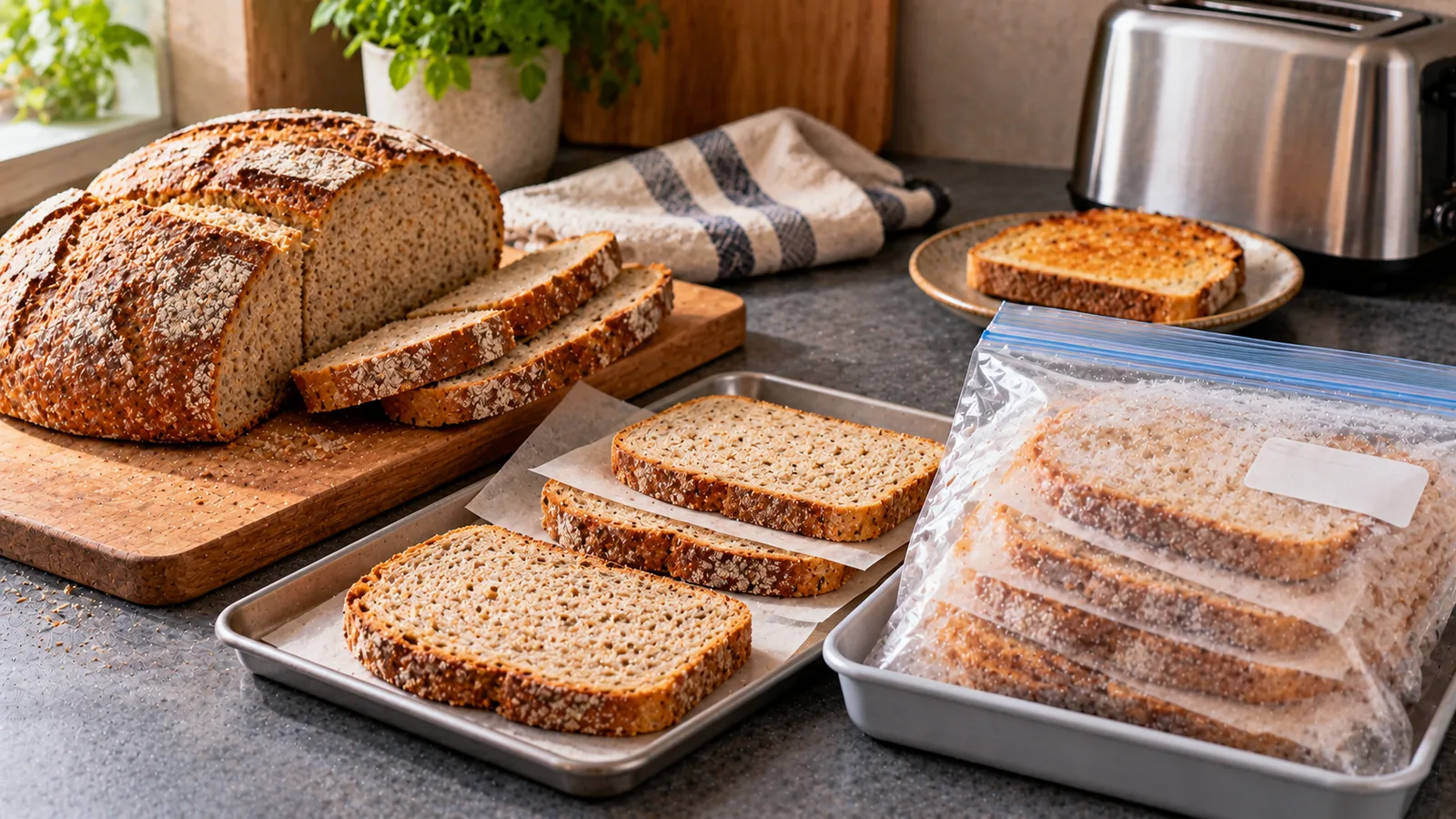
Freezing a whole loaf solves one problem but can create another: when the slices freeze into a single block, taking out one piece becomes awkward. For someone who eats bread only a few times a week, freezing individual slices makes it easier to use what was bought without repeatedly defrosting the whole loaf. You need little more than fresh bread, suitable packaging and a clear label.
This method applies to plain baked bread such as sandwich bread, sourdough or rye bread. It is not a storage guide for filled sandwiches, bread with meat or dairy-based toppings, or unbaked dough. Those foods may have stricter refrigeration and thawing requirements.
Why freezing individual slices works
Bread loses its pleasant texture during storage, and uneaten loaves can turn mouldy before you finish them. Freezing it while it is still fresh slows those changes. Unlike keeping the last few slices on a counter until they become stale, dividing the loaf early preserves flexible meal choices. The goal is not to turn old bread fresh again. Freeze bread you would be happy to eat today, not bread already damp, stale or questionable.
The USDA bread-storage guidance says bakery bread can retain its quality in the freezer for around 3 months. That is a quality benchmark, not a guarantee that a loaf will suddenly become unsafe on day one of month four. USDA explains separately that food kept continuously frozen at −18°C (0°F) remains safe for much longer, though dryness and flavour can deteriorate. Good packaging matters as much as the calendar.
Prepare slices before they go into the freezer
Wait until homemade bread has cooled completely. Warm bread sealed into a bag releases moisture and can leave a damp surface when later thawed. Cut the loaf to your usual sandwich or toast thickness; choosing a consistent size makes portions easier to identify. Store-bought presliced bread needs no additional cutting.
If slices are likely to stick, set small pieces of baking parchment between them, or briefly freeze them in a single layer on a clean tray before transferring them to a bag. Parchment is a separator, not an airtight package. If your presliced loaf separates cleanly when frozen, skip the extra material. Work with clean, dry hands and avoid laying bread on surfaces used for raw meat.
Do not squeeze soft bread until it is flat simply to save space. The object is to make the slices independently accessible, not to compress every crumb. A few small packets can work better than one large bag if several people use the freezer at different times.
Wrap, remove air and label
The USDA guide to freezer packaging recommends freezer-weight bags, heavy-duty wrap, foil or suitable freezer paper to limit air exposure and freezer burn. Put the sliced bread in a freezer-safe bag, push out excess air without crushing it and seal completely. For longer storage, an additional protective layer can reduce drying. Ordinary thin bread sleeves are less dependable for extended freezer storage.
Write the bread type and date frozen on the pack. You may also note how many slices remain. Avoid reusing bags that held raw meat or other contaminants. A reusable food-safe freezer container is another option if it closes well and provides suitable protection from air and moisture.
| Step | Practical choice | Reason |
|---|---|---|
| Portion | Individual slices or packs of two | Remove only what you need |
| Separate | Parchment only if slices stick | Easier removal without tearing |
| Protect | Freezer-safe bag or container | Limits drying and freezer burn |
| Temperature | −18°C (0°F) or colder | Consistent frozen storage |
| Label | Bread type and freezing date | Helps rotate older packs first |
| Quality target | Around 3 months | A guide to flavour and texture, not a safety deadline |
How long does frozen bread last?
Use 3 months as a straightforward best-quality planning window, as suggested in the USDA bread FAQ and Illinois Extension freezer chart. The actual eating experience depends on the original bread, how tightly it was wrapped, and whether your freezer stays cold. A loaf that has been repeatedly exposed to warm air may become dry sooner.
Freezer burn usually means surface dehydration and lost quality; it is not, by itself, proof that bread is unsafe. The USDA freezing explanation distinguishes microbial safety in continuously frozen food from gradual changes in eating quality. Conversely, putting visibly mouldy bread into the freezer does not make it acceptable to eat. If you see mould on a loaf, discard the entire affected loaf rather than cutting off the visible patch, in line with American Heart Association food-storage advice.
Keep your freezer at −18°C (0°F) or colder, preferably checked by an appliance thermometer. A date label is useful but cannot tell you whether the freezer lost power. When temperature history is uncertain, assess the specific food and handling rather than relying on the label alone.
Toast or thaw just the slices you need
For toast, take out one or two frozen slices and put them in a suitable toaster, following the appliance instructions. They may need a slightly different setting from fresh bread. The German Federal Centre for Nutrition specifically recommends toasting bread slices straight from frozen; remove loose ice crystals first so water does not enter the appliance.
For a sandwich, let plain, unfilled bread thaw in its clean wrapper at room temperature, then use it. Oregon State University Extension distinguishes nonperishable baked goods, which can thaw at room temperature, from meals with perishable fillings, which need refrigerator-based handling. Never assume that an assembled cheese, chicken or egg sandwich has the same rules as a plain slice. See the extension guidance.
Avoid repeated thawing and refreezing when a simpler option exists: remove only the portion needed. Freezing does not sterilise food. A slice that is dry after thawing may be better toasted than used for a soft sandwich, but visible mould or evidence of contamination means discard it.
A worked example: one loaf, four weeks
Imagine a loaf cut into 12 slices, each weighing 40 g. Its total bread weight is 480 g. If you normally eat 3 slices a week, those 12 slices cover 4 weeks. Freeze the loaf as individual slices, remove three across each week, and keep the remainder sealed until needed. This is an illustrative schedule, not a claim about standard loaf size or nutritional content.
| Planning question | Example calculation |
|---|---|
| Total bread | 12 × 40 g = 480 g |
| Weekly use | 3 slices, or 120 g |
| How long this loaf lasts | 12 ÷ 3 = 4 weeks |
| Bread removed for one breakfast | 2 × 40 g = 80 g |
Freezing does not change the original calorie count merely because water or texture shifts. For nutrition tracking, record the actual bread brand and the weight or number of slices eaten. The food-waste benefit is not an automatic percentage: it appears only if the frozen portions replace bread that would otherwise be thrown away.
When the method needs changing
Soft filled rolls, pastries with cream, prepared sandwiches and breads topped with perishable ingredients cannot all be treated as plain bread. Follow ingredient-specific handling, packaging and thawing advice. If a product's label says to keep it chilled, honour that direction. If bread is already mouldy, discard it rather than freeze it. Refrigerating plain bread can slow mould formation in some conditions but commonly speeds staling, so freezing is generally the better long-term option for quality.
For related ingredient questions, see meal planning to reduce food waste · protein bread compared with wholegrain bread.
Sources
- USDA: How long can I store bread? — bread freezer-quality guidance.
- USDA: Freezer-safe wrapping materials — packaging and freezer burn.
- USDA: Freezing and food safety — temperature, safety and quality.
- Oregon State University Extension: Freezing convenience foods — thawing plain baked goods versus perishable dishes.
- American Heart Association: Food-storage warning signs — discard mouldy bread.
- German Federal Centre for Nutrition: Bread storage — sliced freezing and toasting.