
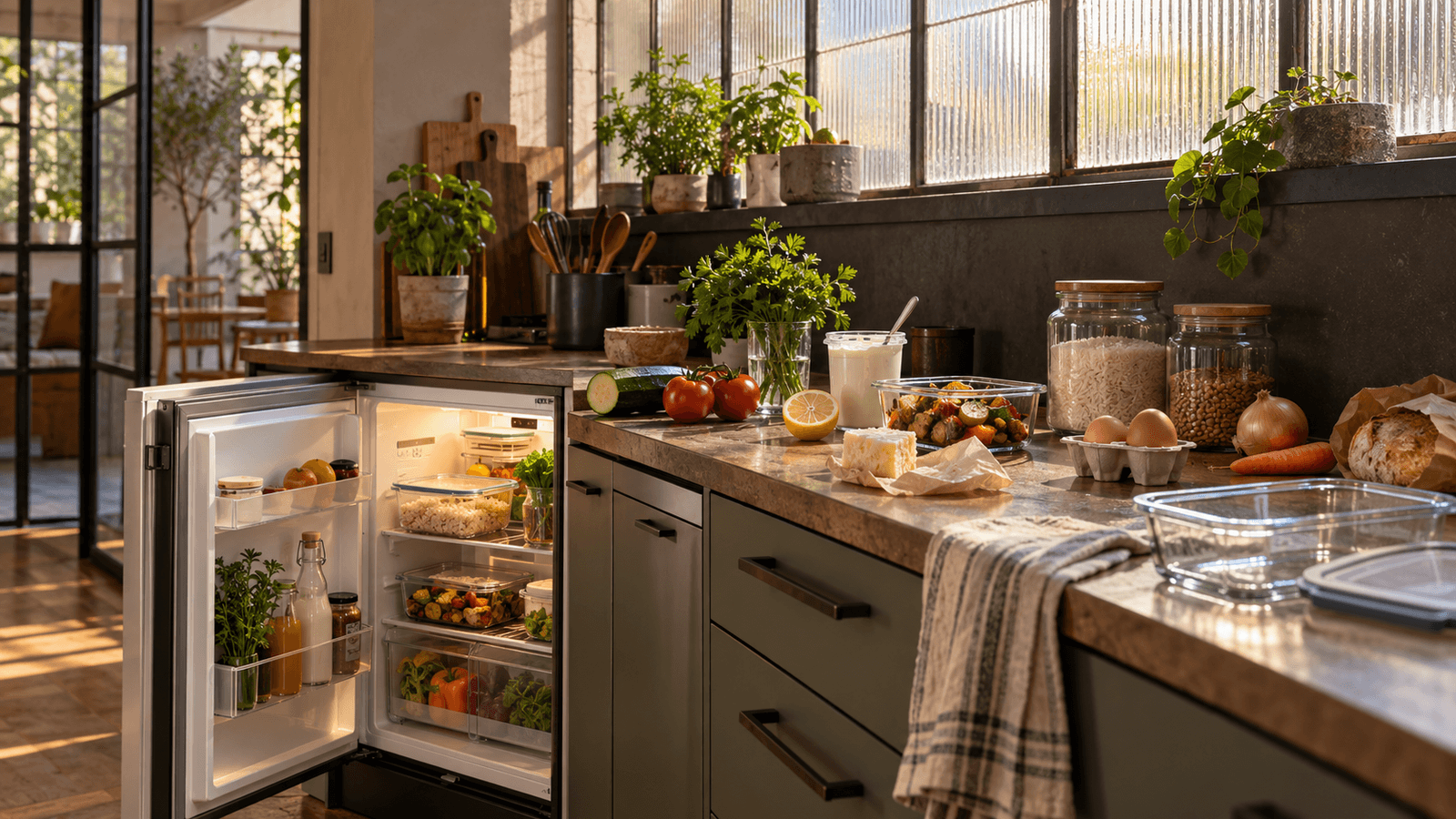
Food waste often begins before food reaches the bin.
It can start when you buy ingredients without a clear use, forget what is already in the refrigerator, prepare more food than you can realistically eat, or plan meals too rigidly to use leftovers and ingredients that need attention first.
Meal planning can help reduce this waste.
The goal is not to predict every meal perfectly. It is to create enough structure to buy, cook and use food more deliberately.
Why meal planning can reduce food waste
A meal plan connects three things:
- what you already have
- what you intend to cook
- what you actually need to buy
Without that connection, it is easy to purchase duplicate ingredients or foods that do not fit into any planned meal.
A useful meal plan starts with your kitchen rather than with a blank shopping list.
Check what you already have first
Before planning meals, look through:
- refrigerator
- freezer
- pantry
- cupboards
- bread storage
- fruit and vegetable storage
Pay particular attention to foods that need to be used relatively soon.
These ingredients can become the starting point for the next few meals.
For a more detailed approach, see How to Plan Meals Around What You Already Have.
Start with foods that need using first
Not every ingredient has the same urgency.
Fresh leafy vegetables, opened dairy products, cooked leftovers and ripe produce may need attention sooner than dry pasta, rice or canned foods.
When planning, give the most perishable foods a specific role.
For example, instead of simply writing “vegetables” on your plan, decide which meal will use the spinach, mushrooms or peppers already in the refrigerator.
Build meals around existing ingredients
Suppose you already have:
- half a package of spinach
- cooked potatoes
- an opened container of yogurt
- several eggs
- a small amount of cheese
Rather than buying ingredients for an unrelated recipe, look for meals that can use several of these foods.
This reduces the number of new ingredients entering the kitchen and gives existing food a clear purpose.
Plan ingredients across multiple meals
One ingredient does not need to belong to only one recipe.
If you buy a large package of carrots, for example, they might appear in:
- a soup
- a roasted vegetable meal
- a grain bowl
- a side dish
- a snack
This is especially useful for ingredients sold in quantities larger than one meal requires.
Avoid buying an ingredient for only one small use
Some recipes require a small amount of an ingredient that may not be used again.
Before buying it, ask:
- Can I use it in another planned meal?
- Is there a smaller package?
- Can I substitute something I already have?
- Can the remaining ingredient be frozen?
- Will I realistically use the rest?
This does not mean every ingredient must appear repeatedly. It simply helps avoid predictable leftovers that have no plan.
Keep the plan flexible
An overly rigid meal plan can sometimes increase waste.
If Tuesday's meal is fixed even though Monday produced more leftovers than expected, the leftovers may be ignored.
A flexible plan allows meals to move.
You might plan:
- several main meal options
- one leftovers meal
- one flexible meal
- a few quick backup foods
This creates room to respond to what actually happens during the week.
See Flexible Meal Planning: Plan Without Over-Scheduling.
Include a leftovers meal
One of the simplest strategies is to intentionally leave space for leftovers.
For example, one lunch or dinner later in the week can be reserved for:
- leftover portions
- combinations of several small leftovers
- ingredients that still need using
This prevents every meal slot from being occupied by a new recipe.
For more ideas, see How to Plan Meals With Leftovers.
Plan realistic portions
Food waste can also come from consistently cooking more than you need.
Think about:
- how many people will actually eat
- whether anyone will be away
- whether leftovers are wanted
- how many leftover portions are useful
- whether the recipe can be scaled down
Cooking extra can be efficient when the extra food has a purpose.
Cooking extra without a plan can simply move waste from raw ingredients to cooked food.
Separate intentional leftovers from accidental leftovers
Intentional leftovers are useful.
You may deliberately cook extra rice, roasted vegetables or protein for another meal.
Accidental leftovers are different.
They are food that remains because the amount prepared did not match what was needed.
If the same dishes repeatedly create unwanted leftovers, adjust the quantity next time.
Give leftovers a specific destination
“Eat leftovers sometime” is easy to forget.
A better plan is more specific:
- soup for tomorrow's lunch
- roasted vegetables in Wednesday's wrap
- cooked chicken in Thursday's salad
- rice for tomorrow's stir-fry
The more clearly leftovers are connected to another meal, the more likely they are to be used.
Store leftovers promptly and clearly
Meal planning works better when leftovers are easy to see and identify.
Use appropriate food-storage containers and refrigerate or freeze foods according to food-safety guidance.
Place foods that should be used sooner where they are visible rather than hidden behind newer items.
When safety is uncertain, follow current local food-safety guidance rather than relying only on appearance or smell.
Use the freezer as part of the plan
Freezing can extend the useful life of many foods and prepared meals.
The freezer is especially useful when:
- plans change
- you cooked more than expected
- an ingredient will not be used in time
- you want to preserve a prepared portion for later
However, the freezer only helps if you remember what is inside.
Keep it organized enough that frozen food remains visible and usable.
Plan a freezer meal occasionally
Instead of continuously adding food to the freezer, plan regular opportunities to use it.
A freezer meal might use:
- a previously cooked portion
- frozen bread
- frozen vegetables
- frozen soup
- frozen cooked grains
This creates a cycle rather than turning the freezer into long-term storage for forgotten food.
Shop from a meal plan
Once you know what you already have and what you intend to cook, create the shopping list.
The list should fill specific gaps.
For example:
If you already have rice, frozen vegetables and eggs, you may only need a few ingredients to turn them into several meals.
This is different from creating a list from scratch based on appealing recipes.
Check quantities before buying
Knowing that you have an ingredient is not always enough.
You may have:
- only a spoonful of yogurt
- almost a full bag of rice
- one onion
- half a package of frozen vegetables
Check whether the quantity is actually sufficient for the planned meal.
This helps avoid both unnecessary duplicates and last-minute extra purchases.
Be careful with bulk buying
A larger package can have a lower unit price but still create waste if you cannot use it.
Bulk buying makes more sense when the food:
- stores well
- freezes well
- is used regularly
- is shared by several meals
- has a realistic place in your plan
The cheapest price per unit is not automatically the cheapest choice if part of the product is discarded.
Plan around package sizes
Package size matters.
If a recipe requires only part of a package, decide what will happen to the rest before buying it.
For example, if you need half a container of yogurt for one meal, another planned meal could use the remaining amount.
This is especially useful for foods that spoil relatively quickly after opening.
Use a “use first” area
Create a small visible area in the refrigerator for foods that should be used soon.
This could include:
- opened packages
- ripe produce
- leftovers
- partial ingredients
It does not need to be a special container or complicated system.
The purpose is simply to make priority foods difficult to forget.
Rotate older food forward
When unpacking groceries, avoid automatically placing new food in front of older food.
Move older items where they are easier to see and place newer items behind them when practical.
This simple habit can reduce forgotten food.
Keep similar foods together
An organized refrigerator or pantry makes it easier to see what you already own.
For example, keeping similar foods in consistent areas can help you notice duplicates before buying more.
The goal is not a perfectly styled refrigerator.
It is visibility.
Keep an inventory only if it helps
A detailed inventory can be useful, but it is not required.
For many households, a quick visual check before meal planning is enough.
If you do use an inventory, keep it simple enough to maintain.
An outdated inventory can be less useful than looking directly at the food.
Use flexible meal templates
Flexible meal templates make it easier to use ingredients that need attention.
Examples include:
- soup
- stir-fry
- omelet
- grain bowl
- pasta
- wraps
- salad
- tray bake
These meals can often accommodate different vegetables, proteins or leftovers.
The goal is not to make the same meal repeatedly.
It is to have formats that adapt to the ingredients available.
Have a backup meal
Plans change.
A backup meal made from foods that store well can prevent unnecessary takeout while fresh ingredients remain unused.
Examples might rely on:
- frozen vegetables
- eggs
- canned beans
- pasta
- rice
- frozen portions
Choose backup foods that you actually enjoy and use.
Do not over-plan fresh produce
Buying many different fresh vegetables with a separate recipe for each can create pressure to cook everything exactly as planned.
Instead, consider buying a manageable selection that can work across several meals.
This provides flexibility when plans change.
Buy highly perishable foods with a clear purpose
Before buying a highly perishable ingredient, know approximately when you expect to use it.
If there is no realistic meal for it in the next few days, consider whether it needs to be purchased yet.
Adjust the plan when life changes
Meal plans should respond to reality.
If dinner plans change, ask:
- Which ingredient now needs attention?
- Can tonight's planned meal move to tomorrow?
- Should something be frozen?
- Can leftovers replace another meal?
- Is there anything that should be used immediately?
A two-minute adjustment can prevent several ingredients from being forgotten.
Review waste occasionally
If you regularly throw away food, notice what types of food are being wasted.
Common patterns might include:
- salad leaves
- herbs
- bread
- opened dairy products
- leftovers
- cooked grains
- produce bought without a plan
The purpose is not to feel guilty about waste.
The information can help improve future shopping and meal planning.
Turn repeated waste into a planning rule
If the same food is repeatedly wasted, create a simple rule.
For example:
- buy smaller packages
- buy it less often
- freeze half immediately
- use it earlier in the week
- plan two meals that use it
- choose a longer-lasting alternative
This converts observation into a practical adjustment.
Food waste and grocery spending
Reducing waste can also improve grocery efficiency.
Food that is purchased but never eaten still costs money.
Using more of what you buy can therefore reduce the effective cost of your meals even without finding cheaper products.
See How to Save Money on Groceries Without Sacrificing Nutrition.
Food waste and nutrition
Reducing waste does not mean forcing yourself to eat food simply because it exists.
Food safety comes first.
It also does not mean eating beyond comfortable fullness to avoid discarding leftovers.
A better strategy is to:
- buy appropriate amounts
- prepare realistic portions
- store food correctly
- freeze food when useful
- plan another use before food becomes unwanted
What not to do
Avoid treating food-waste reduction as a requirement to save every small scrap.
The system should remain practical.
You do not need to:
- build every meal around leftovers
- keep unsafe food
- eat food you dislike
- maintain a perfect inventory
- eliminate all waste
The goal is to reduce avoidable waste, not create another source of stress.
A simple weekly food-waste planning routine
A practical routine might look like this:
Step 1: Check the refrigerator
Identify foods that need attention first.
Step 2: Check the freezer and pantry
Look for foods that can form the base of meals.
Step 3: Choose several meals
Start with ingredients already available.
Step 4: Plan ingredient overlap
Use perishable ingredients across more than one meal when useful.
Step 5: Leave flexible space
Keep at least one opportunity for leftovers or changed plans.
Step 6: Write the shopping list
Buy only the missing ingredients needed to complete the plan.
Step 7: Adjust during the week
Move meals, freeze ingredients or use leftovers when reality changes.
Example of a flexible plan
Imagine you already have:
- carrots
- spinach
- potatoes
- eggs
- yogurt
- cooked rice
A flexible plan could use:
- potatoes and eggs in one meal
- spinach in an omelet and another cooked dish
- yogurt in a sauce and breakfast
- rice in a stir-fry
- carrots across soup and a tray bake
If plans change, several of these ingredients can move between meals without making the entire plan unusable.
How Mealisa-style planning can help
A useful digital meal-planning system can make food waste easier to manage when it connects planning with the foods already available.
Helpful features can include:
- planning around existing ingredients
- remembering leftovers
- adjusting upcoming meals
- generating alternatives from available food
- keeping the plan flexible
Technology is most useful when it reduces the number of decisions required rather than adding more administrative work.
Frequently asked questions
Does meal planning really reduce food waste?
It can. Meal planning helps connect existing food, future meals and grocery purchases, which can reduce unnecessary buying and forgotten ingredients.
Should I plan every meal?
Not necessarily. Leaving flexible spaces for leftovers, changing schedules and spontaneous meals can make a plan more practical.
What should I use first?
Prioritize foods that are more perishable or already opened, while following appropriate food-safety guidance.
Should I buy in bulk to reduce waste?
Only when you can realistically store and use the larger quantity. A lower unit price does not help if part of the food is discarded.
Is freezing leftovers a good strategy?
It can be, provided the food is suitable for freezing, stored safely and eventually used.
Should I keep a refrigerator inventory?
Only if it helps you. A quick visual check may be sufficient for many households.
How can I stop forgetting leftovers?
Store them visibly and assign them to a specific upcoming meal rather than planning to eat them “sometime.”
What if my meal plan changes?
Adjust it. Move meals, use leftovers, freeze ingredients or prioritize foods that need attention first.
The bottom line
Meal planning can reduce food waste by connecting what you already have with what you intend to cook and what you actually need to buy.
A practical system is simple:
- check food before planning
- prioritize ingredients that need using
- plan some ingredient overlap
- cook realistic amounts
- give leftovers a destination
- use the freezer deliberately
- shop for specific gaps
- adjust the plan when life changes
The best food-waste meal plan is not the most rigid one.
It is the one that helps more of the food you buy actually get eaten.
Always follow appropriate local food-safety guidance for storage, refrigeration, freezing and leftovers. This article provides general educational information.