
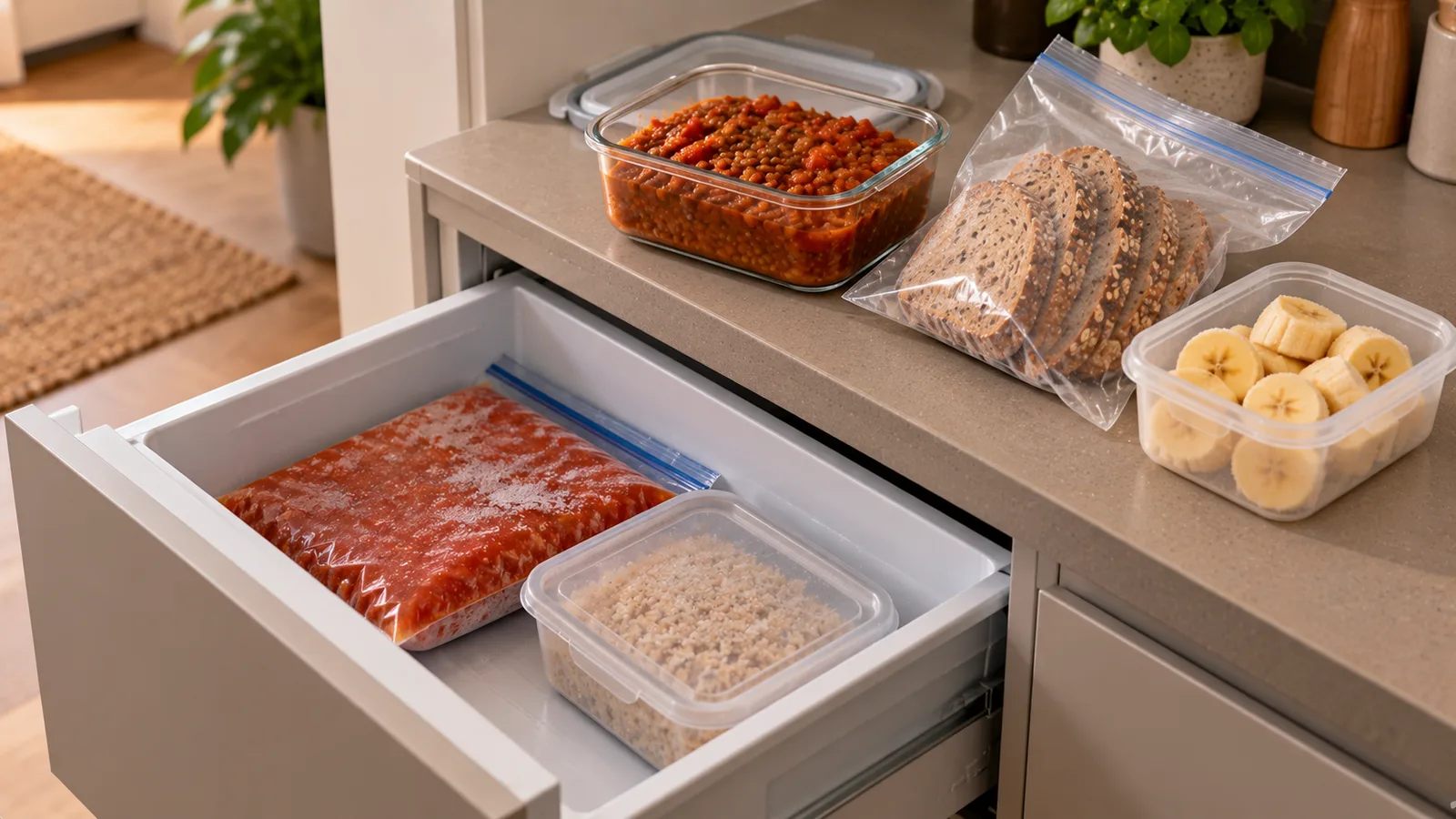
Freezing food can save money for a simple reason: food you actually eat has more value than food you buy and throw away.
The freezer can give ingredients and cooked meals more time before they are lost to spoilage. It can also make larger packs, seasonal purchases and batch cooking more practical.
But freezing everything without a system can simply move food waste from the refrigerator to the freezer.
The useful approach is to freeze the right food, at the right time, in portions you are likely to use.
Freeze food before it becomes an emergency
One of the most useful habits is deciding early.
If you already know that you will not use something in time, freezing it today is usually more useful than waiting until the food is at the edge of spoilage.
A simple decision process is:
- Check what needs to be used soon.
- Decide what you realistically expect to eat.
- Freeze suitable surplus while it is still in good condition.
- Plan when the frozen food could be used.
The freezer works best as part of food planning rather than as a last-minute rescue box.
Which foods are especially useful to freeze?
Many everyday foods can be frozen successfully, although texture may change.
Useful examples include:
- bread and rolls;
- cooked rice and grains;
- cooked beans and lentils;
- soups and stews;
- sauces;
- cooked meat;
- many cooked meals;
- berries;
- ripe bananas for later cooking or blending;
- chopped herbs in suitable preparations;
- some cheeses intended for cooking;
- portions of baked goods.
Some foods are better frozen as ingredients for future cooking than for eating in exactly the same way after thawing.
For example, a food whose texture becomes softer may still work perfectly well in soup, sauce, baking or a cooked dish.
Portion before freezing
Freezing a large quantity as one solid block can make it inconvenient to use.
Suppose you freeze 1.2 kg of cooked stew in one container.
Later you need only one serving.
You may end up thawing much more than you intended.
Instead, divide foods according to how you normally use them.
For example:
| Food | Useful freezing approach |
|---|---|
| Bread | Individual slices or small groups |
| Soup | One- or two-meal portions |
| Cooked rice | Meal-sized portions |
| Meat | Amounts used in typical recipes |
| Sauce | Small recipe-sized portions |
| Berries | Loose or small portions |
| Leftover meal | Individual servings |
The ideal portion is not necessarily the smallest possible portion.
It is the amount that matches how you actually cook and eat.
Freeze ingredients in usable forms
Think about what will happen after the food leaves the freezer.
If you normally use bread two slices at a time, freezing slices separately makes sense.
If you use cooked beans in 200 g portions, freezing roughly that amount can make future cooking easier.
If a sauce is usually used for one family dinner, freezing it in that quantity may be more convenient than dividing it into tiny containers.
The freezer should reduce work later, not create additional work.
Label what you freeze
An unlabeled frozen container becomes surprisingly difficult to identify after a few weeks.
A useful label can include:
- what the food is;
- when it was frozen;
- portion or quantity when helpful.
You do not need an elaborate inventory system.
Even a simple label such as:
lentil soup — 2 portions — 4 Oct
is much more useful than an anonymous frozen container.
Use older frozen food first
A freezer can accumulate food indefinitely if new items are always placed in front of older ones.
A simple rotation system helps:
- put newer items behind older ones when practical;
- keep frequently used categories together;
- check older items before planning the next grocery trip.
This turns frozen food into available inventory rather than forgotten storage.
Create a freezer zone for “use next”
One practical method is to reserve a small area for foods you want to use soon.
This might contain:
- older frozen meals;
- half-used packages;
- ingredients you froze to prevent waste;
- portions that no longer fit your current meal plan.
When planning the next few meals, check this area first.
It creates a visible bridge between storage and actual consumption.
Freeze leftovers intentionally
Leftovers often become waste because they enter the refrigerator without a clear next use.
After dinner, ask:
Will we realistically eat this within the next few days?
If yes, refrigerate it for a planned meal.
If probably not, and the food freezes well, freezing it may be the better option.
The important distinction is between:
leftovers with a plan
and
leftovers being stored without a decision.
For broader meal-planning strategies, see How to Plan Meals With Leftovers.
Use freezing to make larger packs practical
A larger package can have a lower unit price but still cost more if part of it spoils.
Suppose:
- 500 g costs €4.00;
- 1 kg costs €6.50.
The larger pack is cheaper per kilogram.
But if you use only 600 g and discard 400 g, the apparent saving disappears.
If the product freezes well and you can divide the 1 kg pack into usable portions immediately, the lower unit price becomes more meaningful.
This is why storage capacity and realistic usage matter when comparing pack sizes.
See Buying in Bulk vs Smaller Packs: When Does It Actually Save Money?.
A simple savings example
Imagine you buy €12 worth of meat for several meals.
You use €8 worth during the week but regularly let the remaining €4 spoil.
If instead you freeze the unused portion while it is still suitable, that €4 can become part of a future meal.
The saving does not come from the freezer itself.
It comes from converting more of what you purchased into food you actually consume.
This is the key principle behind using freezing as a budget tool.
Freeze bread before it becomes stale
Bread is one of the easiest foods to buy faster than you can eat it.
If you know a loaf will not be finished, freeze part of it early.
Slices are particularly convenient because you can remove only what you need.
This can be more practical than keeping the entire loaf at room temperature and hoping it gets eaten in time.
Freeze ripe fruit for a specific future use
Some fruit changes texture significantly after freezing.
That does not necessarily make it useless.
Very ripe bananas, for example, can be frozen for:
- smoothies;
- porridge;
- baking;
- blended desserts.
Berries can be useful in:
- oatmeal;
- yogurt;
- sauces;
- smoothies;
- cooked dishes.
The key is to freeze them with a future use in mind.
Vegetables: consider how you will cook them later
Many vegetables can be frozen, but quality depends on the vegetable and preparation method.
Some are best blanched before freezing.
Others are easier to buy already frozen commercially.
Vegetables that become softer after freezing may still work well in:
- soups;
- stews;
- sauces;
- curries;
- cooked mixed dishes.
If texture is important for the final meal, plan accordingly.
Freeze cooked grains in practical portions
Cooked rice and other grains can be convenient freezer staples.
Instead of letting excess cooked grain sit unused in the refrigerator, portion it for future meals.
This can help with:
- quick lunches;
- bowls;
- side dishes;
- busy evenings.
Cool and store cooked foods safely and reheat appropriately. Follow applicable food-safety guidance for storage, thawing and reheating.
Soups, stews and sauces are useful freezer foods
These foods often freeze well and can turn into fast future meals.
Instead of preparing exactly the amount needed for one dinner, you can sometimes intentionally cook extra and freeze the surplus.
That can reduce:
- future cooking time;
- dependence on takeaway;
- pressure to use every ingredient immediately.
But extra cooking only saves money if the frozen portions are eventually eaten.
Avoid freezing food you already dislike
A freezer is not a solution for food you never wanted to eat.
If nobody in the household likes a particular dish, freezing six portions does not create value.
It simply delays the waste.
Freeze foods that have a realistic future role.
That may sound obvious, but it is one of the most important rules for maintaining a useful freezer.
Do not overfill the freezer with “maybe someday” food
Freezer space has value.
If it is filled with forgotten containers, you may have less room for food that could genuinely save money.
Periodically review:
- unidentified items;
- foods you repeatedly avoid;
- very old portions;
- duplicate ingredients;
- containers taking excessive space.
The goal is not maximum freezer occupancy.
The goal is useful inventory.
Build meals from frozen components
Not everything needs to be frozen as a complete meal.
You can keep components such as:
- cooked grains;
- cooked beans;
- sauce;
- vegetables;
- portions of protein;
- bread.
Then combine them differently.
For example:
rice + beans + vegetables + sauce
can become one meal.
The same rice may later accompany fish and vegetables.
Component freezing gives you flexibility without requiring a freezer full of identical prepared meals.
Use the freezer when plans change
Food waste often begins when the original meal plan changes.
Perhaps:
- you unexpectedly eat out;
- work runs late;
- guests cancel;
- you cook less than expected;
- another meal produces more leftovers.
Instead of treating the original plan as fixed, reassess the ingredients.
Ask:
Which food is now unlikely to be used before it deteriorates?
Suitable foods can then be frozen before they become waste.
Check the freezer before shopping
Buying a second package of something you already have frozen ties up money and storage space.
Before a grocery trip, check:
- frozen proteins;
- bread;
- vegetables;
- cooked meals;
- grains;
- sauces.
Then incorporate useful items into the next meal plan.
This can reduce duplicate purchases and help older food move out of storage.
A practical weekly freezer routine
You do not need to manage the freezer every day.
A short weekly routine can be enough.
Before grocery shopping
Check what is already frozen.
After shopping
Divide large freezable packages if necessary.
Midweek
Look for fresh foods that are unlikely to be used in time.
After cooking
Decide whether surplus food has a specific refrigerated use or should be frozen.
Before planning the next week
Choose one or two frozen items to use.
This creates a cycle:
buy → use → freeze surplus → use frozen food → buy again
rather than:
buy → forget → discard → buy again.
Food safety still matters
Freezing slows microbial growth but does not make unsafe food safe again.
Do not use freezing as a way to rescue food that has already spoiled.
Use suitable containers or freezer packaging, maintain appropriate freezer conditions, and follow reliable food-safety guidance for:
- cooling cooked food;
- freezing;
- thawing;
- reheating;
- storage duration.
If you are unsure whether a particular food can be safely frozen or how long it should be stored, check current guidance from the relevant food-safety authority in your country.
The budget question to ask
Before freezing something, ask:
- Will I realistically eat this later?
- What portion will I need?
- How should I package it so it remains useful?
- Can I identify it easily?
- When am I likely to use it?
If you cannot answer the first question, freezing may only postpone waste.
If you can answer all five, the freezer becomes a practical extension of your grocery budget.
A freezer is most valuable when food comes back out
The goal is not to build the largest possible frozen-food collection.
It is to create time between buying food and using it.
Freeze surplus while it is still suitable, divide it into practical portions, label it clearly and regularly plan meals around what is already stored.
That is how freezing can reduce food waste and turn more of your grocery spending into meals you actually eat.