
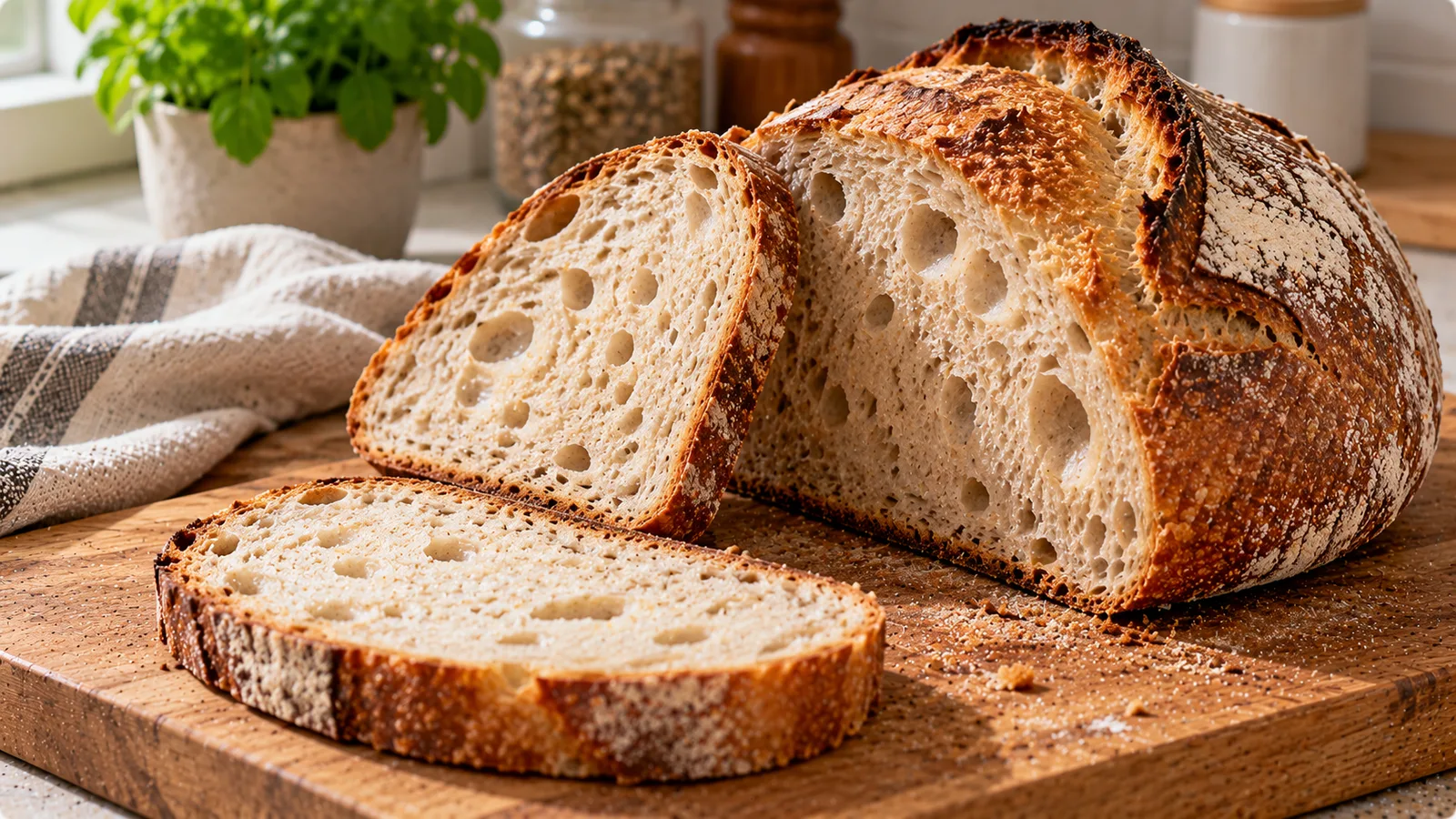
Sourdough bread is popular for its tangy flavor, chewy texture and naturally fermented dough.
But how many calories does sourdough contain?
The answer depends mainly on the flour, added ingredients and the weight of the portion.
A useful starting estimate for plain sourdough bread is approximately 230–270 calories per 100 g.
That means a 40 g slice might contain around 92–108 calories, while a thick 70 g slice could provide 161–189 calories.
These are practical estimates, not a universal nutritional specification. Individual bakery loaves and packaged products can differ substantially.
Sourdough calories at a glance
The following table uses a representative range of 230–270 kcal per 100 g for plain sourdough bread.
| Portion | Estimated calories |
|---|---|
| 25 g, small slice | 58–68 kcal |
| 35 g, thin slice | 81–95 kcal |
| 40 g, medium slice | 92–108 kcal |
| 50 g, generous slice | 115–135 kcal |
| 60 g, large slice | 138–162 kcal |
| 70 g, thick bakery slice | 161–189 kcal |
| 100 g | 230–270 kcal |
| 150 g | 345–405 kcal |
The table is calculated from the stated range.
For an exact value, weigh your portion and use the nutritional information for the bread you actually eat.
Why sourdough calorie values vary
Sourdough describes a fermentation method, not one standardized recipe.
Two loaves labeled sourdough can have different ingredients, moisture levels and nutritional values.
Important factors include:
- White wheat flour versus wholegrain flour.
- Rye, spelt or mixed grains.
- The amount of water remaining after baking.
- Seeds, nuts, oil, sugar or other additions.
- The density and thickness of each slice.
- Differences between bakery and packaged products.
A dense slice can weigh considerably more than a similarly sized airy slice.
That is why comparing slices without weighing them is unreliable.
Calories in one slice of sourdough bread
A slice does not have a fixed weight.
A small, thin slice might weigh 30–35 g.
A medium slice may weigh 40–50 g.
A thick slice cut from a large artisan loaf can weigh 60–80 g or more.
For example, if a sourdough loaf contains 250 kcal per 100 g:
| Slice weight | Calories |
|---|---|
| 30 g | 75 kcal |
| 40 g | 100 kcal |
| 50 g | 125 kcal |
| 60 g | 150 kcal |
| 75 g | 188 kcal |
| 90 g | 225 kcal |
The formula is straightforward:
Calories in your slice = slice weight in grams × calories per 100 g ÷ 100
For a 65 g slice of bread containing 248 kcal per 100 g:
65 × 248 ÷ 100 = 161.2 kcal.
You can round this to approximately 161 calories.
Sourdough bread nutrition per 100 g
Nutritional composition depends on the flour and recipe.
For a typical plain wheat sourdough, the following are broad illustrative ranges.
| Nutrient | Approximate amount per 100 g |
|---|---|
| Energy | 230–270 kcal |
| Protein | 7–11 g |
| Fat | 1–4 g |
| Total carbohydrate, including fiber in US-style databases | 45–55 g |
| Fiber | 2–5 g |
| Sodium | Varies significantly with salt content |
These ranges should not be combined mechanically into one precise nutrition label.
For example, the high end of each nutrient range may describe different products.
Wholegrain sourdough may have a higher fiber content, while sourdough containing seeds or added oil may have more fat.
For nutrition tracking, packaged product labels or a bakery's verified nutrition information are preferable to generic estimates.
A note about carbohydrate labels
US nutrition databases commonly report total carbohydrate including fiber.
EU labels list carbohydrates and fiber separately.
This can make carbohydrate values from different databases appear inconsistent even when they describe similar foods.
Check the definition before comparing numbers.
White sourdough versus wholegrain sourdough
White sourdough is generally made from refined flour.
Wholegrain sourdough uses flour that retains more components of the grain.
The biggest nutritional distinction is often fiber, not necessarily calories.
| Feature | White sourdough | Wholegrain sourdough |
|---|---|---|
| Main flour | Refined flour | Wholegrain flour |
| Calories | Often similar per 100 g | Often similar per 100 g |
| Fiber | Usually lower | Usually higher |
| Texture | Often lighter and airier | Often denser |
| Flavor | Mild to tangy | More grain-forward |
| Portion weight | Depends on slicing | Depends on slicing |
Wholegrain bread can be a useful choice when trying to increase fiber intake.
However, a dense wholegrain slice may weigh more than a lighter white slice.
For calorie comparisons, weigh the bread rather than assuming the darker loaf is automatically lower in calories.
Is rye sourdough lower in calories?
Not necessarily.
Rye sourdough can have a different texture, water content and fiber profile from wheat sourdough.
Some rye breads are dense and moist.
Others contain a combination of rye and wheat flour.
Calories per 100 g can overlap with wheat sourdough, and the exact result depends on the recipe.
Dark color alone is not a reliable indicator of calorie content.
Likewise, a loaf described as multigrain is not automatically wholegrain.
Check the ingredient list and nutrition label when available.
Does fermentation reduce sourdough calories?
Sourdough fermentation changes the dough through the activity of microorganisms.
However, it does not make bread calorie-free or automatically substantially lower in calories than conventional yeast bread.
Flour remains the main energy source.
Fermentation can influence acidity, flavor, texture and the availability of some nutrients, but calorie content still depends heavily on the finished recipe.
Do not subtract an arbitrary percentage of calories simply because a bread is fermented.
A plain sourdough and a plain yeast-raised wheat bread made with similar flour, moisture and added ingredients can have comparable calorie values.
Sourdough versus regular bread: calorie comparison
Different bread products vary, but the broad picture is useful.
| Bread type | General calorie perspective |
|---|---|
| Plain white sourdough | Often around 230–270 kcal per 100 g |
| Plain wheat sandwich bread | Frequently in a similar broad range |
| Wholegrain sourdough | Can overlap with white sourdough |
| Rye sourdough | Depends strongly on moisture and formulation |
| Seeded sourdough | May be more energy-dense because seeds contain fat |
| Sourdough with added oil | May contain more calories per 100 g |
The most reliable comparison is between actual product labels.
For example, comparing a 35 g slice of packaged bread with a 75 g slice of artisan sourdough is primarily a portion-size comparison.
How much sourdough bread is 100 calories?
If the bread contains 250 kcal per 100 g:
100 ÷ 250 × 100 = 40 g.
At 230 kcal per 100 g, approximately 43 g provides 100 calories.
At 270 kcal per 100 g, approximately 37 g provides 100 calories.
So a practical estimate is about 37–43 g of plain sourdough for 100 calories.
Use the actual product value when precision matters.
How many calories are in two slices?
It depends on slice weight.
Using 250 kcal per 100 g:
| Two slices weighing | Total bread calories |
|---|---|
| 30 g each | 150 kcal |
| 40 g each | 200 kcal |
| 50 g each | 250 kcal |
| 60 g each | 300 kcal |
| 75 g each | 375 kcal |
Two thick slices can contain more than twice the calories of two thin slices.
This is one reason why entries such as "two slices of bread" are not always accurate in food diaries.
Toppings can change the total considerably
Sourdough itself is only part of a toast or sandwich.
The toppings may contribute substantial calories.
The following are illustrative estimates; actual products vary.
| Addition | Example quantity | Approximate calories |
|---|---|---|
| Butter | 10 g | 70–75 kcal |
| Olive oil | 10 g | 88–90 kcal |
| Avocado | 50 g | Around 80 kcal |
| Peanut butter | 20 g | Around 115–125 kcal |
| Hard cheese | 30 g | Around 105–125 kcal |
| One large egg | About 50 g edible portion | Around 70–80 kcal |
| Tomato | 50 g | Around 9 kcal |
Consider a 60 g slice of sourdough containing 250 kcal per 100 g.
Bread: 150 kcal.
Add 50 g avocado: approximately 80 kcal.
Add one egg: approximately 75 kcal.
Estimated total: 305 kcal, before any extra cooking oil.
The same slice with only tomato would have a much lower total.
Is sourdough bread good for weight loss?
Sourdough can fit into a weight-loss diet.
Weight change is primarily influenced by overall energy intake and expenditure over time.
No bread type automatically causes weight loss.
A useful approach is to choose a portion that fits your meals and pair it with foods that contribute protein, fiber or vegetables.
For example:
- Sourdough with eggs and tomatoes.
- Wholegrain sourdough with cottage cheese and cucumber.
- Sourdough with hummus and roasted vegetables.
- A moderate slice alongside a bowl of soup.
The goal is not necessarily to eliminate bread.
It is to understand portion size and total meal composition.
Does sourdough have a lower glycemic response?
Some studies suggest that sourdough fermentation and bread structure can influence post-meal blood glucose responses.
However, results differ by recipe, flour, processing and the people studied.
It is not accurate to say that every sourdough loaf has a lower glycemic index than every conventionally fermented bread.
Wholegrain content, portion size and what you eat with the bread also matter.
If you monitor blood glucose for a medical reason, do not rely on the sourdough label alone to predict an individual response.
Is sourdough gluten-free?
Ordinary wheat, rye and barley sourdough is not gluten-free.
Fermentation does not reliably remove enough gluten to make conventional wheat sourdough safe for people with celiac disease.
Gluten-free sourdough can be made using suitable gluten-free flours and carefully controlled ingredients and processing.
People who need to avoid gluten should choose products appropriately labeled gluten-free and consider cross-contact risks.
Does toasted sourdough have fewer calories?
Toasting removes some moisture from bread.
It does not meaningfully remove the energy originally present in the slice.
A 50 g slice weighed before toasting will contain approximately the same calories after toasting, assuming nothing is burned away and no toppings are added.
However, its weight may decrease because water evaporates.
That can make calories per 100 g of toasted bread appear higher than calories per 100 g before toasting.
For accurate tracking, weigh the bread before toasting and use the original product information.
How to log sourdough accurately
A kitchen scale is the easiest tool.
- Place the bread on the scale.
- Record the weight in grams.
- Check the calories per 100 g on the label or a reliable database.
- Multiply the weight by the per-100-g value and divide by 100.
- Record toppings and spreads separately.
Example:
Bread weight: 72 g.
Product label: 242 kcal per 100 g.
72 × 242 ÷ 100 = 174.24 kcal.
Log approximately 174 kcal for the bread.
If the slice is part of a sandwich, add the other ingredients.
When the bakery provides no nutrition label
If the bakery cannot provide a nutritional analysis, use a clearly identified generic bread entry as an estimate.
Choose an entry that resembles the actual loaf: white wheat, wholegrain, rye or seeded sourdough.
Weigh the portion and recognize the remaining uncertainty.
Do not present a generic database estimate as a laboratory measurement of that particular bakery loaf.
Frequently asked questions
How many calories are in a slice of sourdough?
A 40–50 g slice of plain sourdough may contain approximately 92–135 calories, based on 230–270 kcal per 100 g.
How many calories are in 100 g of sourdough?
A useful general estimate is around 230–270 kcal, although individual products vary.
Is sourdough lower in calories than white bread?
Not necessarily. Similar recipes can have similar calorie content.
Is wholegrain sourdough lower in calories?
Not automatically. Its main nutritional advantage is often greater fiber content.
Is sourdough healthier than regular bread?
It depends on the flour, ingredients, nutritional goals and overall diet. Fermentation alone does not determine whether a bread is the better choice.
Does sourdough fermentation remove gluten?
No. Ordinary wheat or rye sourdough is not suitable for a gluten-free diet.
Should I weigh sourdough before or after toasting?
Before toasting is generally easiest when using the original bread's nutrition label.
Sources and references
- USDA FoodData Central — nutritional information for breads and bread ingredients.
- USDA Dietary Guidelines resources — general dietary patterns and grain choices.
- Celiac Disease Foundation — information on gluten and celiac disease.
- European Commission: Food Information to Consumers — EU nutrition-labeling framework.
The bottom line
Plain sourdough bread often provides approximately 230–270 calories per 100 g.
A typical slice can vary widely in weight, so calories per slice are less reliable than calories per 100 g.
For the best estimate, weigh your bread, check the actual product information and count toppings separately.
Sourdough can be part of a balanced diet, but fermentation does not automatically make it low-calorie.