
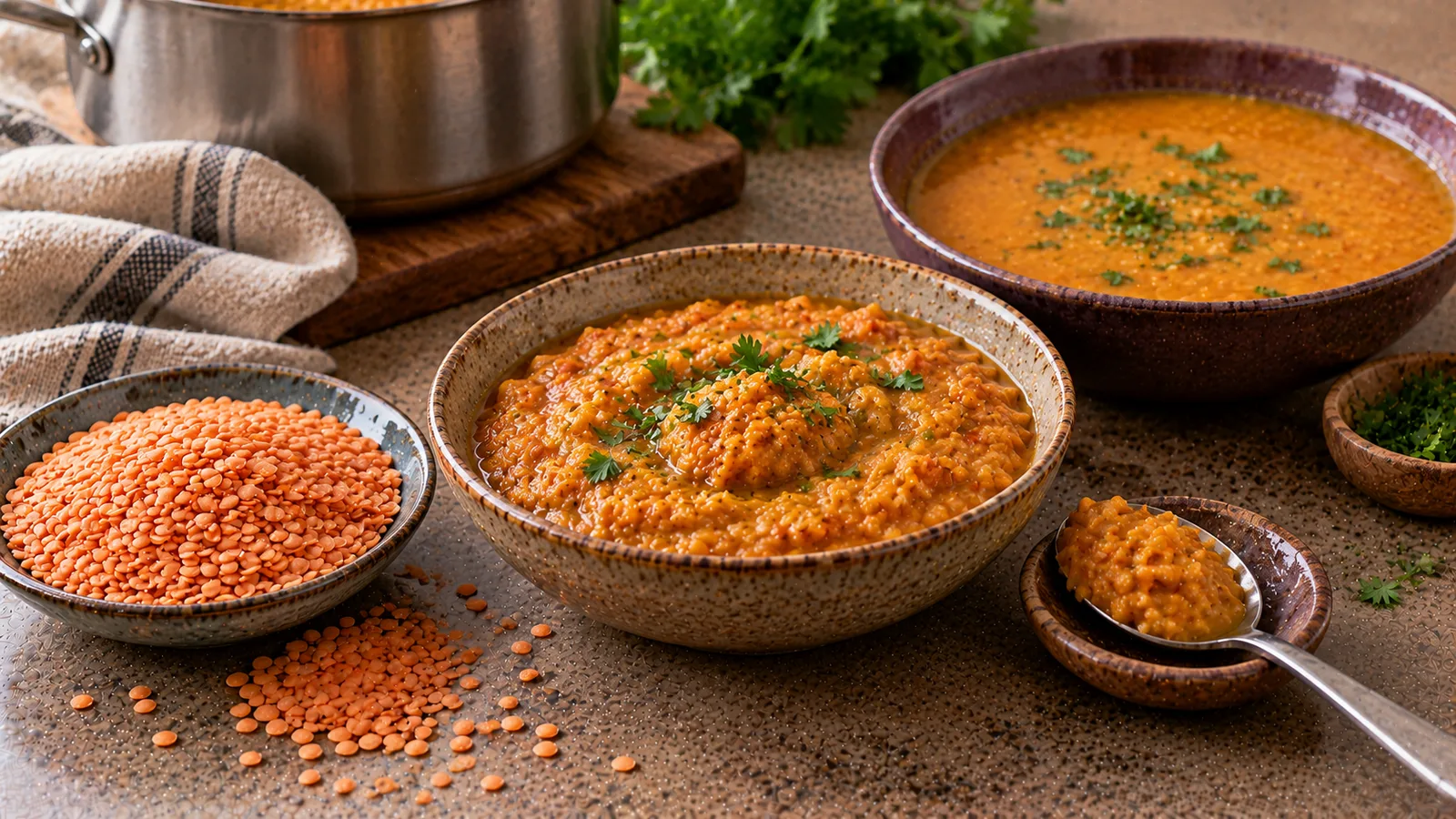
Red lentils are useful when a meal needs to be ready quickly, yet their tendency to disintegrate can surprise a cook who expected distinct grains. The first decision is not how much water to add: it is whether you want pieces for a side, a thick dal or a loose soup. Those are three different outcomes. A controlled simmer, an early taste and a decision to drain or retain the liquid matter at least as much as the written ratio. No technique can turn very soft split lentils back into firm whole lentils.
Why red lentils soften so quickly
Check whether the packet contains split, hulled red lentils or whole red lentils. Splitting and removing the husk shorten the route to a tender centre. Lentils.org gives approximately 5–7 minutes for split lentils and 15–20 minutes for whole lentils; Bob’s Red Mill allows 15–20 minutes for its red-lentil product with a generous amount of water. These are different product instructions, not a universal contradiction. Brand, age, pan size and heat change the result. Soaking is generally unnecessary; sort and rinse before cooking.
Split or whole: identify the bag first
Use ratios by volume when following the table below. For a reproducible example here, weigh 200 g dry lentils, then measure the liquid in millilitres. The 1:2 ratio for a dense dal is an editorial starting trial, not an official standard. Lentils.org and Bob’s Red Mill both describe an approximately 1:3 lentil-to-water volume method as a general approach, which is appropriate for a softer dish or a drained pot. Water can be added during cooking, but it cannot easily be removed from already broken-down lentils without changing texture.
Water ratios are starting points, not guarantees
To retain as much shape as split red lentils permit, bring plenty of water to a gentle simmer before adding 100 g rinsed split lentils. Use around 400 ml water, so there is room to circulate and pour off liquid later. Start tasting at 4 minutes, then check every minute. When tender but not collapsing, immediately drain through a fine sieve and spread out briefly so carry-over heat falls. Do not stir vigorously. This is a texture-preserving trial method, not a guarantee of individual firm grains; use whole lentils if the dish requires a bite.
| Target texture | Dry lentils | Starting liquid | When to stop |
|---|---|---|---|
| Some pieces / drain | 100 g | 400 ml | 4 min + test |
| Thick dal / add water | 200 g | 400 ml | adjustable |
| Soup / adjust after vegetables | 200 g | 600 ml | adjustable |
These are weighed-recipe trials (grams and millilitres), not a conversion of the separate volume ratio 1:3 into grams. Drain only the first method; the others retain and adjust liquid.
Method 1: keep split lentils as separate as possible
For a thick dal, put 200 g dry split red lentils and 400 ml water or unsalted stock in a wide pan. Bring just to the boil, then maintain a low simmer. Stir occasionally along the bottom so starch does not stick; add 50–100 ml more liquid if the mixture becomes too thick before the lentils soften. Begin checking early and expect a creamy, partly broken texture. Onion, spices and tomato can be cooked separately and folded in; any oil should be weighed. A dal is allowed to be soft: the target is spoonable richness rather than separate lentils.
Method 2: a thick red-lentil dal
For soup, use 200 g dry split red lentils and 600 ml stock or water as an adjustable starting point. Add 200 g chopped vegetables and enough additional liquid to keep them submerged if necessary. Simmer gently, check the pieces regularly and stop when the planned texture is reached. To serve chunky, add vegetables that hold shape and avoid prolonged simmering of the lentils. To serve smooth, cook longer or blend at the end. Do not treat the same 600 ml as a universal finished soup yield: vegetables release water and some evaporates.
Method 3: a spoonable red-lentil soup
Compare two labelled example pots. Pot A: 200 g dry lentils with 400 ml water starts as a thick dal; if it becomes too firm, add measured water gradually. Pot B: 200 g dry lentils with 600 ml water plus 200 g vegetables starts as soup, but may still need extra stock depending on the pan. Neither example claims that 200 g dry lentils always become a fixed number of grams cooked. Record the weight of the finished pot if you need accurate serving or meal-prep figures.
Two complete batches with weights
A lid reduces evaporation; an uncovered wide pan concentrates the stew faster. A rapid boil and repeated stirring damage fragile split pieces. Cookware, altitude, batch size and the degree of splitting all matter. Adding tomato or lemon early changes flavour and acidity; do not rely on an exact extra-cooking-time claim without testing the recipe. For a more repeatable process, note the type of lentil, grams used, water volume, pan, lid and the minute when the texture first seems right.
Why the same ratio can give a different result
If lentils are too watery but still hold some shape, drain a portion of the liquid immediately. If they are already soft, simmering longer to evaporate water will make them still softer; instead thicken a dal with its own puree or serve it as soup. If the mixture is dry but crunchy, add small amounts of hot liquid and continue gently until properly cooked. If it scorches, move the unburnt portion to another pan without scraping the bottom. Salt and aromatic seasoning should be adjusted at the end for the actual liquid volume.
Troubleshooting a pot that went wrong
For calorie tracking, weigh the lentils dry before cooking and use the dry-product label; add oil, vegetables and coconut milk separately. Water contributes no calories, but changes kcal per 100 g of finished food. As a worked arithmetic example only, 200 g dry lentils divided among 4 portions represents 50 g dry lentils per portion, before other ingredients. If the finished pot weighs 1,000 g, a 250 g serving is one quarter of the batch. Do not combine a dry-weight calorie value with a cooked-weight serving as though the states were identical.
How to weigh portions and ingredients
Cool cooked dal or soup promptly in shallow containers and refrigerate within 2 hours; if the room temperature exceeds 32 °C, refrigerate within 1 hour. USDA FSIS guidance gives 3–4 days for most cooked leftovers in the refrigerator and recommends reheating leftovers thoroughly to 74 °C. Freezing single portions is useful, although thawed split lentils may be softer still. Reheat with a little water if the dal has thickened. These are practical US food-safety guidelines, not a substitute for locally applicable requirements.
For related ingredient questions, see red lentils and split peas compared · lentil calories by serving.
Cooling, storage and reheating
For a side with discernible pieces, use a short, closely watched simmer and drain early. For dal, start concentrated and add liquid as necessary; for soup, begin looser and monitor the finished level. The cooking skill is recognising the point to stop, not following one promised time. This guide deals with technique and texture: a separate comparison of red lentils with dried split peas and a general lentil-calorie profile answer different search questions.