
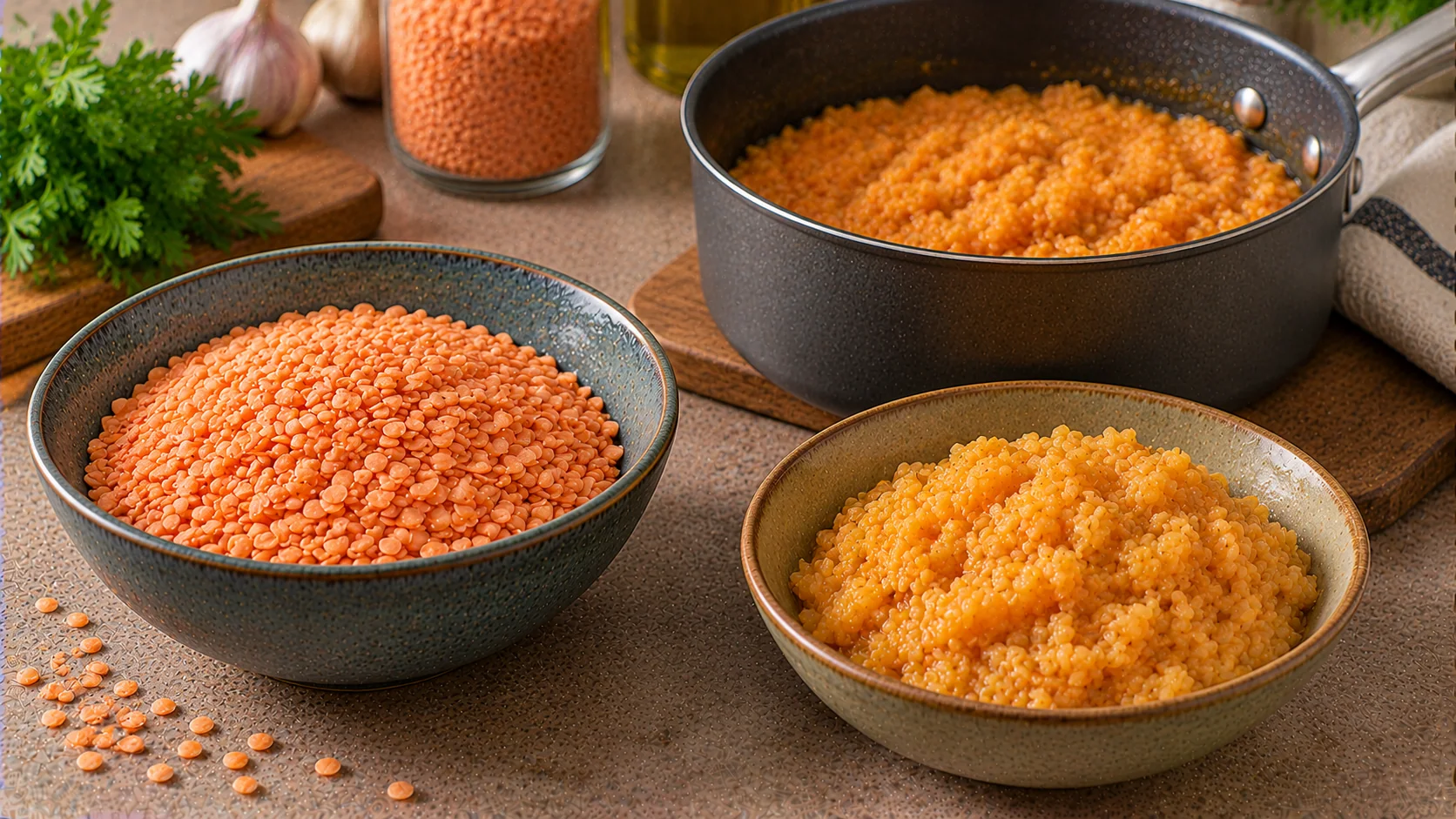
Do Red Lentils Need Soaking? Cooking Time and Yield
The short answer
No: ordinary dry split red lentils do not need overnight soaking. Sort, rinse and simmer them until fully tender. The split seed has less structure to resist water than a whole lentil, which explains why it softens quickly and often turns creamy. An Iowa State University Extension guide gives around 5–7 minutes for split red lentils under its method, while other brands and larger batches may need 10–15 minutes or more. Start checking early rather than relying on a single stopwatch reading. Iowa State University Extension and Lentils.org both describe lentils as no-soak pulses.
Identify the lentils before you begin
Red or orange split lentils, often sold as masoor dal, are typically hulled and split. Whole red lentils with their skins, brown lentils and green lentils behave differently. Always read the packet: a product marked whole, a lentil-and-grain blend or a ready-cooked pouch cannot be treated as ordinary raw split red lentils. Split lentils lose their shape when cooked; that is normal rather than a defect. They suit thick soups, dal and creamy sauces better than a salad requiring intact beans.
What soaking changes—and what it does not
An overnight soak is unnecessary for this type of lentil and makes its short cooking process less predictable. A short rinse removes dust and helps you spot debris. If you have already soaked them, discard soaking water and cook immediately, checking sooner for softness. Soaking does not make raw lentils ready to eat. Do not taste uncooked pulses to judge readiness. Cooking remains essential. The exact effect of soaking on minerals or digestion is not a dependable reason to promise a specific health benefit from skipping it.
A reproducible method for 150 g dry lentils
This is a practical starting method, not a laboratory cooking standard. Use a pan with room for foam. The 150 g dry amount is a weighed example, whereas the liquid is measured by volume.
- Check 150 g dry split red lentils for small stones or unusual fragments; rinse under running water in a fine sieve.
- Add lentils and 450 ml fresh water to a saucepan. This is 3 ml water per gram dry lentils, a deliberately generous starting ratio for soft, spoonable lentils, not a universal absorption figure.
- Bring to a full boil, lower immediately to a gentle simmer, and partially cover to prevent overflowing foam. Stir occasionally, especially near the end.
- Check after 5 minutes of simmering, then every 2–3 minutes. Continue until every lentil is soft and no hard centre remains. In many kitchens this takes approximately 5–15 minutes after boiling; a thick stew or old stock can take longer.
- For a thicker result, simmer uncovered briefly; for soup, add hot water a little at a time. Season to taste once the consistency is right.
Cooking-time and texture table
| Desired result | When to start checking | Practical adjustment |
|---|---|---|
| Soft lentils with some fragments | 5 minutes | Stop when no hard centres remain |
| Creamy dal or sauce | 7–10 minutes | Stir and continue until the pieces break down |
| Smooth soup base | 10–15 minutes | Add liquid if the bottom begins to catch |
| Lentils cooked in acidic tomato sauce | Check repeatedly | Cooking time may differ; add sufficient water |
These are checking windows, not guaranteed completion times. Water hardness, altitude, lentil age, pan size, heat and added ingredients all change results. Follow the package if it gives different instructions. Split red lentils can pass quickly from tender to puree, so taste and texture determine when to stop.
Why volume ratios and weight ratios differ
Advice such as “one cup lentils to three cups water” measures both ingredients by volume. That is not the same as 100 g lentils plus 300 g of water under all conditions: a cup of dry lentils has a variable weight because pieces pack differently. For consistency, choose one method and record it. If you are preparing a bowl whose cooked lentil weight matters, weigh the dry lentils first and weigh the finished batch after cooking. Steam loss and retained liquid make the final weight variable.
How much cooked lentil do 100 g dry produce?
There is no single guaranteed yield. For meal planning, you might initially budget about 200–300 g of cooked soft lentils from 100 g dry depending on drainage and water retained. This is an illustrative range, not a verified conversion factor. When the lentils are served as a saucy dal, part of the weight is free liquid; for a thick drained preparation, it is less. Do not assume the higher finished weight means more protein or calories were created.
| Dry lentils weighed | Example finished weight at 2.0× | Example finished weight at 2.5× | Example finished weight at 3.0× |
|---|---|---|---|
| 50 g | 100 g | 125 g | 150 g |
| 100 g | 200 g | 250 g | 300 g |
| 150 g | 300 g | 375 g | 450 g |
| 200 g | 400 g | 500 g | 600 g |
All figures are arithmetic scenarios. If 150 g dry actually makes 360 g of cooked lentils, your personal batch factor is 360 ÷ 150 = 2.4. A 120 g finished serving then represents 120 ÷ 2.4 = 50 g dry. This is usually more useful for food logging than copying a yield number from another kitchen.
Track nutrients without counting the water as food
Use the nutrition label for the dry product if you know the dry grams added. Example only: if that label states 24 g protein and 340 kcal per 100 g dry, a batch with 150 g dry has 36 g protein and 510 kcal before additions. Three equal portions then contain 12 g protein and 170 kcal each, whether the finished pot weighs 300 or 450 g. These are fictional label figures to explain calculation; substitute your exact pack values. If you use a cooked-lentil database entry instead, weigh only the cooked amount and ensure the database entry matches its water content and preparation. Compare references using USDA FoodData Central.
A practical two-portion red lentil base
For a quick savoury base, weigh 120 g dry split red lentils, rinse and combine with 360 ml water, 150 g chopped tomatoes and 80 g finely diced carrot. Bring to a boil, simmer gently and stir until the lentils and carrot are completely tender. Add 1 teaspoon of cumin, then season with salt to taste. You may need additional water because tomatoes, carrots and pan evaporation change consistency. Divide into two servings and pair with vegetables or wholegrain bread. The recipe is a flexible base, not a claim that one pot has a fixed calorie value; the actual labels and portions determine nutrition.
Common problems and fixes
Still crunchy after ten minutes? Continue simmering and add hot water if required. Some packets, older legumes or an unusually gentle hob need longer. Too watery? Uncover and reduce gently; liquid also thickens as lentils break apart. Scorching at the bottom? Lower heat, stir and move to a clean pot if necessary rather than scraping burnt material through the food. Want distinct lentils for a salad? Use a whole green or brown variety instead; split red lentils naturally become soft. No time to soak? You do not need soaking time: the prep is mostly sorting, rinsing and heating.
Safe cooling, storage and reheating
Treat cooked lentils as perishable prepared food. Cool promptly in shallow containers, refrigerate at 4°C or below, and avoid leaving a pot at room temperature for an extended period. A conservative meal-prep plan is to use refrigerated portions within 3–4 days or freeze for longer storage; reheat thoroughly. Follow FoodSafety.gov's cold-storage chart for general leftover guidance, recognizing that it is not a red-lentil-specific shelf-life study. Discard food exposed to unsafe temperatures rather than trying to rescue it by extra boiling.
Where soaking is actually useful
If the recipe calls for whole chickpeas or dried kidney beans, cooking requirements differ greatly. Do not generalize split red-lentil instructions to every pulse. For a broader comparison of legumes, our guide to choosing dried and canned legumes; for a practical method using cooked grain, our practical grain and legume cooking guide. Keep the guide anchored on the specific split-red-lentil question rather than replacing it with a general beans-versus-lentils article.
Sources
- Iowa State University Extension — Lentils — no-soak preparation and split-red-lentil checking time.
- Lentils.org — How to Cook Lentils — rinsing, water ratio by volume and approximate cooking windows.
- Oregon State University Extension — Lentils — differences between split red and whole varieties.
- USDA FoodData Central — matching dry and cooked food composition entries.
- FoodSafety.gov — Cold Food Storage Charts — general cooked-food refrigeration guidance.