
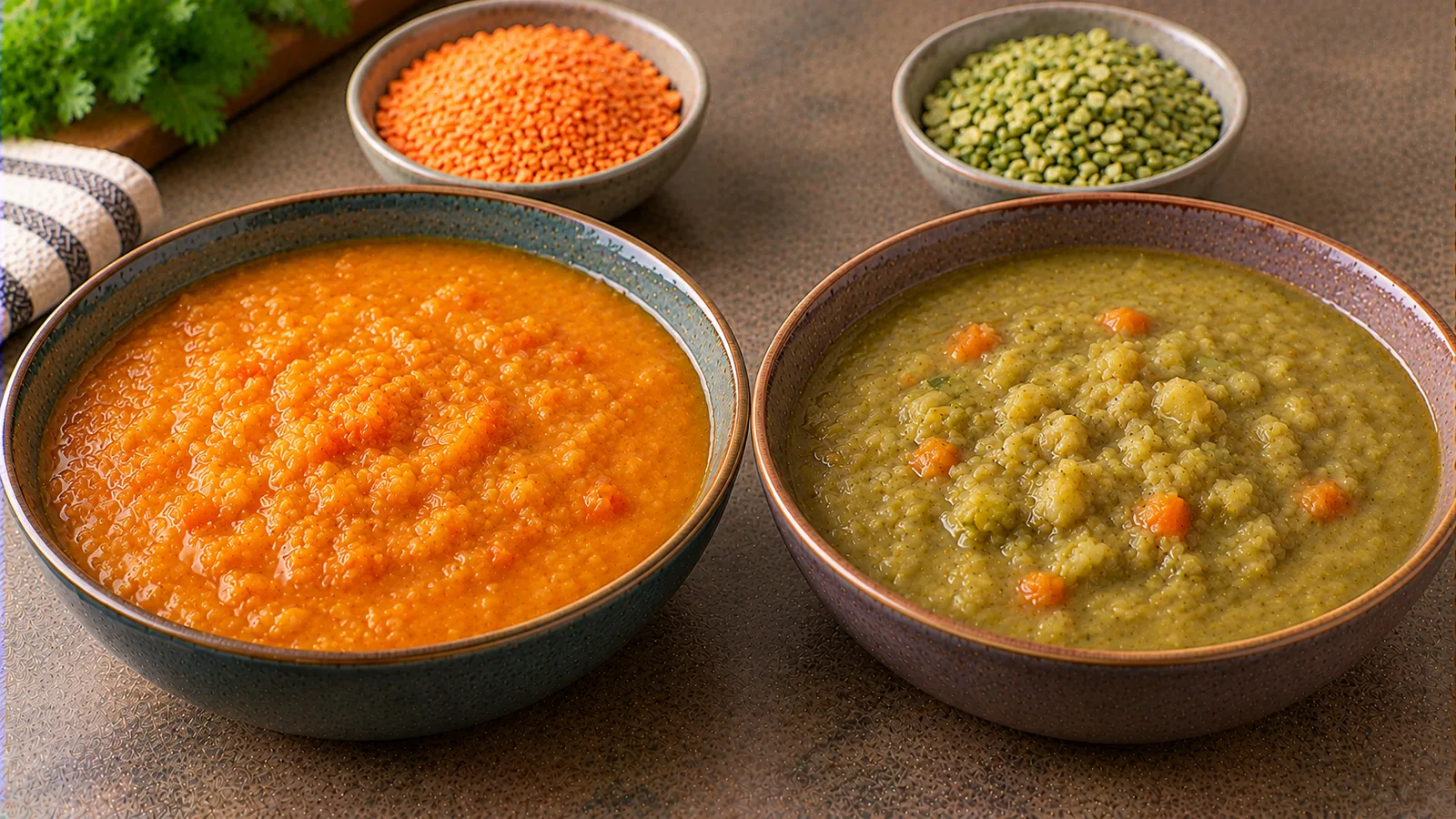
Red lentils and dried split peas both turn an inexpensive bag of pulses into a thick soup. They are not interchangeable on cooking time, however. Peeled split red lentils can soften within about 5–15 minutes of simmering; dried split peas can take considerably longer, and the instructions on the particular bag matter. The cost difference is often much smaller than the time difference.
This comparison uses one 400 g finished soup bowl made with 80 g dry pulses on either side. That is a controlled recipe model, not a claim that every package absorbs the same amount of water. For the ingredient-only example, the regular listed German prices checked on 22 October 2026 are €1.45 for 500 g ALDI SÜD BIO red lentils and €1.69 for 500 g Müller's Mühle green split peas at EDEKA24. The calculated pulse cost is approximately €0.23 vs €0.27 per bowl. Vegetables, seasonings, water, energy, shipping and labour are excluded.
The answer for a quick soup
| Question | Peeled split red lentils | Dried green split peas |
|---|---|---|
| Soak before cooking? | No | No for split/peeled peas |
| General BZfE simmering guidance | Roughly 5–15 min | Roughly 30 min |
| Example manufacturer's instruction | Product/variety dependent | Müller's Mühle: 60–90 min |
| Texture in soup | Breaks down readily | More variable; becomes creamy after longer cooking |
| Regular example pack | ALDI SÜD BIO, 500 g | Müller's Mühle, EDEKA24, 500 g |
| Listed pack price | €1.45 | €1.69 |
| Cost of 80 g dry pulses | €0.23 | €0.27 |
| Difference per matched bowl | Baseline | About €0.04 more |
The BZfE estimates are broad preparation guides (source). The 60–90 minute recommendation belongs to a specific branded green-split-pea product, visible on the REWE product information and EDEKA24 listing. It must not be silently replaced by a blanket promise that all split peas cook in 30 minutes. Start with the package instructions and taste a sample for tenderness.
What exactly is being compared?
Both products are dry, shelled or split pulses, not canned or ready-to-eat peas. The red option is split red lentils, not whole brown or green lentils. The green option is dried peeled split peas, not fresh garden peas, frozen peas or canned peas. Those differences affect preparation, moisture and purchase price.
For a fair same-bowl test, measure 80 g dry red lentils for one pan and 80 g dry green split peas for the other. Cook each completely until tender; then use water or stock and the same weighed vegetables to bring each finished batch to 400 g edible soup. The method is designed to control purchased pulse quantity and final bowl weight. It does not guarantee equal thickness, calories or cooked pulse weight. If you want both soups equally thick, record how much water is needed and calculate cost using the actual final weight instead.
A 400 g soup bowl is a practical example of a meal portion, not a universal standard. A lighter starter might be 250 g; a large dinner portion might be 500 g. The pulse-only cost here is therefore a fraction of the total price of a complete soup. A separate comparison of dried split peas versus canned peas covers dried versus canned pea formats; this article deliberately does not repeat that shopping choice.
Verified German price example
The first eligible standard retail listing found for dry red lentils was ALDI SÜD BIO red lentils, 500 g, €1.45. The listing is not labelled a limited-time promotion. The selected regularly listed split-pea option is Müller's Mühle green split peas, 500 g, €1.69 at EDEKA24. Both are 500 g packages of dry pulses, but they come from different retailers. This selection uses the lowest verifiable non-promotional listing among the comparable large-retailer pages checked, not an average market price or a claim of the lowest price in all Germany.
| Cost calculation, dry pulses only | Red lentils | Green split peas |
|---|---|---|
| Published price for 500 g | €1.45 | €1.69 |
| Listed price per 1 kg | €2.90 | €3.38 |
| Amount used for one 400 g bowl | 80 g dry | 80 g dry |
| 80 ÷ 500 × pack price | €0.232 | €0.2704 |
| Rounded cost per bowl | €0.23 | €0.27 |
| Approximate difference per bowl | — | €0.04 |
| Pulse cost for four such bowls | €0.93 | €1.08 |
The four-bowl calculation uses 320 g of each dry product: 320 ÷ 500 × €1.45 = €0.928, or €0.93; and 320 ÷ 500 × €1.69 = €1.0816, or €1.08. Subtracting rounded bowl prices four times would introduce a small rounding difference, so the batch calculations use unrounded figures. If you shop for four bowls but buy a new full pack, the cash paid at checkout is €1.45 or €1.69; the table allocates only the amount actually used, with the remaining pulses left for a later meal.
Prices were checked on 22 October 2026 and may vary by region, shop, stock and later changes. EDEKA24 is an online retailer and can charge shipping; delivery fees are not included in food-only costs. A €1.49 ALDI SÜD promotional listing for Müller's Mühle split peas exists, but is explicitly marked as a limited-time promotion and is therefore not used as the regular-price baseline. This is a transparent selection rule rather than a guaranteed national minimum.
Prep time versus stove time
Red lentils: Inspect for grit or small foreign material, rinse in a sieve and put into simmering water or stock. Split red lentils are often tender after 5–15 minutes; individual packs may say about 10 minutes. They quickly lose their shape in soup, so they are useful when you want a creamy result without blending. Keep checking from the lower end of the range. Boiling hard can cause foaming and a burnt bottom as the mixture thickens.
Green split peas: Inspect and rinse in the same way. Because they have been split and peeled, overnight soaking is generally unnecessary, but that does not mean they cook as rapidly as lentils. The German BZfE gives approximately 30 minutes as a general orientation for peeled peas; the Müller's Mühle green split peas specified in our price example say 60–90 minutes. That longer package instruction should guide timing for that product. Some batches soften faster, especially with a pressure cooker, while older stored pulses can take longer.
The cooking clock starts when the soup reaches a gentle simmer, not when you first turn on the hob. Add 5–10 minutes for rinsing, vegetable cutting, sautéing and bringing the liquid to a boil. This overhead is not part of the published simmering ranges. If you need a complete meal within 20–25 minutes, red lentils are the more predictable choice. A slow-cooked pea soup can still be convenient for unattended batch cooking, but it is not necessarily a quick weekday dinner.
Two comparable 400 g soup bowls
This simple kitchen trial keeps the ingredient weight and serving size constant. It is not a laboratory study or a validated cooking-yield measurement.
For each soup start with 80 g dry pulses, 60 g chopped carrot, 40 g onion, a little salt or seasoning to taste, and enough water or unsalted stock to cook the pulses thoroughly. Do not assume a fixed millilitre quantity: evaporation depends on pan, lid and time. Once the pulses and vegetables are fully cooked, weigh the soup and add suitable hot water or reduce it gently to obtain 400 g finished edible soup. Season both soups in a comparable way; their textures will still differ.
- Use two similar pans and check both dried products for stones or debris before rinsing.
- Simmer the lentils separately, starting tenderness checks at about 5 minutes, but cooking until fully soft.
- Start the split peas earlier and follow their actual pack instructions, potentially 60–90 minutes for the example brand.
- Add carrot and onion at a point that allows both vegetables to cook properly; very long simmering may break them down.
- After both pulses have become tender, bring each pan to the same 400 g finished weight, then compare texture, effort and total hob time.
- Measure the actual weight and ingredients if you repeat the trial; do not apply the model's yield to every batch as a nutritional database value.
The soups are matched in dry pulse input and finished bowl weight, not protein or fibre. No specific protein- or fibre-per-bowl claim is made here, because labels are reported for the dry product, the vegetables vary and a fixed cooked output cannot be assumed. For guidance on preparing red lentils as an ingredient, see whether red lentils need soaking, which deals with soaking and yield rather than this soup-price comparison.
Why 30 versus 60–90 minutes can both appear
A general food education page offers approximate time ranges for categories. A manufacturer tests or specifies its own product and prints instructions for that bag. Both can be useful if their roles are clearly distinguished. Pea size, age, water hardness, acid ingredients, cooker type, heat and desired texture change the observed duration. A smooth pea purée often needs longer than barely tender halves.
Acidic tomato puree, vinegar or lemon can delay softening of pulses, so add highly acidic ingredients toward the end if the peas are still firm. The BZfE cooking guide explicitly distinguishes this from the common belief that a little salt automatically makes pulses cook longer. There is no need to soak the peeled peas overnight solely because a different type of whole dried pea requires soaking.
If you are using a pressure cooker, consult its manual, check the fill limits for foaming foods and follow the exact product instructions. Do not substitute the stovetop times for a pressure-cooker setting. If using a slow cooker, follow established food-safe preparation guidance and allow enough time; this is not automatically faster.
Which one should you buy?
Choose red lentils when dinner must be fast and a soft, almost creamy texture is welcome. On the verified example prices, they are also cheaper by about €0.04 per matched 400 g bowl for the 80 g dry-pulse ingredient. That difference is modest and could disappear if a different regularly priced split-pea pack is available in your area.
Choose dried split peas when you want the traditional split-pea taste, do not mind longer simmering and are cooking ahead. Check whether the package contains green or yellow split peas and whether its instructions promise 30 minutes or 60–90 minutes. Do not buy whole dried peas by mistake: their soaking requirements and cooking times can differ significantly.
For a household trying to reduce weekly costs, both products can be useful cupboard staples. The saving usually comes from cooking inexpensive dried ingredients in batches and using all leftovers, not from a four-cent difference between two bowls. Vegetables, added oil, toppings and cooking energy may outweigh the ingredient price difference.
Keeping soup safe and using leftovers
Treat the cooked soup as perishable. Divide large batches into shallow containers and refrigerate within 2 hours of cooking. Correctly refrigerated leftovers should generally be used within 3–4 days; freeze portions promptly for longer storage. These are the conservative handling limits in USDA FSIS guidance. Reheat leftovers thoroughly, to 74 °C / 165 °F in the centre where practical.
Dry lentils and peas belong in tightly sealed containers in a cool, dry cupboard, following the packaging. Inspect old packets for moisture, infestation or off-odours. A long-stored split pea can be slower to soften, which makes a universal short cooking promise especially unreliable.
Sources and price-record method
- ALDI SÜD BIO red lentils, 500 g: standard listed €1.45 pack price checked 22 October 2026; store availability can differ.
- EDEKA24 Müller's Mühle green split peas, 500 g: listed €1.69 pack price checked 22 October 2026, excluding shipping; no claim of nationwide stock.
- REWE Müller's Mühle green split peas product page: label-based 60–90 minute example instruction, price location-dependent.
- Bundeszentrum für Ernährung — dried pulses cooking guide: approximate category cooking times and the distinction between hulled and whole peas.
- USDA FSIS — leftovers and food safety: refrigeration and storage of cooked soup.
The 400 g finished bowl, 80 g dry ingredient and matching soup method are editorial test assumptions. The prices are documented product listings, not a survey of every store. Cost calculations are ingredient-only and do not claim measured cooked nutrient composition or an experimentally observed yield.