
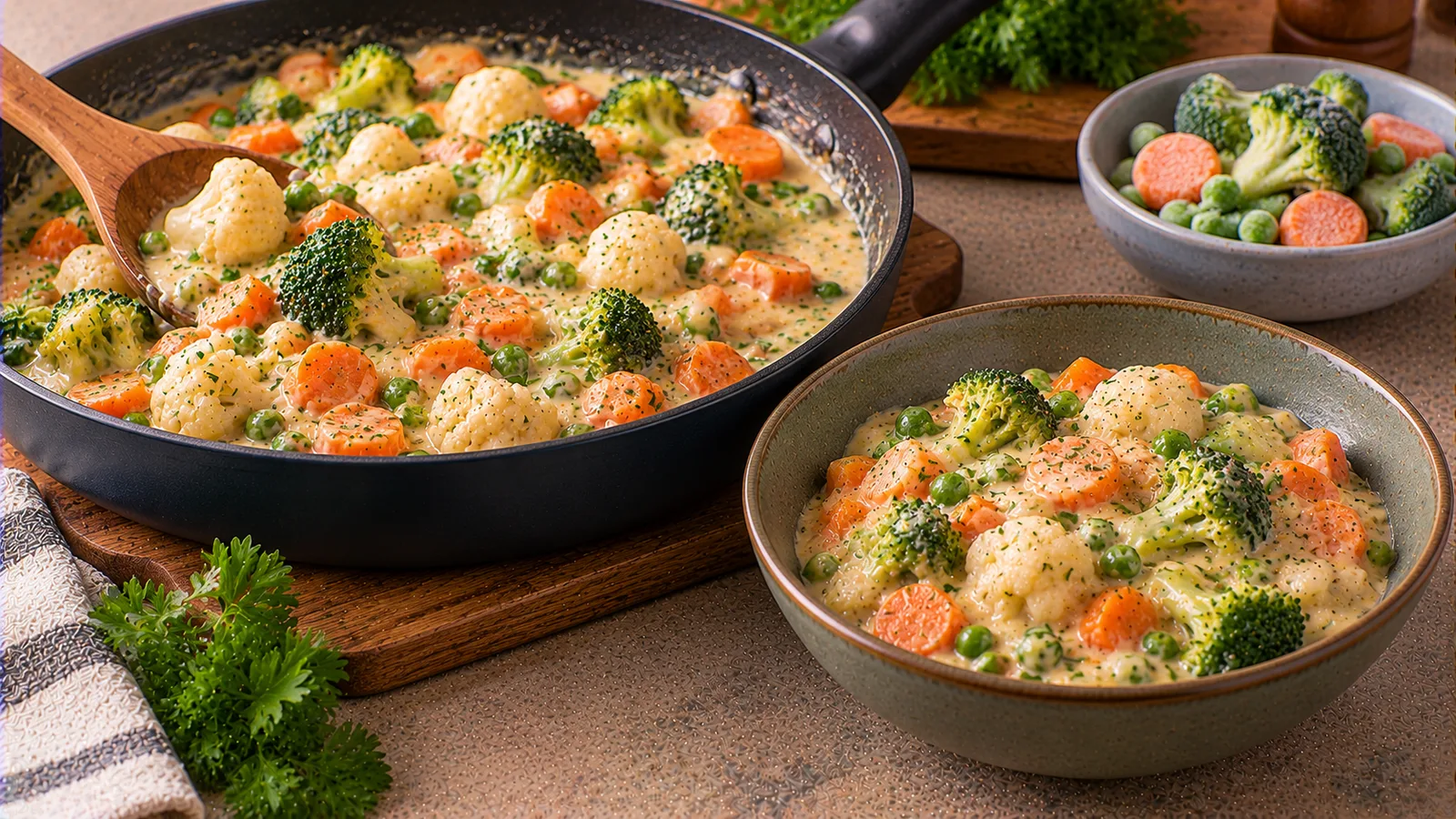
Frozen vegetables in a creamy, buttery or yogurt-based sauce are not nutritionally the same product as plain frozen vegetables. The practical question is straightforward: *how many calories are in the amount of the complete frozen product that actually goes onto your plate?* Use the energy declaration for the mixture, identify whether the values refer to the food as sold or after preparation, and then scale by the correct weight. You do not need to invent a separate calorie value for the sauce if it is already included in the package's nutrition declaration.
The examples below use published manufacturer labels. They illustrate arithmetic, not an endorsement of any brand; formulations, sizes and printed values can change. The label on the exact bag you buy takes priority over an archived web page.
The three numbers to find on the bag
Turn the package over before starting your calculator. Read (1) energy per 100 g, (2) the pack's net weight, and (3) whether nutrition is declared for the product as sold or prepared according to instructions. If a prepared serving is also shown, note its precise weight and preparation conditions. In the EU, packaged foods normally provide nutritional information per 100 g or 100 ml; optional serving information is an addition, not a replacement. See the European Commission's nutrition-declaration guide.
For a product declared as sold, use the weight before cooking when you multiply its per-100-g calories. A bag containing sauce, milk, oil or starch lists the product with those ingredients already included. It is wrong to use a plain-broccoli entry and then assume the sauce adds zero calories. It is equally wrong to take the labelled complete-mixture calories and add an estimated sauce again.
A label might say 56 kcal per 100 g and 500 g per pack. That is 280 kcal for the unopened 500 g pack, before any additions made in your kitchen. If you use 250 g from it, you count 140 kcal. This is an ingredient-level total, not necessarily the calories of an entire dinner; other foods and cooking fats belong in a separate addition.
Worked labels: three frozen vegetable mixtures
The manufacturer iglo Königsgemüse in Rahm lists 56 kcal per 100 g for its cream-sauce vegetable mixture. Its 500 g pack therefore contains 280 kcal by the rounded 100-g label. The ingredients describe the vegetables as 64% of the mixture; that does not mean you multiply 56 kcal by just the vegetable fraction. The declared calories already represent the full mixture.
A second published product, iglo Buttergemüse, lists 92 kcal per 100 g and a 450 g pack. That works out to 414 kcal for the pack. Its label includes butter in the formula. Do not add its butter content again unless you literally add extra butter to the pan.
For contrast, iglo Broccoli & Blumenkohl in Joghurt-Sauce declares 40 kcal per 100 g in a 400 g pack: 160 kcal for the whole pack. The three labels refer to different mixes and recipes, not controlled versions of one vegetable. Their totals cannot establish that one sauce type is always lighter.
| Published product label | Declared kcal per 100 g | Pack weight as sold | Calculated kcal per whole pack | Calculated kcal for 200 g as sold |
|---|---|---|---|---|
| iglo Königsgemüse in Rahm | 56 | 500 g | 280 | 112 |
| iglo Buttergemüse | 92 | 450 g | 414 | 184 |
| iglo Broccoli & Blumenkohl in Joghurt-Sauce | 40 | 400 g | 160 | 80 |
All totals above multiply rounded label values, so a manufacturer's separate per-portion column may differ by a calorie or two. The products and pack sizes are distinct. This table is not a ranking of vegetable quality, a recommendation to eat the whole pack, or proof of a universal difference between creamy and non-creamy sauces.
Calculate your own portion from the frozen weight
The easiest method is a food scale. Put a bowl on it, tare to zero, pour out the amount you plan to cook and record the frozen product weight including sauce pieces. Multiply that weight in grams by the package's calories per 100 g, then divide by 100. For example, with 56 kcal per 100 g:
250 g × 56 kcal ÷ 100 g = 140 kcal.
If you split the full 500 g into two equal servings, each contains 140 kcal before added ingredients. If you divide the pack into three equal servings, each represents about 166.7 g and 93.3 kcal by this calculation. The manufacturer's rounded serving declaration can instead show 93 kcal; that is not a meaningful contradiction.
For a mixed sauce product, take a reasonably representative share of both sauce and vegetables. If most sauce melts into the bottom of the pan, dividing by eye can give unequal portions. Stir thoroughly first or weigh the finished pot and serve equal fractions. For example, one quarter of a 500 g pack counts as about 70 kcal, provided that vegetables and sauce are evenly apportioned and nothing energy-containing is discarded.
If you do not own a scale, you can still calculate from fractions of the package: half of a 500 g, 280 kcal bag is 250 g and 140 kcal; one quarter is 125 g and 70 kcal. Those fractions are less accurate when the product has been partly used without recording the remaining weight.
Do not confuse as-sold weight with cooked weight
Cooking can move water into the pan, evaporate it or cause sauce to cling to the cookware. These changes may affect calories per 100 g of the cooked dish without automatically changing the energy of the original ingredients. A 500 g frozen mixture with 280 kcal that finishes at 460 g after water loss would have an illustrative concentration of about 60.9 kcal per 100 g cooked, assuming no energy-bearing material is discarded or added. The whole cooked pan still contains about 280 kcal under that assumption.
This example does not give an official cooked nutrition value for iglo. It simply demonstrates why taking the 56 kcal per 100 g as sold and multiplying it by 460 g cooked incorrectly produces 257.6 kcal. The correct approach is to keep the accounting basis consistent: calculate from the 500 g input, then allocate the finished dish by actual portions.
Water alone contributes no energy: if the same 280 kcal mixture absorbs or is combined with 100 g of water, the combined 600 g would average about 46.7 kcal per 100 g. The total stays 280 kcal. A spoonful of oil behaves differently because it adds energy. If sauce remains in the pan and you do not eat it, precise consumption may be lower than the all-ingredients estimate; the unrecovered amount cannot be estimated from net weight alone.
Extra oil, butter, cheese or rice: count only what you actually add
The nutritional label describes a defined product. It does not account for the oil you pour into a skillet, cheese sprinkled on top or rice cooked alongside it. According to the EU energy-conversion factors, dietary fat contributes 9 kcal per gram for label calculations. Therefore, an illustrative 5 g of pure cooking oil adds approximately 45 kcal. Weighing the oil rather than estimating from a tablespoon makes that calculation more reproducible.
Suppose you heat 250 g of the 56-kcal mixture and then add 5 g of oil to that single portion. The total is 140 + 45 = 185 kcal before any other food. By contrast, if you use only 5 g oil for the entire 500 g bag, the pan has 280 + 45 = 325 kcal; if divided evenly in two, that is 162.5 kcal per serving. Never accidentally assign a full-pan oil addition to every portion.
A prepared meal might also contain 70 g cooked rice, 100 g fish or 25 g grated cheese. Their calories require the corresponding product label or reliable cooked-food entry with the same state and edible weight. Do not use a raw-rice calorie entry against a cooked-rice weight. Do not automatically assume that thick sauce requires more oil; read the cooking method and add what is actually used.
A label that mentions 'per prepared portion'
Some frozen-vegetable labels show a calculated portion alongside the mandatory per-100-g information. These two columns may differ in weight basis, preparation assumptions and rounding. For example, the iglo cream-vegetable page lists both the frozen-product energy per 100 g and a prepared portion figure. The 500 g bag is described as roughly three portions; its 93 kcal manufacturer portion figure and the 93.3 kcal result from 280 ÷ 3 are consistent after rounding.
Always read the footnotes. If the 'prepared' column assumes nothing but heating and a measured serving, it should represent the same ingredients spread over portions. If instructions require added milk, oil or another ingredient and the prepared column already includes those additions, do not count those ingredients twice. If it explicitly excludes additional fats, add yours. The decisive question is not simply whether the food is frozen or cooked, but what exactly the labelled calculation includes.
When the web listing and your physical bag differ, use the physical bag. Manufacturers change formulations, pack sizes and serving definitions. An app database can also lag behind packaging changes; it is a secondary convenience, not a reason to overwrite a clear current label.
Common errors in a food log—and how to fix them
Using plain vegetables instead of the sauce mix. Choose a database entry matching the complete product, not 'broccoli, frozen, plain'. The mixture can contain cream, oil, flour or cheese even when vegetables are its largest ingredient.
Counting the sauce twice. If the nutrition table is for the whole ready-made sauce mixture, the included sauce is already counted. Add an extra sauce entry only for sauce you introduce separately.
Using 'one pack' as 'one portion'. A 500 g pack may be approximately three manufacturer portions. The actual calories depend on how much you serve, not the number of plates pictured on the packaging.
Multiplying a frozen 100-g value by a cooked weight. That silently combines two different bases when water changes during cooking. Keep the initial amount and then divide finished servings, unless the declaration explicitly refers to the prepared state.
Ignoring skillet additions. The original bag's calories do not cover added oil. Measure it once, allocate it to the portions receiving it and record it alongside the product.
Assuming a lower-kcal bag is a complete meal. Vegetable mixes can make a useful base but may not provide enough energy or protein for an individual lunch or dinner. If you want assembled meal ideas, see six complete frozen-vegetable dinners, rather than using the bag's calories as a complete-dinner estimate.
Treating all 'sauce' labels as added sugar. Dairy naturally contains sugars, and an ingredient list is needed to distinguish added sweeteners from naturally occurring sugars. This is a different labelling task from energy calculation; the approach to interpreting ingredient lists is explained in how to read added-sugar claims on European yogurt labels.
A reusable four-step calculation checklist
- Identify the exact mix. Record product name, pack weight, per-100-g calories and whether the basis is sold or prepared; check the actual bag.
- Measure the ingredient portion. Weigh the frozen mix or record a reproducible share of the bag, including its sauce.
- Calculate product calories. Multiply declared kcal per 100 g by the matching number of grams and divide by 100. For shared pans, calculate the total before splitting servings.
- Add separate ingredients once. Account for extra oil, butter, cheese, starches and protein foods according to their own labels; do not duplicate the sauce already included.
If you are preparing food for several people, write down the total pan energy first and divide by number of equal portions, or by the finished weight of each proportional share. Estimates are useful for consistency, not for claiming laboratory-level precision. The declared values are averages and are subject to permitted rounding and formulation variation.
Sources
- European Commission: EU nutrition declarations — as-sold and prepared declarations, units and portion rules.
- Regulation (EU) No 1169/2011 — labelling provisions and energy conversion for fat.
- iglo Königsgemüse in Rahm — manufacturer product composition and nutrition values.
- iglo Buttergemüse — manufacturer nutritional panel and pack weight.
- iglo Broccoli & Blumenkohl in Joghurt-Sauce — manufacturer nutritional panel and pack weight.