
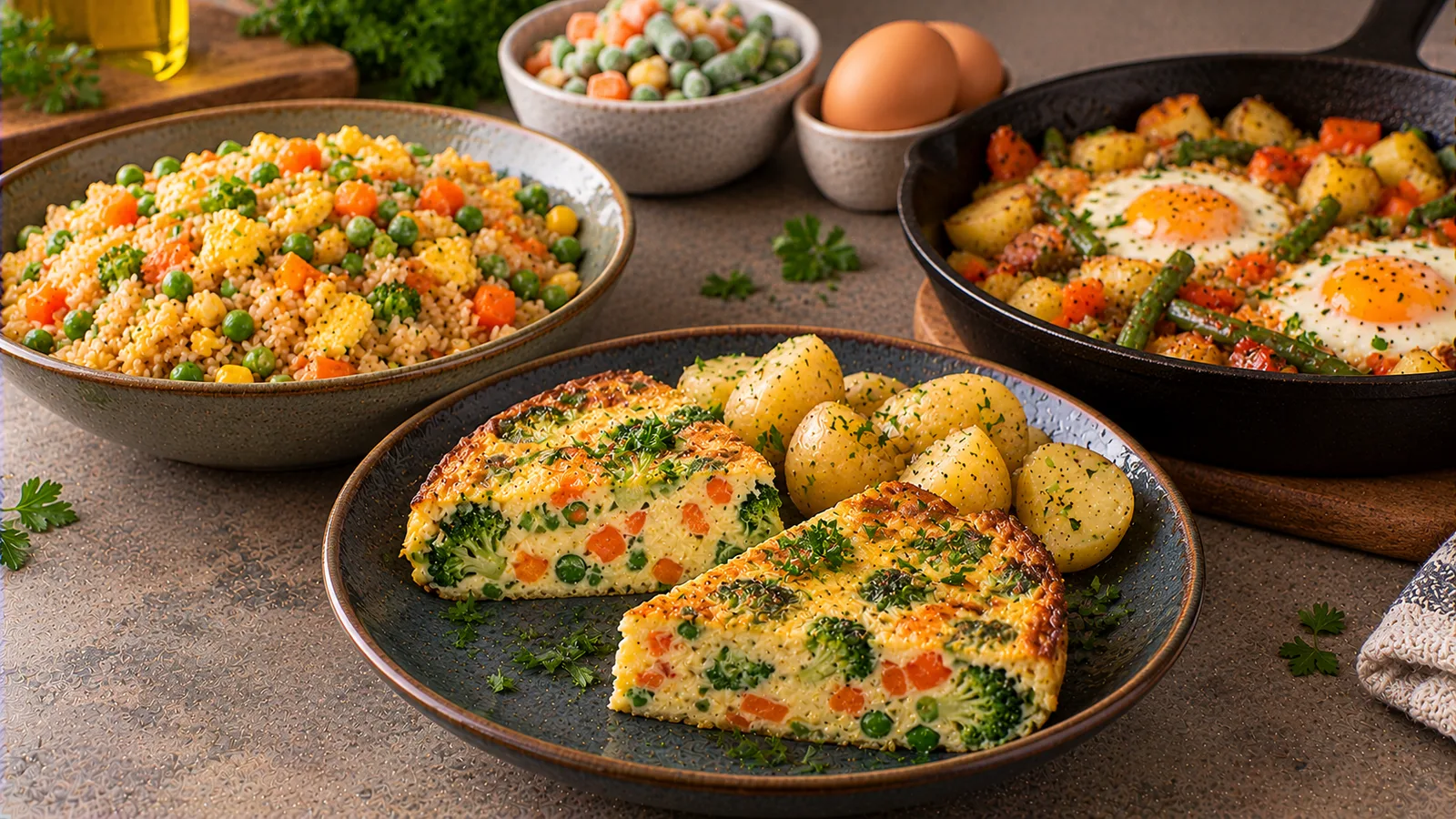
If you cook for one, the usual problem is not a shortage of recipes. It is buying a bag of vegetables, a carton of eggs and several pantry products, then wondering how to turn them into different dinners before anything spoils. This four-night rotation uses one measured basket. It is four complete dinners for one person, not four interchangeable ideas or a promise that eggs alone make every dinner balanced.
The plan uses frozen mixed vegetables every night, two eggs at each dinner and alternating rice, bread, chickpeas and lentils for variety. You cook the eggs and hot dishes fresh each evening. Prices are illustrative assumptions in euros, not a current REWE, Lidl or Aldi quotation. Adjust the portion sizes to appetite and dietary needs; this is a practical template, not a prescribed calorie or protein target.
Four nights at a glance
| Night | Dinner for one | Frozen vegetables | Eggs | Other main ingredients | Illustrative used-ingredient cost |
|---|---|---|---|---|---|
| 1 | Vegetable-and-egg fried rice | 250 g | 2 | 70 g dry rice | €1.42 |
| 2 | Tomato-chickpea egg skillet with toast | 250 g | 2 | 120 g drained chickpeas, 200 g passata, 80 g bread | €2.27 |
| 3 | Lentil-vegetable frittata with toast | 250 g | 2 | 120 g drained lentils, 40 g cheese, 80 g bread | €2.55 |
| 4 | Loaded vegetable-rice pan with both legumes | 250 g | 2 | 70 g dry rice, 120 g chickpeas, 120 g lentils, 200 g passata, 40 g cheese | €3.22 |
Every recipe also uses 10 ml rapeseed oil. Vegetable weights refer to the frozen product before cooking; rice weights are dry, legumes are drained, and eggs are two whole eggs. The four individually rounded costs total €9.46; the underlying unrounded values are used for totals.
One grocery basket, with a complete checkout
Buy one 1 kg bag of plain frozen mixed vegetables (not vegetables coated in sauce), one 10-egg carton, a 500 g packet of dry rice, one 400 g can each of chickpeas and lentils (assumed 240 g drained per can), a 500 g carton of tomato passata, 500 g bread, a 150 g pack of grated cheese and a 500 ml bottle of rapeseed oil. Salt, pepper, paprika, dried herbs and water are pantry seasonings; if you need to purchase them, add those costs.
| Grocery item | Example pack and checkout price | Used over four dinners | Cost attributed to used quantity |
|---|---|---|---|
| Frozen vegetables | 1,000 g / €2.49 | 1,000 g | €2.49 |
| Eggs | 10 / €2.89 | 8 eggs | €2.31 |
| Dry rice | 500 g / €1.29 | 140 g | €0.36 |
| Canned chickpeas | 240 g drained / €0.89 | 240 g | €0.89 |
| Canned lentils | 240 g drained / €1.19 | 240 g | €1.19 |
| Passata | 500 g / €0.79 | 400 g | €0.63 |
| Bread | 500 g / €1.69 | 160 g | €0.54 |
| Cheese | 150 g / €1.69 | 80 g | €0.90 |
| Rapeseed oil | 500 ml / €1.79 | 40 ml | €0.14 |
| Total | €14.71 checkout | Four dinners | €9.46 used |
The €14.71 checkout is cash spent when buying all nine packages, assuming no products are already on hand. The €9.46 is the proportional ingredient cost of the four dinners, or €2.37 per dinner before seasoning and energy. €5.25 is value left in two eggs, rice, passata, bread, cheese and oil; it is not cash returned and will only be useful if you eat the leftovers later. See how to build a balanced budget plate for the broader budget-plate method; this plan goes beyond that by actually allocating every ingredient across four evenings.
Night 1: vegetable-and-egg fried rice
For one: 250 g frozen mixed vegetables, 2 eggs, 70 g dry rice, 10 ml rapeseed oil, pepper and optional low-salt soy sauce. Cook the 70 g rice according to its pack; drain if required. While it cooks, heat the oil in a large non-stick pan, add the frozen vegetables and cook thoroughly according to the package instructions until steaming hot throughout. Move the vegetables aside, break in both eggs and stir until no liquid egg remains. Fold in the freshly cooked rice and heat the mixture through. Season only after tasting.
This is a complete hot bowl rather than vegetables with a token egg on top. Rice provides the main starchy portion; eggs add protein and fat, and a substantial 250 g of vegetables provides volume. Use an appropriately sized pan: overcrowding frozen vegetables can leave excess liquid and cool spots. Do not prepare cooked rice four days in advance for this plan. Cook it on nights 1 and 4, or follow strict rapid chilling and storage rules if you deliberately batch-cook it.
Night 2: tomato-chickpea skillet and toast
For one: 250 g frozen vegetables, 2 eggs, 120 g drained chickpeas, 200 g passata, 80 g bread and 10 ml oil. Drain and rinse the chickpeas. Fully cook the frozen vegetables in the oil, then add chickpeas and passata. Simmer until the whole mixture is piping hot, stir and season with paprika or cumin. Make two shallow wells, add the eggs, cover and cook until their whites and yolks are firm. Toast the bread separately and serve immediately.
Half the chickpea can is used now; refrigerate the other 120 g promptly in a clean, covered container and use it on night 4. Transfer beans out of the opened can if its manufacturer recommends that. A wide pan makes it easier to cook both eggs evenly. The chickpeas make this different from a basic egg-in-tomato sauce; they contribute a substantial legume component. A side of toasted bread adds an easy carbohydrate source without another pot.
Night 3: lentil-vegetable frittata and toast
For one: 250 g frozen vegetables, 2 eggs, 120 g drained lentils, 40 g grated cheese, 80 g bread and 10 ml oil. Drain and rinse the lentils. Heat the vegetables completely in an oven-safe skillet, reduce excess water, then distribute the lentils evenly. Beat the eggs with a tablespoon of water and pour them over the hot vegetables. Sprinkle on 40 g cheese. Cook gently, then finish under a grill if the pan is suitable, until the centre is firmly set; a thermometer should read at least 71 °C for an egg dish. Serve with the measured bread.
Use an oven-safe handle if finishing under the grill. Otherwise cover the pan on low heat and check the centre carefully. The finished dish should not contain a runny middle. Refrigerate the unused 120 g lentils for night 4 in a clean container. This is a one-person frittata, not a large tray bake: if your pan is very wide, a small oven-safe dish gives better depth. Cheese adds salt as well as flavour; avoid automatically adding lots of extra salt.
Night 4: loaded vegetable-rice pan with eggs
For one: 250 g frozen vegetables, 2 eggs, 70 g dry rice, 120 g drained chickpeas, 120 g drained lentils, 200 g passata, 40 g cheese and 10 ml oil. Cook fresh rice. In a large pan, thoroughly heat the frozen vegetables in oil. Add both refrigerated legumes and the passata; heat until hot throughout. Stir in the fresh rice. Make space for the eggs and cook until fully set, then scatter over the final 40 g cheese and melt it. Serve right away rather than holding the entire pan warm for hours.
This is deliberately the most substantial plate because it finishes both opened cans and the rest of the passata. If the double-legume serving is too large, divide night 4 into two meals and refrigerate or freeze the extra promptly; the four-night budget and ingredient totals then describe five smaller eating occasions, not four identical portions. You can also reduce rice to suit appetite, but that changes the used-ingredient total. The plan is flexible; the accounting only stays exact when the listed amounts are used.
Why these dinners vary without requiring four shopping lists
A single frozen-vegetable bag is a convenient base because its contents are already cut and portionable. Its composition matters: a pea-heavy mix contains a different balance from peppers, carrots and broccoli. The table is a plan for ingredient quantities, not an invented nutrient-label calculation. To calculate calories, protein, fibre or salt precisely, use the nutrition information for the exact frozen mix, eggs, bread, legumes and cheese that you buy. Drained canned weight is especially important: the liquid in a 400 g can is not 400 g of legumes.
The rotation also changes texture and format. The first dinner is stir-fried rice, the second is a saucy skillet, the third is a firm frittata and the fourth is a tomato-rice pan. Frozen vegetables appear in every dish, but the two cans are split intentionally. Eggs are an ingredient in every dinner rather than the only protein source. Wholegrain bread and rice are reasonable options; choosing wholegrain versions where practical fits the DGE preference for whole grains and legumes. The DGE guidance is a pattern for an overall diet, not proof that four dinners alone meet all daily needs (DGE dietary guidance).
Storage and food safety across the four nights
Keep eggs under the storage conditions stated on their package. Keep the frozen vegetable bag frozen, close it between portions and take out only 250 g each night. Follow the manufacturer's heating instructions: frozen vegetables are not automatically ready-to-eat food. Germany's BfR recommends heating them fully before eating (BfR frozen-vegetable and household-hygiene advice).
Open the chickpeas on night 2 and lentils on night 3, store their unused halves immediately in the refrigerator, and use both on night 4. Check manufacturer after-opening directions: if the night-4 timing or indicated storage limit cannot be met, freeze the drained portion in advance instead. Cook eggs until whites and yolks are firm; USDA guidance gives 71 °C for egg dishes such as frittatas (USDA egg safety). Refrigerate cooked leftovers within 2 hours, keep them refrigerated for 3–4 days or freeze them, and reheat leftovers to 74 °C (USDA leftovers guidance). These are safety practices, not a reason to intentionally store four days of cooked eggs for this plan.
If the basket or your appetite is different
If a store sells only a 750 g vegetable mix, buy enough bags to reach the measured 1,000 g; the checkout model will change. If you already have rice, oil or seasonings, your new cash outlay falls, but those ingredients still have an economic cost when used. If you prefer higher vegetable variety, buy two unsauced frozen mixes whose combined weights total 1 kg; the final cost must be recalculated from their actual prices.
If one dinner is too small, add extra wholegrain bread, rice, legumes or a suitable side and account for it. If night 4 is too large, save the extra as described above. For someone with allergies, kidney disease, pregnancy-related food restrictions or other specific nutrition needs, adjust products and food-safety choices rather than treating this as an individualized clinical plan. Eggs and cheese are unsuitable for vegan diets; dairy-free cheese or tofu substitutions alter the figures.
For a separate selection of standalone quick meals rather than a shared-basket schedule, browse six separate quick frozen-vegetable dinner recipes. This rotation's advantage is not a claim that eggs are the cheapest or best dinner; it is that 1,000 g frozen vegetables, 8 eggs, 240 g chickpeas and 240 g lentils are deliberately allocated without leaving half-used cans forgotten.
Sources and calculation notes
- German Nutrition Society (DGE), food-based dietary guidelines — variety, vegetables, whole grains and legumes.
- German Federal Institute for Risk Assessment (BfR), household food infections — cook frozen vegetables thoroughly.
- USDA FSIS, Shell Eggs from Farm to Table — safe egg cooking and storage.
- USDA FSIS, Leftovers and Food Safety — cooling, refrigeration and reheating.
All prices in the tables are hypothetical sample inputs, not verified store offers. Used-ingredient cost = pack price × amount used ÷ pack amount. Egg count, drained canned weights and oil volume each use their own units; do not add grams to millilitres. Costs are rounded only for display and the sum is based on full precision.