
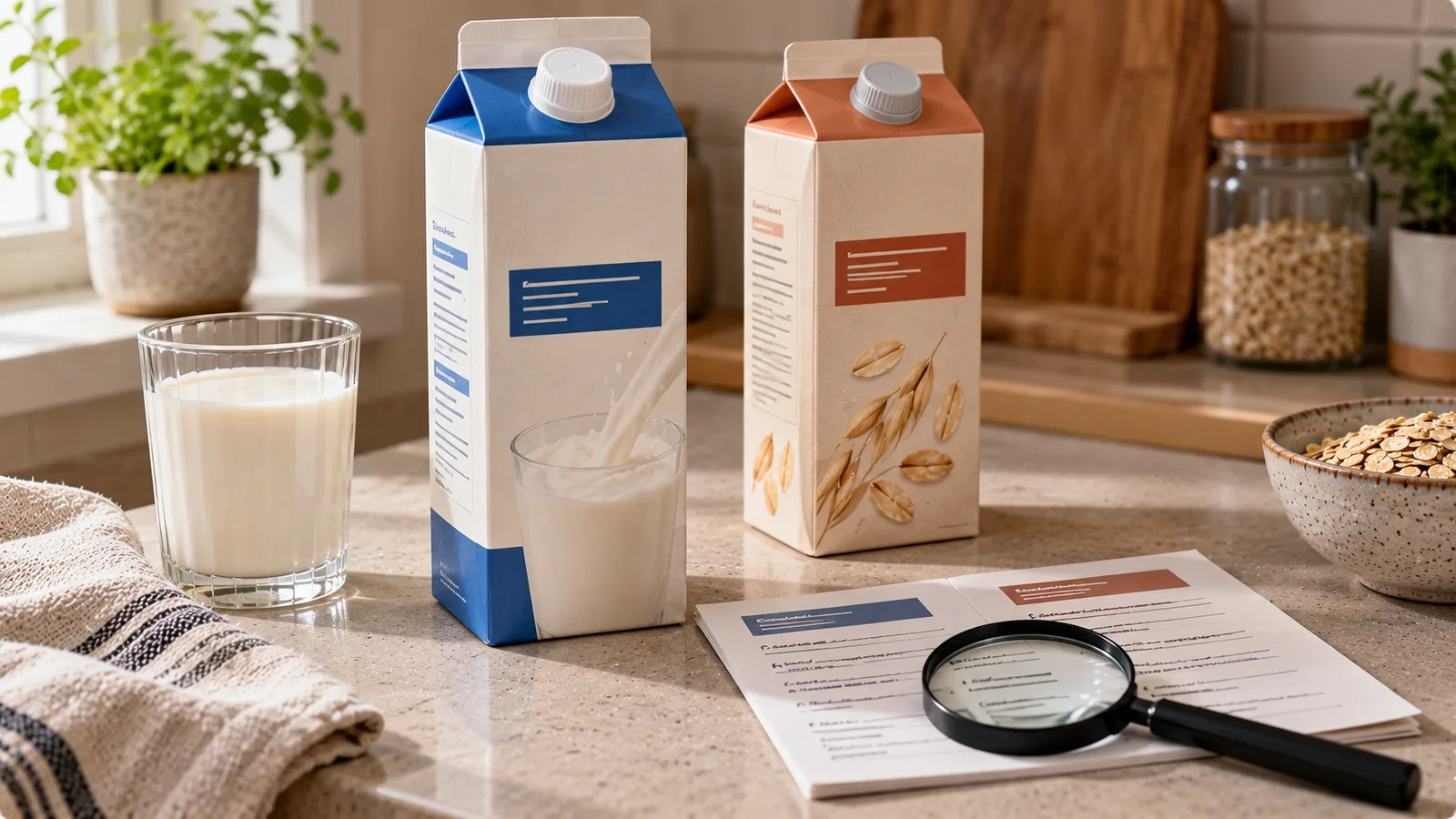
A carton labelled lactose-free and a carton labelled dairy-free may look like alternatives on a supermarket shelf. But the two claims describe different things.
Lactose-free means that lactose, the sugar naturally found in milk, is absent or reduced to a level consistent with the applicable claim. Dairy-free means that the food is intended to contain no dairy ingredients.
The distinction matters most when someone needs to avoid milk proteins rather than lactose.
A lactose-free cow's milk product can still contain casein and whey proteins. It is therefore not automatically suitable for someone with a cow's milk allergy.
Lactose-free vs dairy-free at a glance
| Question | Lactose-free | Dairy-free |
|---|---|---|
| Main focus | Lactose, a milk sugar | Milk and dairy-derived ingredients |
| Can contain cow's milk? | Yes | Not if genuinely dairy-free |
| Can contain milk proteins? | Yes | Should not contain intentionally added milk proteins |
| Suitable for lactose intolerance? | Often, depending on individual tolerance | Generally avoids dairy lactose, but check all ingredients |
| Suitable for milk allergy? | Not necessarily | Requires careful allergen and cross-contact assessment |
| Typical example | Lactose-free cow's milk | Plain fortified soy drink without milk ingredients |
A product's suitability cannot always be determined from one front-of-pack phrase.
The full ingredient list, allergen information, manufacturing warnings and individual medical needs all matter.
What does lactose-free actually mean?
Lactose is a carbohydrate naturally present in milk and many dairy products.
The body normally digests lactose using an enzyme called lactase.
When lactase activity is insufficient, lactose may reach the large intestine without being fully digested. This can contribute to symptoms such as bloating, gas, abdominal discomfort and diarrhoea.
This condition is called lactose intolerance.
In many lactose-free dairy products, manufacturers add lactase to break lactose into glucose and galactose.
The resulting product can still be made from ordinary cow's milk.
That means it can still contain:
- Milk proteins.
- Milk fat.
- Calcium and other nutrients naturally present in milk.
- Other milk-derived components.
Lactose-free milk is not the same thing as plant-based milk.
Is lactose-free milk still dairy?
Yes.
Lactose-free cow's milk is a dairy product.
Removing or breaking down lactose does not remove the milk proteins.
This is why lactose-free milk may be useful for some people with lactose intolerance but inappropriate for people who must avoid milk proteins.
For background on lactose intolerance, see the NIDDK overview of lactose intolerance.
What does dairy-free mean?
Dairy-free generally indicates that a product is made without dairy ingredients such as milk, cream, cheese, yoghurt or butter.
Common dairy-free alternatives include:
- Soy drinks.
- Oat drinks.
- Almond drinks.
- Coconut-based alternatives.
- Certain plant-based yoghurts.
- Plant-based spreads made without dairy ingredients.
However, the phrase dairy-free should not be treated as a universal guarantee of allergen safety.
Its regulatory meaning and use can vary by market and product category.
Some products may be made in facilities that also handle milk.
If a person has a diagnosed milk allergy, checking the ingredient list and relevant cross-contact information remains important.
Lactose intolerance and milk allergy are different
This is the most important distinction.
Lactose intolerance
Lactose intolerance concerns the digestion of lactose.
It is not an immune reaction to milk proteins.
Symptoms are often gastrointestinal and can depend on the amount of lactose consumed.
Some people tolerate small amounts of lactose or certain lower-lactose dairy foods.
Others prefer lactose-free dairy products or dairy-free alternatives.
Cow's milk allergy
Cow's milk allergy involves an immune response to proteins found in milk.
These include casein and whey proteins.
Reactions can vary and may involve the skin, digestive system or respiratory system. Severe reactions are possible.
A lactose-free dairy product can still contain the proteins responsible for an allergic reaction.
For that reason, lactose-free does not mean safe for milk allergy.
People with diagnosed milk allergy should follow advice from their allergy care team.
The NHS guidance on food allergy explains the distinction between food allergy and food intolerance.
How to read the ingredient list
Front-of-pack claims are useful, but the ingredient list provides more specific information.
In the European Union, milk is one of the allergens that must be identified when used as an ingredient in prepacked food.
The relevant allergen is generally emphasised in the ingredients list.
Look for terms such as:
| Ingredient term | What it means |
|---|---|
| Milk | Direct dairy ingredient |
| Skimmed milk powder | Dried dairy ingredient |
| Whey | Milk-derived protein-containing ingredient |
| Whey powder | Dairy-derived ingredient |
| Casein | Milk protein |
| Caseinate | Milk-protein derivative |
| Cream | Dairy ingredient |
| Butter | Dairy ingredient |
| Ghee | Clarified butter derived from milk |
| Cheese | Dairy ingredient |
| Yoghurt | Dairy ingredient |
The presence of one of these ingredients can make a product unsuitable for someone avoiding milk proteins.
The exact wording may vary across languages and markets.
For EU labelling requirements, consult the European Commission's food information legislation.
Five real-world label examples
Example 1: Lactose-free cow's milk
Front label: Lactose-free milk.
Ingredients: Cow's milk, lactase enzyme.
Interpretation: The product remains dairy and contains milk proteins.
It may suit some people with lactose intolerance, but it is not a dairy-free product.
Example 2: Plain soy drink
Front label: Unsweetened soy drink.
Ingredients: Water, soybeans and possibly added vitamins or minerals.
Interpretation: If no milk ingredients are present, the product is dairy-free in composition.
However, soy is itself an allergen for some people.
Check the full label rather than assuming every plant-based drink is suitable for every allergy.
Example 3: Lactose-free yoghurt
Front label: Lactose-free yoghurt.
Ingredients: Milk, yoghurt cultures and lactase.
Interpretation: This is still a dairy food.
Its milk proteins remain relevant for milk allergy.
Example 4: Dark chocolate
Front label: Dark chocolate.
Ingredients: Cocoa mass, sugar, cocoa butter and other ingredients.
Interpretation: Cocoa butter is fat from cocoa beans, not dairy butter.
Nevertheless, some dark chocolates contain milk ingredients or carry milk cross-contact warnings.
The words dark chocolate alone do not establish that a product is dairy-free.
Example 5: Plant-based dessert
Front label: Plant-based dessert.
Ingredients: Oat base, sugar, flavourings and other ingredients.
Interpretation: Plant-based branding is not a substitute for checking ingredients and allergen information.
Review the complete label, especially when an allergy is involved.
What does "may contain milk" mean?
A precautionary statement such as "may contain milk" usually indicates a potential risk of unintended milk presence through cross-contact.
Cross-contact can occur when products share equipment, storage or production environments.
Precautionary allergen labelling is not the same as declaring milk as an intentionally added ingredient.
The absence of a precautionary warning does not automatically prove that cross-contact is impossible.
For people with milk allergy, the relevance of a warning depends on their individual risk and the advice they have received.
Do not rely on an informal rule that all products without a warning are safe.
Can a product be both lactose-free and dairy-free?
Yes.
A plain plant-based drink made without milk ingredients may be both dairy-free and naturally free of lactose.
However, these claims answer different questions.
A lactose-free cow's milk product is lactose-free but not dairy-free.
A dairy-free product generally avoids dairy lactose because it contains no dairy ingredients, but it may still contain other carbohydrates and allergens.
For example, an oat drink may contain carbohydrates from oats.
A soy drink may contain soy proteins.
Neither is automatically nutritionally identical to cow's milk.
Are lactose-free and dairy-free foods nutritionally equivalent?
Not necessarily.
Lactose-free cow's milk often has a nutrient profile broadly similar to conventional cow's milk.
Plant-based alternatives vary considerably.
| Nutrient or feature | Lactose-free cow's milk | Plant-based alternative |
|---|---|---|
| Protein | Usually retains milk protein | Varies; soy often higher than many oat or almond drinks |
| Calcium | Naturally present | Depends on fortification |
| Vitamin B12 | May be present naturally | Often depends on fortification |
| Vitamin D | Depends on product and fortification | Depends on fortification |
| Fat | Depends on milk type | Depends on ingredients |
| Added sugar | Check the label | Check the label |
These are general patterns, not exact values for every brand.
A plant-based drink with very little protein should not automatically be treated as a direct protein replacement for milk.
When replacing dairy regularly, compare protein, calcium, vitamin B12 and vitamin D on the nutrition label.
The NIH calcium fact sheet provides background on calcium requirements and food sources.
Which label should you choose?
The answer depends on why dairy or lactose is being avoided.
If you have lactose intolerance
Lactose-free dairy may be an option.
You may not need to eliminate all dairy foods.
Tolerance differs between individuals, and a clinician or dietitian can help when symptoms are persistent or unclear.
If you have a diagnosed milk allergy
Lactose-free dairy is not a substitute for avoiding milk proteins.
Choose foods consistent with your allergy management plan and review ingredients and cross-contact information.
If you avoid dairy by preference
You can choose dairy-free products without necessarily needing lactose-free dairy products.
Pay attention to nutrient replacement if dairy was previously a major source of protein or calcium.
If you cook for someone else
Do not assume that "no lactose" and "no milk" mean the same thing.
Ask whether the restriction concerns lactose intolerance, milk allergy or personal preference.
The distinction changes ingredient selection and preparation precautions.
A practical supermarket label-checking routine
Use this sequence when choosing packaged foods:
- Identify the restriction. Is the goal to avoid lactose, all dairy ingredients or milk proteins because of allergy?
- Read the exact product name. Lactose-free milk is still milk.
- Check the ingredients. Look for milk, whey, casein, butter, cream and other dairy-derived ingredients.
- Review allergen declarations. Pay attention to emphasised allergens and relevant warnings.
- Consider cross-contact. This is especially important for diagnosed allergy.
- Compare nutrition. If replacing milk, check protein and calcium.
- Recheck after a product change. Ingredients and manufacturing information can change.
This process is more reliable than relying only on a front-of-pack claim.
Sources
- NIDDK — Lactose Intolerance
- NHS — Food Allergy
- European Commission — Food Information to Consumers Legislation
- NIH Office of Dietary Supplements — Calcium
The central rule is simple: lactose-free addresses milk sugar; dairy-free addresses dairy ingredients. Neither front-of-pack phrase replaces careful ingredient and allergen checks when a milk allergy is involved.