
Why Drained Weight Matters for Canned Chickpeas
Start with the weight you actually eat
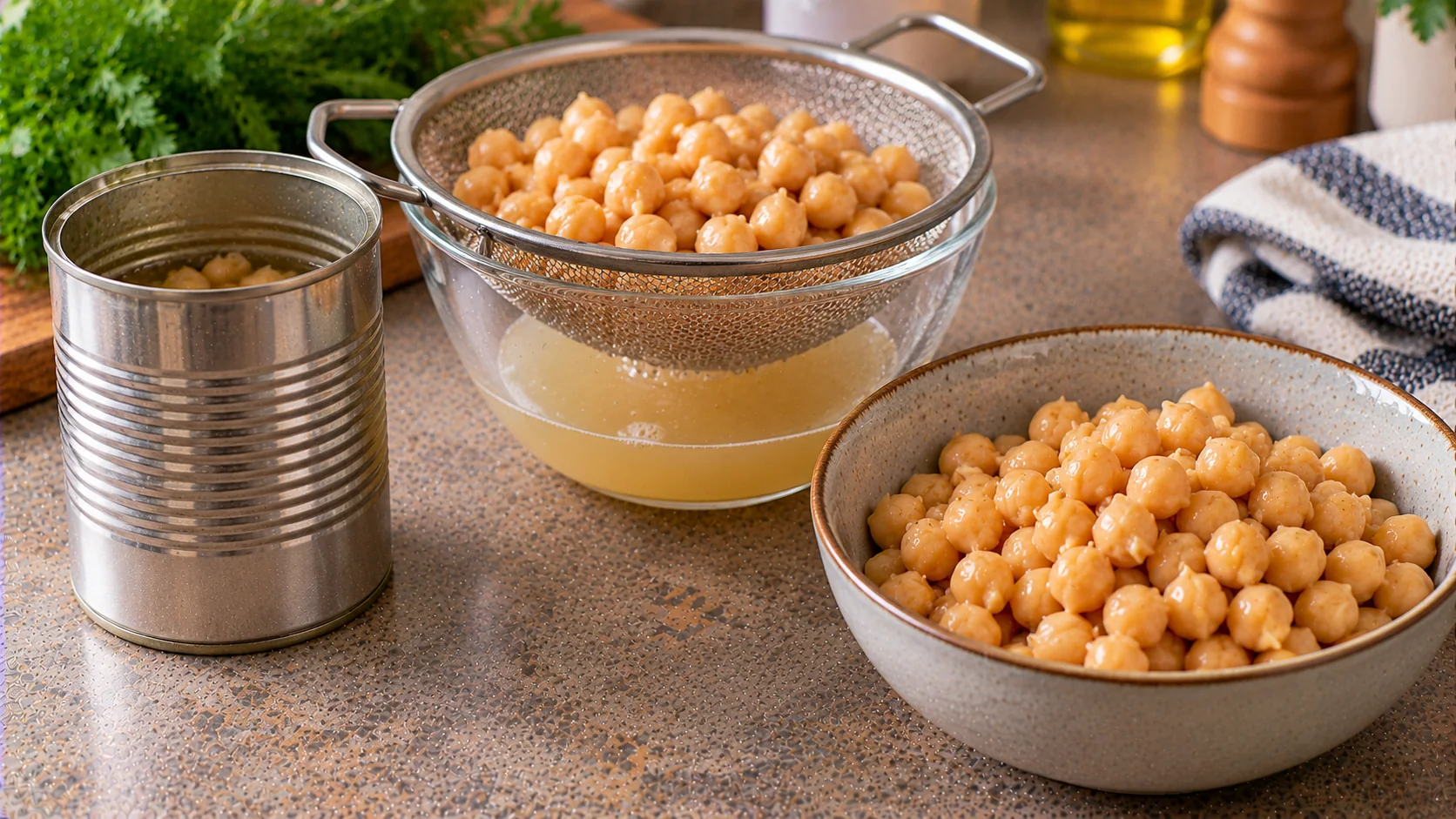
A 400 g can of chickpeas may contain only 240 g of chickpeas after draining. The remaining 160 g is packing liquid, not another serving of chickpeas. This distinction matters for meal planning, price comparisons and food logging. The 400 g and 240 g numbers in this guide are a worked example, not a statement about every brand. Before using any calculation, read the exact net weight and drained weight printed on your own can. A recipe calling for 240 g drained chickpeas usually needs one such can; a recipe needing 400 g drained chickpeas does not.
What the European label means
The EU Food Information to Consumers Regulation, Annex IX point 5, requires an indication of drained net weight when solid food is presented in a liquid medium. For chickpeas in water or brine, look for “drained weight” alongside the total net quantity. Net quantity describes food plus its liquid contents, excluding packaging. Drained weight identifies the solid food portion under the relevant declaration. A label might therefore say 400 g net and 240 g drained. These are not two alternative pack sizes; they describe different things.
Work through a can: a reproducible example
Assume one can costs €0.89 and states 400 g net, 240 g drained. The drained proportion is 240 ÷ 400 = 60%; packing liquid represents 160 g, or 40% of the contents by declared mass. If your recipe needs 120 g chickpeas, that is half of the drained can, not 30% of the total contents. You need two such cans for 400 g drained chickpeas because 400 ÷ 240 = 1.67 cans, rounded up to two whole cans. Some chickpeas will remain for another meal. Do not assume every can follows the 60% ratio.
The same comparison in a table
| Measure | Example value | What it represents |
|---|---|---|
| Declared net weight | 400 g | Chickpeas plus liquid |
| Declared drained weight | 240 g | Chickpeas without packing liquid |
| Liquid by difference | 160 g | 400 − 240 g |
| Drained share | 60% | 240 ÷ 400 × 100 |
| Example can price | €0.89 | Assumed, not a live shop price |
How to compare supermarket prices fairly
Price per 100 g of the whole can is €0.89 ÷ 400 × 100 = €0.22 when rounded to cents. But that includes water. Price per 100 g drained chickpeas is €0.89 ÷ 240 × 100 = €0.37. For comparison, suppose another 400 g can costs €0.99 but contains 265 g drained chickpeas. It costs €0.99 ÷ 265 × 100 = €0.37 per 100 g drained, almost the same despite the higher shelf price. These are invented prices for arithmetic practice; check current packs in your local store.
Nutrition per 100 g versus per can
Use the nutrition panel of the product you actually buy. The declared reference basis matters: many labels give nutrients per 100 g of product, but you must establish whether the numbers describe drained chickpeas, contents as sold or a stated prepared form. Do not silently apply a value for one state to another. For illustration only, if the relevant label specifies 7 g protein and 6 g fibre per 100 g drained chickpeas, the 240 g drained quantity supplies 16.8 g protein and 14.4 g fibre. The numbers are hypothetical, not values verified for a named brand. USDA FoodData Central is useful for exploring food-composition references, but distinguish canned, drained and cooked entries.
A 150 g portion and a whole can
For the same illustrative label, a weighed 150 g portion contains 150 × 7/100 = 10.5 g protein and 150 × 6/100 = 9.0 g fibre. The remaining 90 g drained chickpeas contain another 6.3 g protein and 5.4 g fibre in that model. If you ate the entire 240 g drained content, log 240 g against the correct drained-reference entry, not 400 g of chickpeas. If you also consume the liquid in a soup or sauce, the mass and especially sodium accounting can differ; check the specific label and recipe.
Draining, rinsing and sodium
Drain into a sieve and let the liquid run off. Rinsing can change the surface salt and the measured drained mass, but the change is not a universally fixed percentage. Do not promise that every rinse removes half the sodium. For a medically prescribed low-sodium diet, choose a suitably labelled low-salt product and use its declared composition as the starting point. Avoid equating sodium with salt: European labels commonly show salt; approximate salt equivalents are sodium × 2.5 when both are expressed in the same mass units.
A kitchen method you can repeat
- Record the full can price, net weight and drained weight before opening. 2. Drain using a sieve and allow the liquid to run off consistently. 3. Weigh the chickpeas for your recipe without the container. 4. Multiply the drained portion in grams by the correct per-100-g nutrition value and divide by 100. 5. Divide the pack price by declared drained grams and multiply by your desired edible portion. 6. Store any uneaten chickpeas promptly in a clean covered food-safe container in the refrigerator, following product instructions. Do not store leftovers in an opened metal can as your default meal-prep method.
Avoid three common logging errors
First, entering 400 g into a food tracker when only 240 g solid chickpeas were eaten exaggerates your portion. Second, using dried-chickpea nutrition for canned, hydrated chickpeas produces another mismatch because water changes weight. Third, comparing € per can without dividing by drained yield disguises different amounts of actual legumes. For a broader explanation of drained weights across multiple canned foods, read the general drained-weight guide. For choosing canned legumes for recipes and cost comparison, see related comparisons of canned legumes.
When the example does not fit
Some products are packed in sauce instead of simple water or brine, and their labelled drained-weight treatment may not follow the same scenario. Some nutrition tables state values for the full product as sold. Recipes may also deliberately use aquafaba, the cooking or packing liquid, for texture. If you consume the liquid, do not treat its contents as nutritionally equivalent to a 100 g serving of chickpeas. The safest practical rule is to pair the weight actually used with a nutrition entry describing the same preparation state.
Sources
- Regulation (EU) No 1169/2011, Annex IX, point 5 — requirement to declare drained net weight for solid food in a liquid medium.
- USDA FoodData Central — search for a canned chickpea entry matching the drained or prepared state; not the source of the hypothetical pack values.