
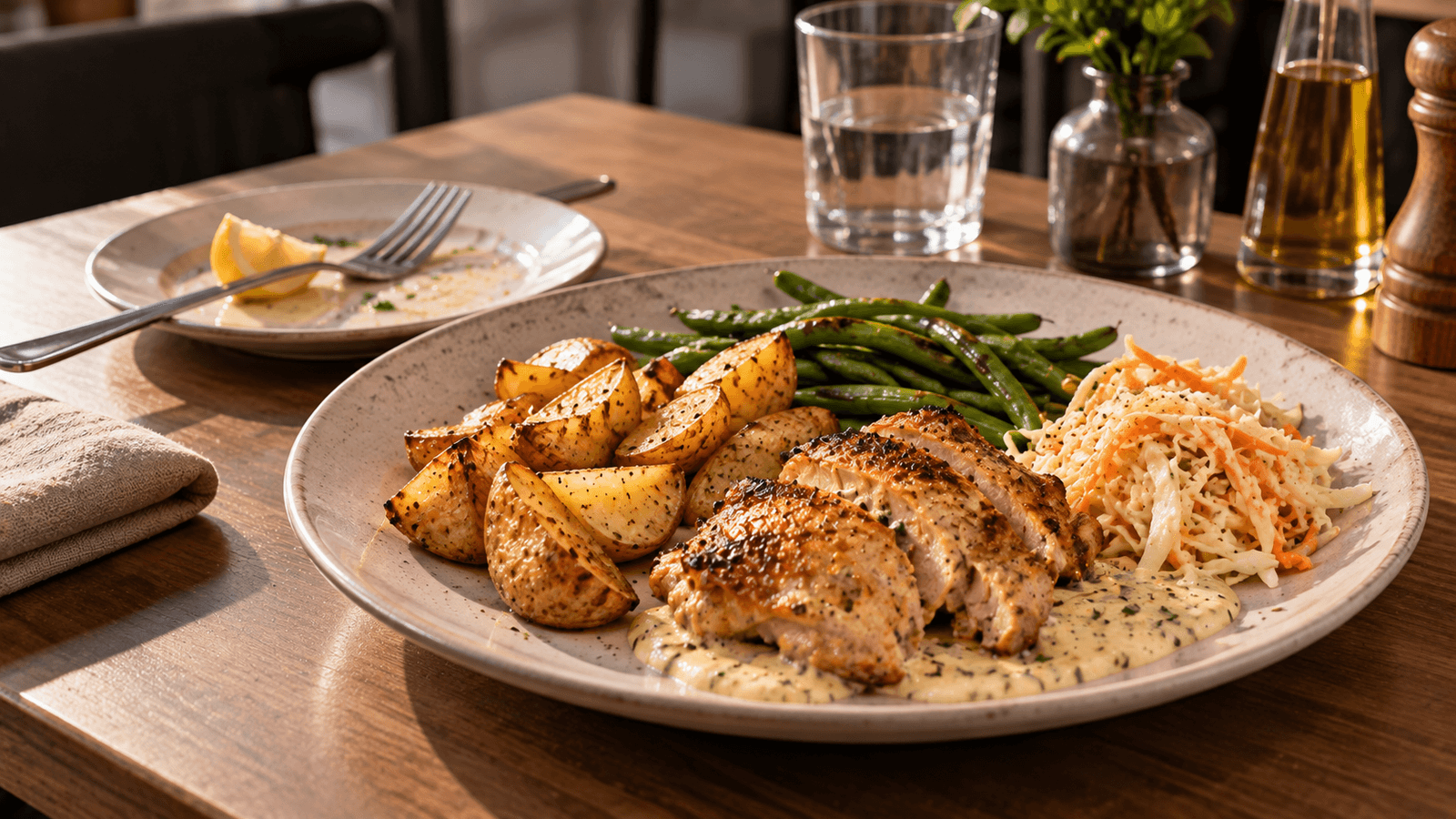
Restaurant meals are harder to track than food prepared at home.
At home, you can weigh ingredients, read package labels and know how much oil or sauce went into a recipe.
At a restaurant, you may know only the dish name and what you can see on the plate.
That does not mean you need to enter every ingredient manually.
A more practical approach is to collect the best information available, make a reasonable first estimate and correct only the parts that matter.
The fastest restaurant tracking workflow
For most restaurant meals, use this order:
- Check whether the restaurant provides nutrition information.
- If not, use the menu description to identify the main components.
- Take a photo of the meal before eating.
- Estimate the major portions rather than every garnish.
- Pay special attention to oils, sauces, dressings and calorie-dense extras.
- Save or reuse the meal if you order it again.
The goal is not to reconstruct the restaurant recipe perfectly.
The goal is to create a useful record without turning dinner into a data-entry task.
Step 1: use official nutrition information when it exists
Some restaurant chains publish calories or full nutrition information for their menu.
If the data clearly matches:
- the restaurant
- the exact dish
- the correct size
- your selected options
it can provide a better starting point than rebuilding the meal from generic ingredients.
Check whether the meal was modified.
For example:
- extra cheese
- additional sauce
- larger side
- different dressing
- removed ingredient
- different drink
A menu value for the standard dish may not include those changes.
Step 2: read the menu description before estimating
A menu description often gives more useful information than the dish name alone.
Suppose the menu says:
Grilled chicken with rice, roasted vegetables and herb sauce.
You already have four useful components:
- chicken
- rice
- vegetables
- sauce
That is enough for a practical estimate.
You usually do not need to create entries for every herb or garnish.
Focus on ingredients that materially affect the meal.
Step 3: photograph the meal before you start eating
A photo preserves information that becomes difficult to remember later.
It can show:
- portion size
- number of components
- visible sauces
- side dishes
- bread
- toppings
- drinks
If you track later, the image gives you something concrete to review instead of relying entirely on memory.
A photo is particularly useful for mixed restaurant meals where the portion cannot easily be weighed.
Step 4: break the meal into major components
Do not begin with every possible ingredient.
Start with the largest components.
For example, a restaurant bowl might contain:
| Component | What you need to estimate |
|---|---|
| Chicken | Approximate cooked portion |
| Rice | Approximate cooked portion |
| Vegetables | Approximate amount |
| Sauce | Approximate amount or separate serving |
| Toppings | Only meaningful calorie-containing additions |
This is much faster than trying to recreate a complete recipe.
For a pizza, the useful unit may instead be:
- pizza type
- diameter or size
- number of slices eaten
- major extra toppings
For sushi:
- number and type of pieces
- sauces
- side dishes
The best tracking unit depends on the meal.
Step 5: focus attention where uncertainty matters most
Not every estimation error has the same effect.
A small error in lettuce or cucumber usually changes the total much less than a similar visual error involving:
- oil
- butter
- mayonnaise
- creamy dressing
- cheese
- nuts
- seeds
- fried coatings
- rich sauces
Restaurant meals can contain cooking fats that are difficult to see after preparation.
You do not need to assume an extreme amount.
Simply recognize that invisible or partially visible fats may be one of the larger sources of uncertainty.
Example: tracking a restaurant chicken bowl
Imagine the meal contains:
- grilled chicken
- rice
- roasted vegetables
- creamy sauce
Instead of searching for one generic entry called "chicken bowl," estimate the visible components.
A practical workflow:
Chicken
Estimate the cooked portion from the photo.
Rice
Estimate the amount of cooked rice.
Vegetables
Use one combined estimate unless individual vegetables need to be tracked separately.
Sauce
Estimate the sauce separately because a relatively small volume can contribute meaningfully to the meal.
This creates a record that is easy to adjust.
If you later realize the rice portion was larger than expected, you can change the rice without rebuilding the entire meal.
When a generic restaurant dish entry is enough
Sometimes speed matters more than detail.
A generic entry can be useful when:
- the meal is straightforward
- you eat it rarely
- exact data are unavailable
- you only need a reasonable record
- rebuilding the recipe would take disproportionate effort
For example, searching for a typical restaurant portion of a familiar dish may be sufficient.
The trade-off is lower specificity.
Generic database entries can differ because restaurants use different recipes and portion sizes.
When component tracking is better
Track components separately when:
- the dish has clearly visible parts
- portion sizes are unusual
- you changed the meal
- sauces or sides are optional
- you want to correct the estimate later
- a generic database entry clearly does not resemble your meal
Component tracking takes slightly longer initially but makes corrections easier.
Use the menu and the photo together
A menu description tells you what is probably present.
A photo helps estimate how much is present.
Neither source is perfect by itself.
For example, the menu may mention avocado but not reveal whether the serving is 30 g or 100 g.
The photo can help with portion context.
Conversely, a sauce may be visible in a photo but impossible to identify accurately without the menu description.
Combining both reduces unnecessary guessing.
What if the menu has a photo?
A menu photo can help identify components, but do not assume it represents your exact serving size.
Promotional images may differ from the food served.
Your own meal photo is generally more useful for estimating the portion you actually received.
Tracking shared dishes
Shared restaurant meals create another problem: the table portion is not the same as your portion.
For shared dishes:
- Photograph the full dish if practical.
- Estimate the fraction you ate.
- Track that fraction rather than the entire serving.
If four people share a dish, do not automatically enter one quarter.
People rarely divide food perfectly evenly.
Use your best estimate based on what you actually ate.
Tracking buffet meals
For a buffet, one photo of the entire experience is usually not enough.
A practical method is to photograph each plate.
Then track the major items from each plate.
For example:
Plate 1
Rice, chicken, vegetables, sauce.
Plate 2
Salad, bread, cheese.
Dessert
Cake and fruit.
This is usually easier than trying to reconstruct everything later.
Tracking tasting menus
For a tasting menu, detailed ingredient-by-ingredient tracking can become impractical.
Instead:
- photograph courses
- record major components
- use available menu information
- group very small courses when appropriate
- accept a wider uncertainty range
A restaurant log can still be useful without pretending the estimate is exact.
Tracking sauces and dressings
Sauces deserve separate attention because they are often difficult to estimate from the main dish.
If sauce is served separately, tracking becomes easier.
You can estimate how much you actually used rather than assuming the full container was consumed.
If sauce is already mixed into the dish, use the menu description and visual cues to make a reasonable estimate.
Avoid false precision.
There is little value in recording an exact gram amount when you have no basis for knowing it.
Drinks are easy to forget
Restaurant tracking often focuses on the plate while ignoring the glass.
Remember drinks that contribute calories, such as:
- juice
- regular soft drinks
- sweetened coffee drinks
- milk-based drinks
- other caloric beverages
Water and zero-calorie beverages do not need to be invented as calorie entries.
Bread and table extras count too
Items eaten before the main meal can be easy to forget:
- bread
- butter
- dips
- olives
- chips
- shared starters
If you ate them and want a complete meal record, include them.
You do not need to track food that was placed on the table but that you did not eat.
Do not turn uncertainty into fake precision
Restaurant calorie tracking is an estimate unless the restaurant provides reliable data for the exact meal.
If you estimate that a portion of rice is around a certain size, recording a highly precise value does not make the estimate more accurate.
Use sensible rounded amounts.
The objective is consistency, not invented precision.
What should you do when you cannot identify an ingredient?
Start with the closest useful category.
For example:
- creamy sauce
- oil-based dressing
- grilled chicken
- fried fish
- cooked rice
- mixed vegetables
You can refine the entry later if you find better information.
An approximate but structured entry is usually more useful than leaving the entire meal untracked because one ingredient is uncertain.
Correct the biggest errors first
After creating an estimate, review it once.
Ask:
- Does the total portion look realistic?
- Did I miss a side dish?
- Was there visible oil or sauce?
- Did I track the entire serving even though I left some?
- Did I forget a drink?
- Is one component obviously too large or too small?
Correct obvious mismatches.
You do not need to repeatedly edit tiny differences.
Save repeat restaurant meals
If you regularly order the same meal from the same restaurant, do not rebuild it every time.
Save the meal or reuse the previous entry, then adjust only what changed.
For example:
Usual chicken bowl
Next visit:
- same chicken
- same vegetables
- half the sauce
- extra rice
Reuse the previous meal and edit those two components.
This can reduce repeated manual entry substantially.
Photo-based tracking can shorten the first estimate
A photo-based food tracker can identify visible foods and propose portion estimates from an image.
This is useful as a starting point, especially for meals with several recognizable components.
But a photo cannot reliably reveal everything about a restaurant recipe.
It may not know:
- how much oil was used in cooking
- ingredients hidden inside a sauce
- exact recipe proportions
- whether sugar or butter was added
- the true weight of overlapping foods
Treat the result as an editable estimate rather than a laboratory measurement.
See Can AI Estimate Portion Size From a Photo?.
A useful correction workflow
When an automated estimate is generated, do not inspect every number equally.
Review in this order:
- Is the food identified correctly?
- Are the main components present?
- Are the largest portions plausible?
- Are sauces and calorie-dense extras included?
- Did you eat the whole serving?
- Are drinks or sides missing?
This prioritizes changes that can meaningfully affect the result.
See How to Correct an AI Food Estimate.
Restaurant tracking should take less time on repeat visits
The first time you order a meal, you may need to:
- read the menu
- identify components
- estimate portions
- add sauces
- save the meal
The next time, much of that work is already done.
A useful tracking system should therefore become faster as your personal meal history grows.
A three-level approach
You can choose the amount of effort based on the situation.
| Level | Method | Best for |
|---|---|---|
| Quick | Use official restaurant data or a close generic dish | Simple or occasional meals |
| Practical | Photo + major components + sauces | Most restaurant meals |
| Detailed | Components + menu data + careful portion corrections | Meals where greater detail is useful |
You do not need the detailed method every time.
Consistency with a practical method is often more useful than occasionally producing a highly detailed entry and skipping other restaurant meals entirely.
Before leaving the restaurant
A 20-second check can make later tracking easier:
- Did you photograph the meal?
- Did you photograph or save the menu description if useful?
- Did you eat the whole portion?
- Was sauce served separately?
- Did you have a drink, starter or dessert?
That is usually enough information to finish the entry later.
The practical principle
Restaurant tracking works best when you separate information collection from precision.
Collect what is available:
- official nutrition data
- menu description
- your own photo
- visible portion information
Then build the simplest estimate that represents what you actually ate.
Correct meaningful errors, save repeat meals and move on.
The purpose of tracking is to create useful dietary information — not to reverse-engineer a restaurant kitchen.