
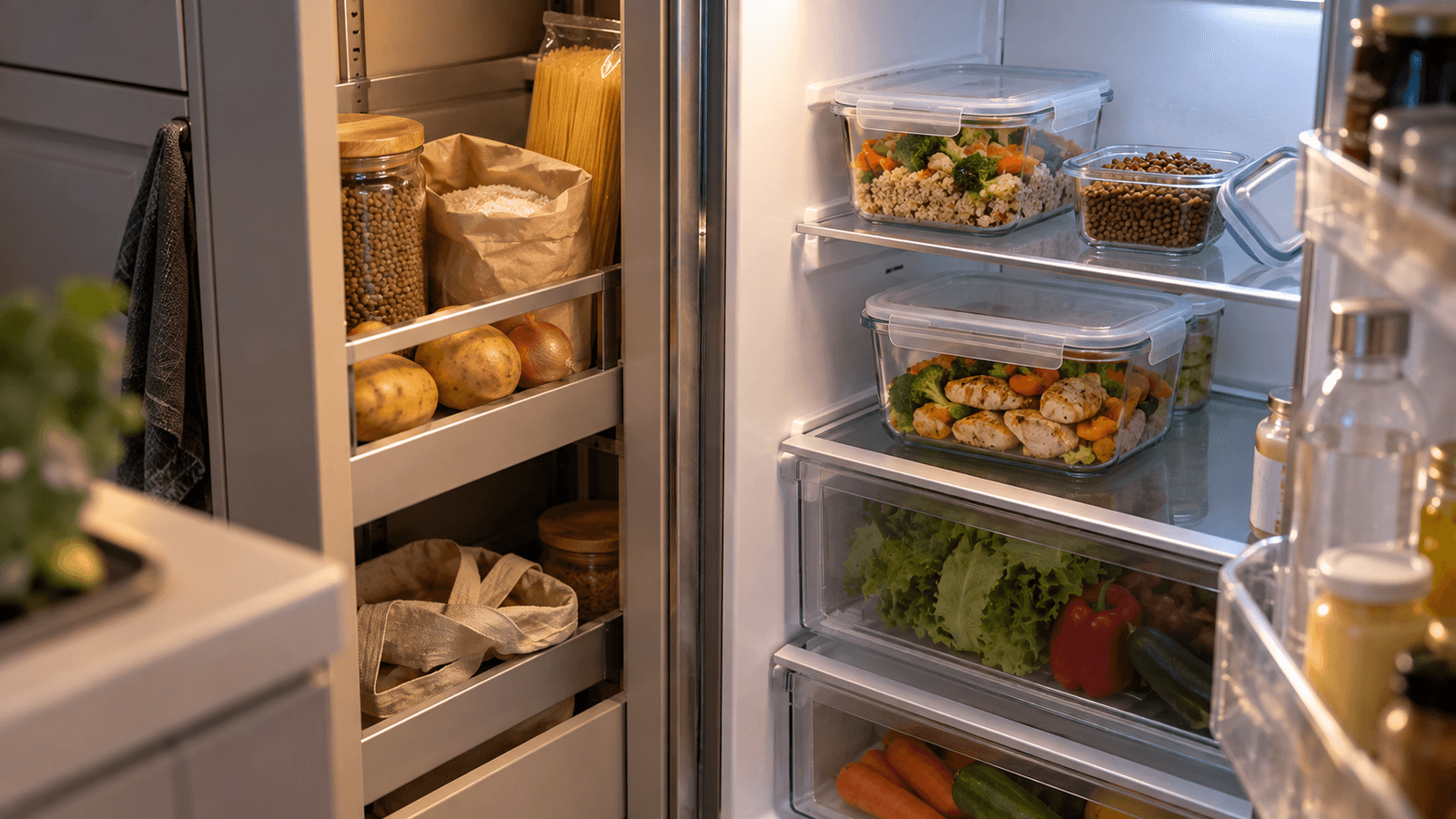
Meal planning and meal prep are often treated as the same thing, but they describe two different parts of organizing food.
Meal planning is deciding what you intend to eat before you need to make the decision.
Meal prep is doing some of the physical food preparation in advance.
You can plan meals without preparing anything ahead. You can also prep food without having a detailed weekly plan.
For many people, the most practical system uses a little of both.
Meal planning vs meal prep at a glance
| Meal planning | Meal prep | |
|---|---|---|
| Main task | Decide what you will eat | Prepare food in advance |
| Typical output | Meal list, schedule or flexible plan | Cooked food or prepared ingredients |
| Requires cooking immediately? | No | Usually some preparation |
| Can reduce last-minute decisions? | Yes | Yes |
| Can help organize grocery shopping? | Directly | Indirectly |
| Requires storage space? | Very little | Often yes |
| Can stay flexible? | Very | Depends on how much you prep |
| Main question | “What are we eating?” | “What can I prepare now?” |
The distinction matters because you do not need to spend hours cooking containers of food to benefit from planning ahead.
What is meal planning?
Meal planning means deciding in advance what meals or meal components you expect to use over a future period.
That period could be:
- tomorrow
- the next three days
- weekdays only
- an entire week
- a flexible list without assigning meals to exact days
For example, a simple plan might be:
Monday: pasta with tomato sauce and chicken
Tuesday: lentil soup
Wednesday: baked potatoes with fish
Thursday: leftovers
Friday: flexible meal or eating out
At this stage, none of those meals needs to be cooked.
The value of the plan is that some future decisions have already been made.
What is meal prep?
Meal prep means physically preparing food before you need it.
That can mean cooking complete meals, but it does not have to.
Meal prep might include:
- cooking rice for several meals
- washing and chopping vegetables
- making a pot of soup
- cooking chicken in advance
- portioning snacks
- preparing overnight oats
- making a sauce
- freezing individual portions
- assembling complete ready-to-reheat meals
So “meal prep” is broader than the familiar image of identical containers filled with the same lunch.
Example: planning without meal prep
Imagine that you plan five dinners for the week and buy the ingredients on Sunday.
You do not chop, cook or portion anything in advance.
On Tuesday evening, you look at the plan and cook the meal assigned to Tuesday.
That is meal planning without meal prep.
It still reduces the question of what to cook and can make grocery shopping more intentional.
Example: meal prep without a detailed meal plan
Now imagine that you cook:
- a batch of rice
- roasted vegetables
- chicken
- a pot of lentils
You store the components separately and combine them in different ways during the next few days.
You have done meal prep, even if you have not decided exactly what you will eat on Wednesday at 19:00.
How planning and prep work together
The two approaches become especially useful when planning determines what is worth preparing in advance.
Suppose your plan includes:
- Monday: chicken, rice and vegetables
- Tuesday: lentil curry
- Wednesday: chicken wraps
- Thursday: leftover curry
- Friday: flexible dinner
From this plan, you can see that chicken appears twice and lentils will be eaten again as leftovers.
Your prep might therefore be limited to:
- cooking enough chicken for Monday and Wednesday
- making the curry in a larger batch
- washing vegetables
You do not need to prepare every meal completely.
The plan tells you which preparation will actually save time.
Meal planning can be useful when your main problem is decision-making
Planning may be the better starting point if you regularly experience situations such as:
- opening the refrigerator without knowing what to cook
- buying groceries without a clear use for them
- discovering that ingredients are missing at dinner time
- ordering food because no meal was decided
- buying ingredients that remain unused
- needing to coordinate meals for more than one person
The intervention happens before cooking.
You reduce the number of decisions that need to be made when you are hungry, tired or short on time.
Meal prep can be useful when your main problem is preparation time
Prep may be more useful when you already know what you want to eat but struggle with the time required to make it.
Examples include:
- mornings are too rushed to prepare breakfast
- lunch needs to be taken to work
- chopping ingredients after work feels inconvenient
- cooking grains or legumes takes too long on busy days
- you want ready-to-reheat food available
In these cases, the problem is less “What should I eat?” and more “When will I prepare it?”
You do not have to prepare seven days of meals
One reason people avoid meal prep is the assumption that it requires a refrigerator full of identical containers.
It does not.
You can prep only the tasks that create the most friction.
For example:
| Instead of... | You could... |
|---|---|
| Cooking seven complete dinners | Cook one double batch |
| Preparing five identical lunches | Prepare two lunches at a time |
| Chopping everything for the week | Chop tomorrow's vegetables |
| Portioning every snack | Keep convenient ingredients available |
| Cooking every component | Prepare only the slowest component |
This approach preserves more flexibility while still reducing work later.
Meal planning usually comes before grocery shopping
Planning gives your grocery list context.
If you know approximately what you intend to eat, you can check what you already have and buy what is missing.
A simple sequence is:
- check the refrigerator, freezer and pantry
- choose meals
- identify ingredients you already have
- create the grocery list
- shop
- decide whether anything is worth prepping immediately
This is different from buying a collection of healthy-looking ingredients first and trying to invent meals afterward.
For more on using food you already own, see How to Plan Meals Around What You Already Have.
Meal prep creates an additional storage question
Planning itself takes almost no refrigerator or freezer space.
Meal prep does.
Before preparing large quantities, consider:
- how much refrigerator space you have
- what should be frozen
- how quickly prepared foods will be eaten
- whether different household members will use the food
- whether you actually enjoy eating leftovers
- whether the food reheats well
Preparing more food than your household will realistically eat can create waste rather than prevent it.
Which approach is more flexible?
Meal planning can be extremely flexible if the plan is designed that way.
Instead of assigning every meal to a precise time, you can plan:
- five dinners for seven days
- three meals plus two flexible evenings
- a list of meals to choose from
- core ingredients rather than exact recipes
Meal prep can also be flexible, especially when you prepare components rather than complete meals.
Cooked rice, roasted vegetables and a protein source can be combined differently instead of becoming three identical boxed meals.
If rigid schedules do not suit you, see Flexible Meal Planning: Plan Without Over-Scheduling.
Which saves more time?
They save different kinds of time.
Meal planning primarily saves decision and organization time.
Meal prep primarily saves future preparation and cooking time.
For example, spending 15 minutes deciding dinners for the next several days may prevent repeated evening decisions.
Spending another 30 minutes preparing two ingredients may shorten cooking on the busiest days.
The most efficient combination depends on where your personal bottleneck occurs.
Which can help reduce food waste?
Both can help, but through different mechanisms.
Meal planning can reduce waste by giving purchased ingredients a purpose before you buy them.
Meal prep can reduce waste by preparing ingredients before they deteriorate or by turning leftovers into ready-to-use food.
Both can also create waste when taken too far.
An overambitious plan may contain meals you never cook. Excessive prep may produce cooked food you no longer want to eat.
A realistic system is more useful than the largest possible system.
See How to Avoid Food Waste With Meal Planning.
Which approach can help with budgeting?
Meal planning often has the more direct connection to grocery budgeting because it influences what enters the shopping basket.
It can help you:
- check existing food first
- reuse ingredients across meals
- choose lower-cost meals intentionally
- reduce unplanned purchases
- decide when leftovers will be used
Meal prep can support the same goal by making already-purchased food easier to use.
For a budget-focused approach, see Meal Planning to Save Money on Groceries.
A simple hybrid system
You do not have to choose one method.
Try this lightweight workflow:
Step 1: Choose a short planning horizon
Start with three to five days rather than forcing yourself to plan an entire week.
Step 2: Pick the meals that matter most
If breakfast is already automatic, do not spend time planning it.
Maybe you only need to decide dinners and two work lunches.
Step 3: Check your schedule
Identify the days when cooking time will be limited.
Those are the best candidates for leftovers, quick meals or food prepared in advance.
Step 4: Shop for the plan
Buy what the selected meals actually require after checking what you already have.
Step 5: Prep only high-value tasks
Ask:
What can I do now that will make the difficult days easier?
The answer might be one pot of soup, cooked rice, washed vegetables or two prepared lunches.
Step 6: Leave room for change
Plans work better when they tolerate normal life.
A meal can move to another day. Leftovers can replace a planned dinner. A social meal can change the schedule.
The plan is a tool, not an obligation.
Meal planning or meal prep: where should you start?
Use the problem you want to solve.
If you frequently do not know what to eat, start with meal planning.
If you know what to eat but rarely have enough time to prepare it, start with meal prep.
If both are problems, create a simple meal plan first and then prep only the parts that make the busiest days easier.
You do not need a refrigerator full of containers or a seven-day spreadsheet.
A useful system is simply one that makes your next meals easier to decide, buy and prepare.