
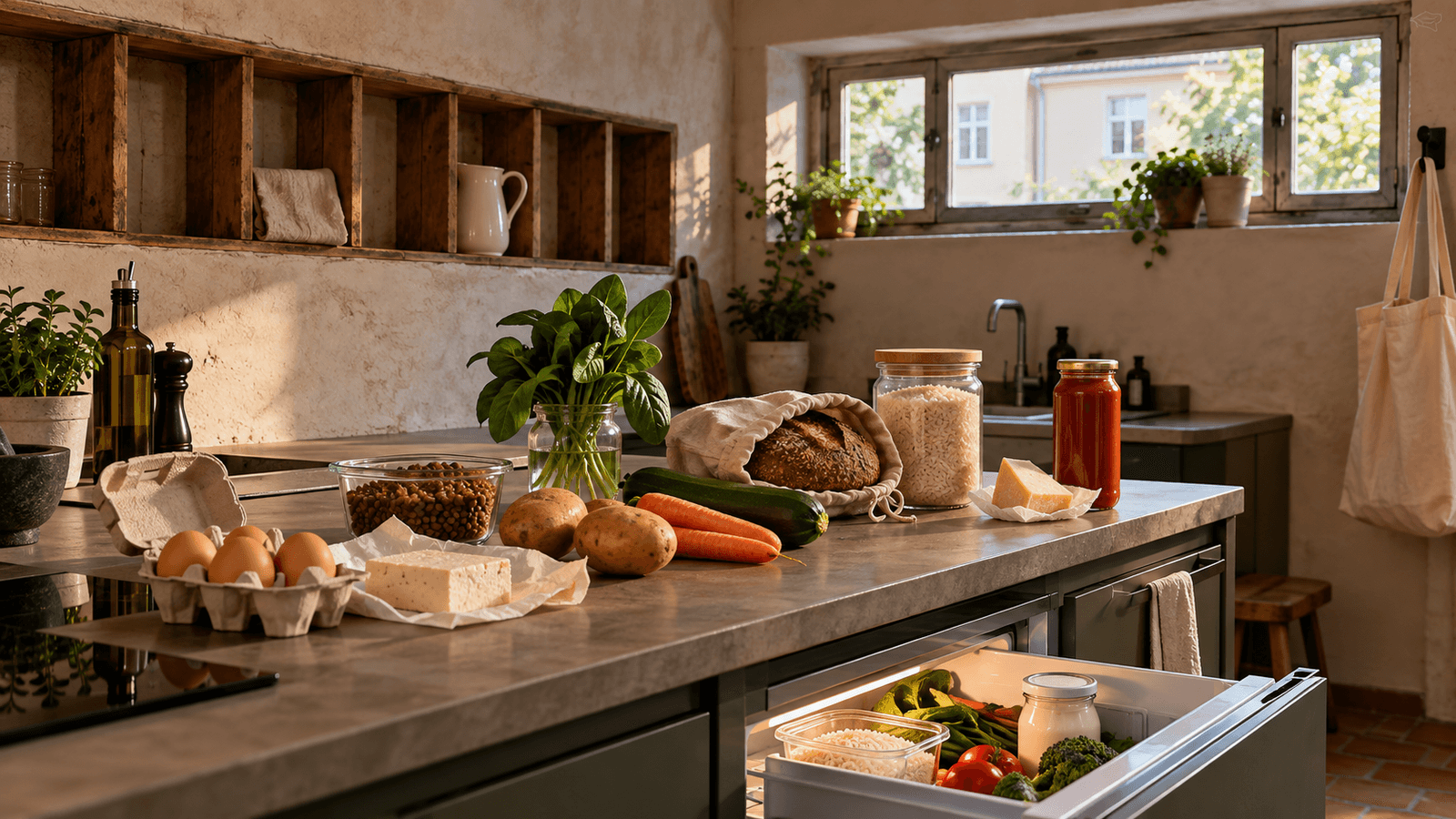
Meal planning can make everyday eating easier, but planning every breakfast, lunch and dinner for an exact day and time does not work for everyone.
Schedules change.
You may eat out unexpectedly, work late, have leftovers, lose interest in a planned meal or simply want something different.
Flexible meal planning keeps the useful parts of planning while leaving room to change your mind.
Instead of deciding exactly what you must eat at every meal, you prepare a small set of ingredients, meal options and backup choices that can be rearranged during the week.
What is flexible meal planning?
Flexible meal planning is a way of organizing food without assigning every meal to a rigid schedule.
A traditional weekly plan might say:
- Monday dinner: chicken and rice
- Tuesday dinner: pasta
- Wednesday dinner: lentil soup
- Thursday dinner: fish and potatoes
A flexible plan might instead prepare for:
- one chicken-based meal
- one pasta meal
- one legume-based meal
- one fish meal
- one leftovers meal
- one quick backup meal
You decide when to eat each option based on your schedule, appetite and what needs to be used first.
The plan provides structure without requiring the week to unfold exactly as predicted.
Why rigid meal plans often fail
Detailed meal plans can look efficient on paper.
The problem is that real life changes.
Common disruptions include:
- working later than expected
- spontaneous restaurant meals
- social plans
- leftover food
- changes in appetite
- ingredients that need to be used sooner
- missing ingredients
- less time to cook
- simply not wanting the planned meal
If a meal plan has no room for these changes, one disruption can make the rest of the week feel out of sync.
Flexible planning expects some uncertainty from the beginning.
Flexible does not mean unplanned
Flexible meal planning is not the same as deciding everything at the last minute.
You still make useful decisions in advance.
You might decide:
- how many meals you expect to cook
- which proteins to buy
- which vegetables need to be used
- which staple carbohydrates you have available
- which ingredients can work in multiple meals
- which quick meals can serve as backups
The difference is that you avoid assigning every ingredient to one fixed moment unless necessary.
Start with your real week
Before choosing meals, look at your schedule.
Ask:
- Which days are busy?
- Which evenings have more cooking time?
- Are you likely to eat out?
- Will anyone be away?
- Do you already have leftovers?
- Which days are unpredictable?
You do not need a detailed calendar.
You only need enough information to avoid planning seven elaborate dinners for a week in which you realistically have time to cook three.
Decide how many meals you actually need
One of the easiest ways to over-plan is to assume that every meal must be planned from scratch.
Suppose you are planning seven dinners.
You might realistically need:
- four cooked dinners
- one leftovers dinner
- one quick pantry or freezer meal
- one flexible evening for eating out or changing plans
That is still a meal plan.
It simply includes uncertainty instead of pretending it does not exist.
Use meal options instead of fixed meal days
Write down several meals you could make during the week without assigning all of them to specific days.
For example:
- chicken with potatoes and vegetables
- lentil pasta with tomato sauce
- tofu stir-fry with rice
- eggs with bread and vegetables
- soup with a simple side
Then choose among them as the week develops.
Meals with highly perishable ingredients can be used earlier.
Meals based on frozen or shelf-stable ingredients can remain available later.
Build around flexible ingredients
Some ingredients work in many different meals.
Examples include:
- eggs
- potatoes
- rice
- pasta
- oats
- yogurt
- beans
- lentils
- frozen vegetables
- fresh vegetables
- canned tomatoes
- tofu
- chicken
- bread
The exact ingredients depend on your preferences.
The useful feature is versatility.
If one ingredient can work in two or three different meals, changing your plan becomes easier.
Think in components
Instead of preparing complete meals in advance, you can prepare components.
For example:
- cooked rice
- roasted potatoes
- washed vegetables
- cooked lentils
- baked chicken
- a simple sauce
- chopped raw vegetables
These components can be combined differently depending on what you want.
Cooked rice might become:
- a side dish
- part of a stir-fry
- a base for a quick mixed meal
Cooked lentils might become:
- soup
- a warm vegetable mixture
- a filling for wraps
- part of a pasta sauce
This gives you more options than preparing several identical finished meals.
Keep some meals intentionally undefined
You do not need to know every meal in advance.
Leaving one or two meals open can make the whole plan more realistic.
An undefined meal can absorb:
- unexpected leftovers
- a social invitation
- a craving for something different
- an ingredient that needs to be used
- a change in schedule
This is planned flexibility rather than failed planning.
Use a “cook first” list
Some ingredients have shorter usable windows than others.
Instead of assigning every meal to a day, identify what should be used first.
For example:
Use earlier:
- fresh fish
- delicate greens
- ripe berries
- opened dairy products
Can wait longer:
- potatoes
- carrots
- eggs
- unopened yogurt
- frozen foods
- dry grains
- canned foods
This lets freshness help determine the order of meals.
Check what you already have
Flexible planning works especially well when you begin with existing food.
Before shopping, check:
- refrigerator
- freezer
- pantry
- opened packages
- leftovers
- produce that should be used soon
Then build possible meals around those foods.
See How to Plan Meals Around What You Already Have.
Plan ingredient overlap without making every meal identical
Ingredient overlap can reduce waste and simplify shopping.
For example, one bunch of spinach might be used in:
- eggs
- pasta
- soup
A package of yogurt might be used for:
- breakfast
- a snack
- a sauce
Cooked potatoes might appear as:
- a dinner side
- part of a lunch
- an ingredient in a quick skillet meal
The goal is not to repeat the same meal.
The goal is to give ingredients more than one possible destination.
Keep one or two reliable backup meals
A flexible plan becomes much easier when you have a few low-effort meals available.
Useful backup ingredients may include:
- eggs
- frozen vegetables
- canned beans
- canned tomatoes
- pasta
- rice
- bread
- frozen fish
- soup ingredients
A backup meal prevents a busy evening from forcing you to abandon the entire plan.
Use the freezer as part of the plan
The freezer can create flexibility.
You can freeze:
- extra portions
- bread
- cooked grains
- sauces
- soups
- selected proteins
- some prepared ingredients
If plans change, freezing food can extend the time available to use it.
It can also give you ready-made alternatives for future busy days.
Plan leftovers deliberately
Leftovers do not need to be accidental.
You can intentionally cook extra when a meal stores well.
For example:
Monday:
cook enough soup for more than one meal.
Tuesday:
eat something different.
Wednesday:
use the remaining soup for lunch or dinner.
This gives you flexibility without requiring the same food several meals in a row.
See How to Plan Meals With Leftovers.
Avoid planning every ingredient too tightly
Suppose you buy exactly enough of every ingredient for one specific recipe.
If you skip that recipe, several ingredients may suddenly have no purpose.
A more flexible approach uses ingredients that can move between meals.
For example, bell peppers might work in:
- pasta
- eggs
- a rice dish
- soup
- a sandwich
This makes substitutions easier.
Separate fixed meals from flexible meals
Some meals really are fixed.
For example:
- a family dinner
- a meal prepared for guests
- a packed lunch needed for work
- a recipe using an ingredient that expires soon
Keep those fixed.
Other meals can remain flexible.
A week might contain:
- two fixed dinners
- three flexible dinner options
- one leftovers meal
- one backup meal
There is no need to make every meal equally flexible.
Flexible breakfast planning
Breakfast is often easy to plan as a set of options.
For example:
- oats
- yogurt with fruit
- eggs and bread
- a quick sandwich
You can keep the ingredients available and choose based on appetite and time.
If mornings are highly predictable, you may prefer repeating one or two breakfasts.
Flexibility is useful only where you need it.
Flexible lunch planning
Lunch often benefits from components.
Possible components:
- cooked grains
- protein
- vegetables
- bread or wraps
- leftovers
- soup
Instead of preparing five identical lunches, you can create several combinations from overlapping ingredients.
Flexible dinner planning
Dinner is often the meal most affected by changing schedules.
Try planning:
- a few main meal options
- one very quick meal
- one leftovers opportunity
- one open evening
Then choose the exact order during the week.
Use meal categories when recipes feel too restrictive
You do not always need to plan exact recipes.
You can plan categories such as:
- pasta night
- soup
- fish meal
- legume meal
- egg-based meal
- leftovers
- freezer meal
This reduces decision-making while keeping recipe choice open.
Plan around cooking effort
Not every day should require the same amount of cooking.
You can keep:
- one higher-effort meal
- several moderate-effort meals
- one or two very quick meals
If your week becomes busier, move the easier meals forward.
The more involved meal can wait if its ingredients allow it.
Plan around ingredient perishability
Flexibility works best when it respects food safety and freshness.
Use highly perishable foods earlier.
Keep shelf-stable and frozen options for later.
If plans change, reassess what needs to be:
- cooked
- frozen
- eaten
- discarded
Do not rely on appearance alone to judge whether potentially unsafe food is still suitable to eat.
Flexible meal planning and food waste
Rigid plans can sometimes create waste when scheduled meals are skipped.
Flexible planning can reduce that risk by allowing ingredients to move between meals.
For example:
If you planned spinach for pasta but decide not to make pasta, the spinach could still be used in eggs or soup.
The ingredient remains useful even when the original meal changes.
See How to Avoid Food Waste With Meal Planning.
Flexible meal planning and grocery spending
Flexibility can also help with grocery costs.
You can:
- use food you already own first
- choose ingredients with multiple uses
- avoid buying ingredients for too many separate recipes
- use leftovers
- freeze extras
- substitute similar ingredients when appropriate
This can make your grocery list shorter and more adaptable.
For more ideas, see Meal Planning to Save Money on Groceries.
Do not confuse flexibility with buying “just in case”
A flexible plan does not require stocking every possible option.
Buying too many backup foods can create its own waste.
Instead, keep a small number of reliable staples that you genuinely use.
Your backup meals should come from foods that regularly fit into your normal eating habits.
Use substitutions
Flexible planning becomes easier when you are comfortable replacing one ingredient with another.
Examples:
- rice instead of potatoes
- beans instead of lentils
- frozen vegetables instead of fresh
- yogurt instead of another suitable dairy ingredient
- one available vegetable instead of another
The substitution does not always need to reproduce the original recipe exactly.
It only needs to produce a meal that works for you.
Keep nutrition goals flexible too
If you track calories or macros, flexibility is still possible.
You do not need every meal to have exactly the same nutritional composition.
Instead, you can consider the broader day.
For example, if lunch contains less protein than expected, dinner or a snack can provide more.
If one meal is larger than planned, another meal may naturally be smaller depending on hunger.
Avoid treating nutritional targets as a requirement for mathematical perfection.
Flexible planning for weight loss
When the goal is weight loss, flexible planning can help maintain structure without making the plan unnecessarily rigid.
Useful anchors might include:
- a general calorie target
- protein-rich meal options
- vegetables and fruit
- planned snacks when useful
- backup meals
- portion awareness
The specific meals can still change.
See Meal Planning for Weight Loss: A Beginner’s Guide.
What if you eat out unexpectedly?
Do not treat the meal plan as ruined.
Simply update the remaining options.
Ask:
- Which ingredients still need to be used?
- Can one planned meal move to tomorrow?
- Should anything be frozen?
- Do you now have restaurant leftovers?
- Can you remove something from the next shopping list?
A meal plan should adapt to reality.
What if you no longer want the planned meal?
First check whether any ingredient urgently needs to be used.
If not, choose another option from your plan.
If an ingredient does need attention, consider whether it can be:
- used in a different meal
- cooked and stored
- frozen
- substituted into another recipe
You do not need to force yourself to eat a particular meal just because it was written down several days earlier.
What if your schedule changes completely?
When the week changes significantly, simplify the plan.
Prioritize:
- highly perishable food
- already cooked food
- opened packages
- easy meals
- freezer and pantry options
Postpone meals based on stable ingredients.
The original schedule is less important than using your food sensibly.
A simple flexible weekly framework
A practical week might look like this:
Fixed
Two meals that need to happen on particular days.
Flexible
Three meals that can move between days.
Leftovers
One meal slot reserved for food already cooked.
Backup
One fast meal based on freezer or pantry ingredients.
This is only an example.
Your week may need a different balance.
A five-step flexible meal-planning method
1. Check your schedule
Estimate how many meals you realistically need.
2. Check your food
Look through the refrigerator, freezer and pantry.
3. Choose a small set of meal options
Prefer options with overlapping ingredients.
4. Identify what needs to be used first
Let perishability influence meal order.
5. Keep a backup option
Have at least one meal that requires little time or preparation.
Then adjust the order as the week develops.
Example
Suppose you have:
- chicken
- eggs
- lentils
- rice
- potatoes
- spinach
- carrots
- yogurt
- bread
- frozen vegetables
Possible meals might include:
- chicken, potatoes and carrots
- lentils with rice and spinach
- eggs with bread and vegetables
- chicken and rice with frozen vegetables
You do not need to decide on Sunday which exact day each meal will happen.
If the spinach needs to be used first, make the lentil meal earlier.
If Tuesday becomes busy, make eggs and bread instead.
If plans change again, freeze the chicken and move that meal later.
The ingredients still have a plan, but the schedule remains adaptable.
Common mistakes
Planning too many meals
Leave room for leftovers, social plans and changing schedules.
Buying ingredients for unrelated recipes
More overlap usually makes the plan easier to adapt.
Having no quick backup
Keep at least one realistic low-effort option.
Ignoring perishability
Flexible does not mean every ingredient can wait indefinitely.
Treating a changed plan as failure
Changing the plan is part of flexible planning.
Preparing every meal completely in advance
Components often provide more flexibility than finished meals.
Buying too many backup foods
A backup system should reduce waste, not create more of it.
Frequently asked questions
Is flexible meal planning the same as intuitive eating?
No. Flexible meal planning is an organizational method. It can be used with many different approaches to eating.
Do I need to plan every meal?
No. You can plan only the meals that benefit from advance preparation.
How many meals should remain flexible?
There is no universal number. It depends on how predictable your schedule is.
Can flexible meal planning work for families?
Yes. You can keep certain shared meals fixed while leaving other meals or side dishes flexible.
Can I use flexible meal planning while tracking calories?
Yes. Meal choices can change while you continue tracking your overall intake.
Does flexible meal planning reduce food waste?
It can help because ingredients are not locked into only one recipe or one day. You still need to pay attention to storage and food safety.
Should I prepare ingredients or complete meals?
Either can work. Preparing components usually provides more options, while complete meals may be more convenient on very busy days.
What if I prefer a strict plan?
A strict plan is fine if it works for you. Flexibility is useful when rigid scheduling creates unnecessary friction.
The bottom line
Flexible meal planning gives you structure without requiring every meal to happen exactly as planned.
Instead of scheduling every dish to a specific day, you can:
- choose a small set of meal options
- use versatile ingredients
- prepare reusable components
- prioritize perishable foods
- plan for leftovers
- keep one or two backup meals
- leave some meals intentionally open
A useful meal plan should make everyday eating easier.
If changing Tuesday's dinner to Thursday makes the week work better, the plan has not failed.
It has adapted.
This article provides general educational information and is not individualized medical or dietary advice.