
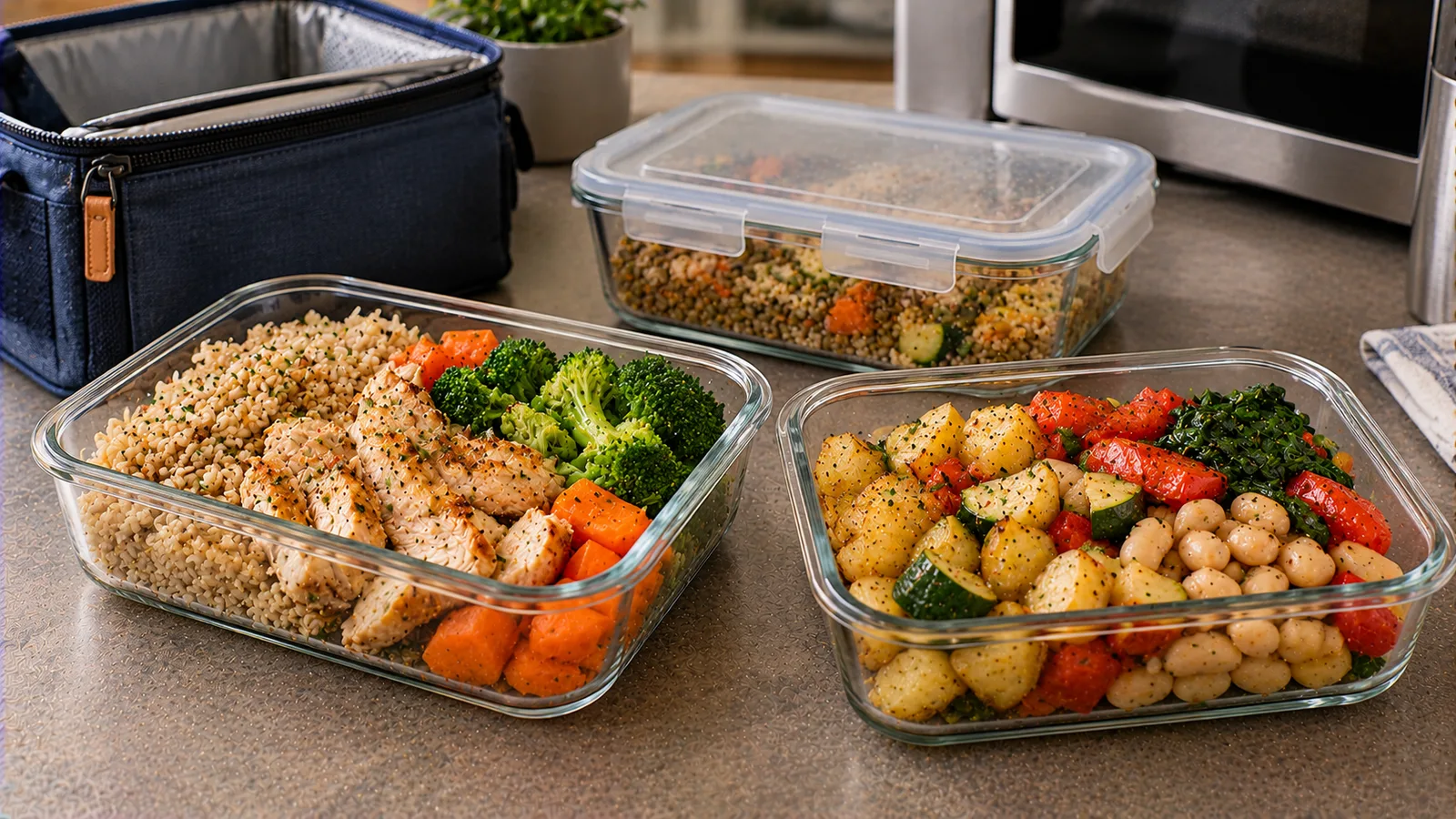
Cooking five lunches on Sunday can work, but putting all five containers in the refrigerator until Friday is not the plan. These are five fully cooked work lunches for one adult, with a microwave available at work and an unbroken cold chain. Eat the Monday and Tuesday meals promptly; freeze Wednesday through Friday portions on preparation day, then thaw them safely and reheat thoroughly at work. The meals are not shelf-stable, and the microwave is for reheating, not for cooking raw chicken at your desk.
The single basket below supplies chicken, beans, chickpeas, whole-wheat pasta, bulgur, frozen vegetables, tomato passata and two tubs of plain yogurt. It creates five different main dishes instead of repeating one large casserole. Everything is measured as raw chicken, dry grains, drained canned beans and edible vegetables before cooking. A serving can be generous; adjust starch or split a box into two eating occasions if appropriate, but recalculate the ingredient usage rather than claiming the same budget.
For a broad selection of independent ideas, see healthy work-lunch recipe ideas. This article is specifically about an executable five-container shopping, cooking, freezing and office-reheating system. It does not replace a shelf-stable lunch plan without a refrigerator, which addresses lunches without access to refrigeration, or budget student dinners made using a microwave, which considers meals cooked by students with only a microwave.
Five lunch boxes, five distinct meals
| Day | Packed main meal | Starch weighed dry | Protein-bearing foods | Storage after Sunday preparation |
|---|---|---|---|---|
| Monday | Chicken, broccoli and tomato whole-wheat pasta; yogurt added cold | Pasta 80 g | Chicken 160 g raw; yogurt 150 g | Refrigerator; eat Monday |
| Tuesday | Lemon-style chickpea, spinach and carrot bulgur; yogurt kept cold | Bulgur 70 g | Drained chickpeas 120 g; yogurt 150 g | Refrigerator; eat Tuesday within 48 hours of cooking |
| Wednesday | Chicken, broccoli and spinach in tomato-bulgur | Bulgur 70 g | Chicken 170 g raw | Freeze Sunday; refrigerator-thaw Tuesday night |
| Thursday | Kidney-bean tomato whole-wheat pasta with spinach | Pasta 100 g | Drained kidney beans 240 g | Freeze Sunday; refrigerator-thaw Wednesday night |
| Friday | Paprika chicken, chickpea, broccoli and carrot bulgur | Bulgur 70 g | Chicken 170 g raw; drained chickpeas 120 g | Freeze Sunday; refrigerator-thaw Thursday night |
Every line is one adult lunch, not a weekly family-size recipe. The yogurt is packed in separate sealed pots and never microwaved. Lemon, black pepper, paprika and dried herbs are optional pantry seasoning, not hidden priced ingredients. If you use a purchased sauce or cheese instead, its quantity and cost are additional.
One basket: purchases versus quantities actually used
The figures are a worked price example in euros, not a live REWE, Aldi or Lidl offer. The price of your local pack, drained weight of canned food, frozen-vegetable formulation and promotional discounts may differ. The 240 g drained weight per can is an explicit example: read and weigh the actual drained contents. If a different tin yields only 220 g, reduce the recipe or buy enough extra; the table is not a guarantee about every brand.
| Food | Example pack bought | Used in five lunches | Example checkout cost |
|---|---|---|---|
| Boneless raw chicken | 500 g | 500 g | €4.49 |
| Whole-wheat pasta | 500 g dry | 180 g dry | €0.99 |
| Bulgur, dry | 500 g | 210 g | €1.59 |
| Chickpeas, one tin | 240 g drained | 240 g drained | €0.89 |
| Kidney beans, one tin | 240 g drained | 240 g drained | €0.89 |
| Frozen broccoli | 750 g | 380 g | €1.49 |
| Frozen leaf spinach | 450 g | 400 g | €1.29 |
| Carrots | 1,000 g | 280 g edible | €1.29 |
| Onions | 1,000 g | 200 g edible | €1.29 |
| Plain tomato passata | 500 g | 500 g | €0.95 |
| Plain yogurt | Two 150 g cups | 300 g | €0.98 |
| Olive oil | 500 ml | 50 ml | €3.29 |
| Total purchased | €19.43 |
The basket costs €19.43 at checkout in this hypothetical model, or €3.89 per planned lunch if the whole basket is charged to the week. But the five meals only consume part of the pasta, bulgur, vegetables and oil. Allocating purchase cost in proportion to the amount used, and counting full purchased tins, yogurt and chicken, gives €12.07 used-ingredient value, or €2.41 per lunch rounded. The difference, €7.36, remains as purchased ingredients—not cash refunded at checkout. Seasonings, energy, storage boxes and travel are omitted. Further comparison of checkout totals versus eaten portions belongs in the broader cost framework, not a claim that each lunch can be bought separately for €2.41.
Sunday batch: order, measurement and separation
Budget about 90–120 minutes including chopping, parallel boiling, pan cooking, cooling and washing up; the exact time depends on your equipment and kitchen workflow. Before starting, label five microwave-safe, freezer-compatible containers and two small yogurt pots. Write both the preparation date and the intended eating day on each box. Check the freezer capacity and the office microwave policy first.
- Wash hands and clean work surfaces. Keep raw chicken and its utensils separate from vegetables and ready-to-eat yogurt. Cut and weigh 500 g raw boneless chicken into a cooking batch; divide the finished cooked meat among Monday, Wednesday and Friday in the ratio of the raw 160:170:170 g assignments, rather than pretending the finished meat still weighs 500 g. Cook poultry to 74°C / 165°F at its thickest point with a food thermometer, as in the USDA safe minimum temperature chart.
- Cook 180 g dry whole-wheat pasta and 210 g dry bulgur separately according to the packages. Drain well. The listed dry weights are not cooked serving weights: absorbed water raises scale weight without creating extra dry grain. Keep the two starch batches apart until you divide them 80/100 g pasta and 70/70/70 g bulgur by their proportional cooked yield.
- Cook 380 g broccoli and 400 g frozen spinach fully according to the packages, without treating a cold frozen centre as cooked. Chop 280 g edible carrot and 200 g edible onion; distribute according to each day's measured recipe. Drain, rinse if desired and weigh the canned chickpeas and kidney beans.
- Divide 500 g passata as Monday 100 g, Wednesday 150 g, Thursday 150 g, Friday 100 g. Portion 50 ml oil as 10 ml per meal. Mix components for each dish in a clean pan so sauces heat through, while keeping Monday and Tuesday yogurt cold and separate.
- Transfer into shallow, portion-sized containers and cool rapidly; refrigerate or freeze perishable cooked food within two hours. Do not stack deep, hot containers tightly and assume their centres cool rapidly. The UK Food Standards Agency advises eating refrigerated leftovers within 48 hours or freezing them. This plan follows that conservative rule: Sunday evening cooking means Tuesday lunch must still fall within 48 hours. Otherwise freeze Tuesday too.
This schedule is based on finished, safely cooked meals rather than raw chicken being stored for five days. If you batch-cook on Saturday, or start cooking early Sunday morning, shift the refrigerator/freezer allocation: the clock starts when the food is cooked, not on Monday morning.
Monday — chicken and broccoli tomato pasta
Use 80 g dry whole-wheat pasta, 160 g raw boneless chicken, 120 g broccoli, 80 g edible carrot, 40 g onion, 100 g passata, 10 ml olive oil and 150 g plain yogurt. The chicken weight is its allocation before cooking; weigh its cooked share according to the batch allocation described above. Cook the pasta, steam the broccoli until done and soften the onion and finely cut carrot in the measured oil. Add passata, combine with cooked chicken and pasta, and portion into the Monday container. The broccoli can be mixed into the sauce or kept beside it so it is not overcooked during reheating.
Refrigerate promptly. At the office add a spoonful of water to the pasta, cover loosely, stir midway and reheat thoroughly. Stir the cold yogurt through after heating for a creamy finish; do not leave the yogurt warm in a lunch bag. The passata makes this a tomato-based pasta rather than a second bean stew. If you reduce the pasta amount for a smaller lunch, keep in mind that the basket will have more uncooked pasta left over.
Tuesday — chickpea, spinach and carrot bulgur
Use 70 g dry bulgur, 120 g drained chickpeas, 100 g frozen spinach, 100 g carrot, 40 g onion, 10 ml oil and 150 g plain yogurt. Cook the bulgur separately; soften onion and carrot, cook the spinach fully, then heat the drained chickpeas through with a little water and dried herbs. Mix the warm cooked grains and vegetables. Lemon juice or zest may be added if you have a lemon already, but it is not included in the example checkout; the dish works without it.
Pack the yogurt in its original sealed cup or a leakproof little container. Transport both portions cold and refrigerate on arrival. Reheat only the grain-and-vegetable container; stir the yogurt in after heating, or serve it as a cool side. Because this is Tuesday, verify it is within 48 hours of Sunday preparation. The cooked chickpeas are not shelf-stable once opened and assembled into a refrigerated lunch.
Wednesday — tomato chicken, broccoli and spinach bulgur
Use 70 g dry bulgur, 170 g raw chicken allocated from the cooked batch, 140 g broccoli, 100 g frozen spinach, 150 g passata, 40 g onion and 10 ml oil. Cook both frozen vegetables according to their packet directions, soften onion in the oil and combine with passata, cooked chicken and bulgur. Simmer briefly so the tomato coats the grain rather than leaving a dry block when frozen. Transfer into Wednesday's freezer-safe box and freeze on Sunday after rapid cooling.
Move this frozen meal to the refrigerator on Tuesday evening, not to the office desk. If still partly frozen by Wednesday morning, transport it with cold packs and use a microwave setting appropriate for frozen leftovers, checking the coldest centre carefully. Heating times depend on microwave power, box shape and whether the food is fully thawed; there is no universal safe “three minutes” instruction. This meal is a saucy chicken-and-grain lunch, not a raw chicken recipe for the office.
Thursday — smoky kidney-bean pasta with spinach
Use 100 g dry pasta, 240 g drained kidney beans, 100 g frozen spinach, 150 g passata, 40 g onion and 10 ml olive oil. Soften onion and, if desired, season with paprika. Heat the already canned, drained beans with passata and fully cooked spinach, then fold into the cooked pasta. Add a little water if the sauce is thick. The whole drained tin goes into this single larger lunch, so reduce the portion and save some beans separately only if you also update the shopping calculation and storage plan.
Freeze Thursday's completed box on Sunday. Transfer it to the refrigerator on Wednesday evening, keep it cold on the commute and reheat until uniformly hot. It is important to recognize that unopened canned beans are shelf-stable, but this cooked, mixed pasta box is not. This is distinct from a plan deliberately built around unrefrigerated foods. There is no need to leave it at room temperature all morning to “defrost”.
Friday — paprika chicken and chickpea bulgur with vegetables
Use 70 g dry bulgur, 170 g raw chicken allocation, 120 g drained chickpeas, 120 g broccoli, 100 g frozen spinach, 100 g carrot, 100 g passata, 40 g onion and 10 ml oil. These quantities deliberately finish the chickpea tin and allocated cooked chicken. Cook the vegetables fully, soften onion and carrot, combine with cooked chicken, drained chickpeas, passata and bulgur. Season with paprika or pepper if available. The result is the largest, most vegetable-heavy lunch; it can be split into two portions if its volume exceeds your appetite, but doing so means you have more than five individual eating portions.
Freeze immediately after safe cooling on Sunday, then place in the refrigerator on Thursday evening for Friday use. Pack cold with ice sources if you cannot refrigerate immediately on arrival. Reheat covered, stir and verify the centre, as with the other meals. Avoid reheating half, returning the rest to the communal fridge, and reheating it again the next day; pack only what you intend to eat.
Cold chain, microwave and office equipment
The USDA packed-lunch guidance recommends an insulated bag with two cold sources for perishable lunches when traveling, with refrigeration at the destination where available. Keep meals at 4°C or below until heating. Do not rely on a backpack, office drawer or a closed insulated bag without cold packs. If the office has no refrigerator, use a properly packed insulated carrier that actually keeps food cold until lunchtime; if you cannot maintain that condition, use a different meal plan.
Use containers clearly marked as microwave-safe and vent the lid according to its instructions; remove metal and any lid not approved for microwave use. Add a splash of water to dried-out grains, cover, stir or turn the food and allow standing time. The USDA leftovers reheating guidance specifies 74°C / 165°F throughout; verify several spots with a clean food thermometer because microwaves develop cold pockets. Reheat once only. An office microwave's wattage determines the time; a fixed minute count is not a food-safety guarantee.
The USDA leftovers storage advice allows 3–4 days of refrigerated cooked leftovers under its conditions, while the UK FSA uses a more conservative 48-hour approach. Rather than applying one authority's longer limit to every jurisdiction, this plan freezes the three later-day boxes on day one and follows the 48-hour refrigerator rule for the first two. Use-by dates on ingredients, actual chilling failures, workplace policies and personal medical circumstances may require stricter decisions. Freezing pauses microbial growth but is not a way to rescue food left warm for hours; consult the FDA storage guidance.
Before leaving for work: the repeatable checklist
Take exactly one labeled main container and, on Monday or Tuesday, the separate cold yogurt. Confirm the meal has stayed frozen or properly refrigerated, place it with two ice sources in an insulated lunch bag and transfer it to the office refrigerator promptly. Check that the microwave and a stirring spoon are available; pack a microwave-safe plate if your workplace requires one. At lunch, heat only the intended serving, mix thoroughly and check the temperature; then eat promptly.
If plans change, keep the frozen meals frozen rather than shuffling them repeatedly between desk, commute and fridge. A missed workday does not make a previously warmed lunch safe. Choose a new serving or use the meal on another day only if you have maintained safe cold storage and followed the actual storage period. If you lack a freezer, the plan is not a safe five-day Sunday refrigerator prep: cook a second batch midweek or use a different plan.
Sources
- UK Food Standards Agency: cooking, leftovers and 48-hour refrigeration guidance.
- USDA FSIS: safe cooking temperatures for poultry and leftovers.
- USDA FSIS: safe packed lunches, cold sources and transport.
- USDA FSIS: reheating leftovers in a microwave.
- USDA FSIS: refrigerated leftovers storage time.
- FDA: refrigerator and freezer storage guidance.
All euro prices and cooking-duration estimates are illustrative, not verified current supermarket offers. All weights are ingredient inputs, not laboratory-tested portions or personalized dietary prescriptions.