
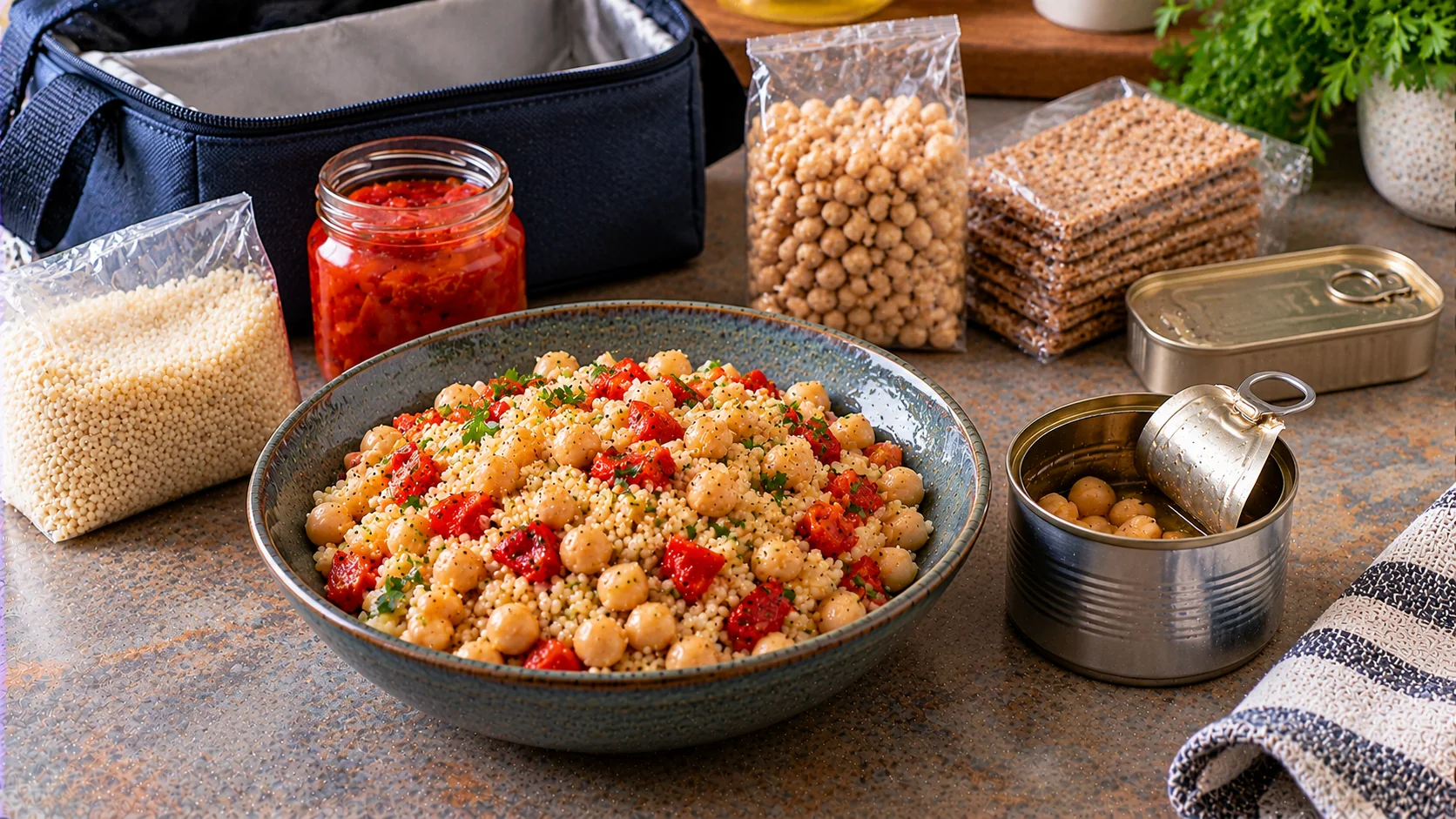
Two-Day Shelf-Stable Lunch Plan Without a Refrigerator
No refrigerator at work? Pack ingredients that are safe to store unopened at room temperature and assemble each lunch immediately before eating. This is a two-day plan for one adult, not an instruction to hold opened beans, cooked rice or mixed salads at room temperature all day. the five-day lunch plan without a freezer addresses planning lunches without a freezer; here the constraint is no refrigerator at the destination.
What to buy for two lunches
- Chickpeas, 1 × 400 g can, about 240 g drained
- Lentils, 1 × 400 g can, about 240 g drained
- Wholegrain crispbread, 100 g package (use 80 g)
- Peanut butter, one sealed 30 g single-serve portion
- Apples, 2 medium, about 150 g edible each
- Whole carrots, 2 × 100 g, intact and washed before eating
- Olive oil, two sealed 10 ml portions
- Lemon juice, two sealed single-use 10 ml portions, labelled shelf stable
- Optional salt-free seasoning, one dry sachet
Buying complete packages versus using portions
| Item | Example checkout cost | Amount paid |
|---|---|---|
| Chickpeas, 400 g can | €0.89 | €0.89 |
| Lentils, 400 g can | €0.99 | €0.99 |
| Crispbread, 100 g | €0.99 | €0.99 |
| Peanut butter portion, 30 g | €0.45 | €0.45 |
| Apples, two | €0.90 | €0.90 |
| Carrots, 200 g | €0.30 | €0.30 |
| Sealed olive oil, 2 × 10 ml | €0.40 | €0.40 |
| Sealed lemon juice, 2 × 10 ml | €0.30 | €0.30 |
Two-day overview
Two lunches for one person, on separate days. Both use shelf-stable components opened just before eating.
Day 1: Chickpea, carrot and crispbread lunch
Carry the unopened chickpea can, a clean can opener, 40 g crispbread, one whole carrot, an apple, a sealed 10 ml olive-oil portion and a sealed 10 ml lemon portion. At lunchtime wash your hands, clean the work surface and equipment, open and drain the can, then mix approximately 240 g drained chickpeas with grated or chopped carrot, oil, lemon and seasoning. Eat immediately with the crispbread and apple. A can labelled to be refrigerated even before opening is not suitable.
Day 2: Lentil crispbread with peanut-butter apple
On the second day bring the unopened lentil can, a clean can opener, another 40 g crispbread, the second whole carrot and apple, plus the sealed 30 g peanut-butter portion. Open and drain lentils at lunchtime. Combine the lentils with diced carrot and the second oil/lemon portions, or eat the lentils and carrot separately. Spread the peanut butter on some crispbread just before eating; keep the rest alongside the lentils. Avoid carrying an assembled moist sandwich for hours. Eat promptly and discard leftovers when safe cooling is unavailable.
Pack unopened and assemble at lunchtime
Carry a functioning manual can opener, clean fork, clean bowl and access to handwashing. Never rely on a rusty can opener or a dirty communal sink. A pull-ring can is easier. Use the manufacturer’s instructions for room-temperature storage and best-before dating. Opening sealed packages at the point of eating is the central safety measure, not a promise that any mixed lunch is safe indefinitely.
Important food-safety boundary
USDA FSIS advises that perishable food should not sit at room temperature for more than two hours, or one hour above 32°C (90°F). After opening and assembling a pulse salad, treat it as perishable; do not assume it stays shelf-stable just because the can did. If the meal will be eaten much later after assembly, use an insulated bag with adequate ice packs and verify the food stays cold, or change to an entirely sealed ready-to-eat option opened only when needed. Never save the open-can leftovers without refrigeration. Avoid swollen, leaking or badly damaged cans.
Nutrition: read the exact label
These are deliberately ingredient-led examples, not laboratory nutrient analyses. A 240 g drained can of pulses contributes substantial plant protein and fibre, while the crispbread and fruit add carbohydrate and fibre. Check the can for drained weight, salt and nutrition per 100 g, especially if the figures refer to beans plus liquid. The peanut butter adds fat and protein but contains peanuts, a major allergen. This two-lunch example does not define anyone’s complete daily calorie or protein requirements.
When a sealed pouch is not shelf-stable
A chilled convenience pot is not automatically safe just because it is sealed. Choose room-temperature storage only when the manufacturer explicitly allows it.
Alternatives and substitutions
Use only cans or pouches expressly labelled shelf-stable before opening; some chilled products in similar packaging are not. Substitute canned white beans for chickpeas only after comparing drained weight and protein on its label. A small sealed fish tin can replace legumes for a different lunch if you can open and finish it immediately, but allergies, odour and local waste rules may make it unsuitable. Swap crispbread for ordinary packaged crackers as long as the product needs no refrigeration unopened.
Equipment and preparation
Carry a functioning manual can opener, clean fork, clean bowl and access to handwashing. Never rely on a rusty can opener or a dirty communal sink. A pull-ring can is easier. Use the manufacturer’s instructions for room-temperature storage and best-before dating. Opening sealed packages at the point of eating is the central safety measure, not a promise that any mixed lunch is safe indefinitely.
Cost: checkout total versus consumed ingredients
The example basket totals €5.22 in illustrative assumptions, or €2.61 per lunch when all purchased products are allocated to the two meals. The entire 100 g crispbread pack is purchased but only 80 g is used; the remaining 20 g is a pantry leftover. All prices are hypothetical teaching inputs, not a current retailer quote. If you already own oil or seasonings, the cash paid at checkout and the value consumed will be different.
What this plan does not cover
This does not cover infants, medical diets, food allergy management or conditions that require temperature-controlled meals. If refrigeration is available, a budget lunch-prep plan with cold storage provides a different way to prepare lunches ahead.
Sources
- USDA FSIS: leftovers and food safety — temperature and time limits for perishable foods.
- USDA FSIS: safe handling of takeaway foods — cooler and transport guidance.
- USDA FoodData Central — general food composition reference; real product labels control portion values.