
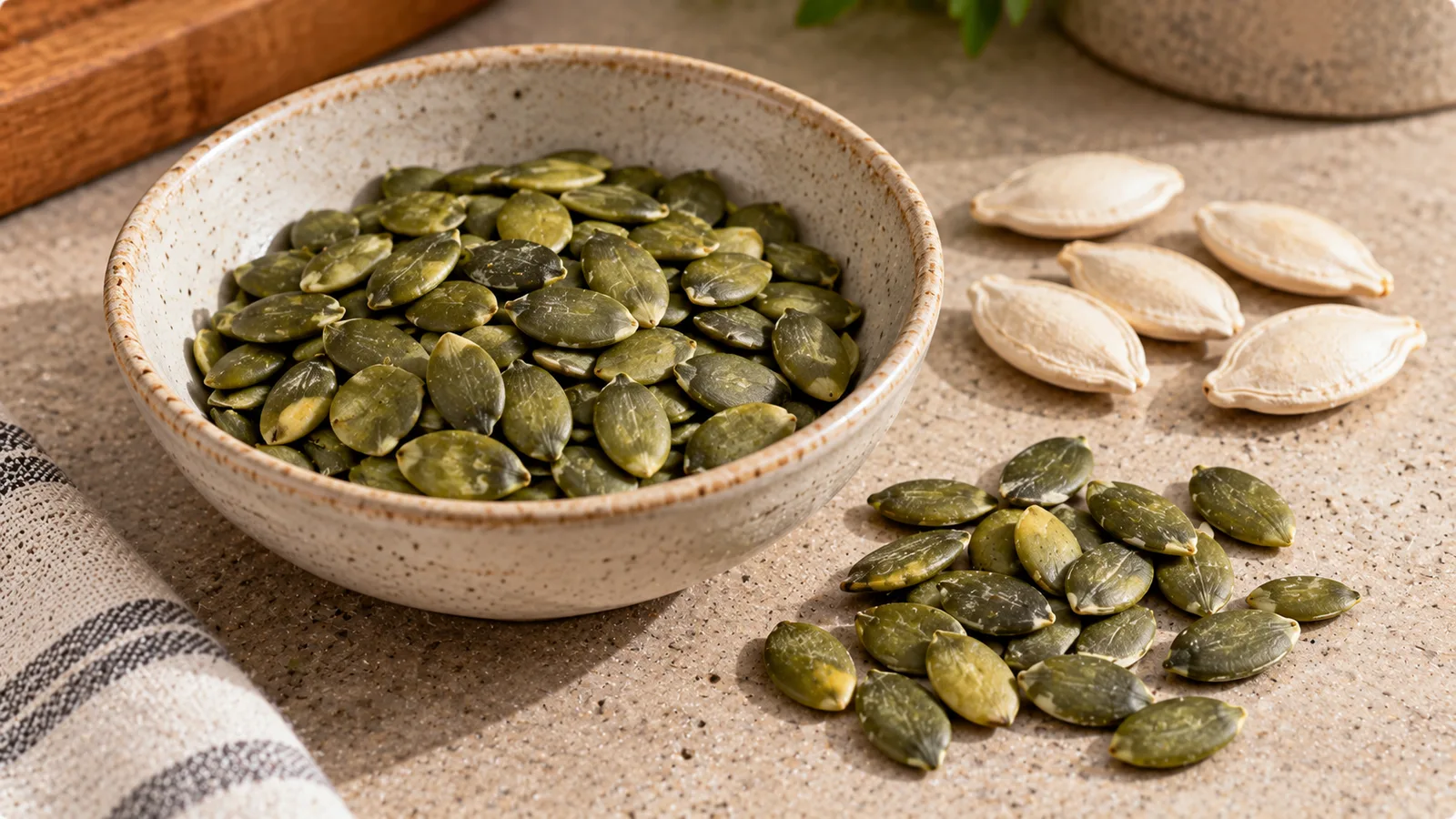
Pumpkin seeds are often added to salads, oatmeal, bread and snack mixes. They provide protein, fat and several minerals, but their calorie content can add up quickly when portions are estimated by handful rather than weight.
The first distinction to make is between shelled pumpkin seed kernels and whole seeds that still have their outer shells. Nutrition values for edible kernels should not automatically be applied to the weight of seeds that will partly be discarded.
For a reliable calorie calculation, identify the product, check whether it is raw or roasted, and use the package label when available.
Pumpkin seed calories by portion
Pumpkin seed nutrition varies by variety and preparation. For a practical estimate, raw, dried, shelled pumpkin seed kernels provide roughly 559 kcal per 100 g in commonly used food-composition data. This is a reference value, not a universal value for every product.
Using 559 kcal per 100 g:
| Edible kernel weight | Approximate calories |
|---|---|
| 5 g | 28 kcal |
| 10 g | 56 kcal |
| 15 g | 84 kcal |
| 20 g | 112 kcal |
| 25 g | 140 kcal |
| 30 g | 168 kcal |
| 40 g | 224 kcal |
| 50 g | 280 kcal |
| 75 g | 419 kcal |
| 100 g | 559 kcal |
These estimates are calculated from the reference value and rounded. A branded product may have a different energy value.
The formula is:
Calories = edible weight in grams × calories per 100 g ÷ 100.
For example, if your product provides 570 kcal per 100 g, a 25 g portion contains approximately 143 kcal:
570 × 25 ÷ 100 = 142.5 kcal.
Use the actual label value when one is available.
Nutrition facts for pumpkin seed kernels
Pumpkin seed varieties and processing methods differ, so a nutrition table should be treated as a reference rather than an exact description of every packet.
Raw, dried, shelled kernels commonly provide approximately the following amounts per 100 g:
| Nutrient | Approximate amount per 100 g |
|---|---|
| Energy | 559 kcal |
| Protein | 30 g |
| Total fat | 49 g |
| Carbohydrates | About 11 g |
| Dietary fiber | Varies by product and database |
| Saturated fat | Varies by product and database |
Source for checking food-specific values: USDA FoodData Central.
These figures are rounded reference estimates. Different pumpkin seed entries can represent different varieties, moisture levels and preparation methods. For a particular product, its label is the better source for tracking.
Why carbohydrate figures can differ
Nutrition databases and package labels do not always calculate or present carbohydrates in the same way. In particular, some databases report carbohydrate by difference, which can include fiber, while EU nutrition labels generally declare carbohydrate separately from fiber.
Do not combine numbers from different conventions without checking their definitions.
Why pumpkin seeds are calorie-dense
Pumpkin seeds contain a substantial amount of fat. Fat supplies approximately 9 kcal per gram, while protein and digestible carbohydrate supply approximately 4 kcal per gram.
That is why a small portion can provide a noticeable amount of energy.
This does not make pumpkin seeds inherently unhealthy. They can contribute protein, unsaturated fats and minerals to a varied diet. The practical consideration is how much you eat and how the portion fits into your meals.
For broader dietary context, see the World Health Organization's healthy diet guidance.
How much protein is in a serving?
Pumpkin seed kernels are a concentrated plant source of protein. Using a reference value of 30 g protein per 100 g, the approximate amounts are:
| Portion | Protein estimate |
|---|---|
| 10 g | 3 g |
| 15 g | 4.5 g |
| 20 g | 6 g |
| 30 g | 9 g |
| 40 g | 12 g |
| 50 g | 15 g |
These calculations use the stated reference value. The label for your product may differ.
A 30 g portion can contribute protein to a meal, but it also provides roughly 168 kcal using the calorie reference above. If you are comparing foods by protein per calorie or cost per gram of protein, calculate both figures rather than judging protein content alone.
Raw, roasted and salted pumpkin seeds
Raw and roasted pumpkin seeds can differ in moisture content, flavor and energy per 100 g. Roasting removes some water, which can make nutrients appear more concentrated by weight. Oil-roasted products may also contain added fat.
Salt does not itself add meaningful calories, but salted products may be prepared differently from unsalted kernels. Their sodium or salt content can also be substantially different.
When comparing two packages, check:
- Whether the seeds are shelled or still in shells.
- Whether they are raw, dry-roasted or oil-roasted.
- Whether oil, sugar, flavorings or other ingredients have been added.
- Energy and protein per 100 g.
- Salt or sodium content.
Do not assume that every roasted or salted product has exactly the same nutrition as raw kernels.
Shelled kernels versus seeds with shells
This is one of the most important distinctions for calorie tracking.
The hard shell is generally not eaten. If you weigh 50 g of whole seeds with shells, you cannot assume that you consumed 50 g of edible kernels.
The edible proportion depends on the product. Avoid using a universal shell-to-kernel conversion unless it has been measured for that specific variety.
For a more accurate home measurement:
- Weigh the whole seeds before eating.
- Collect the discarded shells.
- Weigh the shells.
- Subtract the shell weight from the original weight.
- Calculate calories using the edible kernel weight and the appropriate nutrition value.
For example, if 50 g of whole seeds leave 18 g of discarded shells, the estimated edible weight is 32 g. Using 559 kcal per 100 g as an illustrative reference, 32 g of kernels would provide approximately 179 kcal.
This example demonstrates the calculation; it is not a universal estimate of the edible proportion.
If the packaging gives nutrition values specifically for the product as sold, follow its stated basis rather than assuming that the numbers apply to a different edible-weight calculation.
How many calories are in a tablespoon?
A tablespoon measures volume, not weight. The number of grams depends on kernel size, how the spoon is filled and whether the seeds are whole or chopped.
For a quick estimate, calculate calories from the measured weight:
- 8 g at 559 kcal per 100 g: approximately 45 kcal.
- 10 g: approximately 56 kcal.
- 15 g: approximately 84 kcal.
- 20 g: approximately 112 kcal.
A heaped spoon may hold more than a level spoon. For consistent calorie tracking, weighing the kernels is more reliable than assuming every tablespoon has the same mass.
Pumpkin seeds and weight management
Pumpkin seeds can fit into a diet for weight loss, maintenance or weight gain. Their effect depends on the overall diet and the amount consumed, not simply on whether the food is calorie-dense.
Consider two salad toppings:
- 15 g of pumpkin seed kernels: approximately 84 kcal.
- 30 g of pumpkin seed kernels: approximately 168 kcal.
Doubling the portion approximately doubles the calories from the seeds, while the rest of the salad can remain unchanged.
You do not need to avoid pumpkin seeds solely because they are energy-dense. Measuring the portion can help you include them deliberately.
Minerals and other nutrients
Pumpkin seed kernels can provide minerals such as magnesium, phosphorus, zinc and iron. The exact amounts depend on the seed variety, processing and the food-composition entry used.
A nutrition database is useful for estimating these nutrients, but it does not establish how much of each nutrient an individual absorbs or needs.
Avoid assuming that a food alone will correct a deficiency. If you need to assess a specific nutrient intake for a medical reason, use appropriate professional guidance.
Pumpkin seeds in recipes
Pumpkin seeds are used in bread, granola, salads, soups and roasted vegetable dishes.
When they are an ingredient in a prepared food, the calorie content of the finished dish includes all ingredients. The seed value alone cannot tell you the calories in a slice of bread or a bowl of granola.
For homemade food, calculate the full recipe using the ingredients actually used, then divide by the number of portions or by the final edible weight. Include added oil, sweeteners and other seeds.
For packaged products, the product's nutrition declaration is usually the most useful starting point.
How to compare pumpkin seed products
A simple comparison should use the same weight basis and distinguish similar product types.
| Comparison | What to check |
|---|---|
| Raw versus roasted | Moisture, added oil and calories per 100 g |
| Salted versus unsalted | Salt or sodium, plus any other ingredients |
| Shelled versus shell-on | Whether the stated weight includes inedible shells |
| Plain kernels versus seed mix | Other nuts, seeds, dried fruit or coatings |
| Different brands | Energy, protein, serving basis and ingredient list |
Do not assume that a product is lower in calories just because its portion on the front of the package looks smaller. Compare the nutrition declarations on the same basis.
In the EU, food information and nutrition declaration requirements are addressed by Regulation (EU) No 1169/2011.
Storage and freshness
Store pumpkin seeds in a sealed container in a cool, dry place. Their fat content means that exposure to heat, light and air can gradually affect flavor and quality.
Follow the manufacturer's storage guidance. Refrigeration or freezing can be useful for longer storage, especially after opening.
Discard seeds that smell rancid, show visible mold or otherwise appear spoiled.
Allergies and cross-contact
Pumpkin seeds can trigger allergic reactions in some people, and packaged products may be exposed to other ingredients during processing. Check the ingredient and allergen information when needed.
If you have a diagnosed food allergy, follow the advice of your healthcare professional. A general nutrition article cannot determine whether a particular product is safe for an individual.
Sources
- USDA FoodData Central — food composition data for checking calories and nutrients in pumpkin seed products.
- World Health Organization: Healthy diet — general dietary context.
- Regulation (EU) No 1169/2011 — EU food information and nutrition labeling rules.
The practical takeaway
Pumpkin seed kernels are energy-dense and can contribute meaningful amounts of protein and minerals. A useful starting reference for raw, dried, shelled kernels is approximately 559 kcal per 100 g, but the exact value depends on the product.
For accurate tracking, weigh the edible portion, distinguish kernels from shell-on seeds, and use the package label for roasted or salted varieties. A measured portion can add flavor and texture to meals without making calorie tracking unnecessarily complicated.